
Here’s what you need to know:
- Key Regulation: OSHA 29 CFR 1926.152 outlines rules for safe storage and handling of gasoline on construction sites.
- Training: Workers must be trained in fuel handling, emergency procedures, and the use of safety equipment.
- Approved Containers: Use only OSHA-approved containers (e.g., UL or DOT-certified) with safety features like spring-closing lids and flame arresters.
- Storage Limits: Portable safety cans are capped at 5 gallons, while stationary tanks must have secondary containment for 110% of their capacity.
- Distance Rules: Gasoline must be stored at least 40 feet from buildings and ignition sources, and separated from other hazardous materials.
- Fire Safety: Equip storage areas with fire extinguishers, spill kits, and clear signage ("Flammable" and "No Smoking").
- Inspections: Conduct daily, weekly, and semi-annual checks for leaks, corrosion, and proper labeling.
- Record-Keeping: Maintain logs of inspections, training, and fuel deliveries to demonstrate compliance.
Non-compliance risks: Fines, lawsuits, project delays, and environmental cleanup costs.
Proper storage not only ensures safety but also keeps operations running smoothly and reduces liability.
OSHA Standards for Gasoline Storage
Relevant OSHA Codes and Standards
When it comes to gasoline storage on construction sites, OSHA’s 29 CFR 1926.152 is the key regulation. This standard is specific to construction and differs from the general industry standard, 29 CFR 1910.106. Employers in construction need to ensure they’re referencing the correct code when setting up safety protocols.
One important requirement under 1926.152(a) is that all storage containers must be "approved" by recognized testing laboratories. OSHA considers containers listed by organizations like Underwriters Laboratories (UL) or Factory Mutual Research Corp (FM) as meeting this requirement. Additionally, OSHA Deputy Assistant Secretary Michael G. Connors clarified:
the use of Department of Transportation (DOT) approved containers meets the basic intent of the provisions at §1926.152(a).
This means DOT-approved containers can be used as safety cans, giving employers more flexibility when selecting equipment. For those auditing storage devices, the definition of "approved" equipment can be found in 29 CFR 1926.155(a).
When it comes to fueling mobile equipment, 1926.152(g) outlines specific fire protection measures that must be followed during refueling. These container regulations work hand-in-hand with the safety training requirements discussed below.
Required Safety Training for Workers
OSHA mandates that workers involved in installing, removing, operating, or maintaining fuel storage systems receive training tailored to their roles. This includes Hazard Communication (HazCom/GHS) training, which educates workers on the chemical and physical hazards of gasoline and the safety controls needed to protect themselves.
The training also covers how to operate portable fire extinguishers and prevent spills, ensuring employees are prepared to handle leaks effectively. Many employers turn to OSHA’s 10-hour or 30-hour Construction Outreach training programs to deliver a comprehensive overview of 29 CFR 1926 standards, including proper handling of flammable liquids.
To stay compliant, employers should maintain digital or physical copies of training certificates for all employees. These records not only demonstrate compliance during OSHA inspections but also help avoid potential penalties. With proper training in place, the next step is ensuring that all storage containers meet OSHA’s approval standards.
sbb-itb-aa28329
OSHA – 1926.152 – Flammable Liquids
Container Requirements and Specifications
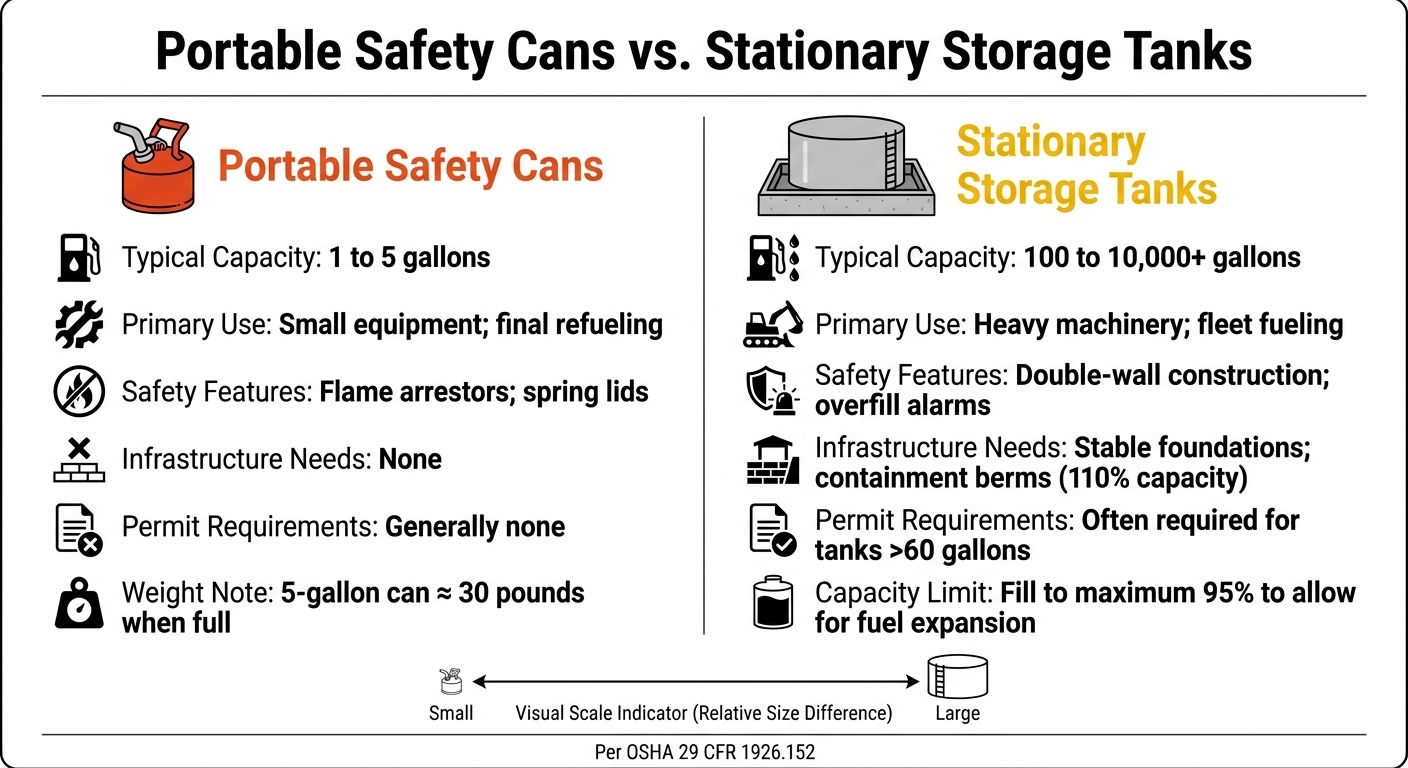
OSHA Gasoline Storage Requirements: Portable Safety Cans vs Stationary Tanks Comparison
Ensuring proper gasoline storage on job sites goes beyond worker training. Strict container standards are essential for maintaining safety and compliance.
OSHA-Approved Container Standards
Gasoline containers must adhere to stringent design requirements, as outlined by OSHA. Using glass or plastic bottles for gasoline storage is strictly prohibited on job sites.
Approved safety cans, with a maximum capacity of 5 gallons, must include a spring-closing lid, spout cover, flash-arresting screen, and a mechanism for pressure relief during a fire. OSHA also mandates that these containers be red with yellow labeling to clearly indicate their contents, following OSHA standard 1910.144. For stationary tanks, a clearly visible sign – at least 6 inches tall – must read "FLAMMABLE – KEEP FIRE AND FLAME AWAY."
When storing multiple safety cans, OSHA limits the quantity to 60 gallons of Class I flammable liquids per safety cabinet. These cabinets must be made of 18-gauge steel, have double walls, and be designed to provide fire protection.
Now, let’s look at how portable safety cans and stationary tanks cater to different operational needs.
Portable Safety Cans vs. Stationary Storage Tanks
Portable safety cans are perfect for smaller tasks like refueling lawnmowers, generators, or handheld tools. These cans are limited to 5 gallons and are optimized for "point of final use" refueling. On the other hand, stationary storage tanks are designed for large-scale operations, such as fueling heavy machinery like excavators or servicing entire vehicle fleets. These tanks can hold anywhere from a few hundred to over 10,000 gallons.
Stationary tanks come equipped with features like double-wall construction, overfill alarms, anti-theft locks, and spill-proof valves. They also require a stable foundation, corrosion-preventing tank saddles, and secondary containment basins that can hold 110% of the tank’s total volume.
Here’s a quick comparison:
| Feature | Portable Safety Cans | Stationary Storage Tanks |
|---|---|---|
| Typical Capacity | 1 to 5 gallons | 100 to 10,000+ gallons |
| Primary Use | Small equipment; final refueling | Heavy machinery; fleet fueling |
| Safety Features | Flame arrestors; spring lids | Double-wall construction; overfill alarms |
| Infrastructure Needs | None | Stable foundations; containment berms |
| Permit Requirements | Generally none | Often required for tanks >60 gallons |
It’s worth noting that a full 10-gallon can weighs over 60 pounds, which is why OSHA limits portable cans to 5 gallons (around 30 pounds) to reduce lifting-related injuries.
For stationary tanks, additional precautions are necessary. These tanks must not be filled beyond 95% of their capacity to allow space for fuel expansion. They should be installed at least 40 feet away from buildings, water sources, or flammable materials. Positioning the tanks in an east-west orientation helps reduce direct sunlight exposure, lowering vapor pressure buildup. Lastly, tanks exceeding 60 gallons often require permits from the local fire department.
Storage Location and Separation Rules
Choosing the right location for gasoline storage is essential for preventing fires, ensuring worker safety, and complying with OSHA regulations. Gasoline, classified as a Class I flammable liquid due to its flashpoint being below 100°F (38°C), is highly combustible. This makes adherence to strict storage and separation rules critical for maintaining a safe job site.
Minimum Distance Requirements
OSHA and NFPA codes outline clear distance rules to minimize risks when storing fuel near potential hazards. For instance, gasoline storage tanks on job sites must be placed at least 40 feet away from structures, combustible materials, and ignition sources like welding stations and generators. These guidelines are designed to reduce ignition risks and ensure safer operations.
When dealing with other hazardous materials, maintaining additional spacing is crucial. Gasoline must be stored 20 feet away from Liquefied Petroleum Gas (LPG) containers. For bulk oxygen storage, the required distance increases: 50 feet for up to 1,000 gallons of gasoline and 90 feet for storage exceeding 1,001 gallons. To further lower fire risks, ensure there is a 10-foot clearance from weeds and dry grass.
Storage areas should be situated on flat, stable, and well-drained ground, away from storm drains, walkways, and slopes. This helps prevent spills from spreading and ensures emergency access remains unobstructed. Additionally, all tanks must be properly grounded and bonded to prevent static electricity buildup during fuel transfers. Beyond maintaining these distance buffers, physical separation from incompatible materials is equally important.
Separation from Incompatible Materials
Besides maintaining proper spacing, isolating gasoline from reactive materials is a key step in ensuring job site safety. OSHA standards 1910.106 and 1926.152 require that flammable liquids be kept away from potential ignition sources such as open flames, sparks, and metal shavings. Different fuel types, like gasoline and diesel, should also be stored separately and clearly labeled to avoid accidental mixing or misuse.
To protect storage tanks from vehicle collisions and to contain possible leaks, install physical barriers like berms, containment walls, or bollards. Use high-visibility signs with warnings such as "Flammable" and "No Smoking" to mark hazard zones. If your site stores more than 1,320 gallons of fuel aboveground, an SPCC (Spill Prevention, Control, and Countermeasure) plan is required by law. Keep spill response kits close to storage and refueling areas, and conduct weekly inspections to check for corrosion, loose fittings, or blocked vents – especially after severe weather conditions.
Ventilation, Fire Safety, and Handling Procedures
Proper ventilation and fire safety measures are critical to preventing hazardous vapor buildup and reducing fire risks. According to OSHA standard 29 CFR 1926.152, storage areas must be well-ventilated to avoid the accumulation of dangerous vapors. This is especially important because gasoline vapors are heavier than air, which means they can settle in low-lying areas and create a serious explosion hazard.
Ventilation and Spill Containment
Fuel storage areas need effective ventilation, which can be achieved either passively – using natural airflow from strategic placement in open spaces – or mechanically, with fans or blowers in areas where natural airflow isn’t enough. Never store gasoline in pits, depressions, or enclosed spaces to prevent dangerous vapor buildup.
Storage tanks should include vapor vents and flame arresters to manage internal pressure and stop flashback risks. For instance, approved Type I safety cans come with gaskets that vent automatically when internal pressure hits 5 psi. Weekly inspections are essential to clear debris or corrosion from vents, especially after storms or high winds.
Spill containment is just as important. Containment basins should be designed to hold at least 110% of the tank’s volume. This ensures that any leaks or ruptures won’t allow fuel to contaminate soil, storm drains, or nearby waterways. Facilities storing more than 1,320 gallons of fuel aboveground must implement an EPA-required Spill Prevention, Control, and Countermeasure (SPCC) plan. These precautions, along with job site protocols, help meet OSHA compliance standards.
Fire Extinguishers and Emergency Equipment
In addition to managing vapor risks, storage areas must be equipped for fire emergencies. Keep fire extinguishers, emergency shutoff switches, and spill response kits readily available near storage and refueling zones. Clearly display "Flammable" and "No Smoking" signs, as well as emergency shutoff and evacuation route markings.
To minimize fire hazards, place tanks at least 25 feet from ignition sources and 40 feet from structures or residential buildings.
Regular inspections are crucial – check for corrosion, loose fittings, or blocked vents weekly, and schedule professional maintenance every six months. During fuel transfers, use bonded and grounded tanks to avoid static electricity. Ensure workers wear proper protective gear and always shut off engines before refueling.
Job Site Compliance Checklist
Following OSHA’s gasoline storage requirements means adhering to a clear process of inspections and documentation. This approach helps identify hazards early and keeps your site audit-ready. This checklist aligns with OSHA’s protocols for storage, handling, and safety, providing a practical guide for inspections and record-keeping.
Regular Inspection Schedules
Daily inspections should focus on the following:
- Check hoses and tanks for any signs of leaks.
- Confirm that engines are turned off during refueling.
- Ensure workers are using the necessary personal protective equipment, like gloves and goggles.
- Verify that fire extinguishers are accessible and that tank seals and valve closures are secure.
Weekly inspections should be more thorough:
- Look for corrosion on tanks, loose fittings, and blocked vents.
- Use dipstick tests or digital sensors to confirm fuel levels match delivery logs, helping to detect siphoning or slow leaks.
- Inspect containment basins for water or sediment buildup, which can compromise their effectiveness.
Every six months, schedule professional maintenance. This should include tank flushing, sensor calibration, and a full safety audit. Additionally, after severe weather or accidents, conduct immediate checks for structural damage and vapor leaks.
Record-Keeping and Documentation
Keep detailed written logs for inspections, maintenance, and refueling activities. Each entry should include the inspector’s name, the date, and any corrective actions taken. Beyond regular logs, documentation is key to demonstrating compliance. Be sure to:
- Maintain records of fuel deliveries, spill incidents, and inventory tracking.
- Log worker training sessions on fuel handling, leak detection, and emergency response procedures.
- Post emergency contact lists and spill flow diagrams in visible areas near storage zones.
Proper record-keeping not only protects you in legal matters but also ensures your site is always ready for audits and insurance evaluations.
Conclusion
The Importance of Gasoline Storage Compliance
Storing gasoline correctly isn’t just about following rules – it’s about protecting lives and ensuring work runs smoothly. Adhering to OSHA 29 CFR 1926.152 and EPA standards significantly reduces the risk of fires, explosions, and other potentially deadly incidents caused by sparks, metal shavings, or open flames. With gasoline accounting for 59% of U.S. transportation energy, its widespread use underscores the importance of managing its risks responsibly.
Non-compliance can be costly. Beyond steep fines and project delays, there’s the potential for lawsuits that could shut down operations and harm your reputation. Great Plains Industries emphasizes this point:
Storing fuel on-site is a convenient option but there are specific requirements and regulations that you are required by law to follow… Risks significantly increase when you incorrectly store and transfer fuel.
Beyond safety, compliance boosts efficiency. On-site fuel storage can cut down on equipment idling and reduce downtime for heavy machinery, helping projects stay on track. Using proper containment systems – sized to hold 110% of tank volume – along with maintaining 40-foot buffer zones and training personnel in emergency protocols creates a safer, more productive work environment.
Protecting assets is another critical benefit. Measures like locking devices, motion-activated alarms, and detailed documentation can deter fuel theft and vandalism, especially during off-hours. Investing in approved equipment, such as DOT-compliant containers, UL-listed tanks with flame arresters, and 20-B:C fire extinguishers placed within 75 feet of dispensing areas, minimizes liability and keeps operations running without interruptions.
FAQs
What OSHA standard governs gasoline storage on construction sites?
OSHA standard 1910.106 outlines the rules for storing gasoline and other flammable liquids on construction sites. It clearly defines what qualifies as a flammable liquid and provides detailed guidelines to ensure these substances are stored and handled safely.
Following these regulations is not just about meeting legal requirements – it’s about creating a safer work environment and reducing the risk of accidents related to improper handling of flammable materials.
When do I need a stationary fuel tank instead of safety cans?
If you’re storing more than about 60 gallons of gasoline, you’ll need a stationary fuel tank. For larger tanks, you’ll likely need a permit from your local fire department. Additionally, these tanks must meet specific safety and installation standards. Always check your local regulations to make sure you’re following the proper guidelines.
Do I need an SPCC plan for my job site fuel storage?
Yes, an SPCC (Spill Prevention, Control, and Countermeasure) plan is mandatory if your job site stores large quantities of petroleum or oil products. This federal regulation is designed to minimize the risk of spills and safeguard the environment. To stay compliant, it’s crucial to review the relevant OSHA guidelines and follow their storage and safety requirements carefully.


