
Smart grid projects are slowing because there are not enough people to do the work. I see the article making one clear point: if utilities, EPCs, and contractors want grid upgrades to stay on track, they need to do three things at once – build talent pipelines, train adjacent workers, and place vetted people into open roles faster.
Here’s the short version:
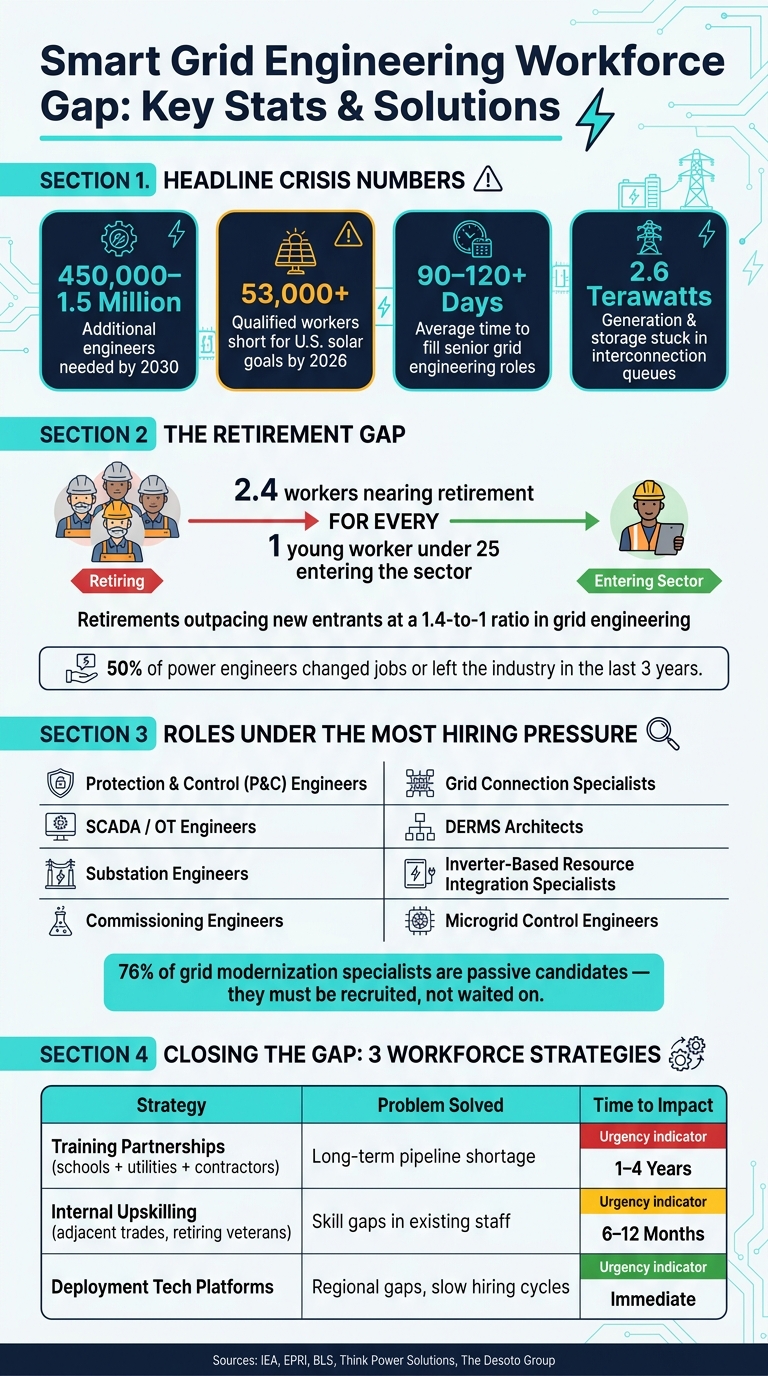
- The power sector may need 450,000 to 1.5 million more engineers by 2030
- U.S. solar goals in 2026 are at risk because of a shortage of 53,000+ qualified workers
- Senior grid roles can take 90 to 120+ days to fill
- More than 2.6 terawatts of generation and storage are stuck in interconnection queues
- The hardest roles to fill include P&C engineers, SCADA/OT engineers, substation engineers, commissioning engineers, and grid connection specialists
- The main causes are retirements, weak training pipelines, burnout, and regional hiring gaps
- The main fixes are:
- school + utility + contractor partnerships
- upskilling people from nearby trades or internal teams
- deployment platforms that help move qualified workers to projects faster
What stands out to me is that this is not just a hiring issue. It is also a training, retention, and labor placement issue. If you only post jobs and wait, projects can slip, tax credit timelines can tighten, and interconnection work can stall.
| Issue | What it leads to | What helps |
|---|---|---|
| Retirements | Loss of grid know-how | Mentorship and knowledge transfer |
| Skill gaps | Slow ramp-up for new hires | Internal training and apprenticeships |
| Regional labor shortages | Delays in staffing projects | Worker deployment tools |
| Hard-to-fill specialist roles | Interconnection and commissioning slowdowns | Targeted recruiting and upskilling |
Bottom line: I’d sum up the article this way – companies that treat workforce planning as part of project delivery, not just HR, will have a better shot at keeping smart grid work moving.
Smart Grid Engineering Workforce Gap: Key Stats & Solutions 2024–2030
The Workforce Crisis That Could Stall the Grid Buildout (NEMA‘s Patrick Hughes)
sbb-itb-aa28329
What is causing the smart grid engineering shortage
These staffing delays aren’t the result of one rough hiring stretch. They come from deeper labor problems that have been building for years. At the center of it are three pressures: retirements, weak training pipelines, and regional gaps between where projects are growing and where engineers actually live.
Retirements and the loss of institutional grid knowledge
The energy workforce is getting older fast. In advanced economies, there are 2.4 workers nearing retirement for every 1 young worker under 25 entering the energy sector. In grid engineering roles, retirements are outpacing new entrants by 1.4 to 1.
That matters because when senior staff leave, they don’t just leave an empty seat. They often take years of hard-won grid knowledge with them: substation procedures, relay settings, and all the legacy fixes that kept systems running. A lot of that knowledge never makes it into formal documentation.
"The risk of retiring talent isn’t just about labor shortages. It’s about institutional knowledge walking out the door." – Dan Helman, CEO, Think Power Solutions
The result is simple: more operational risk, and less margin for error.
Training pipelines are not keeping pace with modern grid skills
University enrollment in power engineering has flattened. Many students are moving toward AI, data science, and software because those fields look like they pay more and offer more momentum. At the same time, 40% of power executives say their top hiring barriers are talent competition and skill gaps.
The bigger problem is what students are, and aren’t, learning. Many programs still leave out OT cybersecurity, DER integration, inverter-based stability, and utility protocols such as IEC 61850 and DNP3. So a new graduate may understand the theory but still walk in without hands-on SCADA, OT, or inverter-focused experience.
Hiring doesn’t fix that overnight. Once a company brings in junior talent, senior engineers often have to step away from core work to train and supervise them. That slows project work and adds more strain to teams that are already thin. It’s no surprise that nearly half of all power engineers changed jobs or left the industry in the past three years, with burnout named as a main reason.
Regional hiring gaps and regulatory-heavy deployment
Project demand and talent supply often miss each other on the map. Fast-growing energy markets, especially places adding solar farms, wind projects, or new data center load, may not have a local bench of qualified engineers. So developers end up competing across the country for a small pool of specialists who are already overloaded.
Rules and market structure add another layer. An engineer who knows ERCOT inside and out may not be the right fit for cluster studies in PJM or MISO. Those skill sets are not interchangeable. Then you add utility-specific onboarding and the four-year-plus path to a Professional Engineer (PE) license, and the delays start stacking up fast.
Those gaps show up most clearly in the roles and skill areas utilities can’t leave vacant for long.
Which roles and skills are hardest to fill
Core smart grid roles facing the most hiring pressure
Some jobs create more project risk than others. The roles under the heaviest pressure – Protection & Control (P&C) Engineers, SCADA/OT Engineers, Substation Engineers, Commissioning Engineers, and Grid Connection Specialists – sit right in the middle of interconnection, commissioning, protection, and compliance work. If those seats stay empty, projects slow down at the exact moments when timing matters most.
Demand is also climbing for DERMS architects, inverter-based resource integration specialists, microgrid control engineers, and battery thermal management specialists. These are hard-to-fill jobs for two big reasons: retirements are draining experience from the market, and training programs aren’t replacing that talent fast enough. On top of that, about 76% of grid modernization specialists are passive candidates, which means employers usually can’t wait for them to apply – they have to go find them.
That shifts the hiring problem. It’s not just about adding more people. It’s about finding the right people for the roles that can hold up the whole project.
Technical skills that separate qualified candidates from general electrical talent
The gap between a general electrical engineer and a smart grid specialist goes well beyond a degree or job title. It comes down to what someone can handle on a live grid project.
A general electrical engineer may see SCADA and cybersecurity as separate IT tasks. A smart grid specialist doesn’t. They treat both as part of grid stability and fault restoration. That’s a big difference in how the work gets done.
The skill mix employers have trouble finding in one person often includes:
- Dynamic modeling with tools like PSS/E, ETAP, or PSCAD
- Integration of SCADA, telecommunications, and DERMS
- Experience managing bidirectional power flows in protection and control schemes
- Working knowledge of NERC CIP compliance requirements
Once you add OT cybersecurity awareness and hands-on commissioning experience, the pool gets small in a hurry. There’s also more competition now. Data centers are going after the same power systems engineers utilities need, which pulls talent away from grid work.
That’s the line between a general electrical hire and someone who’s ready to step into smart grid work without a long ramp-up.
Training signals employers can rely on
When employers review candidates, a few signals tend to stand out. PE licensure is still the clearest marker for senior roles and jobs with a high level of responsibility.
Beyond that, employers are putting more weight on a mix of training and market-specific experience. That includes GIAC Critical Infrastructure Protection (GCIP) certification for cybersecurity-adjacent roles, direct experience with ISO-specific market rules such as ERCOT, PJM, and MISO, and NERC CIP or ICS-focused training from programs like SERC University or the SANS Institute.
Graduates from specialized utility training programs are also getting more attention. One example is TRC Companies‘ Power Academy, which focuses on protection, controls, and substation engineering.
No single candidate checks every box. That’s exactly why employers are putting more attention on pipeline building, upskilling adjacent talent, and getting qualified people into projects faster.
How to close workforce gaps through training, upskilling, and better deployment
The fastest ways to deal with labor shortages fall into three groups: build the talent pipeline, train adjacent workers, and move vetted people into open roles faster.
Build stronger pipelines through utility, contractor, and school partnerships
Recruiting by itself won’t solve a structural labor shortage. The companies making progress are building pipelines instead of waiting for the market to send them candidates.
The strongest programs bring together government, industry, universities, and community colleges. In New York, the Stony Brook University–Haugland Group partnership launched five programs. CyberLearn grew from 27 to 42 students in one year, and utilities hired straight from that cohort.
When employers help shape the training, students learn skills tied to grid work, DER, and cybersecurity instead of old classroom examples. That also helps students see grid careers earlier, which matters more than many firms think.
The T&D sector needs to grow apprenticeship slots from 45,000 in 2024 to 65,000 per year just to keep up with demand. Of course, a pipeline only helps if workers can move into open jobs without getting stuck in a slow hiring process.
Upskill adjacent workers instead of waiting for ideal candidates
If hiring takes too long, the next step is pretty simple: train people who already have related skills.
Many employers are moving workers from HVAC controls, military electronics, residential construction, and conventional power plant operations into smart grid roles when the training is set up well.
Black & Veatch used hybrid apprenticeships to shift workers from residential framing and steel erection into solar construction. EPCs are doing something similar by moving experienced people from oil and gas process teams into power generation roles, where turbine experience and phased project work carry over well.
The same idea works inside utilities too. Lineworkers, substation technicians, and controls specialists already know how grid systems behave under load. With focused training in digital tools, protection updates, and compliance frameworks, many can close the skills gap in months instead of years.
Another missed source of value is the knowledge held by engineers close to retirement. Some companies are preserving that know-how through video walkthroughs with voice annotations and audio logs tagged by GPS. That turns hard-won field knowledge into repeatable onboarding material instead of letting it walk out the door.
Training is often cheaper than delays, outages, and compliance penalties.
Use workforce deployment tools to close regional talent gaps faster
Even with stronger training, some markets still come up short. That’s where deployment tools help by getting vetted workers to active projects faster.
Grid modernization engineering roles in high-growth markets stay open for an average of 140 days. That’s not just a hiring problem. It’s also a deployment and credentialing problem.
Mobile-first labor operations platforms like ABLEMKR help by matching pre-vetted workers to energy projects based on certifications, safety training, availability, and location. For utilities and EPCs running substation builds, transmission line work, or other mission-critical grid projects, that can move site mobilization along faster while keeping compliance tracking and payroll workflows inside the same process.
The table below shows the main workforce fixes side by side:
| Workforce Solution | Problem Solved | Time-to-Impact | Operational Limits |
|---|---|---|---|
| Training Programs | Long-term pipeline shortage; entry-level awareness | 1–4 Years | Requires multi-year commitment and combined funding |
| Internal Upskilling | Skill gaps in existing staff; loss of institutional knowledge | 6–12 Months | Requires active participation from retiring veterans |
| Deployment Tech (e.g., ABLEMKR) | Regional talent gaps; slow hiring cycles; credentialing | Immediate | Depends on the availability of a vetted labor pool |
No single option does it all. Partnership programs build the long-term pipeline, upskilling gets more out of the workforce already in place, and deployment tech helps fill regional gaps fast enough to keep commissioning and interconnection work moving.
Building long-term career paths for a more durable smart grid workforce
Career ladders, retention, and worker experience
Filling a role is only half the job. Retention decides whether that gap stays closed. Hiring solves today’s problem. Career ladders help keep it solved.
Nearly 50% of power engineers changed jobs or left the industry in the last three years, and many pointed to a lack of technical problem-solving work. That’s more than a hiring issue. It’s a retention problem.
One practical move is to build clear paths from field support into P&C, DERMS, SCADA operations, and project management. Workers need to see where they can go next, not just where they start. TRC Companies’ Power Academy is one example. It trains utility workers in protection, controls, and substation engineering.
Day-to-day worker experience matters too. Paid training, mentorship, and clear paths for growth can make the difference between someone staying and someone taking a call from another employer. A smart setup is pairing digital-native engineers with seasoned field leads. The exchange goes both ways: newer workers pick up restoration judgment from people who’ve been through outages and field events, while veteran staff pass along institutional knowledge that doesn’t live in a manual. Pay matters as well. Utilities should benchmark compensation against climate tech and software firms, not only against internal utility pay bands.
These steps tend to work best as a package:
| Retention Lever | Practical Application | Impact |
|---|---|---|
| Paid Apprenticeships | Earn-while-you-learn paths for technical and leadership roles | Reduces debt and builds loyalty |
| Cross-Training | Training employees across multiple technical areas | Expands coverage and resilience |
| Market-Matched Pay | Matching bonuses or equity structures from climate-tech firms | Cuts poaching risk |
| Formalized Mentorship | Pairing new hires with experienced field leads | Speeds ramp-up and early retention |
Conclusion: Match your workforce strategy to the grid modernization challenge
The smart grid engineering shortage is structural. So the workforce response has to be structural too. Retirements are moving faster than new entrants – 2.4 workers are nearing retirement for every young worker under 25 entering the energy sector in advanced economies. And the jobs under the most strain aren’t simple to backfill. They call for electrical fundamentals, digital systems fluency, and compliance awareness, all at once. That mix takes years to build.
"The most successful companies are focusing on long-term workforce development rather than trying to fill positions quickly. Investing in the younger generation is crucial to breaking out of the silo and demonstrating that there is a viable career path within T&D." – Sonya Montgomery, CEO, The Desoto Group
The U.S. power industry may need more than 750,000 new workers by 2030. That’s not far off. Choices made now about training programs, career ladders, hiring cycles, and deployment tools will shape whether grid modernization projects stay on schedule or slip behind. Companies that treat workforce development like a core part of operations – not just an HR task – will be in a much better position to deliver reliable, compliant, and on-time smart grid projects across the country.
FAQs
Why is smart grid hiring so difficult right now?
Smart grid hiring is hard because several pressures are landing at the same time.
An aging workforce is retiring faster than new talent can step in. Meanwhile, demand keeps climbing, driven by data centers, electrification, and renewable energy integration.
At the same time, education pipelines often trail behind newer needs like cybersecurity, AI, and distributed energy resource management. The industry also has to compete with high-tech employers, deal with staffing gaps for remote projects, and fight a perception problem when compared with software careers.
Which workers can transition into smart grid roles fastest?
Workers with hybrid skill sets often make the fastest moves – especially people who pair classic electrical engineering with digital skills like data analytics, cybersecurity, or software engineering.
The same goes for people with hands-on experience in transmission, distribution, or construction. With focused training in smart grid systems, battery storage, and advanced metering infrastructure, they can often shift into jobs like field technician or renewable energy technician without a long ramp-up.
How can utilities fill grid roles faster without sacrificing quality?
Utilities can move faster on hiring without cutting corners if they focus on three things: planning ahead, hiring for hard-to-fill roles, and shortening the path from offer to day one.
That starts with getting specific about what the business needs. For example, teams may need people with experience in power electronics, protection, or grid-edge systems. It also helps to look beyond the usual talent pool. Workers from nearby fields often bring skills that transfer well, which opens up more options when the market feels tight.
Results can improve even more when workforce forecasting lines up with project calendars. Instead of hiring reactively, utilities can map labor needs to upcoming work and fill gaps before they slow projects down. Role-based training also helps new hires get productive faster, especially when the work calls for a narrow skill set.
On top of that, AI-driven tools and platforms like ABLEMKR can take friction out of the process by streamlining hiring, onboarding, and compliance.


