
If you want to get into solar in 2026, the shortest path is usually paid installer training or a 2–12 week bootcamp, then OSHA 10, NABCEP PV Associate, and hands-on field hours.
I’d boil the whole guide down like this: solar hiring is still strong, with 22% job growth projected for solar PV installers from 2022 to 2032, and about 280,000 U.S. solar workers counted in 2023. If you’re starting from zero, your main choice is simple: get to work fast through employer training, or spend more time learning electrical work through school or an apprenticeship.
Here’s what you need to know up front:
- Entry-level requirements: high school diploma or GED, work eligibility, comfort with heights, basic tool use, and physical stamina
- Main training paths: contractor academy, bootcamp, community college/trade school, or IBEW/NECA apprenticeship
- Common safety training: OSHA 10 Construction, with OSHA 30 often used for lead roles
- Main solar code topic: NEC Article 690
- Best first credential signal: NABCEP PV Associate (PVA)
- What gets people hired: mock-roof or jobsite practice, not just online lessons
- What new techs often do first: material staging, module handling, racking, cable management, and torque work under supervision
- What affects your duties: state license rules and whether a licensed electrician must oversee wiring work
Quick takeaway: if your goal is a first job soon, I’d focus on paid training, safety cards, basic code knowledge, and documented hands-on time.
| Path | Time | Cost | First outcome |
|---|---|---|---|
| Contractor in-house academy | Weeks to months | $0 while paid | Entry installer/helper |
| Nonprofit or bootcamp | 2–12 weeks | Varies | Entry installer |
| Community college/trade school | 6 months–2 years | Tuition + fees | Certificate or AAS |
| IBEW/NECA apprenticeship | 4–5 years | $0 while paid | Electrician path + solar |
If I were using this guide, I’d treat it as a straight path from training choice to safety basics, then field practice, cost, license rules, and finally getting hired.
Start Your Solar Career: Training & Certification
sbb-itb-aa28329
Training formats and how long each path takes
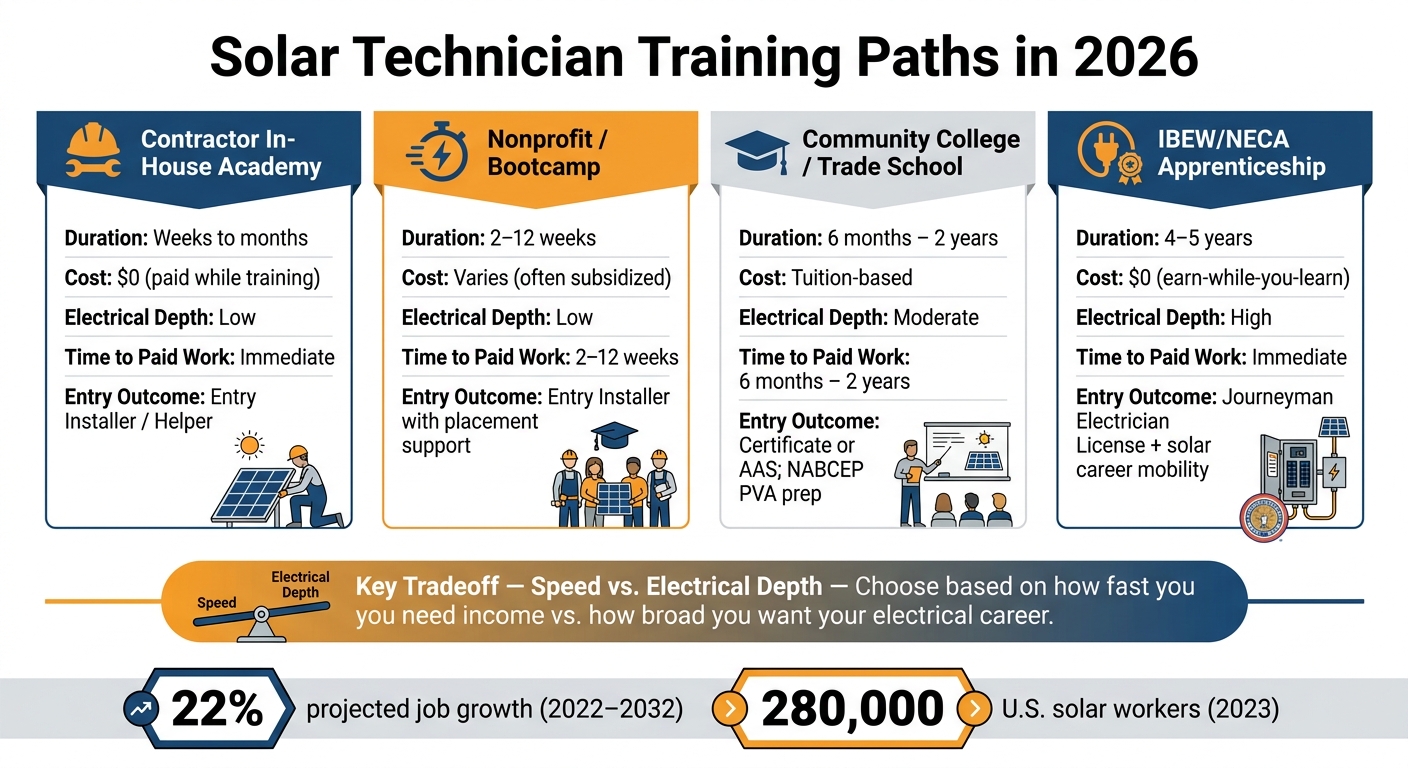
Solar Technician Training Paths 2026: Cost, Time & Career Outcomes
There are four common ways to get into solar technician work in 2026. For most beginners, the choice comes down to one simple tradeoff: speed vs. electrical depth. Some paths get you onto a job site fast. Others take longer but set you up for a broader electrical career later on.
On-the-job training, trade school, bootcamp, or apprenticeship
Paid apprenticeships and installer academies are the fastest ways in. NABCEP PV Associate is the quickest credential signal. A journeyman license tends to offer the strongest long-term payoff.
Here’s how the main training paths stack up:
| Training Format | Typical Duration | Typical Cost | Electrical Depth | Time to Paid Work | Likely Entry-Level Outcome |
|---|---|---|---|---|---|
| Contractor In-House Academy | Weeks to months | Paid | Low | Immediate | Entry installer / installer helper |
| Nonprofit / Bootcamp | 2–12 weeks | Varies (often subsidized) | Low | 2–12 weeks | Entry installer with placement support |
| Community College / Trade School | 6 months – 2 years | Tuition-based | Moderate | 6 months – 2 years | Certificate or AAS; NABCEP PVA prep |
| IBEW/NECA Apprenticeship | 4–5 years | Paid (earn-while-you-learn) | High | Immediate | Journeyman Electrician License; best for workers who want solar plus broader electrical career mobility |
What each training format covers
All four paths cover the core stuff you need on solar jobs: PV basics, electrical theory, NEC fundamentals, construction math, torque specs, fall protection, plus ladder and roof safety.
The difference is in how far each path goes.
In-house academies and bootcamps stay tight and practical. They usually focus on basic NEC knowledge for safe work and enough hands-on reps to help people move into the field fast. Community college programs add more classroom theory, which helps build job-ready fundamentals and prep students for the NABCEP PV Associate (PVA) exam.
Electrical apprenticeships go much deeper. They cover full code theory across many system types, which puts graduates in a strong spot for both solar work and general electrical work.
Timing matters too. If you go the community college route, aim for a spring graduation. December grads often run into winter layoff cycles, while spring cohorts hit the market during peak hiring.
After you pick a path, the next filter is simple: does it give you enough safety training and enough electrical basics to work on site?
Core skills, OSHA safety, and electrical basics
Once you choose a training path, this is the baseline employers expect you to bring on day one.
Technical skills employers expect at entry level
Entry-level employers want people who can step onto a jobsite and handle the basics without constant hand-holding. That means measuring accurately, reading basic wiring diagrams, and understanding voltage, current, and power.
You also need to know one of the big fundamentals in solar: panels produce DC, while most buildings use AC. That difference matters a lot when you’re working on a live system.
On the mechanical side, you’ll be expected to assemble racking and torque hardware to spec. You should also be able to identify core system parts, including:
- string inverters
- microinverters
- batteries
- monitoring gear
- rapid-shutdown devices
OSHA and field safety topics every technician must know
Rooftop solar work comes with real risk. Falls, electrical contact, and heat exposure are hazards every new technician needs to take seriously. OSHA 10 Construction is the common entry-level requirement before you can access a site. It takes 10 hours and covers fall protection, ladder safety, PPE, electrical hazards, and lockout/tagout (LOTO) concepts.
OSHA 30 is aimed at crew leads and foremen.
NEC Article 690 and certification basics
NEC Article 690 covers solar PV systems. At a minimum, learn the rules that shape solar installs: labeling requirements, disconnect placement, overcurrent protection, grounding, bonding, and rapid shutdown practices.
For certifications, here’s how the main options compare:
| Credential | Typical Training Time | Entry-Level Relevance | Career Value |
|---|---|---|---|
| OSHA 10 Construction | 10 hours | High – often mandatory for site access | Foundational safety knowledge |
| OSHA 30 Construction | 30 hours | Medium – targeted at leads | High – required for supervisory roles |
| First-Aid/CPR | 4–8 hours | High – site requirement | Essential for all field crews |
| NABCEP PV Associate (PVA) | About 40 hours + exam | High – fastest credential signal | Industry-recognized baseline |
| NABCEP PV Installation Professional (PVIP) | 1–2 years experience + exam | Low – requires documented field time | Very high – experienced installer credential |
Advanced NABCEP credentials like the PVIP require documented field hours and a tougher exam cycle, but they can help you move into lead installer and commercial project roles.
After you have the basics, the next step is field practice that shows you can work safely as part of a crew.
Field practice, total cost, and licensing rules
How much hands-on practice you need to get hired
Once you’ve got the basics down, employers want proof that you can work on real gear safely. Online coursework by itself usually isn’t enough to land a job. Hiring teams look for documented practice on mock roofs, racking, clamps, and inverters – not just video walkthroughs.
That hands-on time is what turns training into something job-ready.
Many installers now run 90-day paid academies that cover torque specs, fall protection, and NEC basics on practice roofs before field placement.
Typical costs in 2026 and extra fees to budget for
What you pay out of pocket depends on the route you choose. Contractor academies and IBEW/NECA apprenticeships pay you while you train, so tuition is $0. Community college programs charge tuition and usually last 6 months to 2 years. Nonprofit bootcamps are all over the map on price.
On top of tuition, plan for books, exam fees, PPE, and tools.
| Pathway | Cost to Student | Extra Fees | First Job Outcome |
|---|---|---|---|
| IBEW/NECA Apprenticeship | $0 (paid) | Minimal | Journeyman Electrician License |
| Contractor In-House Academy | $0 (paid) | Minimal | OSHA 10/30; entry installer |
| Community College Program | Tuition-based | Books, PPE, exam fees | Certificate or AAS; NABCEP PVA prep |
| Nonprofit / Bootcamp | Varies | Varies | Entry certificates; placement support |
State licensing and electrician supervision rules
State rules shape what entry-level techs can do on the job. In most states, service upgrades, grid interconnection, and official code sign-off must be handled by a licensed electrician. New techs usually take on mounting, racking, and cable management under direct supervision from a licensed electrician or contractor. That’s the kind of work you should expect on day one.
Some states have a dedicated solar contractor license. Others require a full electrical license for any wiring work. Once those lines are clear, the next move is simple: package your field time and training in a way that helps you get that first hire.
Getting your first solar job in 2026
Build a job-ready profile and resume
Once you’ve finished training and picked up field hours, put that info where employers can spot it fast. Hiring managers move through resumes quickly, so your key credentials should sit near the top. Start with OSHA 10 or OSHA 30, then add the NABCEP PV Associate (PVA) credential and, if you have it, First Aid certification. Include your field hours, plus the tools and parts you’ve worked with, like racking, clamps, and torque wrenches.
Be plain about your on-site skills. Say if you’ve done rooftop work, ladder safety, and harness use. If you’ve worked on commercial or utility-scale projects, spell that out too.
How hiring works for solar crews and project staffing
After your resume is set, focus on the channels solar employers use most. A lot of first jobs come through regional installers, EPC firms, and project staffing. Large installers often pull from their own training groups, which means a contractor-run program can give you a direct path to a first job.
For project-based work, ABLEMKR matches pre-vetted workers to active solar jobs based on certification, safety training, availability, and location.
The shortest practical route from training to work
Here’s how entry-level solar roles usually move forward as you add field time and credentials.
| Role | Typical Experience | Common Credentials | Core Responsibilities |
|---|---|---|---|
| Entry Installer / Helper | 0–6 months | OSHA 10, NABCEP PVA | Basic assembly, staging materials, module handling, following torque specs |
| Experienced Installer | 1–3 years | OSHA 30, NABCEP PVA | Layout, racking installation, module mounting, wire management |
| Crew Lead / Foreman | 2–4 years | NABCEP PVIP, First Aid | Crew safety, site layout, quality control, AHJ inspector walkthroughs |
| Solar Technician or Electrician | 4–5 years | Journeyman License | Service upgrades, inverter commissioning, interconnection, O&M troubleshooting |
| Project Lead / Manager | 5+ years | NABCEP PVIP, PMP | Large-scale project oversight, bid compliance, workforce scheduling |
In 2026, the fastest solid way in is usually a paid contractor-led installer academy or a 2–12 week bootcamp with placement support. Pick a format, earn your OSHA card and NABCEP PVA, log real field hours, and keep records of everything you do.
FAQs
Do I need an electrician license to start in solar?
No. Many entry-level solar roles, including solar photovoltaic installer, do not require an electrician license to get started.
That said, certifications such as the NABCEP PV Associate can help you stand out and get your foot in the door.
There’s one catch: some parts of the job still need a licensed journeyman electrician. This usually includes:
- Service upgrades
- System interconnections
- Code sign-offs
So while you can start in solar without an electrician license, you can’t do every part of the work on your own from day one.
Is online solar training enough to get hired?
Usually not. Online training can help you build the basics, but most solar technician jobs also ask for hands-on experience and safety certifications.
If you want to be more hireable, don’t stop at online courses. Pair them with credentials like NABCEP PV Associate or OSHA-10, plus practical training through apprenticeships, installer academies, or technical programs.
Which solar training path is best for beginners?
The best path comes down to how you want to get started.
If you want to get into the field fast, contractor-run installer academies can help you become project-ready in a matter of weeks. If you’d rather follow a more structured route, community college programs offer formal training that usually takes 6 months to 2 years.
For longer-term career growth, apprenticeships offer a strong middle ground. You earn money while you learn, and the full training path usually lasts 4 to 5 years. On the credential side, the NABCEP PV Associate is a solid place to begin, and OSHA 10-hour training is a smart first step too.


