
Solar jobs are growing fast, but the hard part in 2026 is finding trained workers. If I were moving from construction into solar, I’d expect a path that starts at helper, moves to installer, then to lead installer, field supervisor, or service technician. Pay often starts around $20–$26/hour and can move to $32–$42/hour for crew leads, with licensed electricians reaching $38–$55/hour or more.
Here’s the short version:
- I’d expect helper-to-installer in about 90 days to 1 year
- I’d expect installer-to-lead in about 2 to 4 years
- I’d expect the best pay from electrical licenses, NABCEP certs, and travel work
- I’d look at two main tracks after install work: crew leadership or service and diagnostics
- I’d know that solar PV installer jobs are projected to grow 22% from 2022 to 2032, versus 3% for all jobs
If I were hiring, I’d put the ladder in writing. If I were job hunting, I’d look for paid training, OSHA cards, NABCEP paths, and clear wage steps.
Quick comparison:
| Role | Usual Time to Reach | Typical 2026 Pay | Main Focus | Travel |
|---|---|---|---|---|
| Helper | Entry | $20–$26/hr | Site prep, material handling | Mostly local |
| Installer | 90 days–1 year | $20–$34/hr | Mounting, wiring support, system assembly | Local to regional |
| Lead Installer | 2–4 years | $32–$42/hr | Crew pace, quality, safety | Regional |
| Field Supervisor | 2–4+ years | $32–$42/hr | Multi-site crew oversight | Regional, multi-day |
| Service Technician | 4+ years | Varies by market | Troubleshooting, repairs, inspections | Multi-site |
| Journeyman Electrician | 4–5 years | $38–$55/hr | Licensed electrical work | Varies |
That’s the full picture in plain English: where you start, how you move up, what training matters, and where the money tends to be.
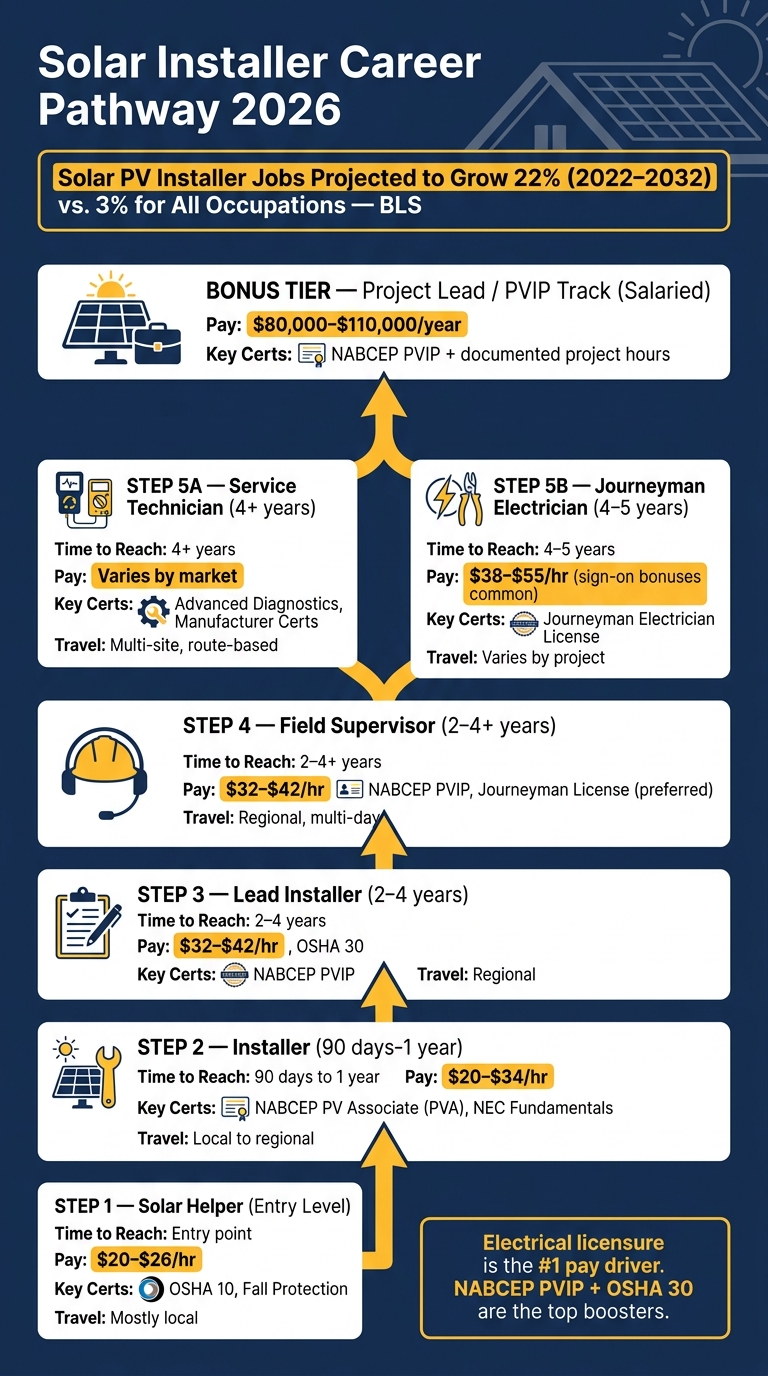
Solar Installer Career Ladder 2026: Roles, Pay & Certifications
The Ultimate Guide to Launching your Solar Career with the NABCEP PV Associate (PVA) Credential
sbb-itb-aa28329
The solar installer job ladder: roles, duties, and travel needs
Most solar careers move up in a pretty clear sequence: helper, installer, then lead installer or field supervisor. There’s also a separate track for solar service technician. For people coming from construction, the shift often starts with general site labor, then moves into electrical-adjacent tasks, and later into crew leadership or service diagnostics. Travel tends to change too. Early on, jobs are often close to home. Later, regional work and multi-day trips become more common.
The next step is to break that ladder into daily duties, certification checkpoints, and travel patterns.
Solar helper and installer
A solar helper is the usual entry point. Many employers run 90-day in-house academies that teach torque specs, fall protection, and NEC fundamentals before moving workers into installer roles.
From there, workers often move up once they’ve learned site prep, basic installation work, and earned the NABCEP PV Associate (PVA) credential. At this stage, travel is usually local or regional.
Lead installer and field supervisor
Moving from installer to lead installer or field supervisor usually takes 2 to 4 years of field experience. Lead installers are expected to keep production moving and make sure crews work safely. The NABCEP PVIP credential is the main cert for project leads, and more commercial and utility-scale bids now expect it.
Field supervisors have a different focus. Instead of pacing one crew directly, they coordinate work across multiple sites. That often means regional travel and multi-day deployments.
Solar service technician
Solar service technicians follow a parallel track built around diagnostics and repair. They handle inspections, troubleshooting, and corrective maintenance, and contractors often use this work to fill slower seasons.
If you’d rather solve problems than manage a crew, this path can be a better fit.
| Role | Core Duties | Key Skills / Certs | Travel Intensity |
|---|---|---|---|
| Solar Helper | Material handling and site prep | OSHA 10, fall protection basics | Mostly local |
| Installer | Module mounting, wiring support, and system assembly | NABCEP PV Associate (PVA), NEC fundamentals | Local to regional |
| Lead Installer | Crew pace, quality control, and safety oversight | NABCEP PVIP, OSHA 30 | Regional |
| Field Supervisor | Cross-site coordination and safety oversight | NABCEP PVIP, Journeyman Electrician license (preferred) | Regional, multi-day |
| Service Technician | Inspections, troubleshooting, corrective maintenance | Advanced diagnostics | Route-based, multi-site service calls |
These role differences set up the pay and promotion timelines in the next section.
Pay bands and promotion timelines from construction into solar
Typical 2026 pay by role
Pay in solar installation now sits well above older federal wage data. The Bureau of Labor Statistics listed a median solar PV installer wage of about $23.50/hour in May 2023, but hiring in tight metro areas in 2026 is coming in higher.
The table below shows what employers are often paying in those markets in 2026:
| Role | Typical 2026 pay in tight metros |
|---|---|
| Entry Installer / Helper | $20–$26/hr (often with paid training) |
| Experienced Installer (2+ yrs) | $26–$34/hr |
| Lead Installer / Field Supervisor | $32–$42/hr |
| Journeyman electrician with solar experience | $38–$55/hr (sign-on bonuses common) |
| Project lead with NABCEP PVIP | $80,000–$110,000 (salaried) |
Travel work can push total pay higher through per diem and vehicle use. Overtime also shows up a lot when crews are short on labor.
How long each step usually takes
For people coming over from construction, moving up tends to hinge on three things: time on roofs, electrical skill, and safety performance. Helper-to-installer can happen in as little as 90 days through an in-house academy, or it can take up to a year when someone is learning on the job. Workers with framing, roofing, or electrical-adjacent backgrounds often move faster.
Lead jobs are usually earned in the field, not handed out on day one. Going from installer to lead installer often takes 2 to 4 years of hands-on field time. Moving into a project lead or NABCEP PVIP track usually means adding 1 to 2 more years of documented install work, plus time for the exam cycle. The journeyman electrician route usually takes 4 to 5 years and has the top pay ceiling.
What affects earnings most
Electrical licensure is the biggest pay driver. Licensed journeyman electricians with solar experience sit right where two tight labor markets meet, which helps explain why their rates can hit $55/hour or more.
After licensure, the main pay boosters are:
- NABCEP credentials, especially PVIP
- OSHA 30
- A strong safety record
Project type also matters. Commercial and utility-scale bids often come with prevailing wage rules and registered apprenticeships, which can push pay scales higher. Travel assignments can also lift total compensation through per diem and vehicle use.
The next section covers the safety cards, solar credentials, and electrical training that unlock each pay jump.
Training and certifications that move workers up the ladder
In solar, pay usually climbs when workers add new credentials and job-ready skills. Time on the job helps, sure. But by itself, it often isn’t enough.
Baseline safety and jobsite readiness
For most people, the first step into solar starts with OSHA 10. From there, the focus is basic jobsite safety: fall protection, ladder safety, PPE, and working-at-heights training. These are the nuts and bolts of being safe on a roof or active site.
Many large installers run 90-day academies to get new hires ready. Nonprofit bootcamps offer a shorter path, usually 2–12 weeks, for veterans and people changing careers.
Once workers have those basics down, they can move into training built for solar installation work.
Solar-specific training for installer and lead roles
After jobsite safety, the work gets more solar-focused. That usually means learning racking, module handling, torque specs, layout, conduit support, and basic wiring. For many employers, NABCEP PV Associate (PVA) is the clearest starter credential in this phase.
Moving up to a lead installer or foreman role usually calls for more than field time. Employers often look for:
- OSHA 30
- documented project hours
- NABCEP PV Installation Professional (PVIP)
Community college certificate programs and AAS programs can also help workers who came from roofing or general labor and need to build up the electrical side of the job.
From there, the next jump is into the deeper technical work and crew leadership needed for supervision and service roles.
Advanced skills for supervisors and service technicians
Field supervisors and solar service technicians need a different mix of skills. At this stage, the job is less about just putting panels in place and more about finding problems, keeping teams moving, and getting systems ready for inspection.
That usually includes inverter and monitoring diagnostics, battery storage familiarity, inspection prep, and multi-crew coordination.
Here’s the clearest way to see how that progression works:
| Career Step | Key Training & Credentials | Essential Skills |
|---|---|---|
| Entry Installer (0–90 days) | OSHA 10, fall protection | Tool handling, PPE, module carry |
| Experienced Installer (1–2 yrs) | PVA, First Aid | Racking, torque, conduit, basic wiring |
| Lead Installer / Foreman (2–4 yrs) | OSHA 30, PVIP, project hours | Layout, NEC, crew management, code compliance |
| Service Tech / Supervisor (4+ yrs) | Journeyman license, manufacturer certs | Troubleshooting, inverter/battery systems, monitoring |
A journeyman electrician license is often required for service upgrades and utility interconnections. On commercial jobs, apprenticeship documentation is also showing up more often as a hiring requirement.
Career paths after installation and conclusion
Next steps beyond installation
After workers pick up safety credentials, PV training, and enough field hours, the career ladder usually branches in four directions. Most people start in installation, then move into service, supervision, licensing, or inspection work.
Here’s where that path usually goes:
| Post-Installation Path | Main Focus | Travel Pattern |
|---|---|---|
| Service Technician | Diagnostics, troubleshooting, corrective maintenance | High – multiple sites daily |
| Lead Installer / Field Supervisor | Crew leadership, cross-site coordination | Moderate – site-to-site |
| Project Lead / Coordinator (PVIP track) | Project management, NABCEP PVIP documentation | Low to moderate |
| Journeyman Electrician | Licensed electrical work, service upgrades, utility interconnection | Varies by project |
| AHJ Inspector / Plan Reviewer | Code review and permitting – the code-and-compliance off-ramp from field work | Local or regional |
Service and repower work can help fill slow periods. It also builds skills that carry over into EV charging and backup power.
Key takeaways for workers and employers
The solar career ladder is pretty clear once you see the whole path. Pay tends to go up with technical skill and willingness to travel. Training can shorten the time it takes to move up. And for workers coming from construction, the move into solar is often fairly fast if they already have a solid safety base and documented field experience.
For employers, ignoring that ladder comes with a real cost. Losing one trained crew lead can cost a midsize installer about $90,000 in recruiting fees, lost throughput, and training delays. Putting a clear promotion path in writing – with printed wage steps from third-hand to lead – is one of the most direct ways to hold onto people. Solar PV installer employment is projected to grow about 22% between 2022 and 2032, compared with 3% for all occupations, which means competition for experienced workers is only getting tighter.
FAQs
Do I need electrical experience to start in solar?
No. Many entry-level solar roles are open to people with a high school diploma or equivalent, and prior electrical experience isn’t required.
That said, experience in construction, roofing, or electrical work can give you a head start. If you don’t have that background, you can still learn on the job through employer training, apprenticeships, or entry-level certifications like the NABCEP PV Associate.
Which certifications help me move up fastest?
Prioritize certifications that prove two things: you can work safely and you know the technical side of solar.
Start with OSHA-10 Construction Safety. It’s the basic jobsite safety credential and a solid first step for anyone entering the field. After that, earn NABCEP PV Associate (PVA) to show you understand the core ideas behind solar systems.
Once you’ve built some hands-on experience, aim for NABCEP PV Installation Professional (PVIP). This certification carries more weight and fits well if you want lead installer or supervisory roles.
If you want to move into a more specialized track, certifications like PV Design Specialist (PVDS) or Energy Storage Installation Professional (ESIP) can help. They make sense for people targeting senior technical work or management positions.
Is the service technician path better than crew leadership?
Neither path is better by default. It comes down to whether you lean toward technical mastery or team management.
The service technician path tends to suit people who like diagnostics, system performance, and working with new tools and systems. Crew leadership makes more sense for those who handle schedules, enforce safety and quality standards, and keep a team moving in the same direction. Both paths can lead to strong career growth.


