
Scaling crews effectively comes down to solving two major challenges: matching specialized skills to project needs and ensuring flexibility to handle unexpected changes. Here’s the key takeaway: a mix of specialized workers and cross-trained generalists can reduce costs, improve efficiency, and address labor shortages.
- Why it matters: The construction and energy sectors are facing a skilled labor shortage, with over 500,000 workers needed annually by 2026. Delays in hiring and mobilizing crews can cost companies up to $50,000 per hour during downtime.
- The solution: Hybrid crew models (specialists + generalists), workforce platforms for fast hiring, and real-time tracking tools can improve crew deployment and project timelines.
- Key stats: Cross-training can cut labor costs by 5–20%, reduce workforce size by 35%, and increase employment duration by 47%. Look-ahead scheduling improves utilization rates by 15–25%.
The Problem: Matching Skills with Workforce Flexibility
Growing Need for Specialized Workers
The Infrastructure Investment and Jobs Act has sparked a surge in demand for certified tradespeople. Electricians, pipefitters, and welders are crucial for everything from electrical installations to pipeline repairs. Construction projects, which progress through phases like foundation work, framing, electrical, and plumbing, rely heavily on specialists to ensure both quality and safety at each stage.
The energy sector faces even greater challenges. Remote pipeline repairs and mine developments demand workers with specific certifications who can respond quickly. The situation becomes even more complicated when multiple projects overlap, creating fierce competition for skilled labor. This growing demand has exposed systemic hiring challenges.
Worker Shortages and Hiring Gaps
The demand for specialized workers continues to rise, but the supply isn’t keeping up. According to the U.S. Bureau of Labor Statistics, the construction industry will face a shortage of over 500,000 workers annually by 2026. Adding to the pressure, about 20% of the current workforce is over 55 and nearing retirement. In energy sectors like oil & gas and utilities, more than 100,000 skilled tradespeople are needed each year to support critical projects in cities and energy corridors.
The impact is especially severe in high-risk industries. Attrition rates hover around 15-20%, and labor costs can spike by 20-30% without efficient hiring systems in place. This imbalance leads to inefficiencies, such as specialists waiting for general labor support or general workers unable to step in due to compliance requirements.
Difficulties in Fast Crew Mobilization
Shortages aren’t the only issue – mobilizing crews quickly presents its own set of challenges. Emergency shutdowns and last-minute repairs often expose the inefficiencies of traditional hiring methods. Verifying certifications and safety training can take up to 24-48 hours, a delay that companies operating in remote locations simply can’t afford. Without centralized databases to track qualifications, availability, and location, mobilization efforts can be delayed by days.
The financial consequences are staggering. During shutdowns, downtime can cost as much as $50,000 per hour. Compliance violations can result in OSHA fines of up to $15,000 per infraction, not to mention insurance complications. When core team members are pulled for emergencies, it disrupts ongoing projects and leads to 10-15% productivity losses as workers take on unfamiliar roles. Streamlining workforce deployment processes is no longer optional – it’s essential in these high-pressure situations.
Solutions: Methods for Scaling Crews Effectively
Hybrid Crew Models for Better Flexibility
One effective way to scale crews is by using a hybrid crew model – a mix of specialized core workers and adaptable generalists. The core team, consisting of skilled professionals like electricians, plumbers, or framers, handles complex tasks. Meanwhile, generalists step in during labor-heavy phases, making it easier to scale up or down as project demands change. This setup ensures that experienced crews stay focused on specialized work while temporary needs are met efficiently.
Another smart addition is floating workers. These individuals move between core teams to tackle specific skill gaps without disrupting ongoing projects. By introducing cross-training programs for generalists, companies can cut down on the need for external hires. This approach shifts crew management from a logistical headache to a strategic advantage, particularly when juggling multiple projects at once.
Hybrid models also pave the way for technology-driven solutions, which can further optimize how crews are deployed.
Platform-Based Workforce Deployment
Modern workforce platforms are game-changers for flexible crew management. For example, ABLEMKR uses mobile-first technology to connect pre-vetted workers to job sites based on certifications, safety records, availability, and location. Whether it’s a last-minute job, a remote repair, or a scheduled project, these platforms make crew mobilization fast and efficient.
The platform’s database ensures that worker skills align with specific tasks. Companies gain instant access to verified profiles, while built-in payroll and compliance tools eliminate administrative delays and ensure all regulations are met. Workers also benefit from this system, with access to well-paying opportunities and guaranteed on-time payments, removing much of the hassle of traditional deployment methods.
Real-Time Tracking and Compliance Management
Real-time tracking tools add another layer of efficiency. Dashboards provide managers with up-to-the-minute updates on worker status, helping them coordinate crews and stick to project timelines. Mobile apps simplify scheduling, task assignments, and compliance checks, reducing administrative workloads and improving communication between the field and the office.
Using look-ahead scheduling, companies can plan in 2–4 week increments, giving workers clear visibility while maintaining flexibility. This method supports resource leveling, which balances workloads across projects to prevent overloading specialized crews or leaving them idle between tasks. When conflicts arise, companies can prioritize based on factors like contract penalties, client relationships, or project profitability. Tracking fully burdened labor costs per crew and project ensures profitability and prevents overextension.
Workforce Management for Construction – Streamline Crews
sbb-itb-aa28329
Implementation: Step-by-Step Workforce Deployment
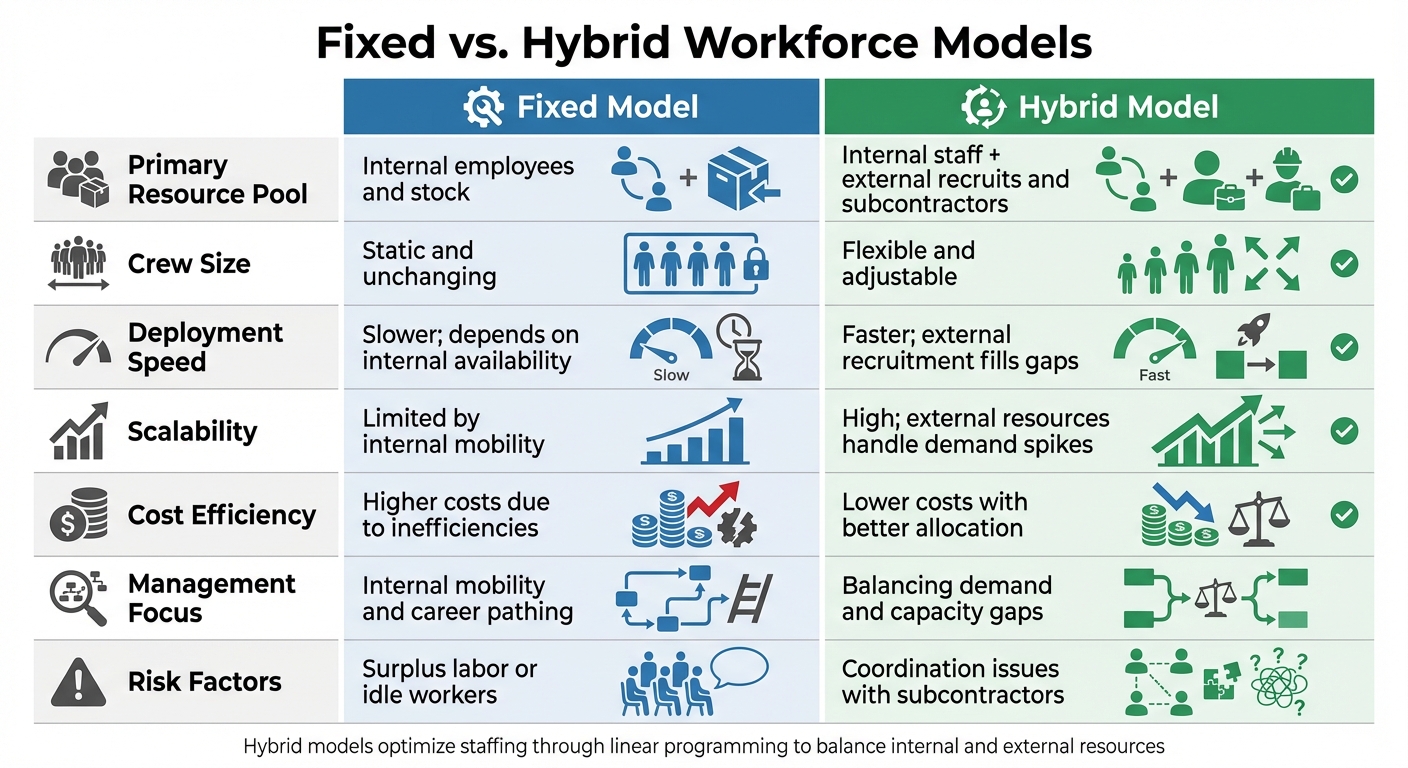
Fixed vs Hybrid Workforce Models: Cost, Scalability and Deployment Comparison
Evaluating Labor Needs by Project Phase
To effectively deploy a workforce, start by analyzing the specifics of your project – its cost, type, size, and timeline. These factors will help you estimate the required man-hours and the skills necessary for each phase. For instance, early stages typically call for general labor, while later phases, such as electrical or HVAC installation, require specialized expertise. Recruitment, transfers, and training should align with these evolving needs. Additionally, simulating design changes can help you anticipate and adapt to mid-project staffing shifts. Keeping detailed, up-to-date worker profiles ensures you can mobilize the right team quickly when needed.
Once you’ve outlined your labor requirements, automation can play a key role in aligning staffing resources to meet project demands efficiently.
Using Automated Matching and Scheduling Tools
After determining labor needs, automated tools make workforce matching and scheduling seamless. These platforms simplify staffing by instantly pairing workers with roles based on predefined criteria. They maintain verified profiles, including certifications and safety records, eliminating much of the manual effort involved in hiring. To prevent scheduling conflicts, these tools also check the availability of external recruits in real time. This ensures that crews are ready to work exactly when and where they are required, minimizing delays and inefficiencies.
Comparing Fixed vs. Hybrid Workforce Models
When deciding how to manage your workforce, it’s important to weigh the benefits and drawbacks of fixed and hybrid models. Here’s a quick comparison:
| Metric | Fixed Model | Hybrid Model |
|---|---|---|
| Primary Resource Pool | Internal employees and stock | Internal staff plus external recruits and subcontractors |
| Crew Size | Static and unchanging | Flexible and adjustable |
| Deployment Speed | Slower; depends on internal availability | Faster; external recruitment fills gaps |
| Scalability | Limited by internal mobility | High; external resources handle demand spikes |
| Cost Efficiency | Higher costs due to inefficiencies | Lower costs with better allocation |
| Management Focus | Internal mobility and career pathing | Balancing demand and capacity gaps |
| Risk Factors | Surplus labor or idle workers | Coordination issues with subcontractors |
To optimize staffing, consider using linear programming. This approach balances internal and external resources, helping you cut down on recruiting and training expenses. As G. J. L. Micheli aptly pointed out:
Workforce planning plays a key role in guiding decisions on human resources’ management, contributing, if properly carried out, to the success of the company.
Conclusion: Key Points and What’s Ahead
Scaling crews in industries with high demand hinges on one critical factor: combining specialized skills with adaptable workforce strategies. Challenges like worker shortages, hiring delays, and slow mobilization call for solutions that strike this balance. Hybrid crew models, platform-driven deployment, and real-time tracking are proving to be effective strategies. By aligning labor needs with project phases, utilizing automated matching, and weighing fixed versus hybrid approaches, companies position themselves for steady growth.
Technology is reshaping how operations are run. In 2026, construction firms using advanced scheduling tools and skills databases saw reduced non-productive travel time through optimized crew deployment based on geography and tasks. Look-ahead planning improved utilization rates by 15–25%, while cross-training helped mitigate up to 30% of workforce shortages. These advancements are already making a difference.
Platforms like ABLEMKR highlight how mobile-first technology can streamline operations. These tools enable companies to mobilize crews for emergency shutdowns or remote repairs in days rather than weeks. Features like real-time worker tracking, integrated payroll systems, and built-in compliance checks eliminate many of the bottlenecks that traditionally slow down industries like oil & gas, mining, and heavy infrastructure. These operational improvements are paving the way for long-term success.
Looking ahead, firms can build on these technological advances to scale operations seamlessly. By 2026, the ability to efficiently scale crews while maintaining quality will be a key factor in staying competitive. To achieve this, companies should document standard operating procedures, develop a strong hiring pipeline, and adopt real-time workforce management tools.
The roadmap is clear: streamline your processes, embrace technology for workforce matching and compliance, and prepare for managing multiple projects simultaneously. Striking this balance allows companies to grow without overextending, meet deadlines, and capitalize on new opportunities.
FAQs
What are hybrid crew models, and how do they help with labor shortages?
Hybrid crew models bring together specialized skilled workers and flexible general laborers to build a workforce that can handle shifting project demands. This setup ensures that highly trained professionals focus on critical tasks, while general laborers step in to handle support roles or help during peak workloads.
When businesses use hybrid models, they gain the ability to scale their teams more effectively, minimize delays, and stay compliant with regulations. Tools like ABLEMKR make this process smoother by using technology to match pre-screened workers to job sites based on their certifications, availability, and location. This makes it easier to fill staffing gaps quickly – whether due to unexpected shortages or surges in demand – helping projects stay on track and run efficiently.
How does technology improve crew mobilization?
Technology is transforming how crews are mobilized, making it easier and faster to match workers to jobs based on their skills, certifications, availability, and location. Mobile-first platforms play a big role in simplifying this process, allowing teams to be deployed quickly and efficiently for critical tasks.
With real-time tracking and compliance tools, companies gain better visibility into their workforce operations. This helps cut down on delays, ensures safety standards are met, and keeps teams ready to handle high-demand or time-sensitive situations with ease.
How can companies effectively manage specialized skills while staying flexible with their workforce?
Balancing specialized skills with workforce flexibility takes careful planning and the right tools. Platforms like ABLEMKR make it easier for companies to connect workers with jobs that fit their certifications, safety training, availability, and location. This approach helps businesses quickly assemble crews for time-sensitive or complex projects.
On top of that, cross-training employees to take on multiple roles boosts adaptability and helps address labor shortages. By blending advanced workforce deployment tools with a focus on multiskilled teams, businesses can streamline productivity, handle shifting project needs, and make the most of specialized expertise.


