
If I had to sum it up in one line: a scaffold user works on the scaffold, and a competent person decides whether that scaffold is safe to use.
That split matters because OSHA treats these as two separate roles under 29 CFR 1926 Subpart L. One role is about safe use. The other is about inspection, hazard control, and stop-work authority. If an employer mixes them up, the result can be missed inspections, weak records, and workers on unsafe platforms.
Here’s the short version:
- Scaffold users must be trained before they work on a scaffold
- Their training must cover fall hazards, electrical hazards, falling-object hazards, load limits, access, and safe use
- They should do a basic visual look before use and report problems
- They should not change planks, guardrails, ties, or base parts unless assigned and trained for that task
- A competent person must be able to spot hazards and have authority to fix them or stop the work
- OSHA requires scaffold inspection by that person before each shift and after events that may affect structural strength, under 29 CFR 1926.451(f)(3)
- Employers should keep training records, written designation records, inspection logs, and scaffold tags
In plain terms, one person may hold both roles, but only if the employer gives that person the training, written designation, and authority required for the higher-level role.
Quick Comparison
| Item | Scaffold User | Competent Person |
|---|---|---|
| Main role | Works from the scaffold | Decides if scaffold can stay in service |
| OSHA focus | Safe use | Inspection and hazard correction |
| Training | User hazards and safe use | Hazard identification, scaffold safety, correction authority |
| Pre-shift inspection | No | Yes |
| Stop-work authority | Can stop personal use and report | Can stop the work and order fixes |
| Records | Training record | Training record, written designation, inspection log |
One fact stands out: the article points to pre-shift inspections before each work shift, plus checks after weather, impact, or changes to the scaffold. That is where many job sites fall short.
If I’m assigning scaffold roles, the rule is simple: train the user, designate the competent person in writing, and document every inspection.
sbb-itb-aa28329
Scaffold User Requirements Under OSHA
Under OSHA 29 CFR 1926.454(a), employers must train each scaffold user before that employee works on a scaffold. That training needs to cover the hazards tied to the scaffold type being used and how to control them. OSHA also requires retraining when there are signs the worker didn’t grasp the training, when the scaffold type changes, or when new hazards show up on the jobsite.
Training Topics for Scaffold Users
OSHA says scaffold user training must cover:
- The nature of electrical hazards, fall hazards, and falling-object hazards in the work area
- The right procedures for dealing with those hazards
- Safe scaffold use
- Proper handling of materials on the scaffold
- The right procedures for erecting, maintaining, and disassembling fall- and falling-object-protection systems in use
- The maximum intended load
- The scaffold’s load-carrying capacities
Put simply, users are trained to operate the scaffold safely. They are not trained to make structural changes or design calls about the scaffold.
Scaffold User Duties and Limits on Site
On site, this comes down to a plain rule: use the scaffold the way it was meant to be used. That means using designated access points, such as ladders, stair towers, or built-in access, instead of climbing cross-braces. Before getting on, workers should make sure the scaffold has been cleared for use by the competent person. They should also do a quick visual check for missing guardrails, damaged planks, debris, or other obvious hazards. If something looks off, the worker should report it to the competent person or supervisor and stay off the scaffold.
There’s a line scaffold users shouldn’t cross. They may not move planks, remove guardrails, adjust ties, or change base components unless they’ve been trained for that task and assigned to do it. That line matters because the competent person is the one responsible for spotting hazards and directing fixes.
Competent Person Requirements Under OSHA
A scaffold user spots and reports hazards. The competent person does more than that: they identify scaffold hazards and fix them before work moves on.
OSHA defines a competent person as someone who can identify existing and predictable hazards that could harm employees and has authority to correct them promptly.
Authority, Designation, and Required Knowledge
The employer must formally designate the competent person and give that person the authority to stop work, remove workers from an unsafe scaffold, and order repairs.
That person also needs solid working knowledge of:
- Scaffold erection, movement, alteration, and dismantling
- Load capacity
- How weather and site conditions affect scaffold stability
This is where the role stops being just a title on paper. If a scaffold is unsafe, the competent person needs the power to act right away, not wait around for approval.
That authority shows up most clearly during inspections.
Inspection Duties Before Each Shift and After Events
Under 29 CFR 1926.451(f)(3), scaffolds and their components must be inspected for visible defects by a competent person before each work shift and after any occurrence that could affect structural integrity. That includes vehicle or equipment impacts, severe weather such as high winds, heavy rain, snow, or ice, unauthorized alterations, or any unusual stress event.
During the inspection, the competent person should check footing, bracing, planking, guardrails, access, and tie-ins, and look for damage or instability. They also need to review load issues, such as whether materials stored on platforms push the scaffold past its rated capacity.
Record each inspection in a log with the date, time, and inspector name.
When a scaffold fails, the result can be severe injury or death. That’s why inspection discipline isn’t optional.
Those differences stand out even more when the two roles are compared side by side.
Scaffold User vs Competent Person: Side-by-Side Comparison
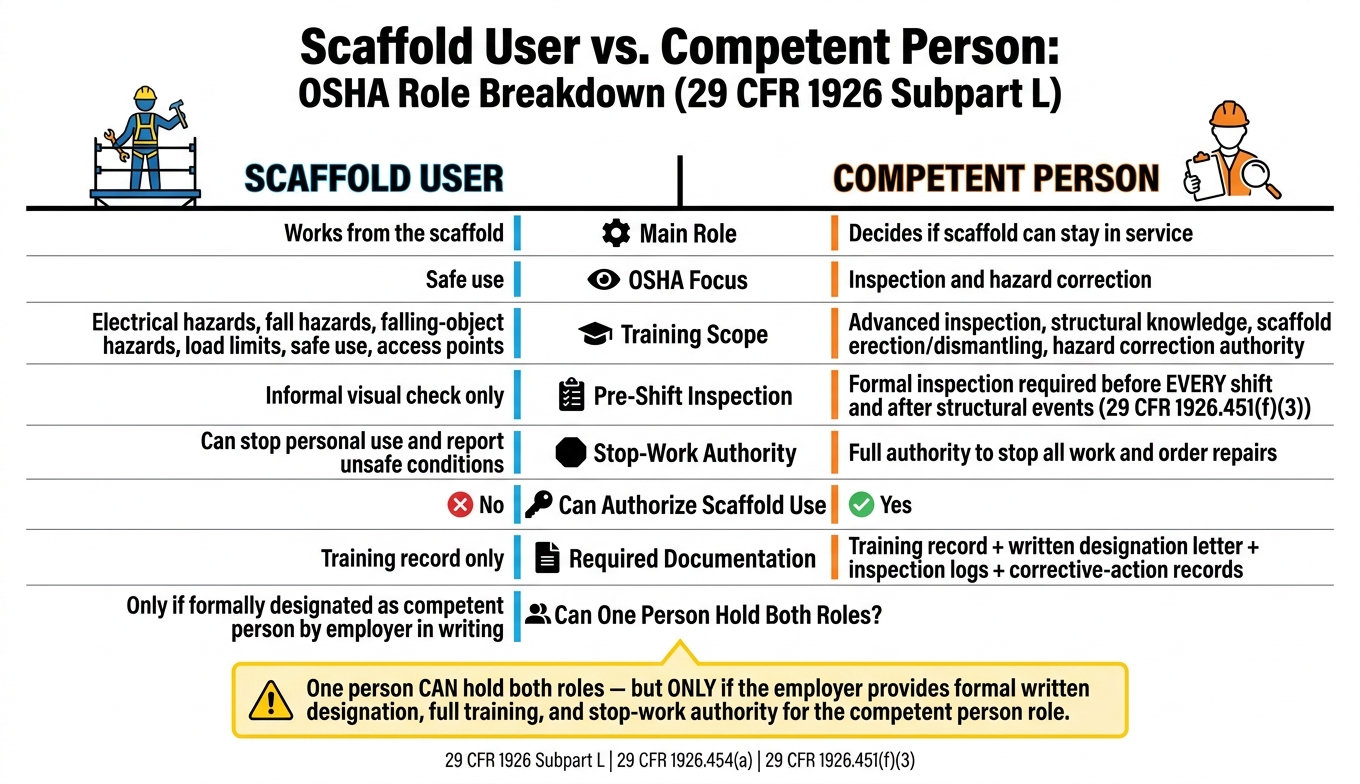
Scaffold User vs Competent Person: OSHA Role Comparison
The main split is pretty simple: scaffold users work on the scaffold, while competent persons decide if it can stay in service. That line becomes a big deal when things move past normal use and into approval, inspection, or fixes.
Training Scope and Decision-Making Authority
A scaffold user’s training centers on day-to-day safety. That means learning scaffold-specific hazards, load limits, access points, and when to stop work and report a problem.
A competent person’s training goes deeper and gets more technical. It covers scaffold design and erection principles, how to spot structural defects, proper inspection methods, and how to decide whether a scaffold is safe to use. The competent person also has formal authority to stop work and direct corrections.
| Feature | Scaffold User | Competent Person |
|---|---|---|
| Training focus | Hazard awareness and safe use | Advanced inspection, structural knowledge, hazard correction |
| Can authorize scaffold use | No | Yes |
| Stop-work authority | Can stop using the scaffold and report unsafe conditions | Yes, with authority to stop work and direct corrections |
Inspection, Documentation, and Role Overlap
If a scaffold user spots a hazard, the right step is to stop using the scaffold and report it. That’s part of the user’s role. But it does not replace the formal pre-shift inspection OSHA requires the competent person to perform before each work shift and after any event that could affect structural integrity.
On the jobsite, authority sets the role. In the paperwork, records prove it. A scaffold user needs a training record showing they were taught about hazards and safe use. A competent person needs more than that:
- a formal designation record from the employer
- inspection logs with dates and findings
- records of any corrective actions taken
That paper trail shows the role was formally assigned.
| Compliance Item | Scaffold User | Competent Person |
|---|---|---|
| Inspection duty | Informal visual check only | Formal pre-shift and post-event inspection |
| Documentation required | Training records | Designation record, inspection logs, corrective-action records |
| Can hold both roles | Only if formally designated as competent person | Yes, if also trained for scaffold use |
One person can hold both roles, but only if the employer formally designates them as the competent person and gives them the training and authority the role requires. That assignment should appear in the employer’s written records.
How Employers Should Assign and Document Each Role
Written Designation, Training Records, and Inspection Logs
After comparing the roles, the next move is to write everything down in a clear, repeatable system. If roles live only in someone’s head, things slip. On a scaffold job, that can turn into trouble fast.
Keep a training record for each scaffold user. That record should include the employee’s name, role, training date, trainer name and qualifications, topics covered, and retraining date. For each competent person, keep that same training record, plus a written designation letter that names the individual, lists the effective date, notes the scaffold types or job sites covered, and states that the person has stop-work authority.
Employers should also post a visible scaffold tag on the scaffold itself. Include the scaffold ID, the latest inspection date and time, the competent person’s name or initials, and the status: safe, restricted, or out of service. Back that up with a central inspection log that shows the date and time of each inspection, any deficiencies found, corrective actions taken, and sign-off by the competent person.
| Record | What to Include |
|---|---|
| Scaffold user training record | Employee name, role, training date (MM/DD/YYYY), trainer identity and qualifications, topics covered, retraining date |
| Competent person designation letter | Name, effective date, scaffold types or job sites covered, explicit stop-work authority, company officer or safety director signature |
| Scaffold inspection log/tag | Scaffold ID, date and time, deficiencies found, corrective action, competent person’s name or initials, status |
Using ABLEMKR to Track Role Readiness Across Projects

Once the records are set up, employers need a simple way to see who is current on each project. That’s where ABLEMKR comes in.
ABLEMKR can keep scaffold user training status, competent-person designation, scaffold types or job sites covered, and training expiration dates in one place across construction, energy, and extractives projects. That gives managers a cleaner way to match workers to the right site and shift before mobilization. It can also flag gaps, such as a site with scaffolding present but no competent person assigned, so safety teams can step in before mobilization.
Conclusion: Assign Authority Clearly and Document It
Put the assignment in writing, keep the records current, and treat authority as part of the role.
FAQs
Can a scaffold user also be the competent person?
Yes – if they meet all requirements for the competent person role.
A scaffold user follows safe use and site protocols. A competent person also needs the training, knowledge, and authority to inspect the scaffold, spot hazards, and take prompt corrective action. Employers must make sure anyone given that role is qualified through training and experience.
What happens if no competent person inspects the scaffold before a shift?
If a qualified person doesn’t inspect the scaffold before a shift, the job can run into serious safety problems. That includes structural instability, collapse, and worker injury.
The fallout doesn’t stop there. Skipping inspections can trigger stop-work orders, OSHA fines, legal liability, insurance problems, contract disqualification, and project delays.
That’s why consistent, documented inspections matter. They help protect workers and keep the project in line with safety and compliance rules.
When does OSHA require scaffold retraining?
OSHA requires scaffold retraining when an employer has reason to believe a worker no longer has the skill or understanding needed to work safely.
That retraining is required when work methods change, new hazards show up, new equipment is brought in, or after safety incidents and near-misses. Employers should also review state-specific rules, since some states require refresher training on a set schedule.


