
Construction safety boils down to two key approaches: compliance and safety culture. Compliance ensures adherence to OSHA regulations and legal requirements, laying a basic safety foundation. Safety culture, however, focuses on embedding safety as a shared value, where workers and leaders actively prevent risks.
Key Takeaways:
- Compliance: Focused on meeting legal standards, avoiding fines, and maintaining records. It’s reactive and often stops at minimum requirements.
- Safety Culture: Centers on proactive behavior, open communication, and shared responsibility for safety. It reduces accidents by addressing hazards before they escalate.
Why it matters: Compliance is essential but insufficient. Companies that combine compliance with a strong safety culture see fewer accidents, better worker engagement, and long-term cost savings.
| Feature | Compliance | Safety Culture |
|---|---|---|
| Goal | Meet legal standards | Prevent accidents |
| Approach | Reactive | Proactive |
| Focus | Avoid fines | Protect lives |
| Worker Role | Follow rules | Actively report hazards |
| Measurement | Past incidents | Safe behaviors |
Bottom line: Compliance sets the rules, but safety culture saves lives. Combining both ensures safer worksites and better outcomes.
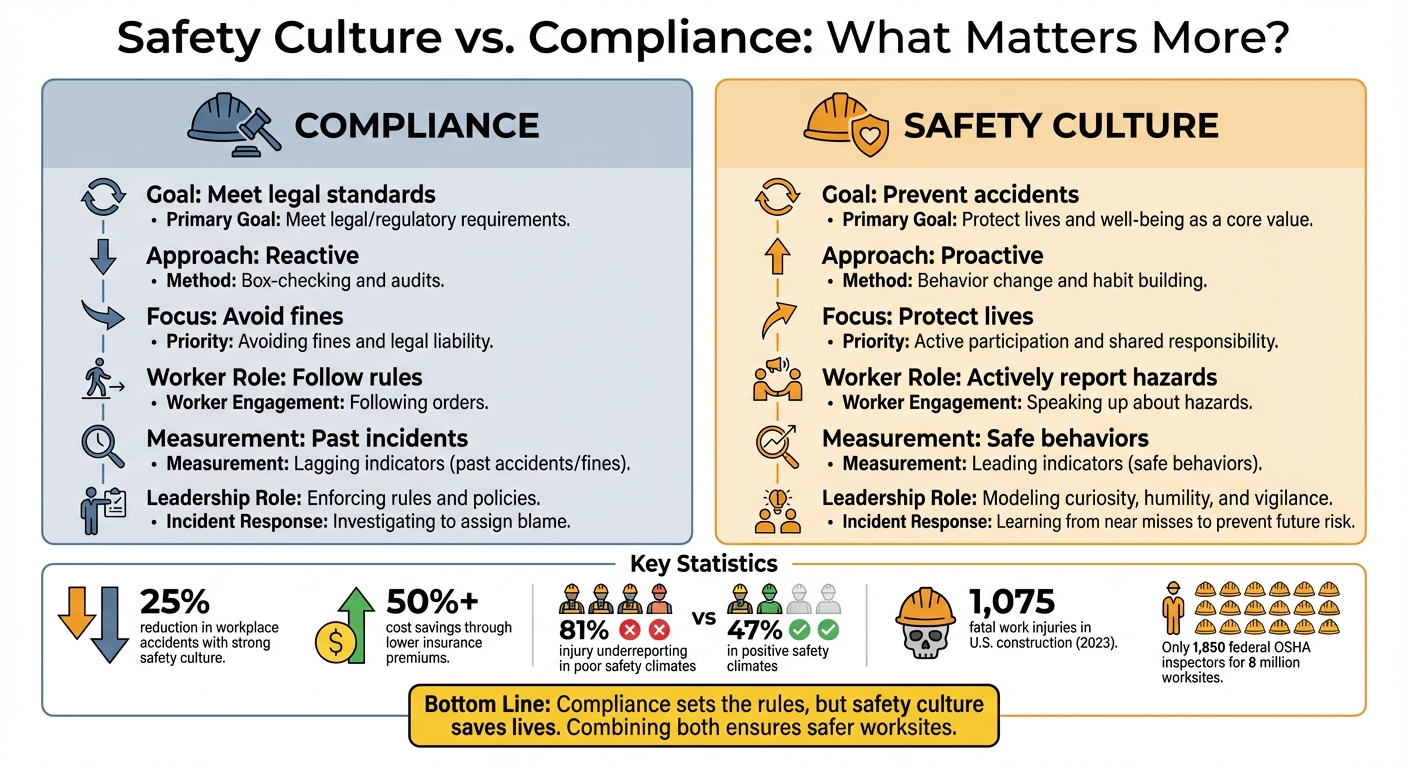
Safety Culture vs Compliance in Construction: Key Differences Comparison Chart
From Compliance to Culture: The Soft Skills That Build Safer Teams
sbb-itb-aa28329
What Is Safety Compliance in Construction?
Safety compliance in construction is all about following legal regulations, safety laws, and industry standards. In the United States, this means adhering to OSHA guidelines as well as state-specific rules. The primary goal? Meet the minimum legal requirements to operate a job site while steering clear of fines, penalties, and legal troubles.
Ken Fulginiti, a trial lawyer and founder of Fulginiti Law, explains the purpose of these standards:
"OSHA standards were never designed to represent the highest level of safety achievable on a job site. They were designed to establish a baseline. A floor. The minimum conditions within which work can legally proceed."
In short, compliance provides the foundation for safety. But it’s just that – a foundation. It’s the starting point, not the ultimate goal.
Elements of Safety Compliance
Safety compliance in construction involves several interconnected elements. At its core are regulatory standards, such as OSHA mandates, which include rules on fall protection and hazard communication. Companies are also required to maintain detailed records, including certified payrolls, incident reports, and signed safety meeting logs.
Regular audits and inspections ensure job sites meet these legal requirements, while mandatory training programs confirm that workers have the certifications and knowledge they need to stay safe. On a day-to-day basis, compliance involves using personal protective equipment (PPE), implementing fall protection systems, and completing equipment checklists before starting work.
In recent years, digital tools have started to play a big role in managing these requirements. They make recordkeeping and preparing for audits much easier.
However, while these measures address basic regulatory needs, they often miss the mark when it comes to addressing the ever-changing risks on a construction site.
Where Compliance Falls Short
The problem with focusing solely on compliance is that it can become a "check-the-box" exercise, which has some serious drawbacks. Compliance often takes a reactive approach, documenting incidents after they happen instead of identifying and preventing hazards ahead of time.
This approach can lead to what safety experts call "safety theater." In these cases, companies appear to have everything in order – clean reports, low incident rates – but hidden dangers still lurk on the job site. In fact, over 70% of workers believe their workplace only meets the bare minimum safety standards. This suggests that many organizations stop improving once they’ve met compliance requirements.
Another issue is the one-way flow of safety communication. In compliance-driven environments, information typically moves from management to workers during formal meetings. This structure often discourages workers from reporting real hazards they encounter in the field. When workers feel ignored, they may stop speaking up altogether, leaving dangerous blind spots that audits can’t detect.
There are real-world examples that highlight these failures. In 2023, two major manufacturers of PFAS chemicals passed all regulatory audits for decades while still causing widespread water contamination. Despite being "compliant" on paper, these companies faced a $10.3 billion settlement for water contamination in 2023 and an $875 million settlement for environmental damage in New Jersey in 2025. Similarly, the Boeing door plug incident – where a plane passed every required inspection but still had a door plug eject mid-flight due to missing bolts – shows how compliance alone isn’t enough.
The binary nature of compliance – either a standard is met or it isn’t – doesn’t account for the dynamic risks that come with construction work. Equipment wears down, worker behavior varies, and environmental conditions change, but compliance checklists stay static. This mismatch between reported safety and actual safety often leads to accidents.
These gaps make it clear: while compliance is essential, it’s not the end goal. To truly protect workers, companies need to move beyond compliance and embrace a proactive approach to safety.
What Is Safety Culture in Construction?
Safety culture goes beyond following rules – it’s about embedding safety into the mindset and actions of every individual on the job. Timothy McFarlain, a Site Safety Manager, explains it like this:
"Safety culture is… a workplace where employees think safely before they act, behave appropriately in the work environment, and never compromise safety for the sake of production."
This perspective shifts the focus from mere compliance to creating a workplace where safety becomes second nature. It’s not just about ticking boxes; it’s about fostering an environment where everyone, from leadership to the newest hire, takes personal responsibility for safety. Workers don’t follow procedures just because they have to – they do it because they want to ensure everyone gets home safely. Mark Whitson, President of DPR Construction, captures this sentiment perfectly:
"A lot of companies talk about safety as a priority. We talk about safety as a value."
This distinction is critical. Priorities can change under pressure, but values are steadfast. While compliance sets the minimum requirements, a strong safety culture continuously pushes for higher standards across the board.
Core Elements of Safety Culture
A strong safety culture rests on several key principles. First, leadership commitment is essential. Managers and supervisors must visibly demonstrate that safety comes first – whether it’s by properly using protective gear, stopping work to address hazards, or allocating resources to safety programs. When leaders consistently model safe behavior, they set the tone for the entire team.
Worker participation is equally important. Every employee should feel empowered to protect their own safety and that of their coworkers. This includes having the authority to stop work if they spot a potential hazard, without fear of retaliation. Open communication strengthens this framework, creating a space where workers can report near-misses or safety concerns without blame. As the SafetyIQ Team notes:
"Silence is often the biggest warning sign of a weak safety culture."
Finally, proactive risk management plays a vital role. By monitoring safety behaviors, tracking training completions, and analyzing near-miss reports, companies can identify and address potential risks before they escalate into accidents.
How Safety Culture Improves Outcomes
Adopting these proactive measures leads to tangible benefits. For example, companies that embrace a strong safety culture often see a 25% reduction in workplace accidents. Over time, this approach can also result in cost savings of more than 50% through lower insurance premiums and reduced accident-related expenses.
There’s a productivity boost as well. When employees trust that their safety is a genuine priority, they’re more engaged and less likely to cut corners. In fact, 60% of job seekers now consider workplace safety a top factor when choosing an employer. As the SafetyIQ Team puts it:
"Safety and productivity are not competing goals – they reinforce each other."
Perhaps the most crucial advantage is addressing the enforcement gap. With only about 1,850 federal OSHA inspectors overseeing 8 million worksites – roughly one inspector for every 70,000 workers – regulatory inspections alone can’t ensure safety. A robust safety culture fills this gap by fostering self-accountability at every level. These benefits highlight why safety culture offers a more effective approach compared to traditional compliance methods.
Safety Culture vs. Compliance: Key Differences
Compliance and safety culture approach workplace safety from two very different angles. Compliance is typically a reactive process – it kicks in after incidents occur or during scheduled audits. Safety culture, on the other hand, emphasizes prevention by identifying hazards and encouraging behavior changes before accidents happen.
Compliance focuses on meeting legal requirements to avoid penalties. It’s driven by external pressures such as OSHA inspections and the threat of fines. Safety culture, however, is built on an internal commitment from workers and leadership alike, aiming for zero incidents through shared responsibility.
The contrast becomes clear in day-to-day operations. A compliance-driven approach often results in workers simply following a checklist, with little personal investment in identifying hazards. In workplaces with a strong safety culture, those same checklists become tools for meaningful conversations, such as during toolbox talks where teams actively discuss site-specific risks. Here’s a closer look at how these two approaches differ in practice:
Side-by-Side Comparison
| Feature | Safety Compliance | Safety Culture |
|---|---|---|
| Primary Goal | Meet legal/regulatory requirements | Protect lives and well-being as a core value |
| Method | Reactive; box-checking and audits | Proactive; behavior change and habit building |
| Priority | Avoiding fines and legal liability | Active participation and shared responsibility |
| Leadership Role | Enforcing rules and policies | Modeling curiosity, humility, and vigilance |
| Worker Engagement | Following orders | Speaking up about hazards |
| Incident Response | Investigating to assign blame | Learning from near misses to prevent future risk |
| Measurement | Lagging indicators (past accidents/fines) | Leading indicators (safe behaviors) |
These differences highlight why a proactive safety culture often does a better job of preventing accidents than simply adhering to compliance standards.
The Risks of Compliance-Only Approaches
Data shows that environments focused solely on compliance often fail to encourage honest reporting. For example, workplaces with a poor safety climate have an injury underreporting rate of 81%, compared to 47% in those with a positive safety climate. Even well-meaning initiatives like "300 Days Without an Accident" boards can backfire, as workers may avoid reporting minor incidents to maintain the streak.
Real-World Examples in Construction
A compliance-driven site might pass audits and meet regulatory standards on inspection day, but that doesn’t necessarily reflect ongoing safety efforts. In contrast, a site with a strong safety culture takes a more hands-on approach. For instance, morning meetings aren’t just about delivering instructions – they’re opportunities for workers to discuss specific risks they’ll face that day.
Imagine a crew preparing to pour concrete on the third floor. Instead of a one-way lecture, the foreman might ask, "What risks do we need to address today?" Workers could raise concerns like slippery surfaces near edges, the crane’s swing radius, or fatigue from a long prior shift. Together, they’d brainstorm solutions before starting work.
With just 1,850 federal OSHA inspectors overseeing 8 million worksites, it’s clear that regulatory inspections alone can’t ensure safety. This is where fostering a strong safety culture becomes essential, creating accountability and vigilance at every level.
Why Safety Culture Works Better Than Compliance Alone
Compliance programs tend to kick in after something has already gone wrong. A safety culture, on the other hand, emphasizes proactive measures – like observing behaviors and identifying hazards – to address risks before they lead to accidents.
The numbers speak volumes. In 2023, the U.S. construction industry reported 1,075 fatal work injuries, with a fatality rate of 9.6 per 100,000 full-time workers. That’s nearly three times the private industry average of 3.5. Clearly, just meeting OSHA regulations isn’t enough. Even when companies check all the compliance boxes, accidents still happen. What’s missing is a mindset where workers actively step in to stop unsafe actions. This highlights why focusing on proactive safety practices, rather than just rules, is critical to preventing tragedies.
Take Alcoa in the late 1980s as an example. Under CEO Paul O’Neill, the company made worker safety its top priority – not just another compliance task. O’Neill called safety a “keystone habit” that influenced every operational decision. The result? Alcoa’s value increased ninefold in just ten years. It’s a powerful reminder that when safety becomes part of a company’s core values, it benefits both people and profits.
Building Trust and Active Participation
Alcoa’s story shows the importance of trust and open communication on the jobsite. Trust is the backbone of any strong safety culture. When workers see their feedback leading to tangible changes, they’re more likely to take ownership of safety. In compliance-driven workplaces, people wear protective gear because they’re told to. In a safety culture, they do it because they care about their own well-being and that of their coworkers. The difference is huge: workplaces with poor safety climates underreport injuries 81% of the time, compared to 47% in those with positive safety climates. Without trust, workers might avoid reporting hazards, allowing risks to pile up until something catastrophic happens.
A no-blame approach to incident investigations can help. Instead of focusing on who’s at fault, these investigations aim to understand what went wrong, turning near-misses into opportunities to learn and improve. This encourages workers to be honest about potential risks without fear of punishment.
Leadership also plays a big role. When supervisors prioritize safety – like conducting walk-arounds focused on high-risk tasks rather than production quotas – it sends a clear message about what matters most. Workers notice when leaders consistently model safe behaviors and are more likely to follow their example. As Timothy McFarlain, Site Safety Manager, puts it:
"Safety culture is a workplace where employees never compromise safety for the sake of production."
Using Compliance as a Starting Point
While trust and engagement are key to everyday safety, compliance provides the foundation. Regulations set the basic rules, standards, and training requirements every workplace needs. The problem arises when companies treat compliance as the finish line instead of the starting point. Enforcement alone can’t guarantee safety. To truly protect workers, companies need systems that go beyond the bare minimum and make safety a core value.
The best safety programs combine compliance with a proactive safety culture. Start with clear protocols and training based on regulatory standards. Then, layer on practices like daily safety meetings, open communication channels, and recognition for proactive safety actions. Tracking leading indicators – such as participation in safety discussions, quality of hazard assessments, and how quickly issues are resolved – helps create a system that’s both compliant and genuinely protective. By building trust and prioritizing continuous improvement, safety culture transforms compliance from a box to check into a powerful tool for protecting lives.
How ABLEMKR Supports Both Safety Culture and Compliance

In industries like construction, oil & gas, and mining, ensuring workers are more than just present – they need to be fully trained, certified, and focused on safety. ABLEMKR’s mobile-first platform tackles this challenge by addressing both regulatory compliance and fostering a proactive safety mindset.
Rather than treating compliance as the end goal, ABLEMKR uses it as a foundation. From there, it builds systems that simplify processes, improve transparency, and empower workers. By balancing compliance with a strong safety culture, ABLEMKR creates a seamless integration of these two critical elements.
Pre-Vetted Workers with Verified Safety Training
To strengthen safety culture and meet compliance standards, ABLEMKR employs a thorough pre-vetting process. The platform matches workers to jobsites based on verified certifications, safety training, availability, and location. Each worker profile is pre-verified, ensuring only qualified individuals are sent to critical projects. This eliminates uncertainty for employers handling last-minute shutdowns, remote pipeline repairs, or scheduled mine developments.
The system automatically considers job-specific safety needs, such as OSHA 10/30 certifications, confined space training, and credentials for specialized equipment. This approach goes beyond simply meeting compliance standards – it communicates to workers that their safety is a top priority. As Steve Smith, Director of Partnerships at Bluebeam, Inc., puts it, maintaining high safety standards through verified certifications serves as a "cultural signal" that workers’ lives are valued.
Real-Time Monitoring and Compliance Tracking
Safety doesn’t stop at deployment – it requires ongoing oversight. ABLEMKR offers real-time visibility into worker status, integrates payroll workflows, and embeds compliance tracking into its platform. These tools help reduce the mental strain that can lead to accidents. As Smith explains:
"Every frustrating extra step, every clunky process, every poorly communicated change – they all add to the cognitive load workers carry. And the heavier that load, the greater the likelihood of physical accidents".
Conclusion: Combining Safety Culture and Compliance
The question of "what matters more" isn’t about choosing one over the other. Compliance provides the legal framework that shields organizations from fines and liabilities, creating a protective baseline. But relying solely on compliance won’t prevent every incident.
A strong safety culture takes those foundational rules and transforms them into proactive, everyday habits. Companies that prioritize safety culture often see up to a 25% drop in accident rates and a 40% reduction in workplace incidents. The key difference is motivation: compliance answers "what must we do", while safety culture answers "why we do it."
Integrating these two approaches is where advanced technology comes into play. Platforms designed for compliance automation lighten the administrative load, freeing workers to focus on safety itself. Simplified processes and better communication not only reduce mental strain but also lower the chances of accidents. The most effective strategy treats compliance as the groundwork for building a thriving safety culture. Businesses that invest in this dual approach often save over 50% in long-term costs through fewer accidents and reduced insurance premiums.
In high-risk industries like construction, oil & gas, and mining, tools like ABLEMKR make it easier to manage verification, tracking, and real-time monitoring. This allows teams to concentrate on the human factors that prevent incidents. When compliance and culture operate together, safety becomes second nature – not just a checklist. The result is a resilient and effective safety system where rules and habits align seamlessly.
FAQs
How do I measure safety culture?
To get a clear picture of safety culture, focus on understanding how employees perceive safety, their level of engagement, and how actively they practice safety measures. Some effective ways to measure this include:
- Surveys: Gather insights into safety attitudes and perceptions through well-designed questionnaires.
- Behavioral Observations: Pay attention to on-site actions to see if safety protocols are followed in real-world scenarios.
- Metrics Tracking: Monitor data like incident rates and near-misses to identify trends and areas of concern.
When safety culture is strong, you’ll notice employees who are genuinely committed to safety and leaders who emphasize and encourage proactive safety measures. At its core, a mature safety culture thrives on shared beliefs and values that consistently prioritize safety in every aspect of work.
What are leading safety indicators?
Leading safety indicators are proactive tools aimed at improving workplace safety by concentrating on actions and behaviors that affect overall safety outcomes. These indicators help spot risks early, giving organizations the chance to tackle potential problems before they lead to accidents.
How can leaders build trust for hazard reporting?
Leaders can create trust by cultivating a workplace where safety is a shared priority. This involves promoting openness, accountability, and avoiding punitive reactions when issues are raised. Employees are far more likely to report potential hazards if they see their concerns addressed and meaningful safety measures put into action.
Key steps include maintaining clear communication, providing training on how to report hazards effectively, and being transparent about how reports are managed. Additionally, acknowledging and rewarding employees who take the initiative to report risks helps reinforce safety as a core value and encourages a more proactive approach to maintaining a secure work environment.


