
Construction remains one of the deadliest industries in the U.S., with two workers dying daily from job-related injuries. In 2023, the "Fatal Four" hazards – falls, struck-by incidents, electrocutions, and caught-in/between accidents – caused 65% of construction deaths, largely due to inadequate training. Key findings include:
- Falls caused 35% of fatalities, often linked to poor fall protection training.
- Struck-by incidents made up 17%, with 70% of workers lacking hazard recognition training.
- Electrocutions (7.6%) and caught-in/between accidents (5.8%) were tied to gaps in equipment and electrical safety training.
- 60% of accidents occur in a worker’s first year, highlighting the need for better onboarding.
Companies spend more on injury costs (3.6% of budgets) than safety training (2.6%). Addressing training gaps – through task-specific, hands-on programs, regular competency checks, and refresher sessions – can save lives. Digital tools like ABLEMKR now help match certified workers to tasks, ensuring job site safety. Proper training isn’t just compliance – it’s a life-saving investment.
Here’s Why Traditional Construction Safety Training FAILS | Gabe Guetta, CEO at SALUS
How Training Failures Affect Construction Safety
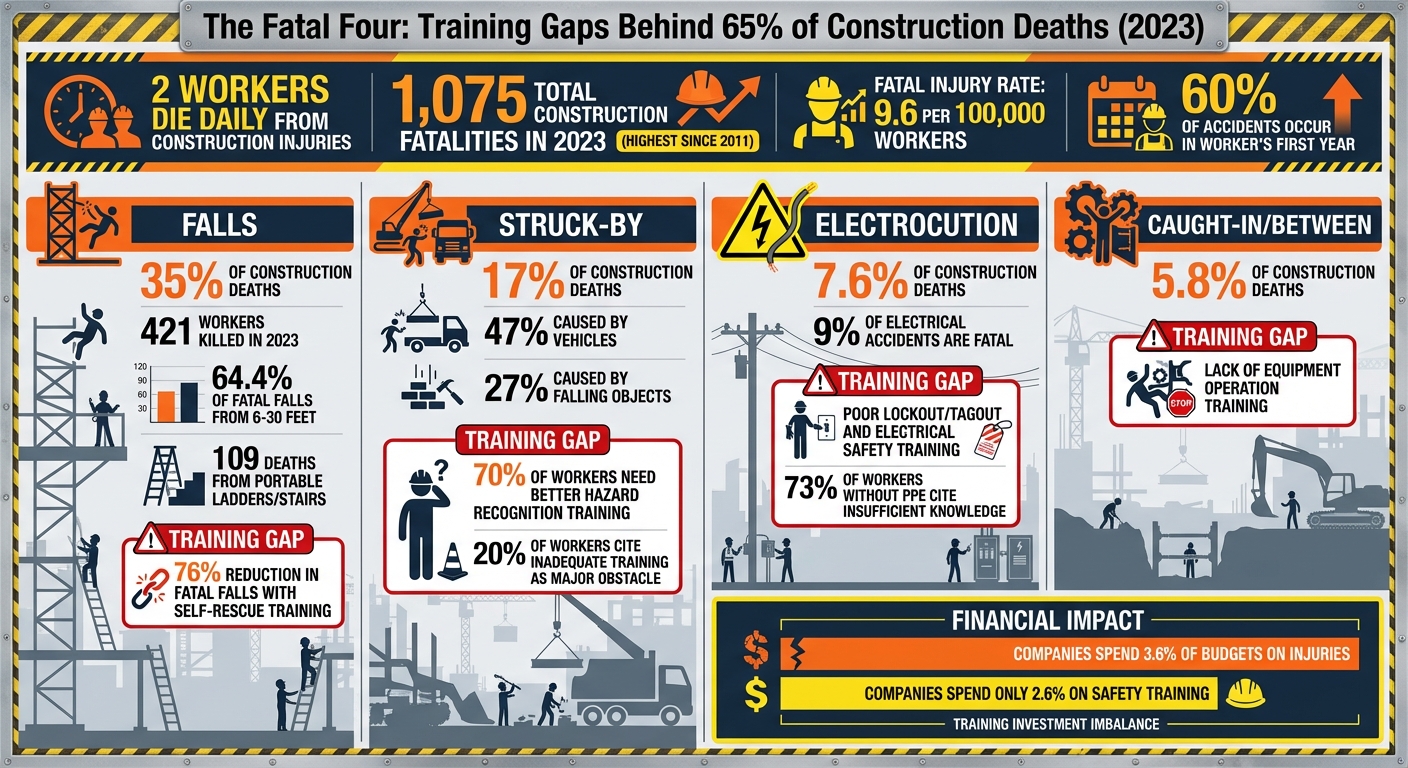
OSHA Fatal Four Construction Hazards: 2023 Statistics and Training Gaps
What Training Failures Mean as a Root Cause
When accidents happen on construction sites, the immediate cause – like a slip or mishandling equipment – often gets the blame. But these surface-level issues usually point to a deeper problem: systemic training failures. Without proper training, workers lack the tools to recognize hazards, follow safety protocols, and operate equipment in line with OSHA’s 29 CFR 1926 standards.
Take a scaffold fall, for example. It might seem like a simple misstep caused the accident. Yet, the real issue could be insufficient training on fall protection systems, improper harness use, or failing to identify height-related hazards. These gaps create conditions where preventable accidents become unavoidable. A study examining 714 fatal construction injuries revealed that 54.5% involved unskilled or casual workers, showing a direct link between inadequate training and deadly outcomes.
This distinction between immediate and root causes is crucial. Reminding workers to "be careful" doesn’t solve the problem. Instead, addressing root causes through thorough and ongoing training programs tackles the underlying risks, leading to meaningful safety improvements. Unfortunately, these training gaps are evident in the alarming accident statistics.
Statistics and Trends in Training-Related Accidents
The data paints a grim picture of how training failures contribute to fatal accidents on construction sites. OSHA’s "Fatal Four" hazards were responsible for 65% of all construction deaths in 2023, with training deficiencies playing a role in every category.
- Falls remain the leading cause of fatalities, accounting for 35% of construction deaths in 2023. Workers trained in self-rescue techniques are 76% less likely to experience fatal falls than those without this training.
- Struck-by incidents caused 17% of fatalities, with vehicles responsible for 47% and falling objects for 27% of these deaths. Surveys show that over 70% of workers see the need for better training in recognizing and preventing struck-by hazards. Yet, 20% of workers and 23% of employers cite inadequate training as a major obstacle.
- Electrocutions accounted for 7.6% of construction deaths, often due to poor training on lockout/tagout procedures and safe practices around electrical hazards.
- Caught-in/between incidents made up 5.8% of fatalities, frequently involving workers who lacked proper equipment operation training.
Adding to the problem is the financial imbalance in how construction firms allocate resources. On average, companies spend 3.6% of their budgets on injuries but only 2.6% on safety training – a misstep that leaves workers exposed to unnecessary risks.
| OSHA Fatal Four Hazard | % of Construction Fatalities (2023) | Training Link |
|---|---|---|
| Falls | 35% | Lack of fall protection and height safety training |
| Struck-by | 17% | Gaps in hazard recognition and prevention training |
| Electrocution | 7.6% | Insufficient training on electrical safety and lockout/tagout |
| Caught-in | 5.8% | Deficiencies in equipment operation training |
Where Training Gaps Most Often Occur
Fall Protection and Working at Heights
Falls from heights continue to be the leading cause of construction-related deaths. In 2023 alone, 421 workers lost their lives due to falls, slips, and trips – making up 39.2% of all construction fatalities. A closer look reveals that 64.4% of these fatal falls happened from heights between 6 and 30 feet, with 109 deaths linked to portable ladders and stairs. These tragedies are often preventable but highlight critical training failures. Workers frequently lack proper instruction on how to fit harnesses, choose the right lanyard, locate secure anchorage points, and safely set up scaffolds, ladders, and tie-offs. Additionally, inadequate training in self-rescue techniques can turn a survivable fall into a fatal one. Compounding these risks, gaps in training for heavy machinery operation create further dangers on construction sites.
Equipment Operation and Heavy Machinery
Beyond falls, improper use of heavy machinery stands out as a major contributor to workplace accidents. Poor training on equipment like cranes, excavators, forklifts, and bulldozers significantly increases the likelihood of incidents. Surveys show that 20% of workers and 23% of employers identify training deficiencies as a serious safety challenge. A NIOSH study found that 36% of struck-by injuries involved working near heavy equipment or vehicles. Inexperienced workers are particularly at risk, as insufficient training in hazard recognition leaves them ill-prepared to handle potential dangers, jeopardizing not only their safety but that of their coworkers.
Electrical Safety and Hazard Recognition
Electrical safety is another area where training shortfalls leave workers exposed to preventable risks. Electrocutions accounted for 7.6% of construction fatalities, underscoring the need for effective training to address hazards like arc-flash incidents and electrical shocks. Data from the Electrical Safety Foundation International indicates that about 9% of electrical accidents in 2018 were fatal. Despite these dangers, many workers lack essential guidance on lockout/tagout procedures, grounding techniques, the proper use of ground-fault circuit interrupters, and staying safe near energized lines. Alarmingly, 73% of workers who forgo personal protective equipment (PPE) cite insufficient knowledge as a key reason. These gaps in training not only endanger lives but also highlight the urgent need for better safety education across the industry.
sbb-itb-aa28329
How to Build Effective Safety Training Programs
Task-Specific and Hands-On Training
Generic lectures alone don’t cut it when it comes to preventing workplace accidents. Workers need training that directly reflects the hazards they’ll encounter on the job. For example, task-specific training – like steel connection at 30 feet, operating excavators near utilities, or setting up scaffolding – offers far more value than classroom-only sessions. Research from NIOSH and CPWR shows that workers consistently find hands-on, practical training more effective for identifying and managing risks compared to lecture-based methods. Practicing real-world scenarios, such as rigging fall protection systems, performing lockout/tagout on actual equipment, or running blind-spot drills with heavy machinery, helps workers build both muscle memory and situational awareness.
The benefits of task-based training can be life-saving. For instance, teaching self-rescue techniques for suspended harness scenarios significantly reduces fatalities in such high-stakes situations. This focused approach works because it prepares workers to handle specific, critical challenges. Similarly, training workers to conduct job hazard analyses (cited by 78% of respondents) and spot risks before starting tasks (73% of respondents) has been rated among the most effective ways to reduce struck-by injuries. To ensure these skills stick, companies should regularly assess workers’ competencies through testing and practical evaluations.
Testing Competency and Providing Refresher Training
Hands-on training is just the start – verifying that workers can apply what they’ve learned is equally important. Simply attending a training session doesn’t guarantee competence. Effective programs incorporate written tests and observed performance evaluations to confirm that workers understand safety procedures and can execute them. For example, workers should demonstrate how to properly set up a harness, safely perform lockout procedures, or operate a forklift before being allowed to work independently. Companies that regularly use job hazard analyses and have safety personnel oversee practices report fewer injuries.
Refresher training is critical for maintaining skills and adapting to changing conditions. High-risk activities like working at heights, crane operation, or electrical tasks demand annual refreshers at a minimum, with additional training triggered by near-misses, new equipment, or incidents. Structured onboarding followed by regular retraining is especially vital, given that 60% of construction accidents occur during a worker’s first year on the job. OSHA standards often require periodic retraining for specific hazards, but companies should also analyze their own incident data to identify which areas need more frequent updates. Regular competency checks and refreshers ensure workers stay sharp and prepared.
Making Training Accessible to All Workers
Even the best training program falls flat if workers can’t understand it. OSHA mandates that safety training be provided in a language and vocabulary workers can understand. With the diverse U.S. construction workforce – including individuals with varying literacy levels and language skills – this means going beyond text-heavy manuals. Instead, effective training relies on tools like pictograms, step-by-step visuals, short instructional videos, and interactive demonstrations. Avoiding dense slide decks and incorporating these methods makes training more engaging and easier to grasp. Pairing new or low-literacy workers with experienced bilingual mentors and using teach-back techniques to confirm understanding are also highly effective strategies.
The stakes here are real: among workers who failed to use required PPE for chemical exposure, 73% admitted they didn’t know how to use it. This highlights a clear training accessibility gap. Offering mobile-friendly materials, scheduling sessions during paid hours, and using plain, straightforward language can significantly improve participation and retention. When training is accessible, workers gain the critical knowledge they need to protect themselves and their coworkers, reducing risks across the board.
Using Technology to Improve Training Results
Digital Training Delivery and Tracking Systems
Safety training is getting a major upgrade with digital tools. Workers can now tap into short, on-demand videos and quizzes right from their phones to learn about crucial topics like fall protection and equipment operation. This shift toward bite-sized digital modules has become a game-changer – 60% of trainees prefer this format, and OSHA leveraged it to train over 1.3 million workers in 2023.
Learning management systems (LMS) take things a step further by organizing simulations, tests, and refresher courses while tracking progress in real time. These systems can identify workers who might need extra training, addressing gaps that 33% of workers report facing. Digital checklists also play a key role, ensuring critical safety steps are completed before high-risk tasks. This tech-driven approach doesn’t just improve training – it creates a foundation for smarter, data-driven safety management.
Using Data to Manage Safety
By combining training records with incident data, companies can pinpoint where skills are lacking. For example, 20–23% of workplace incidents stem from poor hazard identification. Analytics dashboards can reveal patterns, such as specific job sites or tasks with higher accident rates, helping employers focus on the most pressing training needs. If a project sees a spike in struck-by incidents, data might show that workers haven’t completed pre-task planning training – a preventive measure that 73% of companies consider essential.
This data-driven strategy replaces guesswork with actionable insights. Safety managers can track metrics like training completion rates and test scores, then link them to specific incident types. Instead of rolling out generic training for everyone, they can target the workers who actually need it. Platforms like ABLEMKR use these insights to streamline compliance and enhance safety outcomes.
ABLEMKR: Matching Certified Workers to Job Sites

ABLEMKR takes these advancements a step further with its mobile-first platform, which ensures only pre-vetted, certified workers are deployed to job sites. The system matches workers based on their training records, certifications, availability, and location. Need a crew for a pipeline repair or a heavy infrastructure project? ABLEMKR provides instant access to each worker’s compliance history, ensuring they’re properly trained for the job.
This verification process directly addresses training gaps that could lead to accidents. Employers can confirm that workers have completed training for specific hazards – whether it’s fall protection, equipment operation, or electrical safety – before they’re sent to a site. The platform also integrates compliance tracking and payroll workflows, making it easier to maintain safety standards. With geo-location features, companies can quickly deploy crews for urgent tasks while keeping safety a top priority.
Conclusion
Safety failures in training can have devastating consequences. In 2023, the construction industry saw 1,075 worker fatalities – the highest number since 2011 – with the "Fatal Four" hazards accounting for 65% of these deaths.
To tackle this, effective safety programs must combine hands-on, task-specific training with thorough competency assessments. For example, workers trained in self-rescue techniques have been shown to reduce fatal falls by an impressive 76%. Regular refresher courses and updates based on recent incidents are essential to keep skills sharp and address new risks as they arise.
In addition to these training efforts, digital tools and real-time data analytics are transforming construction safety. Learning management systems now allow companies to track training progress in real time, while data analytics help identify critical gaps in safety knowledge. Surveys reveal that around 20–23% of workers cite insufficient hazard identification training as a major issue. By using this data, companies can allocate resources more effectively and ensure their workforce is prepared. Platforms like ABLEMKR take this a step further by assigning only pre-vetted, certified workers to job sites based on their training records, ensuring that high-risk tasks are handled by properly qualified individuals.
Competency matters more than attendance. By integrating training into pre-task planning and using data to focus on high-risk areas, companies can ensure that only skilled workers are on-site. With the fatal injury rate in construction hovering at 9.6 per 100,000 workers for over a decade, adopting targeted training, regular competency checks, and data-driven safety measures can significantly reduce preventable accidents and save lives.
FAQs
What steps can construction companies take to improve training and prevent the ‘Fatal Four’ accidents?
To tackle the ‘Fatal Four’ accidents in construction, companies should prioritize practical, interactive safety training. This means covering key areas like spotting hazards, using equipment correctly, and handling emergencies effectively. Adding regular refresher sessions and simulation-based drills can go a long way in helping workers keep safety protocols fresh in their minds and ready to apply on the job.
Fostering a strong safety-first mindset is equally important. Focus on creating an environment where accountability, open communication, and leadership backing for safe practices are the norm. Tools like ABLEMKR can simplify onboarding by ensuring workers complete all necessary safety certifications and are fully equipped to navigate high-risk situations.
What are the best ways to deliver effective construction safety training?
The best construction safety training methods blend practical, hands-on experiences, interactive simulations, and real-life scenarios. These techniques make it easier for workers to grasp and remember essential safety protocols.
To keep safety knowledge fresh and up-to-date, regular refresher courses, skill assessments, and safety meetings play a vital role. Using mobile training tools can also streamline the process, making it easier to deliver consistent training across different job sites and helping to create safer work environments.
How does ABLEMKR make sure only qualified workers are sent to job sites?
ABLEMKR takes the guesswork out of hiring by carefully verifying each worker’s certifications, safety training, and necessary credentials. Their pre-vetting process ensures that every individual is fully qualified and meets the specific needs of a project before being assigned.
This thorough approach not only upholds strict safety standards but also gives companies peace of mind, knowing their critical projects are staffed with capable and reliable professionals.


