
The retrofit labor gap is now a job delivery problem, not just a hiring problem. If I need to keep projects on time and on budget, I need workers who can handle HVAC upgrades, heat pumps, insulation, air sealing, panel upgrades, and envelope work in older occupied buildings, not just people with trade cards.
Here’s the short version:
- Demand is up, but site-ready labor is short
- The problem is mostly a skills-mix gap, not only a worker-count gap
- Training often lags behind modern retrofit work
- State licenses, safety rules, and project requirements slow hiring across markets
- Retrofit firms compete with construction, utilities, and energy projects for the same trades
- Short, paid training paths and on-the-job learning help move people into work faster
- Digital staffing tools can cut delays by matching verified skills to job needs
A few numbers stand out:
- 44% of existing homes had energy performance certificate non-compliance in 2022, up from 38% in 2021
- Retrofit employers may face a shortfall of 200,000 workers
- Some employer-led bootcamps can prepare entry-level workers in 4 to 5 weeks
- Community college paths often take 1 to 2 years and may cost $3,000 to $10,000
- Short certifications can take 1 to 5 days and cost about $500 to $2,000
What does that mean in plain English?
Certificates alone do not get jobs done. I need workers who can apply skills on site, in old buildings, without causing moisture issues, mold, delays, or rework. That means training has to connect the full job: building envelope, airflow, HVAC, controls, and electrical work.
The fix is simple to state, but harder to do well:
- Define the skills each job needs
- Train for those exact job scopes
- Pay people while they learn
- Verify job readiness before dispatch
- Use staffing systems that match workers to sites fast
EP218 Breaking Down Silos: The Path to Better Retrofit Training with Ben Hildebrandt (May 2025)
sbb-itb-aa28329
Quick Comparison
| Issue | What’s going wrong | What to do |
|---|---|---|
| Training | Older course content misses modern retrofit tasks | Use short modules tied to current job scopes |
| Hiring | Paper credentials don’t always match site ability | Screen for proven field skills |
| Upskilling | Workers can’t stop earning to attend training | Offer paid learning and apprenticeships |
| Staffing | Multi-state rules slow crew placement | Standardize checks before dispatch |
| Deployment | Manual staffing takes too long | Use digital matching for skills, availability, and compliance |
If I had to sum up the article in one line, it would be this: hire for proven ability, train in short paid steps, and get the right workers to the right retrofit jobs with less admin drag.
What Is Causing the Retrofit Skills Gap
The shortage is a skills-mix problem, not just a headcount problem. In plain English, there may be workers in the market, but not enough with the right mix of retrofit skills. The gap comes from how people are trained, how crews move between states and projects, and how many industries are chasing the same workers.
Training Programs Are Not Built for Modern Retrofit Work
A lot of trade training still reflects older construction or maintenance jobs. That’s a poor fit for modern retrofit work, which often calls for whole-building diagnostics, building envelope work, HVAC upgrades, controls, electrification, and energy-code compliance.
The data makes that gap hard to ignore. Energy performance certificate non-compliance for existing homes rose to 44% in 2022, up from 38% the year before. And a certificate, on its own, does not show that a site is ready.
Another issue: continuing education often becomes a box-ticking exercise instead of skill building. Workers may learn one isolated task, like insulation, without learning how that task affects airflow, heating, controls, and the rest of the building. But retrofit jobs don’t happen in silos. They depend on joined-up training across the envelope, mechanical systems, and controls.
That’s why retrofit training needs to bring together diagnostics, envelope work, mechanical systems, and controls.
The Workforce Is Fragmented Across States, Licenses, and Project Types
Training is only part of the story. The workforce is also split across state rules, license systems, and job requirements.
When retrofit firms hire across multiple states, things can slow down fast. Licensing rules differ. Safety certifications differ. Project requirements differ. So even when workers are available, it can take time to confirm who is qualified for a given retrofit scope. That friction delays crews before they even get to the site.
Retrofit Employers Compete for the Same Labor Pool as Construction and Energy
Retrofit firms are not hiring in a vacuum. They’re competing with general construction, utilities, and industrial energy projects for many of the same trades. Roofers, electricians, and insulation specialists can usually find work in several sectors, not just retrofit.
That creates another problem: retrofit is often seen as basic installer work instead of a technical specialty. And when a field is framed that way, it gets harder to attract seasoned tradespeople who already have other options.
"Many existing programmes often discourage participation from those already in employment, as they don’t provide wages while the training takes place." – Kevin O’Connor, Head of Social Value Delivery, Durkan
That wage gap during upskilling is a direct barrier. If an experienced worker has to give up paid work for weeks of training, many simply won’t do it. And that leaves the retrofit sector short on the people it needs most.
How Companies Can Close the Gap Through Training
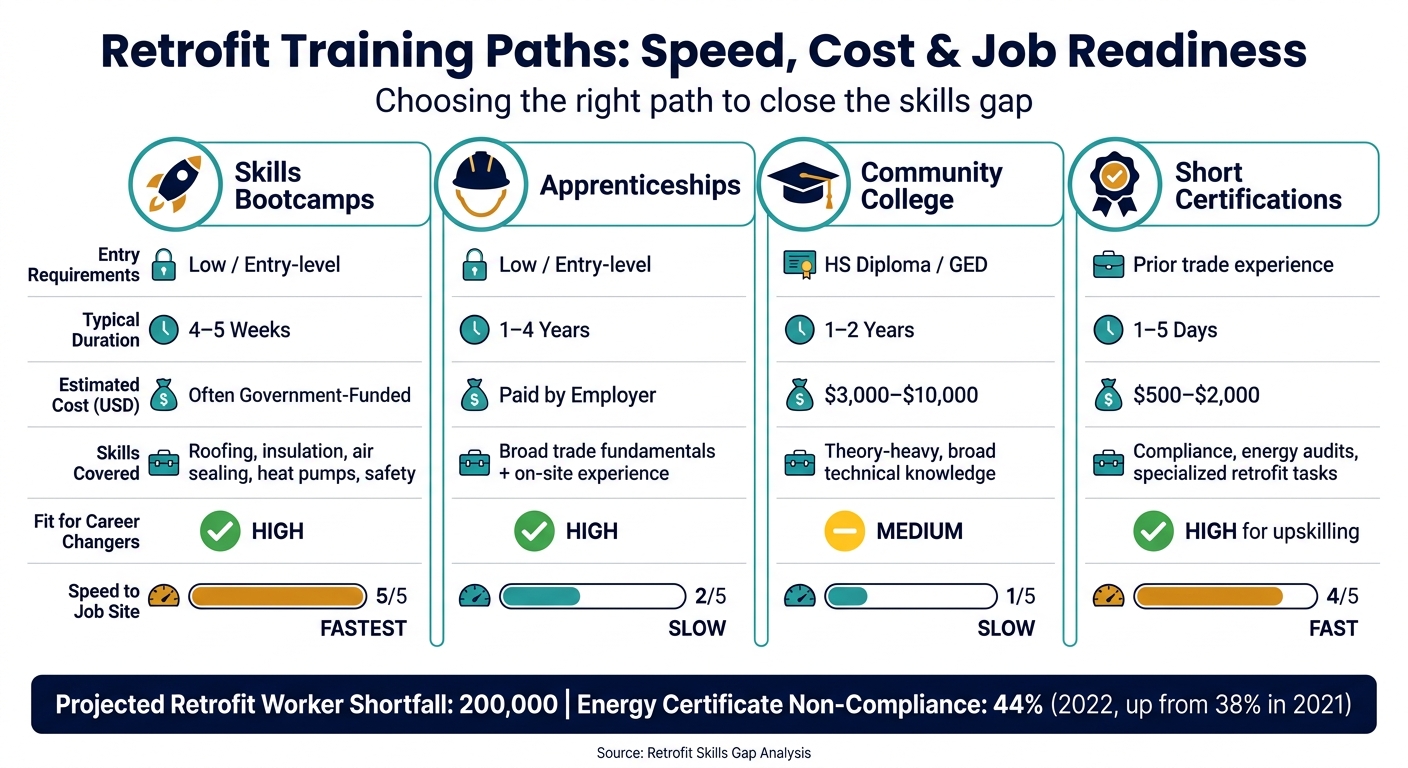
Retrofit Training Paths Compared: Speed, Cost & Job Readiness
Build a training pipeline that turns out site-ready workers, not just people with certificates.
Build Stackable Training Paths Tied to Real Job Scopes
A practical way to do this is to split training into short, step-by-step modules that workers can finish without leaving paid work for months. Start with a 4–5 week intensive that covers weatherization basics, insulation, roofing, air sealing, and job site safety. After a worker gets some field time, add more focused modules like heat pump installation, digital controls, or commissioning support across envelope, HVAC, electrical, and controls work.
This setup helps employers build crew skills in stages. It makes training easier to manage. But training alone doesn’t fix deployment.
Use Apprenticeships and On-the-Job Learning to Lower Hiring Risk
Apprenticeships cut the risk of hiring people who haven’t yet proved themselves on site. Pair each trainee with an experienced lead, set clear skill milestones, and track progress against those marks. The trainee gets paid while learning, and the employer shapes that worker to the company’s standards.
In late 2024, Durkan partnered with the Build East branch of the Skills Centre, L&Q, Bauder, and London Felt to run a five-week roofing and retrofit bootcamp. Several participants secured immediate placements with Bauder and London Felt after finishing, which shows that short, structured, employer-led programs can move people from training into productive work fast.
"Skills bootcamps provide onsite, targeted training with tight timescales. They also open up opportunities for career progression and an offer of wage certainty." – Kevin O’Connor, Head of Social Value Delivery, Durkan
Training Options for Retrofit Employers and Workers: A Side-by-Side Look
These paths differ in speed, cost, and depth:
| Training Type | Entry Requirements | Typical Duration | Est. Cost (USD) | Skills Covered | Fit for Workers Changing Trades |
|---|---|---|---|---|---|
| Skills Bootcamps | Low/Entry-level | 4–5 weeks | Often government-funded | Roofing, insulation, air sealing, heat pumps, safety | High – fast track to job-ready placement |
| Apprenticeships | Low/Entry-level | 1–4 years | Paid by employer | Broad trade fundamentals + on-site experience | High – earn while you learn |
| Community College | HS diploma/GED | 1–2 years | $3,000–$10,000 | Theory-heavy, broad technical knowledge | Medium – can be too slow for immediate needs |
| Short Certifications | Prior trade experience | 1–5 days | $500–$2,000 | Compliance, energy audits, specialized retrofit tasks | High for upskilling existing workers |
No single format fits every case. Bootcamps are the fastest route for getting new workers onto a job site. Apprenticeships build deeper trade skill over time. Short certifications help experienced tradespeople close specific technical gaps as they move into higher-value retrofit scopes. Once workers are trained, the next choke point is getting the right people onto the right job without delay.
How Technology Helps Get Retrofit Workers on Site Faster
Training builds capability. Technology helps turn that into work on the ground, so the right people can get to the right site without getting stuck in admin work.
Use Workforce Data to Match Skills to Project Needs
Manual staffing is not only slow. It also leads to poor matches between credentials and the actual work.
Once workers have the right training, the next step is simple in theory but messy in practice: get the right person onto the right job fast. Digital workforce tools help do that by matching verified skills to job scope. They use skill checks and task-based assessments to confirm job readiness, not just paper qualifications. They can also support workers onsite with short guides and walkthroughs, which helps them make better decisions in the field.
For retrofit projects, that means workers can be matched to site-specific tasks while their safety training, availability, and location are tracked at the same time.
Where ABLEMKR Fits in Retrofit Workforce Deployment
This is where mobile workforce platforms start to matter. They take verified skills and turn them into active crews.
ABLEMKR’s mobile-first platform matches prequalified workers to job sites based on certifications, safety training, availability, and geolocation. That helps retrofit employers get crews moving fast. For project managers running crews across several sites, ABLEMKR gives real-time visibility into worker availability and status, payroll workflows that connect into the process, and built-in compliance tracking. Workers also get a clearer view of open jobs and guaranteed on-time payments, which helps cut down on turnover friction.
Manual Staffing vs. Digital Workforce Deployment: A Direct Comparison
| Factor | Manual Staffing | Digital Deployment (ABLEMKR) |
|---|---|---|
| Speed of Mobilization | Slow; depends on fragmented networks and manual verification | Fast; prequalified worker pools and geolocation matching reduce lead time |
| Compliance Tracking | Harder to manage across crews and job sites | Built-in compliance tracking with real-time status updates |
| Worker Verification | Based mainly on paper credentials; higher risk of placing someone who is not ready | Competency and certification data matched to specific project scopes |
| Admin Workload | Heavy; coordination and data gathering consume time | Automated workflows reduce paperwork and keep managers focused on execution |
| Data Visibility | Limited; hard to track availability and coverage across distributed sites | Real-time visibility into worker availability and status across projects |
| Remote and multi-site U.S. projects | Inconsistent; local labor access varies by region | Strong fit for U.S. cities and energy corridors, including remote sites |
Conclusion: A Practical Plan to Solve the Retrofit Skills Gap
Meeting retrofit demand means closing the gap between paper credentials and site-ready skills. With a projected shortfall of 200,000 workers, the retrofit skills gap is an urgent business problem. The labor pool is out there, but the skill mix often doesn’t match what jobs need. That’s the part employers need to fix.
The first move is simple: hire for capability, not just certification. In plain English, don’t stop at what’s listed on a card or resume. Build hiring and training around verified competence, not credentials alone.
Once you know what capability looks like for each role, the next job is to train people into those roles fast.
The Next Steps Employers and Workforce Leaders Should Take
Start by defining the competencies your projects actually require, not just the licenses workers hold. A worker may have the right paperwork and still not be ready for the job in front of them. That’s why role clarity matters so much.
From there, build short, role-specific training paths tied to exact job scopes. Pay workers during training so they can upskill without giving up income. That one detail can make all the difference. Short-format bootcamps can move workers into active roles fast.
After training, deployment speed often becomes the bottleneck. Standardize how you verify skills and safety credentials before workers go out to a site. Then use workforce deployment technology where fast mobilization and compliance visibility matter most. For retrofit employers, ABLEMKR can help match pre-vetted workers to job sites and keep compliance visible in real time.
Targeted training, paid on-the-job learning, and faster deployment tools help close the gap. Target the skills, train for the job, and get workers on site faster.
FAQs
What skills matter most in retrofit hiring?
Retrofit hiring centers on a mix of building science know-how and hands-on technical skill. Employers want people who understand how HVAC, insulation, and building envelopes work together to control moisture and improve energy use.
The skill set is pretty specific. Teams often look for workers who can install cold-climate heat pumps, high-performance insulation, and zero-energy home systems. Digital skills matter too, especially with tools like energy modeling, Building Information Modeling, and data analytics.
And it’s not just about the technical side. Communication matters too, especially for roles that involve working directly with clients.
How can employers verify real job readiness?
Employers can check job readiness by looking past formal qualifications and focusing on how people perform on site. That means comparing team skills with industry benchmarks and reviewing project results to spot gaps that resumes alone can miss.
Hands-on training on the job is one of the best ways to see whether workers can use technical knowledge where it counts: in day-to-day work. It turns theory into proof.
Platforms like ABLEMKR can help by tracking certifications, safety training, and verified skill growth in real time.
What training path gets workers onsite fastest?
Skills bootcamps and immersive tools like virtual reality are often the fastest way to get people job-ready. Bootcamps focus on the exact skills a role calls for and can deliver that training in as little as four to five weeks. That means workers can start contributing much sooner.
Immersive learning adds another layer. It gives trainees a chance to practice in lifelike settings instead of just hearing about the work in a classroom. In many cases, that can shorten training time and help people feel more confident when it’s time to do the job for real. ABLEMKR supports this process by tracking critical certifications and qualifications.


