
Oil and gas retention usually comes down to four things: pay, schedules, career paths, and field logistics. When those break down, people leave. And in this industry, turnover is expensive: replacing one worker can cost 33% to 200% of annual pay, while remote FIFO roles can see turnover near 25%.
If I had to sum up the fix in plain terms, it would be this:
- Pay people at local market rates
- Make rotations predictable
- Show workers what the next job step looks like
- Get housing, travel, credentials, and payroll right every time
- Track turnover, overtime, and incident trends by role and site
The article makes one point very clear: retention is not just an HR issue. It affects safety, downtime, crew stability, and project delivery. It also gets harder when nearly 50% of the workforce is over age 45, while only a small share of employers have a formal plan to keep older workers.
Here’s the short version of where pressure shows up most:
| Area | What drives people out | What tends to help |
|---|---|---|
| Remote and rotational field roles | Long shifts, travel strain, weak time-off predictability | Stable rotations, buffer travel days, clean site planning |
| Specialized technical jobs | Hard-to-find skills, high replacement cost | Better pay, stronger career paths, mentor support |
| Early-career workers | Poor role visibility, limited growth | Clear promotion steps, cert paths, supervisor check-ins |
| Remote assignments | Bad housing, travel issues, missing credentials, pay errors | Pre-trip planning, compliance tracking, mobile-first hiring and payroll |
So if you want the short answer, it’s this: workers stay longer when the job feels worth the pay and easier to live with. The rest of the article explains how to make that happen in simple, direct ways.
How To Recruit, Retain, And Motivate Employees In The Fuel Industry
sbb-itb-aa28329
Why Turnover Stays High
Turnover in oil and gas often comes from the grind of day-to-day work: long shifts, remote travel, unstable rotations, and weak career paths. The main pressure points are fatigue, travel, and limited room to grow. These are job-design problems, not mysteries, which means companies can act on them directly.
Long Shifts, Fatigue, and Burnout
Many oilfield schedules are hard from the start. A lot of field workers put in 12-hour shifts for 14 to 28 straight days, with no weekends or holidays. That kind of schedule wears people down fast. And in oil and gas, fatigue is more than a morale issue. It increases the risk of major mistakes in places where one bad call can turn deadly.
The bigger retention problem is often the lack of predictability. When overtime jumps with no warning or a rotation gets extended at the last minute, workers lose the one thing they were planning around: time at home. Study after study links shift work and job fatigue to higher turnover intention, worse sleep, and declining physical and mental health among front-line energy workers. Good pay helps, sure. But if someone can’t trust when they’ll be home, a steadier job starts to look like the better deal.
Remote Locations, Travel Burden, and Housing Gaps
Remote work makes it harder to recover, not easier. Getting to site can be draining before a shift even begins. Fly-in/fly-out (FIFO) and drive-in/drive-out (DIDO) setups mean workers spend a lot of time in transit, and that time comes straight out of rest and family life. Research on remote operations in oil, gas, and mining puts annual turnover rates around 25% for FIFO workers.
Housing matters too. If camp rooms, food service, or site amenities are poor, the strain piles up on top of an already tough schedule. On the other hand, companies that put money into high-quality remote housing have seen better morale, stronger productivity, and improved retention.
Limited Career Visibility for Early-Career Workers
When people can’t see what comes next, pay stops carrying the whole load. A 2023 EY survey found that only 26% of Gen Z respondents saw oil and gas jobs as appealing. Part of that comes down to image: the industry can seem unstable, dangerous, physically demanding, and vague about where a job might lead.
For newer workers already in the field, this issue feels much more concrete. If someone spends two or three years doing the same field work without mentorship, without a promotion track, and without a clear career path, it’s easy to start viewing the job as a stopgap. With nearly 50% of the oil and gas workforce over age 45, the sector is staring at a major retirement wave, and the next line of workers is thin. Keeping early-career workers on board is one of the clearest ways to protect the future labor force.
Solutions That Improve Retention
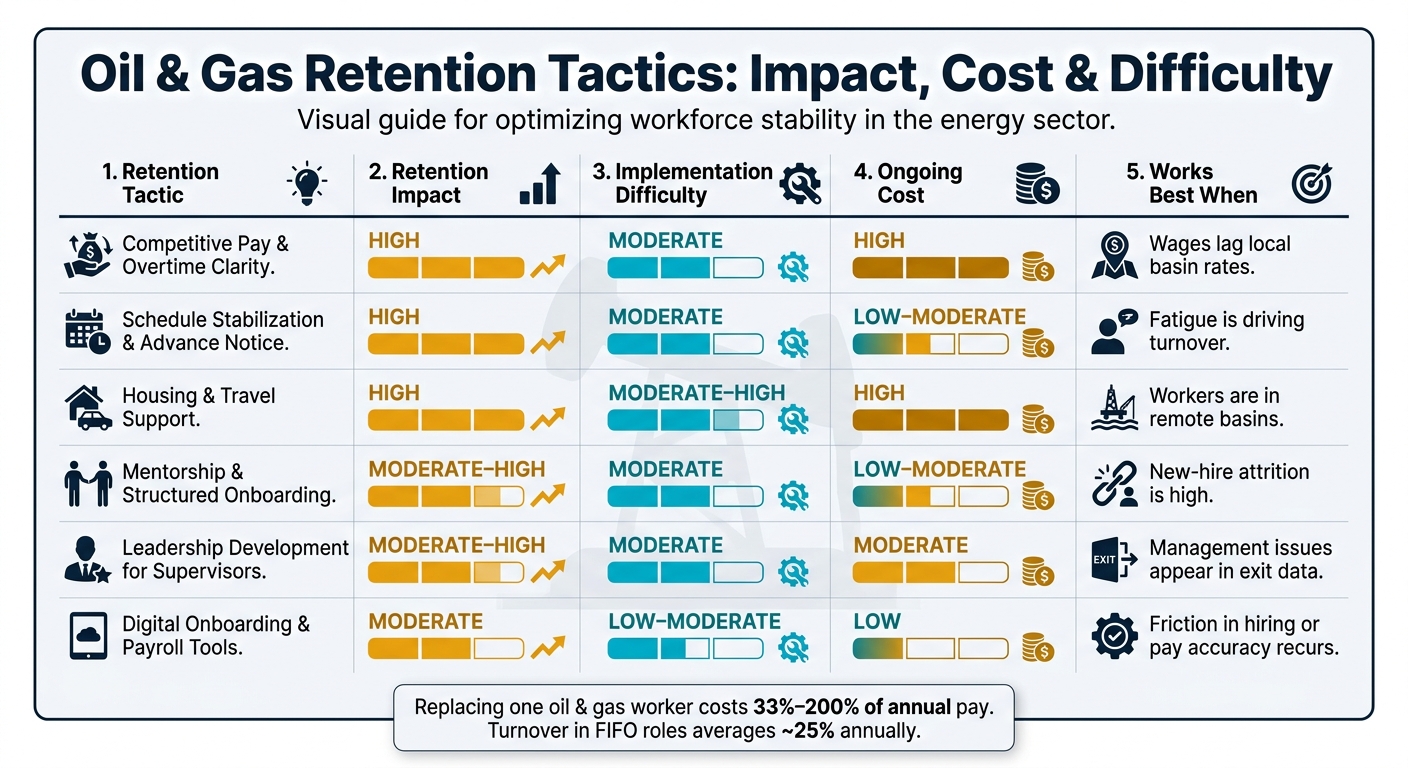
Oil & Gas Retention Tactics: Impact, Cost & Difficulty at a Glance
Retention works best when it runs like a system. Pay, scheduling, growth, and day-to-day job conditions need to line up. If one part breaks, people feel it fast.
That’s why retention fixes can’t live in silos. They need to deal with the same pressure points pushing people out: fatigue, travel strain, and limited visibility into what comes next.
Start With Competitive Pay and Benefits
Pay is the floor. If wages don’t stack up against other local options, workers won’t stay just because the team gets along or the company talks about growth.
For mid-level field technicians in active U.S. basins like the Permian or Bakken, competitive hourly rates usually land in the $32–$45/hour range, based on local market benchmarks and rival sectors such as construction and utilities. Overtime rules also need to be plain from day one. Offer letters should spell out time-and-a-half after 40 hours, double-time on designated holidays, and any other pay rules that affect take-home earnings. Pay stubs should be easy to read so workers can check the numbers without playing detective.
Travel support matters too. Per diem policies should match actual field costs, with daily per diem in the $75–$125 range depending on the basin, plus company-paid lodging and either mileage reimbursement or paid travel days for long mobilizations. On top of that, health plans with low deductibles, disability insurance, family coverage options, a 401(k) with employer match, and annual or project-completion bonuses send a clear message that the company is thinking past the next hitch.
Once pay is in line, scheduling becomes the next big pressure point.
Cut Burnout With Better Scheduling and Time-Off Planning
What most workers want isn’t a perfect schedule. It’s a schedule they can count on.
Publishing 14/14, 21/21, or 28/28 rotations at least one cycle ahead gives crews a fair shot at planning life outside work. That can mean family events, doctor appointments, or just knowing when they’ll be home. When changes happen at the last minute, they shouldn’t be treated like no big deal. Those changes should need manager approval, go into a tracking log, and come with some form of compensation if they cut into rest time or family plans.
Research backs this up. One study found that moving from a rapid-swing pattern to a longer-swing pattern lowered perceived fatigue among rotation workers. There are also some plain, practical moves that help right away: require at least 7 days off after multiple straight weeks of 12-hour shifts, and add buffer travel days before departure and after return for long-distance commuters. Those steps ease the wear and tear without leaving operations uncovered.
Build Loyalty Through Career Paths, Mentorship, and Leadership
Early-career workers are more likely to stay when they can see where the job leads. Not in vague terms. In plain terms.
That starts with onboarding that does more than cover safety rules. New hires need a clear view of performance expectations, short-term growth options, and what the next role actually involves. Certification pathways help too. When workers can see which credentials are required, how long each step should take, and how those steps connect to field roles, the path feels real instead of fuzzy.
Mentorship also matters more than a lot of companies think. Formal mentorship during the first 6–12 months, along with regular one-on-one check-ins from supervisors, shows up again and again in retention research as a strong practice. Supervisor quality plays a big role here. Training managers in psychological safety, feedback, and team management can shape whether people stick around or start looking elsewhere.
Lateral mobility helps as well. Companies that let workers move into HSE, maintenance, or planning roles give them a way to stay with the business through commodity swings instead of leaving when field demand changes.
Even with strong policies on paper, retention can still slip if remote assignments create daily friction.
Retention Tactics Compared: Impact, Difficulty, and Cost
| Tactic | Retention Impact | Implementation Difficulty | Ongoing Cost | Works Best When |
|---|---|---|---|---|
| Competitive pay & overtime clarity | High | Moderate | High | Wages lag local basin rates |
| Schedule stabilization & advance notice | High | Moderate | Low–Moderate | Fatigue is driving turnover |
| Housing & travel support | High | Moderate–High | High | Workers are in remote basins |
| Mentorship & structured onboarding | Moderate–High | Moderate | Low–Moderate | New-hire attrition is high |
| Leadership development for supervisors | Moderate–High | Moderate | Moderate | Management issues appear in exit data |
| Digital onboarding & payroll tools | Moderate | Low–Moderate | Low | Friction in hiring or pay accuracy recurs |
The next step is removing the logistical friction that slows remote assignments.
Operational Systems That Reduce Worker Friction
Retention isn’t just about pay or scheduling. It also comes down to a simple question: does the job feel organized when workers show up, or does it feel like a mess?
People notice when the basics fall apart. Housing isn’t set up. Credentials aren’t cleared. Payroll shows up late. Those problems send a loud message, and workers start looking for employers that run a tighter ship. In many cases, the biggest drag on retention starts with logistics that burn worker time before the job even begins.
Plan Housing, Travel, and Site Readiness for Remote Assignments
For remote assignments, crew housing should be booked near the site and travel should be locked in before mobilization. When housing or travel breaks down, workers read that as poor planning, and they’re more likely to leave early. Companies that set up housing close to the site help workers get steady rest between shifts.
Just as important, site access credentials, gate passes, and reporting instructions need to be cleared before anyone gets on the road. Sending a worker to a remote site and then turning them away on day one because a badge wasn’t ready is the kind of mistake people don’t forget.
The mobilization packet should be treated like a standard handoff, not a nice extra. That packet should include:
- Housing details
- Travel itinerary
- Check-in contacts
When workers arrive prepared and settled, they’re much more likely to finish the rotation and return for the next one.
Use Compliance Tracking and Worker Status Visibility to Prevent Delays
Missing or expired certifications can wipe out hours, stall the job, and create serious safety risk. If a worker travels to a site and gets turned away, there’s a good chance that worker won’t come back. An expired H2S cert or TWIC card means the mobilization failed. It wastes time and chips away at trust fast.
A centralized compliance system helps avoid that by keeping real-time status on each worker’s certifications in one place, including issue dates, expiration dates, and renewal needs, while flagging gaps before the assignment is approved. A pre-arrival clearance check also helps. Supervisors can confirm who is cleared to report and who still needs documents, which turns a day-one surprise into something handled ahead of time.
Speed Up Staffing, Onboarding, and Payroll With Mobile-First Tools
Digital tools cut friction by keeping staffing, onboarding, and payroll inside one workflow. Slow hiring and stacks of paper tell workers the rest of the job will probably run the same way. In a market where skilled oilfield workers have options, that first impression can cost an employer the candidate before shift one even starts.
ABLEMKR is a mobile-first platform built for remote, high-risk work. It matches pre-vetted workers to job sites based on certification, safety training, availability, and location. Employers get real-time visibility into worker status, payroll workflows tied into the same system, and built-in compliance tracking. Workers get clear job details and on-time pay.
Conclusion: A Practical Retention Plan for Oil and Gas
Retention in oil and gas is a system problem. Pay, schedules, travel, and career visibility all shape whether workers stay.
That means the answer isn’t one policy tweak. Good pay gets people in the door, but workable schedules help them last. Clear career paths give early-career workers a reason to stick around. And when housing and travel support are handled well, remote rotations feel doable instead of draining. The main point is simple: pay, scheduling, growth, and logistics need to work together as one retention system.
Day-to-day execution matters just as much. Missed certifications, messy onboarding, or late payroll can push people out in a hurry. Staffing speed, compliance visibility, and smooth deployment workflows don’t just affect operations on paper. They shape whether workers want to come back for the next rotation.
The practical move is to build retention into project planning from the start, not scramble after someone quits. That includes:
- benchmarking pay on a regular basis
- building structured time off into rotation schedules
- defining clear career ladders
- running clean logistics for each remote deployment
- tracking turnover, overtime, and incidents by site and role to catch pressure early
When those parts line up, retention turns into a performance edge. It helps safety, uptime, and project delivery because experienced workers stay on site longer.
FAQs
What is the biggest driver of turnover in oil and gas?
Pay is the main reason people leave jobs in oil and gas. When skilled workers can get higher wages or better benefits somewhere else, many of them do.
Other factors matter too. Some workers hit a wall when it comes to career growth. Others deal with a workplace culture that feels unsupported or hard to navigate. Unpredictable schedules also wear people down, especially in roles tied to remote sites and high-risk conditions.
If companies want to keep good people, they need to focus on a few core areas: competitive pay, clear career paths, and a work environment where people feel backed up.
How can companies improve retention in remote field roles?
Companies can keep people in remote field roles longer when they get the basics right: good pay, a clear path forward, and a work culture that doesn’t ignore the hard parts of isolated work.
That matters because remote field jobs can wear people down fast. Long stretches away from home, limited social contact, and tough site conditions all add pressure. So it’s not just about salary. It’s also about making the job feel stable and worth staying in.
A few things tend to help:
- Competitive pay that matches the demands of the role
- Clear growth paths, so workers can see what comes next
- Predictable rotation schedules that make family life easier to plan
- Strong on-site logistics, including housing, travel, and day-to-day support
- Wellness programs that help reduce stress
Burnout is another big issue. Companies should keep a close eye on warning signs like too much overtime and poor work-life balance. If those problems build up, turnover usually follows.
Tools like ABLEMKR can help with retention by supporting on-time pay, compliance, and better worker-to-project matching. That can make day-to-day operations smoother for both crews and employers.
What metrics should employers track to catch retention problems early?
Track workforce data that may point to disengagement or possible turnover, such as:
- absenteeism patterns, tardiness, and spikes in sick leave
- declining productivity, disciplinary actions, or incomplete safety certifications
- time since last promotion, low training participation, or reduced team involvement
It also helps to watch for refusal of overtime, withdrawal from company activities, and delays in pay or raises. Those issues can be strong drivers of turnover.


