
Clean energy already supports about 3.6 million U.S. jobs, and many entry-level roles do not need a four-year degree. If I want to get into renewable energy systems, the shortest path is usually this: pick one job target, choose hands-on training that fits it, earn OSHA safety training, and keep my records ready for hiring.
Here’s the article in plain English:
- Solar is often the easiest starting point if I come from construction or roofing.
- Wind fits people with mechanical or maintenance experience and comfort working at height.
- Battery storage (BESS) and smart grid roles fit best if I have electrical, controls, utility, or industrial maintenance experience.
- I can train through a community college, a short certificate, an online course, or an apprenticeship-style path.
- For many field jobs, employers want OSHA 10 or OSHA 30 and may look for NABCEP credentials for solar work.
- For grid and storage work, I should add training in SCADA, communications, battery safety, lockout/tagout, and code topics.
- After training, I need a simple digital folder with certificates, safety cards, issue dates, and expiration dates.
A few numbers stand out:
- Clean energy added 142,000 jobs in 2023
- Transmission, distribution, and storage already employ 1.4+ million workers
- Short certificate programs can cost around $1,000–$2,500
- Community college programs often run about $6,000–$15,000 total in-state
Accredited Renewable Energy Solutions Course: The Renewable Energy Institute

Quick Comparison
| Path | Best fit | Time | Usual starting point |
|---|---|---|---|
| Solar PV | Construction, roofing, entry-level trade workers | 1–3 months + job training | Certificate + OSHA + NABCEP track |
| Wind | Mechanical, maintenance, field service | About 2 years | Tech program or associate degree |
| BESS | Electrical, utility, industrial maintenance | Varies | Electrical training + storage-specific courses |
| Smart Grid | Electrical, controls, utility systems | Varies, often up to 2 years | Utility/power tech training + communications basics |
The main takeaway: I should start with the job I want – not the course I happen to find first. That cuts wasted time, lowers training costs, and makes it easier to get hired.
Pick the Renewable Energy Role You Want to Train For
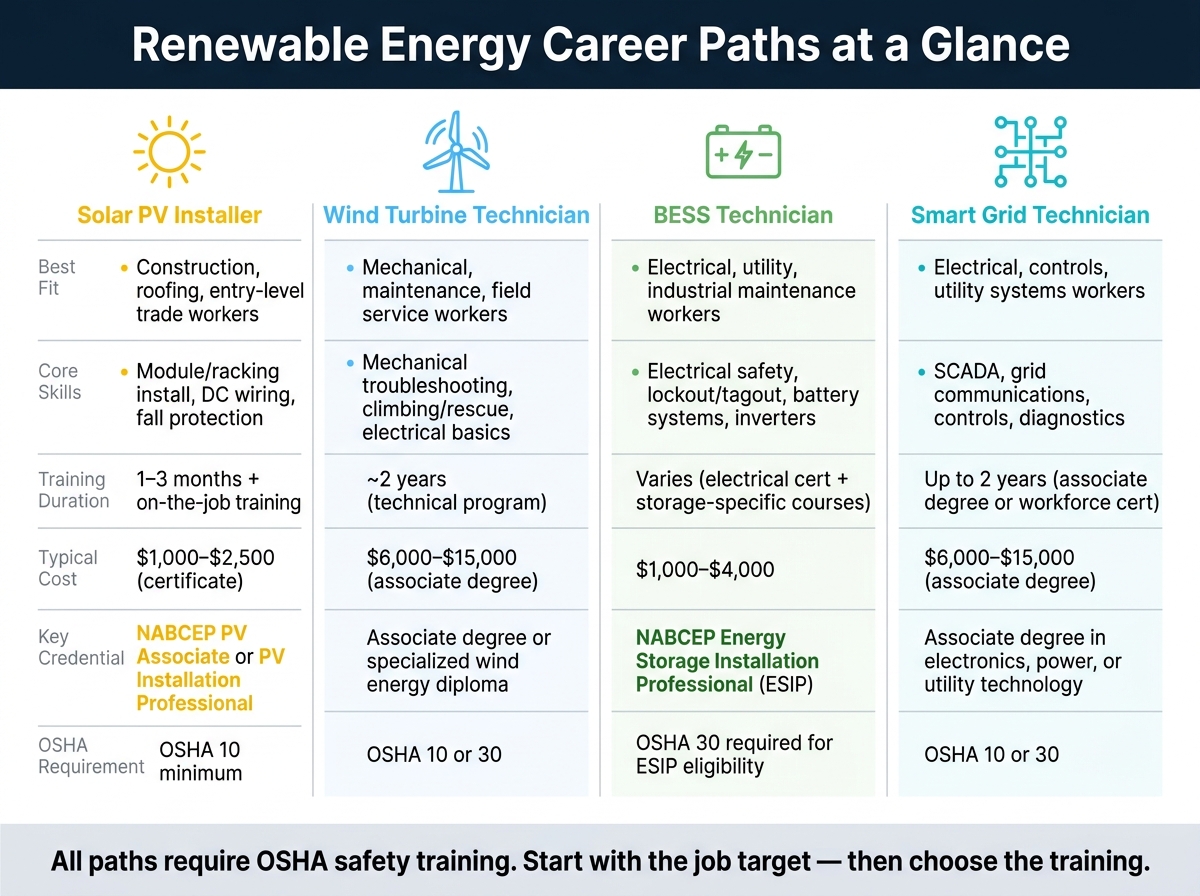
Renewable Energy Career Paths: Training, Cost & Timeline Comparison
Choosing your target role before you enroll can save you time, money, and a lot of frustration. Solar PV installers, wind turbine technicians, BESS technicians, and smart grid technicians do different kinds of work, so they need different training paths. The simplest way to avoid ending up in the wrong program is this: start with the job, then pick the training that fits it.
| Role | Core Technical Skills | Typical Training Duration | Typical Credential Path |
|---|---|---|---|
| Solar PV Installer | Module and racking installation, DC wiring basics, reading simple plans, tool safety, fall protection | Short certificate program plus up to 1 year of on-the-job training | NABCEP PV Associate or PV Installation Professional |
| Wind Turbine Technician | Mechanical troubleshooting, electrical basics, climbing and rescue readiness, torqueing and fastening | About a 2-year technical program plus employer on-the-job training | Associate degree or specialized diploma in wind energy or a related field |
| BESS Technician | Electrical safety, battery system familiarity, lockout/tagout awareness, inverter and power electronics basics, diagnostics | Electrical or utility-focused certificate plus system-specific training | NABCEP Energy Storage Installation Professional (ESIP) |
| Smart Grid Technician | Electrical fundamentals, controls awareness, communication-network basics, troubleshooting, meter or sensor familiarity, grid-connected systems | About a 2-year associate degree or workforce certificate | Associate degree in electronics, power technology, or utility technology |
Match Your Background to Solar, Wind, BESS, or Smart Grid Work
Your past work can point you toward the right lane.
If you’ve worked in construction or roofing, solar PV installation often makes sense. The job leans on roof work, plan reading, and everyday construction tools. If your background is in electrical work or industrial maintenance, BESS and smart grid roles may fit better because those jobs rely more on troubleshooting, controls, and electrical systems. Mechanical or maintenance experience also transfers well to wind turbine work, where techs service equipment at height and often deal with changing weather.
No experience yet? Start with entry-level solar training or a pre-apprenticeship program. That’s often the easiest way in.
Learn the Core Skills Employers Expect on Energy Job Sites
No matter which path you choose, employers tend to look for the same base skills first. That usually includes:
- Basic math
- Electrical fundamentals
- Mechanical aptitude
- Reading technical plans
- Safe tool use
- Comfort working outdoors or at height
From there, each role has its own focus. Solar leans more toward installation and commissioning. Wind puts more weight on inspection and mechanical repair. BESS work centers on energized battery systems. Smart grid roles deal more with diagnostics and utility communications.
Safety training matters a lot in this field. OSHA training is often required or strongly preferred because these jobs can involve electrical hazards, fall risks, heavy equipment, and shifting weather conditions. In some cases, that requirement is spelled out in the credential rules. For example, the NABCEP Energy Storage Installation Professional (ESIP) credential requires OSHA 30-hour construction outreach training, along with 58 hours of advanced PV training, as part of eligibility.
That’s why it makes sense to line up safety credentials before you enroll.
Next, compare training programs that teach these skills directly.
Choose a U.S. Training Path That Fits Your Budget and Schedule
Once you know which job you’re after, pick the training format that lines up with that goal. Field roles usually call for hands-on programs. Grid and storage roles often lean more toward online study. The key is to match the job to the training path that gets you ready to work without wasting time or money.
| Pathway Type | Typical Duration | Approximate Cost (USD) | Hands-On Training |
|---|---|---|---|
| Community college associate degree in renewable energy or electrical technology | 2 years | $6,000–$15,000 total (in-state) | Extensive – labs, solar arrays, and electrical panels |
| Workforce certificate (often NABCEP-aligned) | 1–3 months | $1,000–$2,500 plus exam fees of $125–$180 | Focused labs – PV system assembly, inverter setup, wiring tasks |
| Online smart grid / BESS course | 2 days to 3 months | $500–$4,000 depending on depth | Mostly simulations, case studies, and virtual labs |
Enroll in a Community College or Workforce Certificate Program
A community college program makes a lot of sense if you’re new to the trades or want a broad base before you narrow your focus. A one-year certificate usually blends hands-on labs with job-specific skills. A two-year associate degree in electrical or renewable energy technology goes deeper into electrical theory, electronics, and safety, along with solar and basic grid topics.
Aid can help bring down what you pay out of pocket. That can include federal financial aid, state grants, and workforce scholarships. If you already have construction or electrical experience, a shorter workforce certificate may be the faster and lower-cost option. These programs often help prepare you for NABCEP-related entry work.
Use Online Courses for Smart Grid and Battery Storage Basics
Online and blended courses work well for people who already have a job and need to add skills without stepping away from a paycheck. If you’re aiming for smart grid or BESS roles, these courses can help you learn grid architecture, communication protocols, battery system operation, and storage integration on your own time.
That said, online courses tend to be heavy on theory and light on equipment practice. So they’re often a better fit for engineers, technicians, or supervisors who already know their way around field work. If you don’t have that background yet, online-only training should be paired with lab time or field practice.
Check Accreditation, Curriculum, and Hands-On Practice Before Enrolling
Before you spend a dollar, check three things: who backs the program, what it teaches, and whether you’ll work with actual equipment.
For clean energy training, IREC accreditation is one of the clearest signs that a program meets a solid bar. The Interstate Renewable Energy Council has accredited more than 200 programs across the country, and its review looks at curriculum depth, instructor qualifications, assessment methods, and quality management systems. IREC’s analysis of exemplary solar programs found instructional hours ranging from 420 to over 1,000. That’s a good reminder that serious training usually goes far beyond a weekend class.
If you’re looking at solar training, check whether the program is a NABCEP Associate Registered Training Provider or clearly says it aligns with NABCEP standards. It’s also smart to confirm whether OSHA 10 or OSHA 30 is part of the program.
Once those boxes are checked, the next step is looking at the certifications employers want most.
sbb-itb-aa28329
Earn the Certifications and Safety Credentials Field Work Requires
Once you’ve picked a training path, the next move is simple: turn that training into credentials an employer can check on the spot. In solar field work, the easiest credentials to verify are NABCEP solar certifications and OSHA construction safety training. The table below helps match each path to the kind of role you want.
| Credential | Target Audience | Typical Training Hours | Exam Required | Job-Site Value |
|---|---|---|---|---|
| NABCEP PV Associate (PVA) | Entry-level installers, technicians, sales staff | ~40 hours | Yes – PV Associate exam (passing scaled score: 65) | Baseline solar credential that signals foundational PV knowledge |
| NABCEP PV Installation Professional (PVIP) | Lead installers, designers, project managers | 58 hours of prescribed advanced PV training | Yes – board certification exam | Advanced credential widely regarded as the gold standard for PV professionals |
| OSHA 10-Hour Construction | Front-line workers on solar, wind, and BESS sites | 10 hours | No | Baseline safety training often expected before site access on utility-scale projects |
| OSHA 30-Hour Construction | Supervisors, foremen, safety leads | 30 hours | No | Common for leadership and compliance roles |
Complete NABCEP-Aligned Solar Training and Exam Preparation
For solar workers, certification gives your training something concrete: a credential employers can verify fast. If you’re aiming for entry-level solar work, start with the NABCEP PV Associate (PVA). It covers PV basics, safety, and codes. If you’re targeting lead installer or designer work, the NABCEP PV Installation Professional (PVIP) is the advanced credential tied to lead PV roles.
For the PV Associate, NABCEP recommends about 40 hours of instruction from a Registered Associate Training Provider whose course covers the PV Job Task Analysis (JTA). That matters because the JTA lays out the knowledge areas on the exam. Before you enroll, compare the course syllabus against that outline. It’s a small step, but it can save you time and money later. After meeting the eligibility rules, candidates register for the PV Associate exam and need a scaled score of 65 to pass. To keep the credential active, Certified Associates must complete 12 hours of continuing education every 3 years.
The PVIP route asks for more planning. Candidates need at least 58 hours of prescribed advanced PV training, including minimum hours in the National Electrical Code (NEC), PVIP JTA content, building and fire codes, and renewable energy electives. Associate-level coursework usually does not count toward those advanced hours, so don’t assume your first class will carry over. Map the sequence out before you commit.
When it’s time to apply, NABCEP requires records of your course titles, provider names, dates, total hours, and topic breakdowns. Employers often want to see the same paperwork. In plain English: keep your records organized from day one.
Add OSHA 10 or OSHA 30 Based on Your Work Environment
OSHA cards are often the fastest way to get cleared for an active job site. In most cases, OSHA 10 fits field workers, while OSHA 30 fits supervisors and safety leads.
OSHA 10-Hour Construction is the usual starting point for front-line workers on solar, wind, and BESS sites. It covers fall protection, electrical hazards, PPE, and general site safety across 10 instructional hours. On utility-scale sites, workers are often expected to have it before work starts.
OSHA 30-Hour Construction is built for supervisors, foremen, safety coordinators, and anyone directing crews or enforcing a safety plan. It goes further than OSHA 10, adding hazard analysis, incident response, and crew supervision. If you’re moving toward leadership on a large solar array, wind farm, or battery storage project, OSHA 30 is often expected and, in some cases, written into the contract.
One detail that trips people up: OSHA 10 is not a prerequisite for OSHA 30. If your goal is a supervisory role from the start, you can go straight to OSHA 30. Either way, keep your OSHA card and completion certificate easy to access, because many contractors only send workers to site when their safety credentials are current and simple to verify.
Build Skills in Smart Grid and Advanced Energy Systems
Smart grid and BESS skills take solar and wind training a step further. They open the door to utility work, plant operations, and commissioning. And with aging infrastructure plus more distributed energy resources on the grid, employers need people who can monitor and control smart inverters, batteries, and grid communications.
If you’re aiming for utility, plant, or commissioning roles, smart grid and storage training is a smart next step.
Learn Smart Grid Operations, Automation, and Grid Communications
Start with the core systems behind grid control: smart grid architecture, AMI, DMS, EMS, PMUs, SCADA, and distribution automation. From there, move into grid communications, including IEC 61850, DNP3, and Modbus over fiber, microwave, cellular, or private LTE.
Why does this matter? Because utility and EPC jobs depend on these systems every day. Field devices talk through those protocols. So if you can read communication network diagrams, configure intelligent electronic devices (IEDs), and troubleshoot a failed link between a substation and a control center, you stand out. Those skills are hard to find.
Utilities also want people with basic OT cybersecurity awareness. That includes role-based access control, secure remote access, and NERC CIP compliance basics. Put together, these skills can lead to utility, SCADA, and field-communications roles.
Look for training that includes:
- Control-room simulation
- Field networking
- Device troubleshooting
Once you understand grid control, storage is the next logical move. The same communication and protection skills show up there too.
Train on Battery Energy Storage Systems and Renewable Integration
BESS now sits at the center of how many solar and wind projects are built and run across the U.S. If you understand how storage connects with generation and distribution systems, you’re in a better spot for long-term work on renewable projects.
Start with the basics: battery chemistries, SOC, SOH, DoD, cycle life, efficiency, and degradation. Then move into safety and code topics like thermal runaway, fire suppression, ventilation, gas detection, emergency response, and NFPA 855 plus local fire code requirements. You should also cover DC hazards, arc-flash risk, and lockout/tagout.
After that, learn how BESS ties in at the interconnection point, how power conversion systems manage AC/DC conversion, and how storage helps with frequency regulation, voltage support, and peak shaving. On the job, practical commissioning skills matter a lot – functional checks, communication point verification, and protection settings all map directly to roles such as BESS field technician, renewable plant operator, and energy storage commissioning specialist.
The table below maps the main advanced topics to course formats, background requirements, and related roles.
| Advanced Topic | Typical Course Format | Recommended Background | Related Career Path |
|---|---|---|---|
| Smart grid operations and control-room systems | Community college certificate, utility academy module | Entry-level electrician, lineworker, or power technology certificate | SCADA technician, distribution system operator |
| Distribution automation and protection | Vendor/manufacturer in-person training, utility academy | Experienced technician with electrical background | Substation technician, grid automation field engineer |
| Grid communications and OT cybersecurity | Online professional course, vendor training | Basic IP networking familiarity and technician experience | SCADA field technician, protection and controls engineer |
| DER and smart inverter integration | Online course, community college module | Electrical foundation, solar or wind field experience | DER integration specialist, distribution system technician |
| BESS safety and integration | Online course, manufacturer training, community college module | Entry-level electrician or renewable technician | BESS field technician, renewable plant operator |
| BESS commissioning and operations | Manufacturer in-person training, utility academy | BESS fundamentals and electrical safety training | Energy storage commissioning specialist |
When you compare programs, don’t just skim the course title. Check whether the curriculum covers NFPA 855 and local fire codes, includes scenario-based safety drills, addresses both DC and AC hazards, and leads to a verifiable certificate or completion record.
Vendor and manufacturer programs usually give you the best hands-on lab access to live BESS equipment. That’s a big deal when employers want proof that you can do the work, not just sit through class time.
Keep every course record. In this part of the industry, proof of training matters almost as much as the training itself.
Turn Your Training Records Into Renewable Energy Work
Finishing training is only part of the process. You also need to make your credentials easy to find, verify, and use when a project team has to fill a role fast. In hiring, speed matters. Employers often move first on candidates whose records are already in order.
After you finish training, gather your proof before you apply anywhere. Put your documents into a digital credential folder with PDFs or clear photos of your certifications, safety cards, course records, and work history. It also helps to keep a simple tracking sheet with:
- Credential name
- Issuing organization
- Issue date
- Expiration date
- Job type
Use clear file names so you can search them fast. And keep your current cards with you for site access.
OSHA documentation guidance says a training record should include your name, course title, date, provider, and ID number. Double-check that nothing is missing. Then set reminders 60 and 30 days before anything expires so you can renew it before a project kicks off.
NABCEP’s Associate Directory gives employers a quick way to verify your credential status. If that information is up to date, onboarding and compliance checks tend to move with less friction.
The table below shows which credentials line up with common project types and how verified records help hiring teams move faster.
| Credential Type | Typical Projects | How Verified Records Help |
|---|---|---|
| NABCEP board certification | Solar installation, commissioning, O&M | Helps verify advanced qualifications. |
| NABCEP Associate credential | Entry-level solar roles, supervised installation, sales, maintenance | Gives employers a fast way to confirm baseline knowledge and credential status. |
| OSHA 10 / OSHA 30 | Construction, solar farms, wind sites, utility and infrastructure projects | Shows safety readiness and supports site-access requirements. |
| Wind turbine technician certificate | Onshore wind farms, turbine maintenance, blade inspections | Confirms training for turbine-specific work, including climbs and rescue procedures. |
| BESS and high-voltage training | Battery storage plants, substations, renewable integration | Supports safe work near high-voltage equipment and energy storage systems. |
| Smart grid / SCADA coursework | Grid modernization, substation automation, control centers | Shows systems knowledge for advanced grid and utility projects. |
| General training records | Solar, wind, BESS, smart grid support roles | Proves practical preparation and speeds onboarding. |
Once your records are organized, the next move is getting in front of active jobs. ABLEMKR matches pre-vetted workers to energy, utility, and infrastructure projects across the U.S. based on certifications, safety training, availability, and geo-location. Workers with complete, verified profiles tend to move through onboarding faster, especially for last-minute shutdowns or time-sensitive deployments.
Conclusion: Choose Your Path, Complete Recognized Training, and Stay Ready to Deploy
The goal is simple: prove your training fast and stay ready to deploy. Choose a target role, match it to the right training, earn recognized certifications and safety credentials, and add smart grid or BESS skills where the job calls for them. Keep every record current, keep your profile complete, and be ready to move when the next project opens up.
FAQs
Which renewable energy path best fits my background?
The best renewable energy path depends on your background and where you want your career to go. If you’ve worked in electrical systems, construction, or power utilities, you may have a clear route into roles like solar installation, wind turbine maintenance, or smart grid engineering.
The same goes for people with project management or engineering experience. You may line up well with work in grid modernization, energy storage design, or clean energy project management. In many cases, transferable skills give you a head start, and certifications or training programs can help you build the rest.
Do I need a degree to start in renewable energy?
No. You don’t always need a degree to get started in renewable energy.
A bachelor’s degree is often expected for senior engineering or management roles. But many entry-level jobs, like solar installation, are open to people who come in through hands-on training, apprenticeships, or trade school certificate programs.
You can also build your way into the field with certifications like OSHA 10 or 30 and industry-specific credentials such as NABCEP.
Which certifications should I get first?
If you’re new to renewable energy, start with OSHA 10-hour or 30-hour Construction Safety and Health training. It’s often needed to get on-site, and many other credentials build on it.
At the same time, learn the basics of electrical theory through an apprenticeship or trade program. That gives you the groundwork you’ll need once the job gets more hands-on.
If you’re aiming for solar or energy storage roles, start with associate-level credentials. Skip advanced certifications like ESIP for now. Those are geared toward people who already have more time in the field.


