
Renewable energy sites are still high-risk job sites. If I had to boil this down fast, I’d say the biggest issues are falls, electrical shock, heat stress, dropped objects, vehicle traffic, severe weather, and fatigue – and each one changes who should be on site, what training they need, and when work should stop.
Here’s the short version:
- Falls remain one of the deadliest construction risks, with 389 of 1,034 construction deaths in 2024 tied to falls.
- Electrical work on solar, wind, and battery sites can involve live DC/AC systems, stored energy, and arc-flash risk.
- Heat often climbs fast on open job sites, especially when the heat index moves past 80°F.
- Dropped objects and vehicle traffic put both field crews and support staff at risk.
- Severe weather can stop tower work, lifts, and site access with little warning.
- Fatigue increases mistakes during climbing, driving, switching, and troubleshooting.
What stands out to me is simple: safe staffing is part of safe work. You can’t send just anyone to every task. You need the right people, current training, clear site rules, and daily checks for things like weather, heat, and rest.
Quick Comparison
| Hazard | Main Risk | Who It Hits Most | What I’d Check First |
|---|---|---|---|
| Falls | Work at height | Wind techs, solar installers, riggers | Fall training, rescue coverage, tie-off plan |
| Electrical Shock | Live circuits and stored energy | Electricians, techs, commissioning crews | Qualifications, LOTO status, boundaries |
| Heat Stress | Sun, hot surfaces, hard labor | New hires, outdoor crews, supervisors | Water, rest cycles, acclimatization |
| Dropped Objects | Tools or parts falling from above | Tower crews and workers below | Tool tethering, exclusion zones, spotters |
| Vehicle Traffic | Trucks, forklifts, heavy equipment | Ground crews, flaggers, operators | Traffic control, routes, backing zones |
| Severe Weather | Lightning, wind, hail, flooding | Wind and solar field crews | Stop-work triggers, shelter, restart rules |
| Fatigue | Long shifts, travel, repetitive work | Techs, operators, supervisors | Hours worked, commute time, task fit |
If I were using this as a field guide, I’d treat it as a plain reminder: match the task to the worker, verify training before dispatch, and adjust the crew plan when site risk changes.
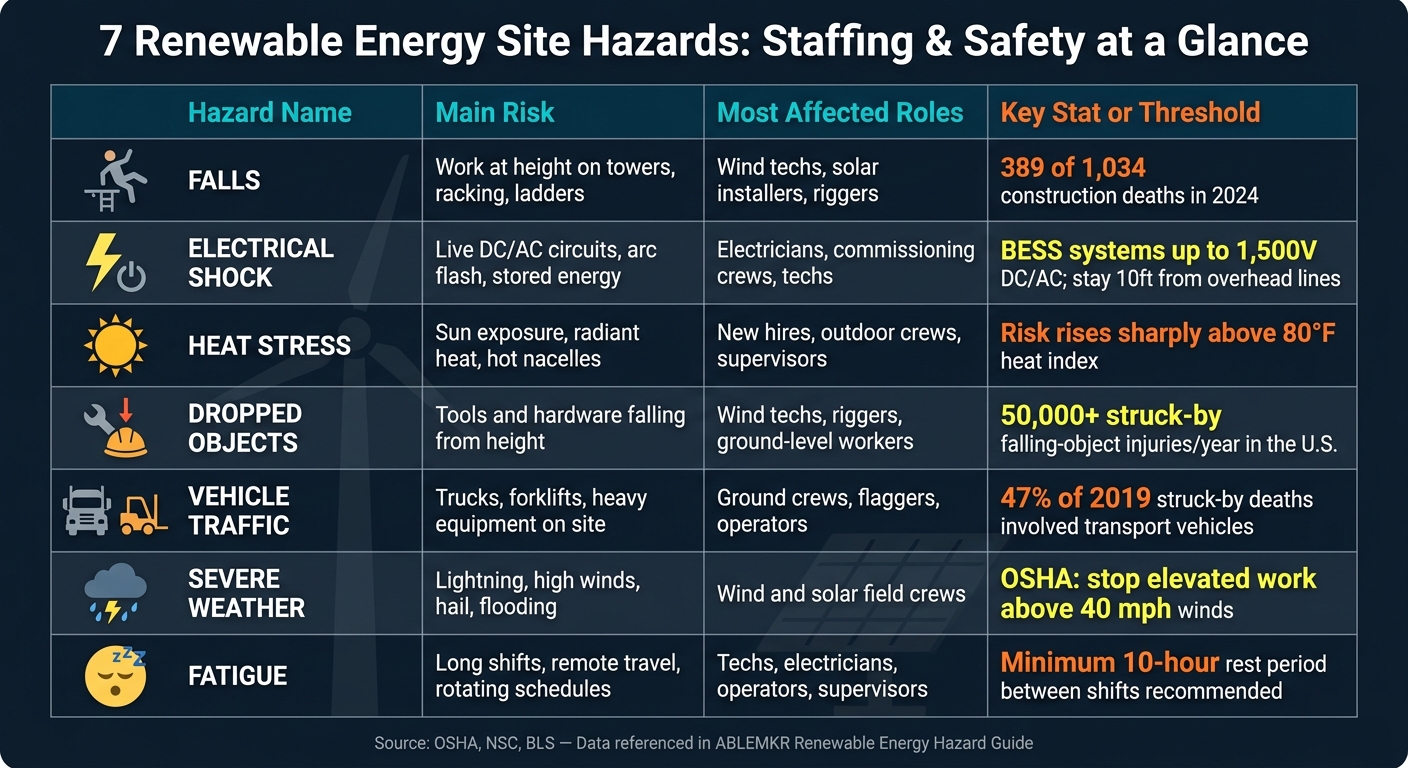
7 Renewable Energy Site Hazards: Risks, Roles & Training at a Glance
Common Safety Risks on Utility-Scale Solar Sites | During Construction Vs. After Construction
sbb-itb-aa28329
Why Hazard Planning Matters for Renewable Energy Staffing
Hazard planning affects staffing long before anyone steps onto the site. It shapes who you hire, how fast crews can move, and what training they need before work begins.
That has a direct effect on hiring, dispatch, and pre-job prep.
For example, fall protection rules kick in at 6 feet or more. That means crews need current fall-arrest training, rescue skills, and an on-site competent person.
Electrical work adds another layer. Those tasks need qualified workers with NFPA 70E training. Heat stress and fatigue can force staggered shifts and backup crews. Traffic exposure and dropped-object risk mean flaggers, spotters, riggers, and operators should be part of the crew plan from day one. Stop-work authority should also be built into onboarding, not treated like an afterthought.
The hard part is checking all of this before mobilization. Someone has to confirm that OSHA cards are current, fall-protection training is still active, and site-specific orientations are done. A mobile-first system like ABLEMKR can store certifications, track expiration dates, and flag missing documents before dispatch.
When the hazard profile shifts, staffing plans have to shift with it. Crew mix, supervision, and training all need to change too. The seven hazards below show how.
1. Falls
Fall risk shapes the crew plan from the start. It decides who can climb, who needs to supervise, and how rescue is handled.
Falls are one of the biggest hazards on renewable job sites. In 2024, 389 of 1,034 construction fatalities came from falls. That makes fall prevention a staffing and training issue, not just a box to check for safety.
Primary Exposure
Wind crews climb 200- to 300-foot towers using fixed ladders, platforms, and open hatches. Solar crews usually work at 4 to 10 feet around racking, modules, and staging areas. BESS and substation crews deal with edges, trenches, pads, and platforms during construction.
Those height differences change the whole crew setup. They affect crew mix, rescue planning, and how much supervision each work area needs.
Most Affected Roles
Wind climbers, rope-access crews, and rigging teams face the most exposure. Wind jobs need climbers who are trained for rescue, not just ascent.
On solar sites, installers and electricians face the most risk while working on racking, modules, and lifts. That means solar crews need people who know how to use ladders and lifts the right way. BESS, substation, and civil crews also need fall protection when they’re working near open edges and excavations.
Staffing Impact
At 6 feet and above, each elevation zone needs trained climbers, rescue coverage, and a competent person. That puts a hard cap on how many work fronts can run at the same time.
More elevation zones mean:
- More competent persons
- More rescue coverage
- Fewer simultaneous work fronts
Wind tower work is often staffed with at least two tower-rescue-trained technicians, which can tighten scheduling when one person is out or unavailable.
Training Focus
A harness doesn’t do much if the worker isn’t tied off the right way. That’s the simple truth.
Good programs cover:
- Harness inspection
- Anchor point selection
- Proper tie-off
- Rescue-from-height drills
Wind sites need tower-climbing and rescue scenarios that match the job. Solar training should focus on safe ladder use, safe lift use, and moving carefully on racking and modules. JSAs and toolbox talks should call out the day’s exact fall exposures, not just give a generic warning.
Those requirements should be built into dispatch before crews mobilize.
2. Electrical Shock
If falls shape access, shock shapes isolation. Before any energized work starts, crews need the right qualifications in place.
Electrical shock is easy to miss until it’s not. A combiner box, a damaged cable, or a live solar array can energize part of the site without much warning.
Primary Exposure
Where workers face exposure depends on the site. Solar arrays produce DC power anytime modules are in the light, even if they’re disconnected from the grid. So string inverters, combiner boxes, and conductors may stay live all day.
Wind sites bring a different set of exposure points, including nacelle wiring, turbine switchgear, control cabinets, transformers, and backup battery/UPS systems. Battery energy storage systems (BESS) can operate at up to 1,500 V DC/AC, which adds serious shock and arc-flash risk. Temporary power systems, temporary wiring, and damaged insulation can also increase exposure across the site.
Most Affected Roles
Electricians, installers, technicians, commissioning crews, and maintenance workers face the most exposure. That said, civil crews and general labor crews still need the same site boundaries and onboarding. If people don’t know where the danger starts, that’s when small mistakes turn into big ones.
Staffing Impact
Only assign electrical work to workers with documented OSHA and site-specific qualifications. If a qualified worker isn’t available, pause the task until a qualified replacement is on site.
Shift handoffs can also create problems. If the handoff on isolation status is weak, the next crew may start work assuming a system is de-energized when it isn’t. Staffing plans should cover more than the day’s output goals. They also need backup coverage during commissioning windows, lockout/tagout holds, and emergency response.
Training Focus
Training should match the site:
- Solar crews need training on module covering and lockout/tagout.
- Wind crews need training on turbine de-energization.
- BESS crews need training on stored-energy and high-voltage procedures.
Across all site types, crews should also be trained on minimum approach distances, including staying at least 10 feet from overhead power lines, using insulated tools, and following a clear stop-work process when labeling or isolation status is unclear.
Once electrical work is under control, the next staffing pressure is heat.
3. Heat Stress
Heat is a constant pressure on renewable job sites. These sites are often wide open, with little to no shade and full sun for most of the day. On solar farms, panels and gravel ballast throw off extra radiant heat. In wind, technicians deal with tower climbs, hot nacelles with limited ventilation, and non-breathable PPE that adds even more body heat.
When the heat index gets above about 80°F, the risk goes up fast, especially during hard physical work. That changes more than comfort. It affects crew schedules, task pacing, and how fast new workers can move into full-duty roles.
Primary Exposure
Solar crews often spend long stretches in direct sun. Wind crews face a different mix: tower climbs, enclosed nacelle work, poor airflow, and PPE that traps heat.
Most Affected Roles
New hires and workers coming back after time away face the highest risk because they have not acclimatized.
Staffing Impact
Acclimatization puts limits on how many people can safely work full shifts in summer conditions. So staffing plans need to phase in new hires, rotate the hottest tasks, and assign a heat safety lead. In plain terms, heat training is also a scheduling issue, not just a safety topic.
Training Focus
Training should cover the basics early and often:
- How to spot heat exhaustion and heat stroke
- Why workers need to hydrate before they feel bad
- Why symptoms must be reported right away
- How supervisors should track heat index or WBGT
- When to enforce work/rest cycles
- When to trigger emergency response
Once heat is addressed, the next risk is overhead.
4. Dropped Objects
Dropped objects force a site to control three things at once: who is working overhead, who is below, and when the area is clear. That matters a lot on renewable energy sites, where overhead work is part of the day-to-day job. On solar sites, crews handle tools and hardware on racking systems and elevated inverter platforms. And once an item slips from someone’s hand at height – a wrench, a socket, even a loose bolt – it turns into a serious hazard fast.
In the U.S., more than 50,000 struck-by falling-object injuries are reported each year, or about one every 10 minutes. In 2019, falling objects made up 27% of struck-by fatalities in construction.
Primary Exposure
The highest-risk tasks include tower climbs, nacelle work, rigging operations, and elevated cable tray installation. It doesn’t take a big item to hurt someone below. Small tools and loose hardware can do plenty of damage. A 2014 IMCA safety flash documented a ratchet and two sockets falling about 50 feet from a technician’s work pouch and landing near a crew member on a vessel deck below.
Most Affected Roles
Wind turbine technicians, rope access workers, and crane rigging crews face the most exposure because they work at height with lots of small tools in tight spaces. But the risk doesn’t stop with the crew up top. Ground-level workers – such as supervisors, inspectors, and logistics staff – can also get hit when they pass through areas below active overhead work without proper exclusion zones.
Staffing Impact
This hazard affects both the people above and the people below, so staffing has to cover the whole drop zone. That usually means having dedicated spotters to control exclusion zones during overhead work, plus certified rigging and working-at-height personnel who know tool tethering inside and out.
Sites also often stagger shifts so tower-top work happens when ground-level activity is low. That helps, but it can make crew scheduling more of a juggling act. Staffing plans also need backup coverage for spotter and exclusion-zone lead roles.
Training Focus
Training should be hands-on and tied to the actual site. Workers need to know how to pick the right tool lanyards, use them the right way, inspect tethering gear before each climb, and set up proper exclusion zones below overhead work. Buddy checks before descent also matter. They help crews clear loose items from pockets and pouches before someone heads down.
Even when dropped-object controls are in place, crews still have to deal with moving equipment and haul routes at ground level.
5. Vehicle Traffic
Vehicle traffic is a constant hazard on renewable energy sites. Trucks, heavy equipment, and workers often share the same tight routes. In 2019, struck-by injuries killed 170 construction workers in the U.S., and 47% of those deaths involved transport vehicles.
Primary Exposure
The risk is highest during active construction. Delivery trucks, cranes, forklifts, and telehandlers move through busy work zones and internal site roads while crews are also on foot. That makes traffic control a day-to-day safety issue. It affects how many ground workers can be on site at one time and which routes can stay open.
The most common incidents are easy to picture: a worker gets hit by a reversing truck, equipment swings through a turn, or two vehicles collide near a site entrance. Laydown yards and staging areas can be just as risky, especially when space is tight and movement stacks up.
Staffing Impact
This has a direct effect on crew planning. Sites need trained flaggers and spotters in backing zones, loading areas, and road crossings. When delivery volume climbs or access routes shift, backup coverage also needs to be in place.
The roles most affected include:
- Ground crews
- Flaggers
- Equipment operators
- Supervisors
Each of those roles needs job-specific training and certification, and those checks should happen before dispatch. ABLEMKR can dispatch pre-vetted workers with traffic-control and flagger certifications.
Training Focus
Training should stay focused on the moments when things go wrong fast: backing hazards, blind spots, site entrances, and stop-work triggers when drivers lose sight of the path. Workers on foot should stick to designated walkways, stay clear of blind spots, and never assume a driver sees them.
Spotter and flagger training should cover:
- Standard hand signals
- Radio protocols
- Clear stop-operation rules
Use daily toolbox talks to go over deliveries, route changes, and exclusion zones.
Poor visibility and slick access roads make traffic control even harder when weather turns.
6. Severe Weather
Renewable energy sites often sit out in the open – on ridgelines, plains, and other spots with little cover. That means lightning, high winds, hail, flooding, snow, ice, and dust storms can shut work down in a hurry. So weather planning isn’t just a field safety issue. It’s a staffing issue too.
Primary Exposure
Wind crews face the most weather risk because they work at height, where lightning and strong gusts become far more dangerous. On solar farms, hail, high winds, and flash flooding can damage panels and racking. After a storm, crews may also face broken glass, sharp metal edges, and damaged equipment, which makes inspection and repair work more hazardous.
Wind thresholds should be treated as clear stop-work triggers for elevated tasks and material handling. OSHA considers winds above 40 mph hazardous for elevated work, and 30 mph when material handling is involved.
Staffing Impact
Storm stand-downs can change staffing plans fast. Lost time may force overtime, longer shifts, or extra personnel to get work back on track. And that’s where trouble starts. Fatigue goes up, judgment slips, and people may cut corners around fall protection or electrical safety.
Remote sites make this harder. If roads flood, ice over, or become tough to see, crews may not be able to leave the site safely. That’s why teams need to define shelter capacity, evacuation routes, and minimum staffing levels before storm season starts.
Training Focus
Crews should know the exact weather triggers used on site, including wind limits, lightning stand-down rules, and shelter locations. Stop work at the first thunder, and keep crews sheltered for 30 minutes after the last thunder or lightning before resuming work.
Training should also cover post-storm damage checks and spell out who has the authority to clear the site for restart. Before forecasted storms, short toolbox talks can help reset expectations and keep everyone on the same page.
Those weather delays can also push fatigue risk higher on the next shift.
7. Fatigue
Fatigue tends to show up the same way weather trouble and overtime pressure do: quietly. It’s easy to miss. But tired workers are more likely to make mistakes during climbing, electrical work, and equipment operation. And unlike some jobsite risks, there’s no clear visual warning.
Primary Exposure
On renewable sites, the main fatigue drivers are long hours, irregular shifts, and hard physical labor. Wind turbine technicians may travel long distances to a remote site and then climb a tower that same day. Solar crews often start before dawn and repeat the same installation tasks for hours in hot, exposed conditions. Battery and substation teams may work overnight or outage-based schedules with very little recovery time between shifts. NSC-cited surveys show that fatigue risk factors are common and often linked to incidents.
Most Affected Roles
The highest fatigue risk falls on technicians, electricians, equipment operators, riggers, material handlers, and supervisors. The risk gets worse when they rotate between day and night shifts or work long hours during commissioning and outage windows. Supervisors face a serious problem here because fatigue can dull judgment, and they’re the ones making go/no-go calls on high-risk work.
Staffing Impact
Fatigue affects crew size, rotation length, and shift coverage. Long commutes and fly-in/fly-out schedules also eat into recovery time between shifts. OSHA recommends reviewing staffing, work hours, rest breaks, and sleep opportunities as part of any fatigue plan.
Training Focus
Workers should learn how to spot common fatigue signs, including:
- heavy eyelids
- slowed thinking
- poor balance
- irritability
- microsleeps
They also need to report those signs early. Supervisors should be trained to pull tired workers from climbing or switching tasks and move them into lower-risk work until they recover. NIOSH offers training on shift work and long work hours for both workers and managers, and that material can be adapted for wind, solar, and utility crews.
The table below condenses these hazards into a quick staffing and training reference.
Hazard Comparison Table
Use this table as a fast reference for staffing and training decisions.
| Hazard | Primary Exposure | Most Affected Roles | Staffing Impact | Training Focus |
|---|---|---|---|---|
| Falls | Elevated work on turbine towers, rooftop solar, and ladders | Wind technicians, solar installers, riggers | Limit the number of workers at height at the same time; require rescue-trained personnel and closer supervision | Harness and fall arrest systems, anchor point selection, rescue drills |
| Electrical Shock | Live circuits, inverters, transformers, and switchgear on DC and AC systems | Electricians, wind technicians, solar installers | Assign only qualified workers to energized areas; verify lockout/tagout before work starts | Arc flash awareness, lockout/tagout procedures, which tasks only qualified workers can perform |
| Heat Stress | Prolonged outdoor work in hot, open-field work areas | Solar installers, laborers, operators, supervisors | Rotate crews to reduce individual workload; move heavy tasks to cooler morning hours | Heat illness symptoms, hydration, acclimatization, work-rest cycles |
| Dropped Objects | Tools and hardware falling during tower climbs and lifting operations | Wind technicians, riggers, laborers below | Set exclusion zones; move ground crews away from drop zones during overhead work | Tool tethering, exclusion zone enforcement, communication between workers above and below |
| Vehicle Traffic | Access roads, haul trucks, forklifts, and heavy equipment on active sites | Operators, laborers, supervisors | Add spotters at entry points; restrict traffic in active lift zones; verify certifications before dispatch | Spotter methods, radio communication, blind spot awareness, pedestrian routes |
| Severe Weather | Lightning, high winds, and sudden storms on open-field and elevated sites | Wind technicians, solar installers, field supervisors | Stop tower climbs at site wind limits; plan contingency crews to recover lost time safely | Weather alert interpretation, lightning and wind thresholds, crane shutdown procedures |
| Fatigue | Long shifts, rotating schedules, remote travel, and repetitive physical labor | Wind technicians, electricians, operators, supervisors | Review shift length and rotation schedules; use local workers to cut commute time | Fatigue sign recognition, reporting without stigma, supervisor protocols for reassigning tired workers |
Two hazard pairings tend to change staffing plans the most: heat plus fatigue and wind plus falls.
Heat can slow reaction time and increase near-miss risk on summer solar builds. Wind can shut down tower work and move crews to ground-level tasks until conditions improve. That’s the point where dispatch planning can make or break the day.
ABLEMKR helps on that front by matching pre-vetted workers to sites based on verified certifications, safety training, availability, and location.
Training and Crew Readiness Steps
Turn the hazard list into a daily dispatch checklist.
Begin with a structured pre-job orientation for each new project phase. Walk through the site layout, emergency contacts, muster points, PPE, access rules, and the hazards for that day. Make stop-work authority plain and direct so anyone on the crew can pause the job when conditions turn unsafe. That matters in moments like lightning, high winds, or worker fatigue. It shifts hazard awareness from a box to check into part of the day’s go/no-go call.
Before any high-risk work starts, complete a documented JHA that lists the task, hazard, risk level, control, and owner. Include controls for falls, electrical exposure, lift zones, traffic, weather, and fatigue. Then use the JHA to line up roles, controls, and certifications before anyone begins work. In plain terms: the right task should go to the right person, with the right safeguards in place.
Dispatch should clear crews only when credentials are current. That means checking what is current before dispatch, not just confirming that records exist somewhere in a file. A practical setup uses digital records, expiration alerts, and role-based task matching so only qualified workers get sent to the site. ABLEMKR can track expiration dates and match pre-vetted workers to assignments by certification, training, and location.
Check fatigue and heat every day, not just during onboarding. Before assigning high-risk tasks, supervisors should review shift length, commute time, and signs of fatigue or impairment. Many fatigue programs use a minimum 10-hour rest period between shifts as a baseline. It also helps to schedule the hardest tasks during cooler hours, add water and rest breaks, rotate crews, and keep newer workers in lower-risk roles with direct supervision.
Conclusion
These seven hazards are predictable. That means teams can plan for them, staff around them, and control them before someone gets hurt.
The pattern is hard to miss: these risks show up again and again, and they can be prevented when crews are trained, qualified, and properly supervised for the job.
So staffing isn’t just an office function. It’s a safety control. Safer job sites depend on matching crew size, supervision, certifications, and daily briefings to the risk level on-site. Training and communication matter just as much as equipment, because many incidents come back to preventable human error.
That matters most at dispatch, where qualification gaps can stop a crew before it ever reaches the site. Platforms like ABLEMKR can match pre-vetted workers to assignments based on certification, safety training, availability, and location.
Renewable sites run safely when the crew, the training, and the site rules fit the job’s risk profile before the first lift, climb, or energized connection.
FAQs
Which hazard causes the most staffing changes on renewable sites?
Falls drive more staffing changes on renewable sites than anything else. They’re the top cause of fatalities in the sector, making up 80% of deaths from 2012 to 2016.
Because of that, teams often reassign crew members and tighten fall-protection training for anyone working at height.
When should work stop because of weather, heat, or fatigue?
Work must stop at once if the Job Safety Analysis (JSA) flags hazards and there’s no approved plan to control them safely. Site rules should also spell out when to stop operations during high winds, storms, or other unsafe conditions.
If weather, heat stress, or fatigue puts safety or compliance at risk, work needs to pause until conditions are safe again or a revised safety plan is approved.
What training should crews have before arriving on site?
Before arriving on site, crews should have current certifications and training for high-risk tasks, including:
- Fall protection
- Lockout/tagout
- Electrical safety under OSHA 29 CFR 1910.269 or NFPA 70E
- Confined space entry
- Emergency response
- Site-specific hazard identification
ABLEMKR helps by pre-verifying credentials, so project managers can confirm workers are qualified and compliant before deployment.


