
If I send crews before I verify training, I risk delays, site access problems, and more incidents. In 2024, solar supported 370,556 jobs and wind supported 131,874 jobs, with about 181,700 solar roles and 43,800 wind roles tied to installation and maintenance. That hiring pace makes one thing clear: general construction training is not enough for renewable jobs.
Here’s the short version:
- Wind gaps often show up in GWO status, work at heights, rescue drills, and remote-site onboarding
- Solar gaps often show up in electrical safety, lockout/tagout, arc-flash awareness, and commissioning work
- Across both, employers run into expired credentials, scattered records, and weak site orientation
- Those gaps lead to smaller ready-to-work crews, slower mobilization, audit trouble, and more risk on high-hazard tasks
- The fix is simple in concept: set role-based training rules before hiring, verify records before travel, and check hands-on readiness before dispatch
I’d boil the article down to this: safety readiness starts before mobilization. If I want fewer day-one surprises, I need one clear process for training checks, renewals, onboarding, and proof on file.
| Area | Main gap | What it affects |
|---|---|---|
| Wind | GWO lapses, rescue readiness, site access prep | Climbing work, rescue response, dispatch timing |
| Solar | NFPA 70E, LOTO, arc-flash, energized work prep | Commissioning, electrical tasks, crew assignment |
| Both | Expired certs, weak records, rushed orientation | Audits, owner requests, mobilization, site entry |
That’s the core message of the piece: training gaps are not just a safety problem. They’re a staffing and deployment problem too.
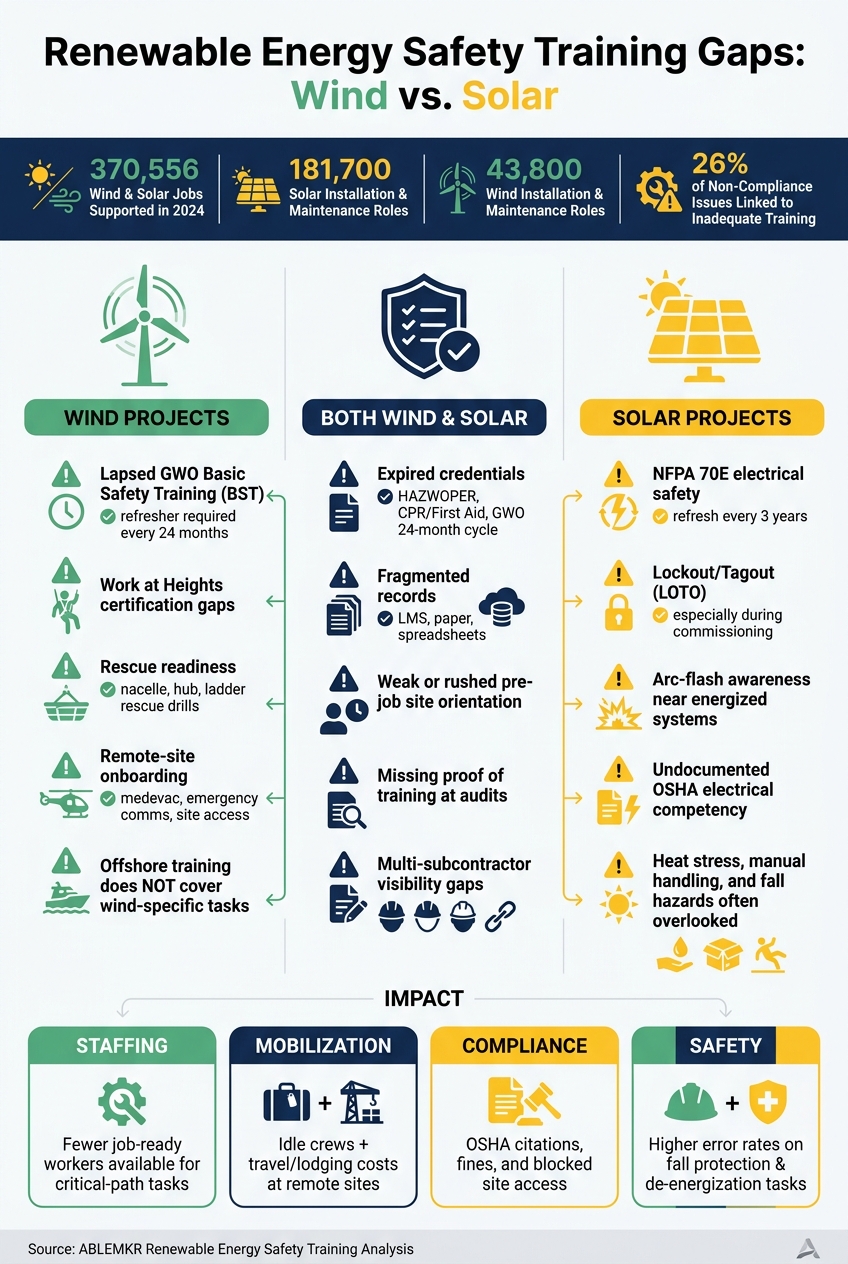
Wind vs. Solar Safety Training Gaps: Key Differences & Shared Risks
Inside Wind Turbine Safety Training | Iain Tindall
sbb-itb-aa28329
Where safety training gaps appear on wind and solar projects
Safety training gaps usually show up in the space between general construction training and the work crews actually do on wind and solar sites. A worker may be fine on a standard jobsite, then hit a wall once the work shifts to turbines, inverters, or commissioning tasks.
Wind projects: fall protection, rescue readiness, and remote-site onboarding
Wind work brings a different set of hazards than standard construction. Climbing a turbine tower, working inside a nacelle, and carrying out a rescue at height all call for training that goes far beyond a basic OSHA-10 course.
For most wind projects, Global Wind Organisation (GWO) Basic Safety Training (BST) is the baseline. It covers Working at Heights, Manual Handling, First Aid, Fire Awareness, and Sea Survival, with refreshers required every 24 months. One common problem is simple but costly: lapsed GWO credentials can stop mobilization cold. Workers coming from offshore or general construction often think their old training will carry over. In most cases, it won’t. Offshore training does not cover key wind tasks such as working at heights or manual handling.
Rescue readiness is another weak spot. Fall-arrest training is not the same as rescue training. If someone gets stranded in a nacelle, a hub, or on a ladder, the crew needs practiced communication plans, backup systems, and drills built for those exact situations.
Remote-site onboarding can also trip teams up. On wind farms far from major services, workers need to show up already briefed on emergency communications, medevac logistics, site access rules, and local hazards. If onboarding is weak, crews can end up unsure about site-specific access steps and what to do in an emergency.
Solar projects have a different risk profile, but the mobilization headache looks familiar.
Solar projects: electrical safety, lockout/tagout, and field hazards
On utility-scale solar sites, the most common gaps center on electrical safety, lockout/tagout (LOTO), and arc-flash awareness, especially where systems connect to the utility. Many crews still arrive without documented NFPA 70E or OSHA electrical competency.
LOTO becomes a sharp pain point during commissioning, when parts of the system may already be energized. A solar project can involve PV circuits, batteries, generators, and grid interconnections all at once. That means workers have to isolate every power source and verify de-energization before servicing begins.
And electrical risk isn’t the whole story. PV installation also brings heat stress, manual-handling strain, and fall hazards. So if training focuses only on electrical work, it leaves a big part of the field risk untouched.
Cross-project gaps: fragmented records, expired credentials, and weak pre-job orientation
Some of the toughest issues aren’t pure training gaps. They’re proof gaps. Across wind and solar, one of the most common problems is not a missing certification, but the inability to prove a worker’s credentials are current. Many employers still keep records spread across LMSs, paper sheets, certificates, and spreadsheets. When an inspector or project owner asks for documents on confined space, fall protection, or another topic, pulling everything together fast can become a scramble.
Expired credentials are another repeat issue. Annual renewals like HAZWOPER and CPR/First Aid, along with GWO’s 24-month cycle, turn expiration tracking into a dispatch problem. Add multiple subcontractors to the mix, and no single employer may have a full view of what’s current and what has lapsed. That gray area at dispatch can turn a training issue into a full-blown mobilization delay.
Pre-job orientation is the last backstop. A worker may hold valid general certifications and still miss the site-specific details that matter most: project hazards, emergency procedures, PPE rules, and reporting channels. Site-specific orientation must cover hazards, emergency procedures, PPE, and reporting channels. When that step gets skipped or rushed, the gap between what a worker knows and what the job demands stays open until something goes wrong.
How training gaps affect staffing, mobilization, and compliance
Once those gaps appear, staffing and compliance issues tend to show up fast.
Fewer job-ready workers and slower crew mobilization
If workers don’t have required training – such as fall protection under 29 CFR 1926.503 or lockout/tagout – they can’t be assigned to those tasks. That cuts down the number of people available for critical-path work on any given day. Supervisors are then forced to lean on a smaller group of fully trained crew members, or pause work until training is done.
The cost side can get ugly fast. Crews may sit idle while gaps are fixed, and remote projects can pile on thousands of dollars in travel and lodging costs. Contract milestones may slip. Missed deadlines can then trigger liquidated damages. One renewable-sector safety study found inadequate training in 26% of non-compliance issues.
Higher incident risk on high-hazard tasks
Training gaps don’t just slow work down. They also make the jobsite more dangerous.
When training is incomplete, error rates go up on high-hazard tasks like fall protection and de-energization. That’s a bad mix on any site, but it’s even tougher at remote wind and solar projects, where emergency response can take longer if crews lack rescue, first-aid, or site-specific emergency training. Recent incident data show how serious that risk is on construction sites.
Harder OSHA documentation and audit readiness
Bad or missing records create another problem: even if training happened, it may be hard to prove.
Under 29 CFR 1926.503, employers must keep written certification records for fall protection training that include the employee’s name, training dates, and the trainer’s signature. Other required training records bring the same paperwork load.
So when an OSHA inspector or project owner asks for proof during an audit, scattered records can turn a routine request into a fire drill. That can lead to citations, fines, and corrective actions. On large renewable projects, missing records can even block prequalification and site access before work starts.
That makes pre-mobilization verification the next critical step.
How employers can close training gaps before mobilization
Fixing training gaps after crews reach the site gets expensive fast. It also throws off schedules. The smarter move is to bake safety readiness into staffing before mobilization.
Build a role-based training matrix for each renewable project
A training matrix links each job role to the training, certifications, refresh cycles, and site hazards that role requires. Build it during project planning, not after hiring kicks off.
For wind roles, the matrix should include OSHA 10 or OSHA 30 Construction, GWO Basic Safety Training modules, and tower-specific rescue training. It should also track renewal dates. Employers can verify those records through the Global Wind Organisation’s WINDA database directly.
For solar and electrical roles, add NFPA 70E training, with refreshes every three years, along with lockout/tagout procedures for inverters, arrays, and balance-of-system equipment. Once the matrix is in place, share it with recruiting teams and subcontractor coordinators. That way, every job posting and subcontract agreement spells out those requirements clearly.
Use the matrix as the main dispatch filter. Then confirm hands-on readiness before anyone travels.
Run competency checks and pre-mobilization onboarding to catch gaps early
Paperwork alone doesn’t tell the whole story for high-risk roles. A certificate on file might look fine, but can the worker do the job safely on day one?
For wind tower rescue leads, that means checking current GWO Working at Heights and Advanced Rescue training, plus documented hands-on rescue drills, not just a saved certificate. For solar electricians working near energized systems, it means checking PPE selection, LOTO, and the project’s single-line diagrams.
A strong pre-mobilization process should also cover:
- Medical clearance
- Drug and alcohol testing
- Physical ability checks
- Site-specific orientation
- Digital acknowledgment before travel
Require workers to acknowledge site rules and emergency plans digitally before travel. That creates a clear record for OSHA and project owners, and it helps spot gaps before they turn into day-one disqualifications at a remote site.
Use ABLEMKR to match staffing with verified training and compliance status
When teams need that kind of visibility across many workers, ABLEMKR puts certifications, availability, and dispatch status in one place. The platform matches pre-vetted workers to renewable projects based on verified training and compliance requirements, flags expiring credentials before dispatch, and shows employers which workers are cleared for high-hazard tasks and which still have open items.
Conclusion: Build safety readiness into workforce planning
In renewable energy, training gaps tend to show up in the same places: wind rescue readiness, solar electrical safety, expired credentials, and weak site onboarding. That’s why the planning phase needs to spot those issues before anyone gets dispatched.
The fix starts early. Build role-based training requirements into project planning before hiring begins. But planning on paper won’t do the whole job. Crews still need pre-mobilization checks to make sure they’re ready to work, not just scheduled to show up.
Before mobilization, verify:
- training recency
- hands-on readiness
- site-specific orientation
When you’re staffing at scale, that only works if you have one system of record for staffing and compliance.
A connected workforce system makes that kind of visibility easier to manage. ABLEMKR keeps certification status, onboarding, and dispatch readiness in one place, so employers can close gaps before crews travel – and keep documentation audit-ready without scrambling. Safety readiness is workforce planning.
FAQs
What training is required for wind crews?
Wind crews need special training for turbine hazards. That includes documented GWO training, or an equivalent, for work at height.
Turbine nacelles and towers may also count as confined spaces. So crews need training in hazard identification, atmospheric testing, and emergency rescue.
For electrical work, crews should complete NFPA 70E training. Employers should also confirm current fall protection certification and fit-testing for any required PPE.
What safety training is most critical for solar work?
For solar projects, the first training that matters most is OSHA 10- or 30-hour safety training. That gives workers a base level of job-site safety before they ever set foot on a project.
From there, training should cover the risks crews run into every day, including:
- electrical safety
- fall protection
- proper tool use
- PPE inspection and use
Employers should also check for site-specific orientations and make sure training is current for high-risk tasks like confined space entry and lockout/tagout. That step can save a lot of trouble later.
ABLEMKR can help track credentials and confirm workers are properly trained before deployment.
How can employers verify training before mobilization?
Employers can check training and certifications before mobilization with digital, mobile-first platforms like ABLEMKR. Instead of chasing paperwork, they can review pre-vetted worker profiles that store and confirm credentials such as OSHA training, GWO certifications, and state-specific licenses in one place.
These platforms also show real-time readiness status, which makes staffing decisions a lot easier. And with alerts sent 60 and 30 days before a certification expires, teams have time to fix gaps before they turn into job-site problems. Some systems can even connect to access controls at the site, so only qualified workers are approved for deployment.


