
The short answer: U.S. building projects are slowing down because there aren’t enough workers with solar, storage, controls, code, and commissioning skills. I see the main pressure points in mid-level roles, apprentice-hour compliance, field safety, and digital controls.
If you’re hiring, managing projects, or trying to move into this work, here’s what matters most:
- 86% of solar employers report trouble filling jobs
- The industry could be short 53,000 workers by late 2026
- 53% of employers say missing experience, training, or technical skill is the top hiring problem
- Projects over 1 MWac need 15% of labor hours from qualified apprentices to keep full federal tax credit value
- Only 43% of the current U.S. solar workforce has access to the specialized training these jobs need
This means one thing: basic trade experience alone is not enough. You now need people who can handle energy modeling, solar PV, battery storage, microgrids, controls, permitting, inspections, safety rules, and job-site documentation.
Here’s the article in plain English:
- The biggest labor gap is not entry-level labor. It’s the people who connect design, install, commissioning, and handoff.
- Standard electrician or HVAC training often does not cover battery safety, interconnection rules, automated controls, or tax-credit labor tracking.
- The weakest skill areas show up in energy modeling, solar and storage permitting, code compliance, microgrids, digital controls, and lockout/tagout on retrofit sites.
- These gaps lead to rework, failed inspections, slower interconnection, schedule slips, and more worker risk.
- The best fixes are registered apprenticeships, targeted certifications, field pairing with experienced leads, and digital tracking for compliance and crew status.
I’d sum it up like this: the problem is not demand. The problem is getting enough trained people onto job sites with the right paperwork, the right safety knowledge, and the right system-specific skills.
The rest of the article explains where those gaps show up, why they hurt cost and timelines, and what employers and workers can do next.
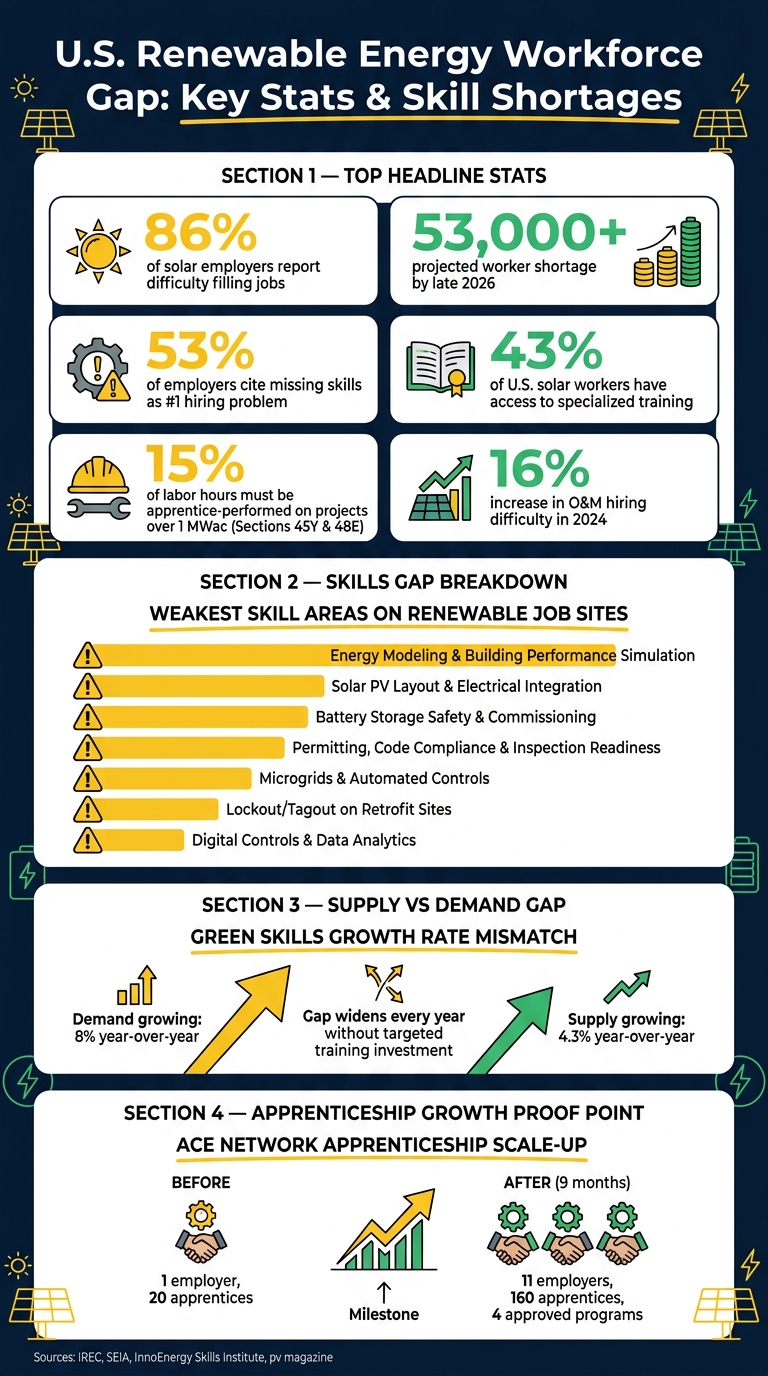
U.S. Renewable Energy Workforce Gap: Key Stats & Skill Shortages 2024–2026
Resilient Clean Energy Workforce in TImes of Uncertainty
The Renewable Energy Skills Gap in U.S. Building Projects
The biggest labor crunch in U.S. building projects isn’t basic trade work anymore. It’s the people in the middle: the supervisors and technicians who can pull entire energy systems together.
Today’s projects need crews that can connect solar, storage, controls, and energy modeling into one working setup. That makes mid-level roles the main bottleneck, because they’re the ones keeping all those moving parts lined up.
Where Labor Shortages Show Up Most on Job Sites
The pain shows up most in supervisor-level roles and other mid-level leadership jobs. Forty-seven percent of firms report serious difficulty hiring directors, supervisors, and vice presidents. That’s a big problem, because these are the people who keep projects moving from design through installation and handoff.
Electricians with high-voltage and solar experience are also hard to find. Solar firms are competing for the same workers needed in EV charging and heat pump projects. So even when demand is there, the labor pool gets stretched thin.
O&M roles are under strain too. Hiring difficulty for those jobs is up 16%, as more installed systems need steady monitoring, service, and repair. Put simply, every new system added to the field creates more work after installation, not less.
Why Standard Trade Experience Is Not Enough
This gap isn’t just about trade skill. It’s about coordination across systems, code compliance, and commissioning.
A licensed electrician or HVAC technician still brings a lot to the job site. But standard trade training usually doesn’t cover interconnection rules, battery safety protocols, automated energy management systems, or the digital documentation tools now tied to federal tax credit compliance.
Only 43% of the current U.S. solar workforce has access to the specialized skills training these roles demand. That leaves a lot of workers on active projects doing jobs that ask more of them than their original training did.
When that happens, projects tend to slow down during commissioning, and compliance risk goes up.
How Compliance Targets Are Increasing Training Pressure
The labor gap gets worse when teams also have to meet tighter tracking and reporting rules. Policy is adding another layer of pressure by requiring more documentation and labor-hour tracking.
Federal tax credits under Sections 45Y and 48E require 15% of total labor hours on projects over 1 MWac to be performed by qualified apprentices. At the same time, demand for green skills is growing 8% year over year, while supply is growing just 4.3%.
Those pressures don’t hit every role the same way. They tend to land first in the jobs tied to energy modeling, solar, storage, and controls training, where the mix of field work, software, and compliance is hardest to teach on the fly.
Key Training Gaps in Sustainable Construction and Energy Modeling
The biggest training gaps tend to show up where field work, software, and code rules meet. That mix creates friction at the worst times: during design signoff, commissioning, and final handoff. When teams don’t have the right mix of skills, projects slow down.
Energy Modeling and Building Performance Simulation
Training is still behind what employers need, especially for energy auditors, retrofit specialists, and modelers who size systems before anything gets installed. That matters more than it may seem at first glance. These jobs shape system size and expected performance before crews ever step onto the site.
There’s another issue here too: as experienced workers retire, a lot of commissioning and coordination know-how is leaving with them. And that kind of knowledge isn’t easy to replace. You can teach software. It’s harder to teach the judgment that comes from years of seeing what works, what fails, and where projects usually go sideways.
Solar PV, Storage, Permitting, and Code Compliance
This gap runs across the whole workflow: layout, electrical integration, battery safety, permitting, and inspection readiness. In plain terms, it’s not just about installing equipment. Teams also need to produce clean permit plan sets and installation drawings, and that’s still a weak spot for many crews.
Battery safety is another pain point. Standard electrician training doesn’t always cover it in enough depth, which leaves people underprepared when storage enters the picture. The result is familiar: more rework, failed inspections, and slower interconnection. When these skills are missing, permit approvals stall and inspections take longer than they should.
Microgrids, Controls, and Field Safety
Microgrid and controls work calls for both electrical and software skill sets, and that’s where the labor pool is thinnest. Workers need to know how automated energy management software connects with hardware, how to document work for compliance, and how to commission systems safely without cutting corners.
Lockout/tagout is still a gap, especially on retrofit sites where battery and controls equipment must be added to live systems. That raises the stakes fast. O&M hiring difficulty jumped 16% in 2024, which shows that even after systems are installed, the people needed to keep them running safely are still hard to find.
Digital controls are pushing the bar higher. Storage management and site tracking now depend more on digital controls and data tools, but training pipelines are still behind. The same problem shows up again at startup, commissioning, and long-term operations.
sbb-itb-aa28329
Practical Steps to Close the Skills Gap
Training and Certification Paths Worth Pursuing
The problem isn’t a lack of trade experience. It’s a lack of renewable-specific training that shows a worker can model, install, and commission these systems the right way.
If you’re trying to build trust in energy modeling, solar, or controls work, structured training is the fastest route. Registered apprenticeships matter a lot here because they blend paid field work with technical instruction. They also help projects meet federal labor-hour rules.
Under current federal rules, projects must have 15% of total labor hours performed by qualified apprentices to secure the full value of Section 45Y and 48E tax credits. And with only 43% of the current U.S. solar workforce having access to the skills training needed, companies that build apprenticeship capacity now have a clear edge.
There’s already proof this can scale. The ACE Network helped employers grow registered apprenticeship programs from one employer with 20 apprentices to 11 employers and 160 apprentices across four approved programs in nine months.
That matters even more when you look at who can move into this work. People coming from oil and gas or heavy construction often already have a lot of what the job needs, including:
- Electrical maintenance experience
- High-voltage experience
- Project coordination skills
Once those training paths are in place, the next step is making sure those skills show up on live projects.
Steps Employers Can Take on Active Projects
Training has to show up in the field before crews ever arrive on-site. Trying to patch skill gaps after a failed inspection is like fixing a roof after the storm already hit.
A practical setup uses a small group of experienced workers to guide larger crews of semi-skilled laborers. Digital site-tracking tools help keep documentation clean and compliance easy to see. When newer workers are paired with experienced leads on renewable-specific tasks, skill transfer happens faster. That can cut rework, keep inspections moving, and lower compliance risk.
"In 2026, the ability to secure a compliant, documented workforce has become a determining factor in project bankability." – Ryan Kennedy, Author, pv magazine
As project timelines tighten, workforce deployment has to move just as fast as certification and compliance checks.
Using ABLEMKR to Deploy Trained, Compliant Crews Faster
Even the best training program falls apart if workers can’t get deployed fast enough. ABLEMKR helps bridge that gap by turning trained workers into crews that are ready to go.
Its mobile-first platform connects credentials, availability, and job-site needs in one place. It matches pre-vetted workers to projects based on certifications, safety training, availability, and location. It also includes compliance tracking, payroll workflows, and worker status visibility, which cuts paperwork and helps crews mobilize faster.
For renewable projects, that means fewer delays, cleaner compliance, and a smoother path from training to field execution.
Building a Renewable-Ready Workforce: Next Steps
A Clear Framework for Employers and Project Managers
Once the gaps are clear, employers need a simple plan to turn that information into action.
Start with the exact skill gaps on active projects. That could mean rapid shutdown protocol compliance, high-voltage experience, or apprenticeship-hour documentation. The point is to get specific early, not halfway through the job when delays start piling up.
Next, tie those gaps to training or certification paths before the project breaks ground. When workforce planning is built into the early project lifecycle, employers have time to check local labor supply and build relationships with nearby training programs. That same early window is the right time to connect with local workforce boards and community colleges.
After training is set, tighten up onboarding and site documentation. Standardized onboarding helps crews get on site with less confusion, and digital site tracking makes onboarding, time logs, and apprentice hours easier to audit.
"Today we don’t have a technology problem. What we have is a scaling problem." – Elias Paul, Head of Operations at InnoEnergy Skills Institute
Then comes the part every project team cares about: getting crews in place fast. ABLEMKR matches pre-vetted workers to job sites based on certification, safety training, availability, and location.
That same skill map helps workers too. It shows which credentials can help them move into better roles instead of getting stuck in the same spot job after job.
What Workers Should Focus On to Get Better Opportunities
Workers who build skills in solar PV, battery storage, high-voltage work, and digital controls are in a strong spot for near-term openings. Those who also learn energy-efficient system controls, such as heat pump integration, line up well with demand in the growing retrofit sector.
Safety rules matter across the board. On a modern job site, compliance around rapid shutdown protocols isn’t optional.
Registered apprenticeships give workers a way to earn while they build renewable-specific skills. And many workers already have part of the puzzle. People coming from power plants, refineries, or roofing often bring solid transfer skills with them. In many cases, the missing piece is renewable-specific certification, not a full restart.
Skill Gap, Training Path, and Deployment Action: A Quick Reference Table
Use this table to match each gap with a training path and a deployment move.
| Skill Area | Common Gap | Training Solution | Deployment Strategy |
|---|---|---|---|
| Solar PV & Storage | Lack of high-voltage, battery commissioning, and inverter troubleshooting skills | Registered apprenticeships; NABCEP certification | Deploy as lead installers or site supervisors |
| Code Compliance | Failure to meet the 15% apprenticeship labor-hour mandate | ACE Network templates; internal training pipelines | Use digital site-tracking to document compliant labor hours |
| Energy Modeling | Shortage of retrofit coordinators and heat pump specialists | Community college programs; energy modeling software certifications | Assign to building retrofit and HEMS projects |
| Field Safety | Improper implementation of rapid shutdown (RSD) protocols | OSHA-30; manufacturer-specific MLPE safety training | Pair expert journey-level workers with semi-skilled crews |
| Digital Controls | Deficiency in data analytics and software engineering | Controls training; home energy management system (HEMS) courses | Deploy on grid resilience and microgrid control projects |
FAQs
Why are mid-level roles hardest to fill?
Mid-level and management roles are the toughest to fill because employers need people with specialized industry experience, certifications, and technical training that simply aren’t easy to find.
As projects get more complex, the pool of qualified applicants stays small. At the same time, retirements are draining institutional knowledge, and training pipelines haven’t kept up with modern technical requirements.
What training matters most for renewable projects?
The most important training for renewable projects goes beyond general construction skills. What employers want most is specialized technical, digital, and safety expertise.
That usually means hands-on training in areas like high-voltage maintenance, solar inverter configuration, battery storage installation, and wind turbine service. On the digital side, teams often need skills in BIM, data analytics, and SCADA systems.
Safety training matters just as much. For hydrogen-related work, employers look for people who understand high-pressure systems and flammable gases. And when grid security is part of the job, credentials such as NERC CIP and SANS Institute training can help candidates stand out.
How do training gaps delay project timelines?
Training gaps can slow a project down fast. When a team’s skills don’t line up with the job’s technical demands, the result is often poor performance, costly rework, and staffing bottlenecks.
That shows up on-site in very concrete ways. Installation mistakes – like incorrect wiring or an improper heat pump setup – can lead to expensive fixes that eat into budget and time.
The problem doesn’t stop there. Skill gaps can leave specialist roles unfilled, which can delay interconnection and commissioning right when a project needs to keep moving.
There’s also a money side to this. Missing compliance or apprenticeship requirements can put tax credits at risk and weaken project bankability.


