
Hiring the wrong geoscientist can lead to weak drilling calls and wasted budget. If I were hiring for an upstream oil project, I’d keep the process simple: define the role by basin and project phase, source from the right talent pools, test technical judgment with a short case, and move fast on the offer and onboarding.
Here’s the short version:
- Set the role first: lock in project phase, asset type, reporting line, travel, and software needs
- Hire for basin fit: a strong geoscientist in one play may need time to ramp up in another
- Use clear minimum criteria: mid-level and senior roles should not have the same bar
- Screen for project impact: look for decisions made, risk reduced, and support given to drilling or development teams
- Test with a short exercise: use a 2–3 hour case tied to seismic, logs, or subsurface risk
- Close fast: senior talent is often passive, and the U.S. oil and gas workforce is still 40% smaller than a decade ago
- Prepare Day 1 access: software, data, safety training, and cross-team meetings should be ready before the start date
A few numbers stand out. One cited report points to an “extreme shortage” of geoscientists and petroleum engineers with 15–25 years of experience. Another point from the article: senior upstream geoscientists are often about 90% passive, which means most are not applying to posted jobs.
If I had to sum it up in one line, it would be this: hire for basin experience, decision quality, and speed of execution.
This article lays out that process in a clear order so you can staff upstream roles with less guesswork.
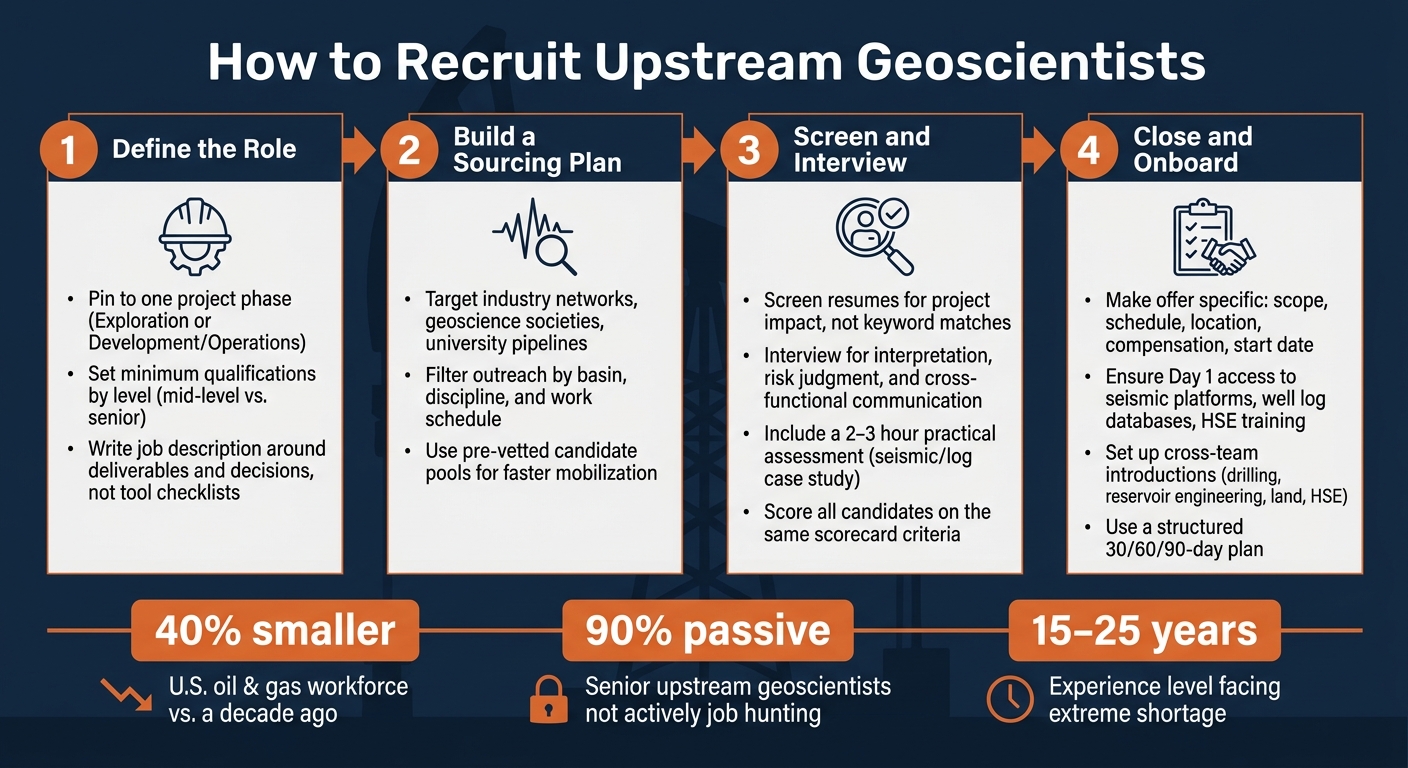
How to Recruit Upstream Geoscientists: A Step-by-Step Hiring Process
1. Define the Role and Minimum Hiring Criteria
Match the role to the project phase and asset type
Start by defining one project phase and one asset type. That keeps the role tight and easy to measure.
An offshore Louisiana exploration hire needs a very different skill set than a Permian unconventional hire. That’s why it helps to use a scorecard. It keeps the role narrow, clear, and tied to what the job actually needs.
Pin the role to a specific phase – exploration or development/operations – and then map it to the asset type. An exploration role is focused on finding prospects and interpreting subsurface data. A development or operations role is more tied to reservoir management, efficiency, and support for operating decisions. These roles are not interchangeable. Treating them that way usually leads to a bad match.
Once the phase and asset type are set, minimum qualifications are much easier to define.
Set realistic minimum qualifications for mid-level and senior hires
The U.S. oil and gas workforce is currently 40% smaller than it was a decade ago, even as production is at record highs. When a role is tough to fill, it’s easy to start loosening the requirements. That usually backfires. Vague requirements pull in the wrong people. Overstated ones can push away strong candidates.
For a mid-level hire, look for:
- Basin familiarity in the target play
- Field experience
- Proof that they’ve contributed to asset team decisions
For a senior hire, the focus shifts. Look for independent interpretation, sound risk judgment, and a history of shaping technical decisions that connect subsurface interpretation with field conditions.
You should also screen for the ability to work across change, along with solid technical depth. The market still needs people who can work with digital oilfield technology, emissions reduction, and methane management.
Write a job description around deliverables and decisions
Most geoscience job descriptions read like software inventories. They tell candidates what tools to know, but not what the person will actually own.
A better approach is to write the role around deliverables and decisions, not a checklist of platforms. Mention tools only when they are required for the workflow. Be clear about whether the hire will present recommendations to leadership, help shape development decisions, or explain technical risk to non-technical stakeholders.
That’s the stuff that shows the real scope of the role.
When the role is this clearly defined, sourcing gets a lot more precise. You can target the right basins, disciplines, and work schedules instead of casting too wide a net.
sbb-itb-aa28329
2. Build a Focused Sourcing Plan
Use industry networks, geoscience societies, and university pipelines
Once the role is clear, build your sourcing funnel around the places upstream geoscientists already know and trust: industry networks, geoscience societies, and university pipelines.
Target outreach by basin, discipline, and work schedule
Generic outreach usually misses the people you want. A better move is to target by basin, discipline, and work schedule.
Upstream geoscientists tend to cluster in a small group of major upstream hiring states, so it helps to filter for the exact technical work you need. Then review role-specific profiles to gauge technical depth instead of leaning on keyword-stuffed resumes.
When time is tight, use a system that shows who’s available now.
Use ABLEMKR for faster hiring and mobilization
Use ABLEMKR to track pre-vetted candidates by certification, availability, and location. It can also speed onboarding for remote or multi-site projects, which keeps your candidate pool ready for technical screening.
3. Screen and Interview for Technical Depth and Team Fit
Screen resumes for project impact, not keyword matches
Once you have a short list, screen for impact, judgment, and fit.
The main thing to look for is proof that the candidate improved a drilling, development, or risk decision, not just a list of tools, software, or basins. A resume should show where someone helped move a project forward.
Look for signs that the person:
- presented technical findings to a drilling team
- helped cut subsurface uncertainty for a development decision
- supported a recommendation that advanced the project
Vague lines like “subsurface analysis” don’t tell you much. Clear examples tied to actual project decisions and outcomes tell you a lot more.
In a tight market, resume reviews need to surface real project contribution fast. Tool familiarity matters, but it shouldn’t be the main filter.
Use interviews to test interpretation, risk judgment, and communication
The interview is where you learn whether a candidate can think through a problem clearly and explain it to people outside their discipline.
Ask them to walk through one actual exploration or development decision they made. What data did they have? What was uncertain? How did they explain the risk to the broader asset team?
Pay close attention to how they deal with conflicting subsurface data. Do they admit uncertainty, or do they gloss over it? Strong candidates are clear about what they don’t know as well as what they do. In upstream work, that kind of honesty matters.
You should also hire for safe execution, cost awareness, and cross-functional communication under pressure. That means probing for work across functions. A geoscientist who has been in drilling planning meetings and worked with reservoir engineers on development scenarios brings a different kind of value than someone who has stayed inside one lane.
Include a practical assessment tied to real upstream work
Add one role-relevant test, scoped to 2–3 hours, to get a concrete data point that a resume or interview can’t fully replace.
Keep it realistic. For example, ask the candidate to review a seismic cross-section with well log data, point out the main uncertainties, and present a recommendation with a short rationale.
The point isn’t to trick them. It’s to see how they:
- structure a problem
- communicate uncertainty
- make a defensible recommendation under time pressure
Score every candidate on the same criteria: technical reasoning, clarity of communication, and awareness of risk. That gives you a hiring decision based on evidence instead of gut feel. Use the same scorecard to compare finalists before making an offer.
What Working in ‘Oil & Gas’ Actually Entails w/ Petroleum Geologist, Julia Astro | GEO GIRL
4. Close the Hire and Prepare for Day-One Readiness
Once you’ve picked the finalist, don’t let the process drift. Move fast on the offer and onboarding work.
Make the offer specific on scope, schedule, location, and expectations
The offer letter should give the candidate enough detail to make a clear yes-or-no decision. Spell out the asset type, project phase, expected deliverables in the first 6–12 months, rotation schedule, compensation, travel expectations, relocation assistance, and primary work location. Name the direct manager, set a firm start date – such as August 15, 2026 – and include a short list of first-week outcomes.
That level of detail matters. It cuts down on back-and-forth and helps both sides start on the same page.
After acceptance, the focus shifts to access, safety, and team alignment.
Set up software, data access, safety requirements, and team introductions
Make sure the geoscientist has Day 1 access to seismic interpretation platforms, well log databases, geological modeling tools, and petrophysical software. Also confirm which HSE steps apply before the first field visit. That usually includes safety orientation, OSHA-related training, H2S awareness for sour gas environments, and any site-specific inductions. Be plain about which certifications must be finished before travel.
In the first week, set up focused introductions with drilling, reservoir engineering, land, and HSE teams. These meetings tie subsurface work to drilling decisions, lease constraints, and production targets. A structured 30/60/90-day plan, shared by the manager and the new hire, keeps that early progress moving well beyond week one.
Use ABLEMKR for onboarding visibility and compliance support
For remote or multi-site upstream projects, ABLEMKR gives hiring managers a way to track new hires, flag missing certifications before deployment, and use location-based matching to line up the right person with the right asset based on skills, basin experience, and availability. Use ABLEMKR to track onboarding status and prevent deployment delays. That kind of visibility helps keep mobilization on schedule.
Conclusion: A Practical Hiring Process for Stronger Upstream Geoscience Teams
Hiring geoscientists for upstream oil projects gets a lot easier when the process follows a clear path. Start by defining the role. Then go where the right candidates are, test sound technical judgment, and move fast on the offer and onboarding. Role-based profiles, scorecards, and 90-day plans help teams hire faster and cut onboarding risk.
That kind of structure matters. Senior geoscience talent is still hard to find, and the numbers back that up. The U.S. oil and gas workforce is 40% smaller than it was a decade ago, even while production has reached record levels.
Once the hire is approved, mobilization becomes the last big step. For fast mobilization, ABLEMKR matches pre-vetted workers by certification, availability, and location while tracking compliance and status.
FAQs
How much basin experience is enough?
It depends on the project’s complexity and the candidate’s seniority.
For most mid-level roles, a good target is 3 to 7 years of relevant experience on projects with a similar scale and level of difficulty. Senior roles usually call for 8 to 10+ years, plus a proven track record across multiple project cycles.
Put more weight on project-specific experience than total time spent in a basin. And field-based work matters a lot. That’s the kind of experience that helps someone deal with real job-site issues like weather, site access, and contractor coordination.
What should a geoscientist case study include?
A geoscientist case study should show the kind of problems that come up on actual projects, not just textbook work. It needs to make the candidate’s technical skills clear while also showing how they think through field issues, data limits, and day-to-day project demands.
That usually means including examples tied to well log interpretation, geological modeling, or seismic data analysis with industry-standard tools. The point isn’t just to name the software. It’s to show how the candidate used those tools to solve a problem, make a call, or support a project decision.
The case study should also spell out the candidate’s project role in practical terms. That can include work tied to budgets, schedules, and change orders, along with how they helped keep the job moving when conditions shifted.
Just as important, it should show how the candidate dealt with job-site limits on similar projects, including:
- Weather delays
- Site access issues
- Regulatory compliance
- Other field or operating limits that affected delivery
That kind of detail helps connect technical work to how projects actually get done.
How can I speed up geoscientist hiring?
To speed up geoscientist hiring, use ABLEMKR to connect with pre-vetted, qualified professionals. Its mobile-first platform lets you filter candidates by certifications, experience, and location, so matching happens faster.
Pair that with digital onboarding, clear credential requirements, and scenario-based technical evaluations, and you can cut hiring time while putting geoscientists first who are ready to contribute on day one.


