
Managing oil and gas shutdowns is challenging, especially when they’re unplanned. These events can cost operators up to $500,000 per hour in downtime and lead to safety risks, delays, and inefficiencies. Traditional tools like spreadsheets often fail to handle the complexity of these situations. The solution? Real-time scheduling tools.
Here’s how they help:
- Faster Crew Deployment: Match and mobilize certified workers within 24–48 hours.
- Reduced Downtime: Cut shutdown durations by 20–30%, saving time and money.
- Improved Safety: Ensure only qualified personnel handle critical tasks with automated credential checks.
- Real-Time Updates: Supervisors get live data on task progress, worker locations, and compliance.
- Lower Costs: Predictive maintenance and efficient scheduling reduce labor and equipment expenses.
Real-time scheduling tools streamline shutdowns by combining live scheduling, mobile crew dispatch, and safety workflows into one platform. This approach minimizes delays, enhances safety, and reduces costs, making shutdowns more efficient and predictable.
Master Plant Shutdown Management Life Cycle with This Proven Step-by-Step Guide
sbb-itb-aa28329
Main Problems in Last-Minute Shutdown Management
Managing last-minute shutdowns is riddled with challenges that can derail operations and inflate costs. Here are some of the most pressing issues:
The Cost of Unplanned Downtime
Unplanned downtime can drain resources at an alarming rate. For oil and gas operators, the costs can climb to over $500,000 per hour during halted operations. On average, offshore companies lose $38 million annually due to these disruptions, with some high-impact cases reaching losses of over $88 million per year. Even a modest 1% downtime – roughly 3.65 days – can cost a company over $5 million annually.
The financial burden has only grown. Since 2022, refinery downtime costs have doubled, with longer recovery times adding 62% more expense despite fewer incidents. A real-world example: in March 2024, Tesla’s Gigafactory in Germany suffered a week-long shutdown due to a suspected arson attack, leading to losses exceeding $111.6 million. Elon Musk described the idle facility as a "money furnace", underscoring the staggering costs of inoperative industrial assets.
And here’s the kicker: the visible costs – repairs, parts, and lost production – only make up 30–40% of the total impact. The hidden costs, like idle labor, disrupted supply chains, reputation damage, and waste during restarts, account for the remaining 60–70%. Emergency replacement parts cost 40% more than planned orders, while overtime labor to make up for lost production is 1.5 to 2 times the standard rate. Equipment failure causes 42% of these incidents, with human error contributing another 23%.
Disconnected Planning and Communication Systems
When emergencies strike, relying on outdated tools like spreadsheets and paper-based work orders can cause chaos. Critical information often ends up scattered – some in a supervisor’s notebook, some in an email thread, or even scribbled on a whiteboard in the control room. This fragmentation makes coordinated responses nearly impossible. Without real-time updates, field teams might miss last-minute changes, and supervisors waste precious time tracking down crew locations and task progress. The result? Disjointed operations and delayed responses.
Difficulties in Scheduling and Deploying Workers
Coordinating skilled workers during last-minute shutdowns is a logistical headache, especially in remote areas. Imagine trying to mobilize certified crews for emergency pipeline repairs in West Texas or maintenance on a Gulf of Mexico platform – it’s a race against time. The industry’s "Relief Factor" of 4.77 means nearly five workers are needed per role to avoid fatigue. Falling short – say, hiring only four people for a 24/7 position – creates a 1,400-hour annual deficit, which then has to be filled with costly overtime.
Safety and Compliance Gaps
Rushed shutdowns often push operations beyond standard Hours of Service (HoS) limits, creating safety and compliance risks. Exceeding these limits requires an official "Exception Process", including documented risk assessments and senior management approval. Fatigue management becomes critical during these periods, as cognitive performance can plummet during the Circadian Nadir (between 2:00 AM and 5:00 AM), significantly increasing safety risks.
"The scheduler effectively becomes the guardian of the organization’s ‘alertness reserve,’ tasked with deploying human capital in a way that maintains cognitive vigilance during safety-critical tasks." – Roger Wood, Manager, TimeTrex
Inadequate shift handovers can also lead to the loss of vital safety information. Guidelines like API RP 755 mandate a 36-hour rest period after seven consecutive 12-hour shifts, but rushed operations often sideline these protocols. Another issue is maintaining "Experience Density" – the right balance of experienced mentors to less seasoned workers. Without it, critical tasks can end up in the hands of underprepared personnel.
No Real-Time Information for Supervisors
During shutdowns, supervisors often operate in the dark. Without real-time updates, they have no idea which crews have arrived, which tasks are complete, or where bottlenecks are forming. This lack of visibility delays decision-making and wastes valuable time. By the time an issue is flagged through a phone call or radio check-in, hours may already have been lost.
The absence of live data also makes it harder to track compliance and safety metrics in real-time. Supervisors can’t verify worker certifications or ensure safety permits are in place before tasks begin. These gaps not only slow operations but also open the door to legal risks under regulations like the Fair Labor Standards Act (FLSA). Real-time scheduling solutions could be the answer to these challenges, offering better oversight and more efficient decision-making.
How Real-Time Scheduling Tools Fix Shutdown Problems
Real-time scheduling platforms simplify last-minute shutdowns by keeping all scheduling data in one place. When unexpected changes occur – like discovering additional issues during an inspection – the schedule automatically updates task sequences, resource needs, and completion timelines. This seamless coordination reduces confusion and keeps shutdown operations running efficiently.
Single, Live Schedule for All Shutdown Activities
By combining engineering, permitting, safety, materials, and progress data into a single live schedule, teams can see updates in real time. This eliminates the need to sort through scattered emails or outdated notes. Supervisors can track task dependencies and resource allocation in one place. For example, Actenum’s AI-powered scheduling tool helped a client cut 366 days of idle time. If equipment breaks down or a permit gets delayed, the system recalculates assignments and adjusts the task order, avoiding costly ripple effects.
Mobile Crew Dispatch and Assignment
Mobile-first platforms allow real-time updates to be sent directly to field crews, replacing slower methods like phone calls or radio messages. Automated systems match shutdown needs with workers who have the right certifications, such as TWIC cards or H2S training, ensuring quick deployment. ABLEMKR‘s platform, for instance, filters workers by their qualifications, safety training, availability, and location, enabling operators to send certified crews to remote sites or offshore platforms within 24–48 hours. GPS-verified timecards also let supervisors track crew arrivals and on-site activities in real time.
Live Field Updates and Progress Reports
Field crews can use mobile apps to log start and finish times, update task statuses, upload photos of equipment, and flag issues directly from the job site. These updates flow into a central dashboard, giving supervisors instant insight into which tasks are on schedule and which need attention. This eliminates the typical 24–48 hour delay in reporting.
Built-In Safety and Permit Workflows
The system ensures that work begins only after all necessary safety checks, permits, and lockouts are verified. For instance, tasks like hot work in flammable or confined spaces won’t be marked as ready until the required digital approvals are completed. This prevents unsafe shortcuts under tight deadlines and gives supervisors a clear view of which jobs have met safety requirements.
Data Analysis for Better Decisions
Real-time analytics and scenario planning tools help operators test strategies like adding extra crews, extending shifts, or reordering tasks to minimize downtime and control costs while maintaining safety. After the shutdown, dashboards track constraints, material readiness, safety, and schedule deviations. Comparing planned outcomes with actual results helps refine future shutdowns. Research from McKinsey shows that projects without effective real-time data and integrated planning often face 10–20% schedule overruns.
Steps to Implement Real-Time Scheduling
Transitioning to a real-time scheduling approach requires consolidating accurate data and establishing streamlined digital workflows, especially for high-pressure shutdown scenarios. Each step outlined below plays a key role in creating a reliable system for managing shutdowns without interruptions.
Create Accurate Worker and Asset Data
A real-time scheduling system starts with centralizing data from various sources like paper logs, legacy systems, and spreadsheets. For example, in January 2026, Shell‘s Prelude Floating Liquefied Natural Gas (FLNG) facility replaced paper-based inspections with TrueContext‘s mobile platform. This change allowed technicians to boost inspections from 4 to 10 per day – a 250% productivity increase – saving $3–$4 million annually while ensuring engineers had 24/7 access to data.
Develop skills and competency matrices to track worker roles, proficiency, and certification expiration dates for safety-critical credentials like Well Control, H2S, TWIC, and BOSIET. Set up automated alerts to block assignments if certifications expire. Calculate Net Annual Work Hours (NAWH) by subtracting non-productive time (vacation, training, holidays) from total contract hours to determine available labor for scheduling.
For assets, integrate IoT sensors to monitor factors like vibration, temperature, and pressure, and use GPS to track mobile equipment such as drilling rigs and transport units. Occidental Petroleum (Oxy) effectively managed over 1.5 million assets by implementing a digital system with 330 forms used by nearly 10,000 field workers. Through API integrations and geolocation tracking, they eliminated manual data entry and gave supervisors real-time visibility into dispatch operations.
"Oil & Gas Staff Scheduling transcends mere administrative rostering; it is a primary lever for operational risk management, process safety, and financial efficiency." – Roger Wood, TimeTrex
Set Up Standard Digital Processes
Standardizing procedures for scheduling, reporting, and communication is crucial. Bridging the gap between Information Technology (business systems) and Operational Technology (field sensors) allows supervisors to view asset health and crew availability in one place. Assign clear roles for data ownership and enforce consistent standards to ensure data integrity. Replacing manual entry with mobile digital forms reduces errors and ensures real-time updates on worker progress and asset conditions.
When scheduling shifts, use forward rotation (Day to Afternoon to Night) because it aligns better with how the human body adjusts. Implement "Experience Density" rules to ensure each shift includes a mix of experienced mentors (e.g., Level 4) and newer workers, promoting both safety and knowledge transfer. Follow API RP 755 guidelines for 12-hour shifts, limiting workers to 7 consecutive shifts with a minimum 36-hour rest period afterward.
Give Field Teams Mobile Access
Providing field teams with mobile apps enables them to access schedules, receive work instructions, and submit reports from anywhere. For instance, an Energy Services Company used the ABLEMKR mobile platform during a multi-week pipeline project. The app helped manage real-time project updates, GPS timecards, and automated payroll, simplifying administrative tasks and ensuring workers with specific certifications were quickly assigned.
"ABLEMKR helped us find qualified workers for our pipeline project. The app made managing timecards and payroll simple during a complex multi-week shutdown." – Project Manager, Energy Services Company
Mobile tools can filter workers based on project-specific needs, such as Confined Space entry permits or ISNetworld pre-qualification. GPS-integrated timecards ensure precise labor tracking. Most job postings via mobile platforms receive qualified applicants within 24–48 hours, making it easier to adapt to changing project demands.
Control Changes and Maintain Safety
Dynamic events often require rescheduling, so it’s essential to have robust change-control processes. Digital scheduling tools can list trade certifications (e.g., ASME/API for welders) and safety training (e.g., H2S, Confined Space), ensuring only qualified workers are matched to tasks. Automated verification of certifications like TWIC, ISNetworld, and OSHA 10/30 ensures safety compliance even during last-minute changes.
Using platforms with worker ratings and histories helps select reliable personnel, reducing the risk of no-shows and emergency rescheduling. Tools integrated with industry standards like ISNetworld ensure all scheduled workers meet operator requirements before arriving on-site. Keep in mind that cognitive function during the "Circadian Nadir" (2:00 AM to 5:00 AM) is significantly impaired, comparable to a blood alcohol concentration of 0.05%–0.10%.
Learn from Each Shutdown
Post-shutdown reviews are essential for identifying areas of improvement and refining scheduling practices. Compare planned outcomes with actual results to pinpoint successes and address shortcomings. Track factors like material readiness, safety incidents, and schedule deviations using dashboards. With over 50% of shutdowns experiencing major delays and 80% exceeding budgets by more than 10%, analyzing this data is key to avoiding repeat mistakes and improving future performance.
Measuring Results from Real-Time Scheduling
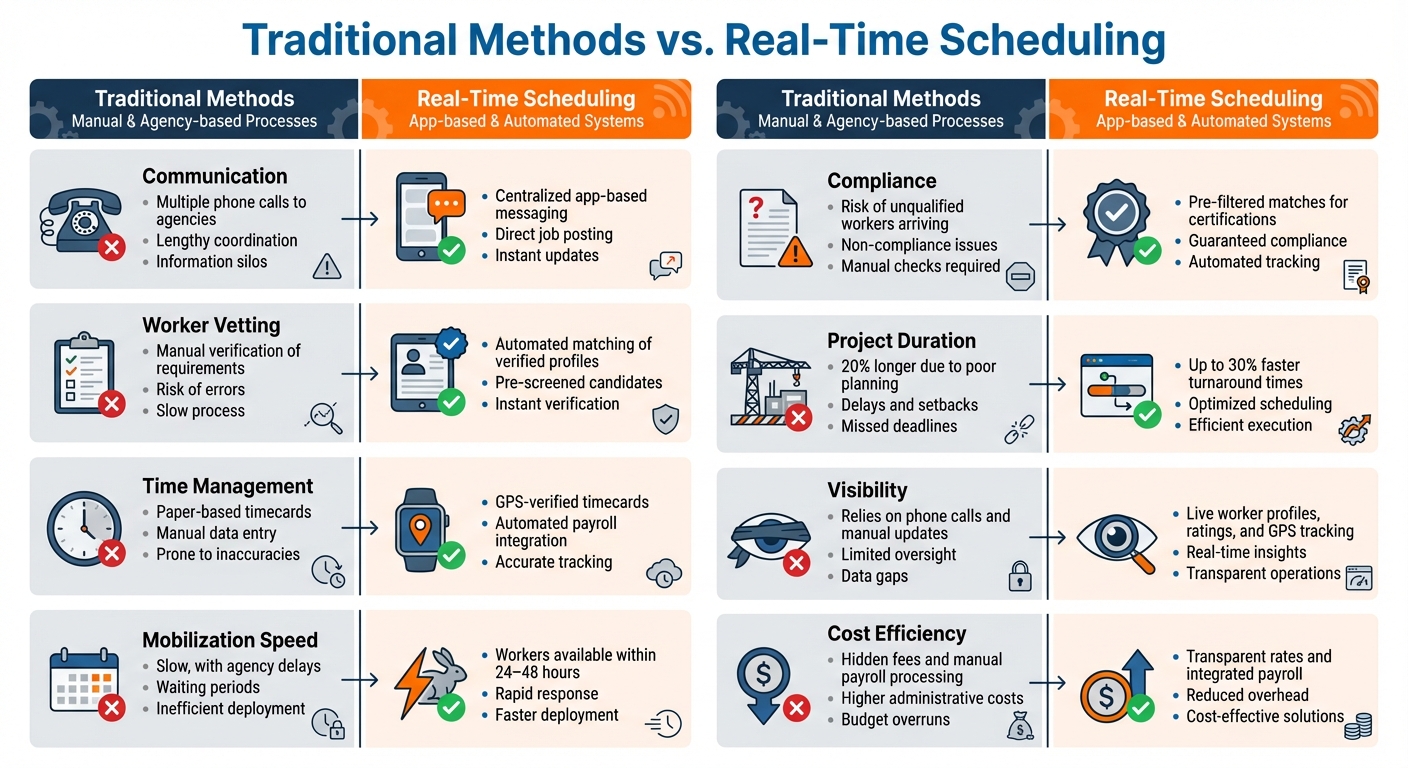
Traditional vs Real-Time Scheduling Methods for Oil & Gas Shutdowns
Understanding how real-time scheduling tools improve shutdown efficiency is crucial for the oil and gas sector. The measurable outcomes highlight why these tools are becoming essential.
Shorter Shutdowns and Fewer Delays
Real-time scheduling tools can assemble qualified crews in just 24–48 hours. This quick turnaround is critical during unplanned shutdowns, where downtime can cost up to $1 million per hour in the oil and gas industry. Compared to manual spreadsheet-based methods, advanced planning tools have been shown to shorten project durations by 20%, with some operators achieving up to a 30% reduction in turnaround times. These platforms also guarantee worker replacements within 24 hours, ensuring that schedules stay on track even with last-minute staffing issues. By matching certifications like H2S training or Confined Space permits to job requirements, delays at the gate are minimized, directly improving labor efficiency and operational flow.
Lower Labor and Operating Costs
Switching to real-time scheduling tools leads to significant cost savings by moving away from reactive "run-to-failure" maintenance strategies. When paired with predictive maintenance, these tools can reduce overall maintenance costs by 40%. Additionally, smarter inventory planning enabled by predictive models can cut replacement part costs by 10% to 20%. Features like GPS-verified timecards and automated payroll systems eliminate administrative overhead, prevent overtime expenses, and reduce hidden fees. By automating worker matching and cutting out the need for endless calls to staffing agencies, companies save both time and money while maintaining clear visibility into worker statuses to avoid overstaffing or understaffing.
Better Safety and Compliance Records
Real-time scheduling tools improve safety and compliance by ensuring only workers with valid credentials are assigned to critical tasks. They filter candidates based on specific requirements – such as TWIC, ISNetworld, and OSHA certifications – before they even arrive on-site. These platforms also maintain digital audit trails for certifications, training, and site-specific safety orientations, providing valuable documentation during regulatory inspections. By replacing manual card checks with automated digital systems, the risk of human error is significantly reduced, ensuring compliance and safety standards are met.
More Reliable Production and Less Downtime
The efficiency gains from real-time scheduling directly impact production reliability. Completing shutdowns on schedule means facilities can resume operations faster, reducing revenue loss. These tools also help minimize emergency repairs by enabling well-planned maintenance windows. Whether for planned or unplanned shutdowns, the ability to quickly mobilize teams ensures that potential issues are addressed before they escalate into major problems.
Comparison: Old Methods vs. Real-Time Scheduling
The advantages of real-time scheduling tools over traditional methods are clear when comparing key features:
| Feature | Traditional Methods | Real-Time Scheduling |
|---|---|---|
| Communication | Multiple phone calls to agencies | Centralized app-based messaging and job posting |
| Worker Vetting | Manual verification of requirements | Automated matching of verified profiles |
| Time Management | Paper-based timecards | GPS-verified timecards and automated payroll |
| Mobilization Speed | Slow, with agency delays | Workers available within 24–48 hours |
| Compliance | Risk of unqualified workers arriving | Pre-filtered matches for certifications |
| Project Duration | 20% longer due to poor planning | Up to 30% faster turnaround times |
| Visibility | Relies on phone calls and manual updates | Live worker profiles, ratings, and GPS tracking |
| Cost Efficiency | Hidden fees and manual payroll processing | Transparent rates and integrated payroll |
Conclusion: Better Shutdown Management with Real-Time Scheduling
Managing last-minute oil and gas shutdowns doesn’t have to feel like a scramble. By replacing outdated methods like phone calls and spreadsheets with real-time scheduling platforms, companies can sidestep unnecessary delays and reduce risks.
With automated systems, qualified crews – complete with verified certifications like H2S and TWIC – can be matched and deployed within 24–48 hours. This makes shutdowns more predictable and manageable, especially when mobile tools streamline the process.
The benefits are clear: direct cost savings, improved production efficiency, and better coordination of crews, equipment, and safety protocols. Tools like ABLEMKR’s mobile-first technology highlight this shift, instantly connecting certified workers to critical projects. Whether it’s a planned maintenance turnaround or an urgent repair, having the right people in the right place at the right time ensures operations stay on track.
For operators handling shutdowns at remote facilities or working under tight deadlines, real-time scheduling offers a decisive edge. Unlike traditional manual methods, these platforms provide GPS-verified timecards, automated job matching, and quick crew replacements within 24 hours. The tools to make shutdowns safer, faster, and more efficient are already here.
FAQs
What data is needed before using real-time scheduling?
To make the most of real-time scheduling, you’ll need access to crucial data like live equipment sensor readings, weather forecasts, workforce availability, and geo-location details. Additionally, keeping track of certifications and safety training records is essential. With this information, you can quickly adjust schedules, respond to emergencies more efficiently, and stay compliant with safety and certification requirements.
How does real-time scheduling prevent compliance violations?
Real-time scheduling plays a crucial role in maintaining compliance by instantly checking worker certifications, safety training records, and location details. This system ensures that only properly qualified and certified individuals are assigned to job sites. With immediate access to worker status, businesses can significantly reduce the chances of deploying unqualified staff, helping them stay aligned with regulatory requirements.
How do you connect field updates to the master shutdown schedule?
Integrating field updates with the master shutdown schedule hinges on using real-time data and effective communication tools. For example, platforms like ABLEMKR leverage mobile-first technology to connect skilled workers with job sites, track their locations, and monitor task progress. By utilizing centralized dashboards and dynamic scheduling, these tools ensure that field updates align seamlessly with the master plan. This synchronization allows for quick adjustments and smarter resource allocation, which is essential during shutdown operations.


