
When accidents happen on construction sites, blaming workers often overshadows the bigger issue – system failures. The 5 Whys method helps dig deeper by repeatedly asking "why" until the root cause is identified. Originally developed by Toyota, this approach is widely used in high-risk industries to identify systemic problems like inadequate training, outdated procedures, or unclear responsibilities.
Key takeaways:
- Focus on systems, not individuals: Most incidents stem from organizational gaps, not worker negligence.
- Recurring issues: Problems like training gaps, procedural failures, and lack of oversight are common root causes.
- Actionable solutions: Examples include mandatory training, clear ownership of safety updates, and triple-verification processes.
- Technology’s role: Tools like ABLEMKR prevent incidents by ensuring only qualified workers are assigned to high-risk tasks.
ROOT CAUSE ANALYSIS – How to use the "Technique of 5 WHY’s" to investigate a Fatal Accident?
sbb-itb-aa28329
Real-World Construction Accident Case Study Using the 5 Whys Method
The Skanska Finland crane incident is a great example of how the 5 Whys method can uncover deeper, systemic problems. Here’s a breakdown of the incident and how this investigative technique was applied.
Skanska Finland Crane Incident
Skanska Finland used the 5 Whys approach to investigate recurring near-misses involving cranes. The process started with a clear problem statement: "Why did the crane experience repeated operational issues?" By asking "why" multiple times, the team uncovered several root causes, including operator uncertainty, inadequate training, and outdated materials. They also found a critical gap – no one was assigned responsibility for keeping operational procedures up to date.
To address these findings, Skanska Finland implemented two key changes: assigning clear ownership for updating procedures and requiring all crane operators to complete mandatory rigging-specific training. This ensured both immediate and long-term improvements in crane operations.
Key Patterns and Lessons from These Case Studies
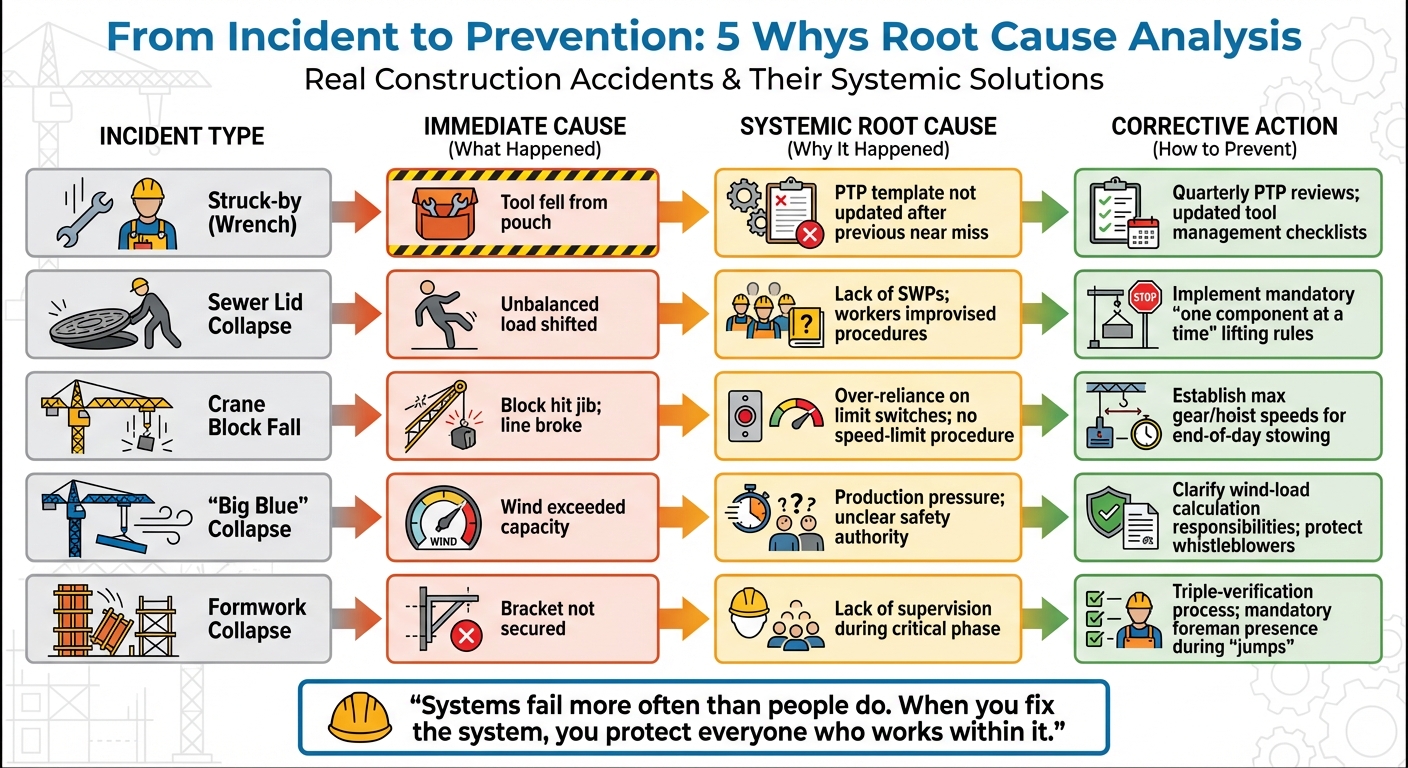
5 Whys Analysis: Construction Accident Root Causes and Corrective Actions
Case studies consistently show that stopping at "worker error" oversimplifies the problem and hides deeper systemic flaws. When you dig deeper, it’s clear that many incidents stem from broader organizational issues rather than individual mistakes. For instance, a worker improvising rigging often signals the absence of formal Safe Work Procedures (SWPs). Similarly, when a crane operator works in high winds, it’s usually due to unclear safety guidelines or pressure to meet production deadlines.
"Systems fail more often than people do. When you fix the system, you protect everyone who works within it." – Safety Mojo
Three recurring patterns stand out across these incidents:
- Training Gaps: Workers are sometimes assigned high-risk tasks without the necessary specialized training.
- Procedural Failures: Pre-Task Plans (PTPs) and safety templates are often not updated after near misses, increasing the likelihood of repeat incidents.
- Lack of Oversight: Prime contractors may prioritize operational progress over ensuring subcontractors have robust safety protocols in place.
The most effective solutions address these systemic issues head-on. Instead of placing blame on individual workers, companies can implement measures like quarterly updates to PTP templates, assigning clear responsibility for procedure revisions, and introducing triple-verification processes for life-critical tasks. These changes not only reduce risks but also create a safer environment for future workers. These lessons highlight the importance of tools that can identify systemic problems and streamline the corrective actions needed to address them.
Below is a table summarizing the key issues and their corresponding corrective actions:
Comparison Table: Root Causes and Corrective Actions
| Incident | Immediate Cause | Systemic Root Cause | Corrective Action |
|---|---|---|---|
| Struck-by (Wrench) | Tool fell from pouch | PTP template not updated after previous near miss | Quarterly PTP reviews; updated tool management checklists |
| Sewer Lid Collapse | Unbalanced load shifted | Lack of SWPs; workers improvised procedures | Implement mandatory "one component at a time" lifting rules |
| Crane Block Fall | Block hit jib; line broke | Over-reliance on limit switches; no speed-limit procedure | Establish max gear/hoist speeds for end-of-day stowing |
| "Big Blue" Collapse | Wind exceeded capacity | Production pressure; unclear safety authority | Clarify wind-load calculation responsibilities; protect whistleblowers |
| Formwork Collapse | Bracket not secured | Lack of supervision during critical phase | Triple-verification process; mandatory foreman presence during "jumps" |
How Technology Supports Safety and Root Cause Analysis
Technology has become a cornerstone in advancing safety measures, particularly when addressing systemic failures uncovered through 5 Whys investigations. For example, if an analysis reveals issues like missing certifications or inadequate supervision, modern tools can step in to ensure these problems don’t resurface. This is crucial in industries like construction, where 80% of structural collapses are linked to human errors. Yet, many companies still rely on outdated manual processes, which can inadvertently assign unqualified workers to high-risk tasks.
The shift to AI-driven safety solutions has been transformative. Companies using these systems report incident reductions of 40% to 50%. Unlike traditional methods that focus on documenting incidents after they occur, these technologies act proactively, preventing issues in real time. For instance, if an investigation reveals that a worker lacked proper rigging training, digital platforms can block uncertified personnel from being assigned to similar tasks, closing the gap before it becomes a hazard. By addressing root causes like training and certification lapses, technology ensures that corrective measures are consistently applied.
"Technology plays a critical role in streamlining safety through innovations that start far before boots hit the ground on the job site."
- Konnor Kamm, Field Safety Specialist, Riley Construction
Digital dashboards further enhance safety by offering real-time insights into workers’ credentials, training statuses, and task assignments. This allows contractors to confirm, even before work begins, that everyone on-site has the necessary certifications for their roles, such as operating cranes or performing critical lifts.
Using ABLEMKR for Safer Construction Projects
Platforms like ABLEMKR showcase how technology can address systemic safety challenges identified in 5 Whys investigations. ABLEMKR ensures that only pre-vetted workers with the right certifications, safety training, and availability are assigned to high-risk tasks, factoring in their geo-location as well. This approach directly addresses issues like those highlighted in a June 2020 WorkSafeBC investigation, where a fatal rigging accident was traced to insufficient training and oversight. ABLEMKR’s verification system is designed to prevent such tragedies.
One of the platform’s standout features is its real-time visibility into worker status. Project managers can instantly check which certifications are valid or about to expire and confirm whether required safety training has been completed. This functionality transforms 5 Whys corrective actions into enforceable protocols. If an investigation calls for new certifications for specific tasks, ABLEMKR can update job requirements across all projects, ensuring that only qualified workers are dispatched moving forward.
Communication gaps, often a weak point in manual safety processes, are also addressed. When Pre-Task Plans are updated following a near-miss investigation, the platform automatically pushes these changes to workers’ mobile devices, eliminating the delays and errors that come with manual updates. For contractors managing multiple sites, this ensures consistent safety standards across all locations, regardless of geography or subcontractor involvement.
Designed for high-risk industries like construction, oil & gas, mining, and utilities, ABLEMKR provides a dual benefit: workers gain access to well-paying jobs that align with their verified skills, while employers can trust that everyone on-site meets the safety requirements specific to their projects. This alignment not only reduces risks but also builds confidence in the workforce and the systems supporting them.
Conclusion
Case studies show that the 5 Whys method shifts the focus away from blaming individuals and toward addressing systemic problems. For instance, investigations often reveal that issues like outdated Pre-Task Plans or unclear oversight are the real culprits behind incidents – not worker negligence. This highlights a key principle: systems are more likely to fail than people.
The strength of the 5 Whys method lies in its ability to uncover patterns that manual processes might miss. By tracking these findings over time, companies can tackle recurring problems before they lead to serious injuries.
Technology has become an important tool for reinforcing these systemic improvements. For example, when a 5 Whys investigation identifies gaps in training or certification, tools like ABLEMKR ensure that only certified and pre-vetted workers are assigned to high-risk tasks. With real-time visibility into worker qualifications, project managers can verify skills before work begins, reducing the risk of incidents. Combining thorough investigations with proactive technology creates a foundation for safer construction practices.
FAQs
How do you write a good 5 Whys problem statement for an incident?
Start by clearly defining the specific problem or incident you’re analyzing. The goal is to pinpoint the root cause by repeatedly asking "why" – typically five times. For example, if the issue is "Worker slipped on wet floor", you would dig deeper with each "why" to uncover the true cause. This might lead you to discover that poor gutter maintenance caused water to accumulate on the floor.
Clarity and precision are key. Make sure each step logically connects to the next, and avoid vague or overly broad answers. The more specific and focused your problem statement, the easier it will be to identify actionable solutions.
When should you stop asking “why” in a 5 Whys investigation?
When you’ve identified the core reason behind a problem, or when additional questioning stops revealing useful insights, it’s time to stop asking "why." The aim is to dig deep enough to uncover answers that lead to clear, actionable steps – without going in circles.
How can ABLEMKR help prevent repeat incidents after a 5 Whys review?
ABLEMKR simplifies the process of documenting root cause analyses and managing follow-ups, helping to reduce repeat incidents. The platform records detailed insights from 5 Whys reviews, monitors corrective actions, and ensures they are carried out effectively. It also provides real-time updates on worker status, safety training, and compliance. By enforcing safety measures across job sites, ABLEMKR promotes a safer workplace and encourages ongoing safety improvements by learning from past incidents.


