
The energy transition is reshaping workforce demands, with renewable energy projects requiring a variety of skills across development, construction, and operations. The U.S. alone may need millions of workers in this sector by 2030. To meet these demands, businesses must address skill gaps, regional labor shortages, and compliance challenges early. Here’s how to plan effectively:
- Define Project Scope: Outline project size, location, and timelines to estimate labor needs.
- Break Down Workforce by Phases: Identify staffing needs for development, design, construction, commissioning, and maintenance.
- Close Skill Gaps: Conduct a gap analysis and implement training or recruitment strategies.
- Address Regional Differences: Analyze local labor markets to balance supply and demand.
- Leverage Data Tools: Use predictive analytics and platforms like ABLEMKR for efficient workforce management.
- Build Diverse Teams: Simplify hiring requirements, partner with local training programs, and create clear career pathways.
Efficient workforce planning ensures projects stay on schedule and within budget, while also supporting long-term renewable energy goals.
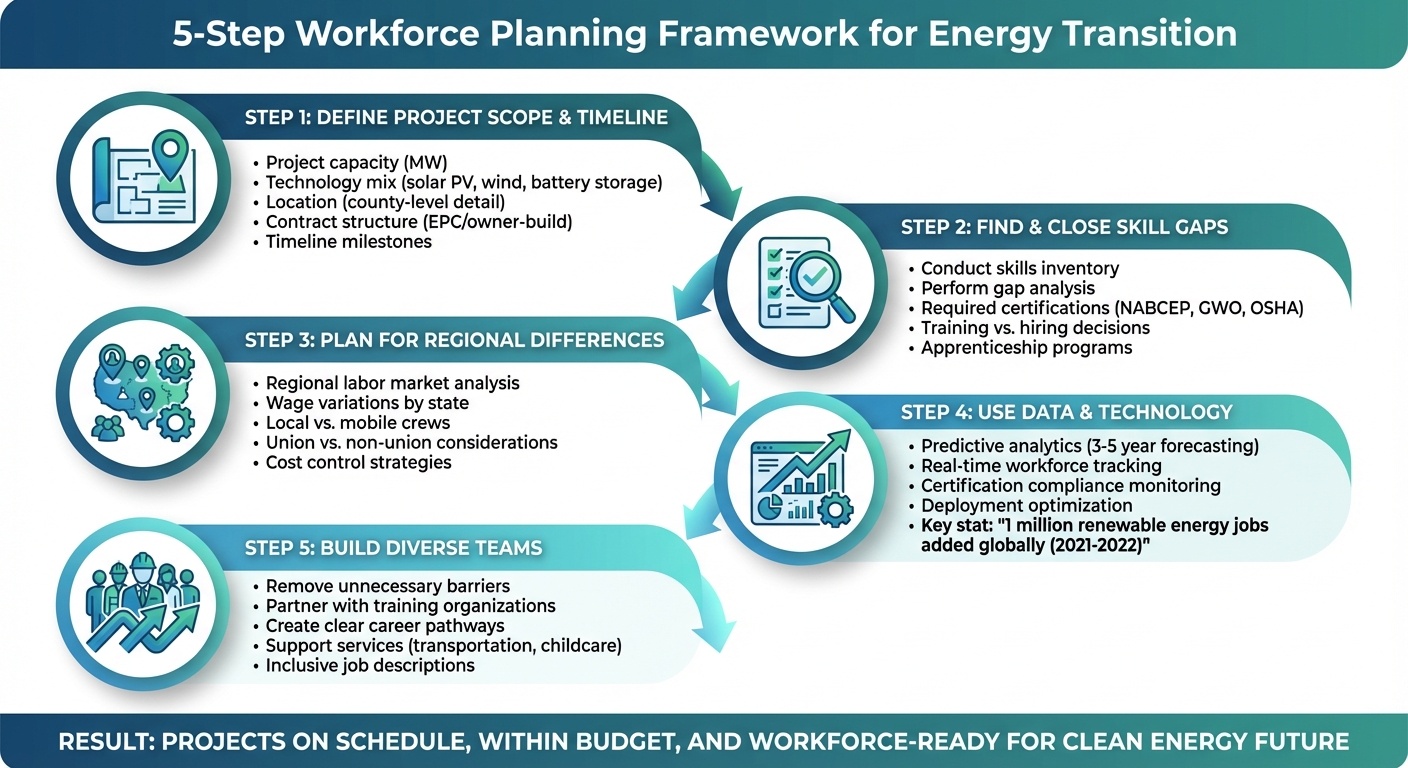
5-Step Workforce Planning Framework for Energy Transition Projects
Tackling workforce planning in renewables with Victoria Gilbert | Taylor Hopkinson

Step 1: Define Your Project Scope and Timeline
Start by outlining the core details of your energy project. Determine your installed capacity – whether it’s a 150 MW utility-scale solar farm or a 200 MW onshore wind project – and clarify whether the project involves new construction, repowering, or expansion. Identify your technology mix – solar PV, onshore wind, battery storage, or grid upgrades – as each option demands different levels of labor and specific skill sets.
The project’s location is crucial. Pinpoint the site down to the county level to account for factors like local labor availability, union versus non-union labor conditions, prevailing wage requirements, permitting processes, and site access challenges. For instance, workforce logistics for a remote desert site will differ greatly from those for a location near a major city. Also, consider your contract structure – whether you’re using an EPC contractor, multiple prime contractors, or an owner-build approach – as this will influence the balance between in-house and subcontracted labor.
Finally, create a realistic timeline with key milestones: notice to proceed, start of civil works, mechanical completion, commissioning, and the commercial operation date. These milestones dictate when various trades need to mobilize and demobilize, and they help you estimate crew sizes required to meet deadlines tied to financial and regulatory obligations.
Break Down Workforce Needs by Project Phase
Organize your workforce planning by project phases, detailing the specific staffing needs at each stage.
- Development Phase: This phase typically requires smaller, specialized teams, including project developers, permitting experts, environmental scientists, community engagement staff, and interconnection specialists. For a large project, this might involve 5–20 full-time employees, with activity peaking during permitting hearings and grid studies.
- Engineering and Design Phase: This phase ramps up with electrical and civil engineers, CAD/BIM technicians, and grid interconnection engineers. Staffing in this phase often involves dozens of team members, many of whom may work across multiple projects. Procurement efforts also begin to overlap here, involving category managers, contract specialists, logistics coordinators, and quality inspectors.
- Construction Phase: Labor demand skyrockets during construction. Key roles include site supervisors, safety managers, equipment operators, electricians, pile drivers, ironworkers, crane operators, and general laborers. For large solar or wind sites, hundreds of workers may be needed, with demand peaking during mechanical installation.
- Commissioning Phase: This phase requires fewer workers than peak construction but involves highly skilled roles, such as test engineers, control technicians, SCADA specialists, and utility interface staff.
- Operations and Maintenance (O&M): After the project is operational, staffing levels stabilize for the long term. A small team of site managers, technicians, and asset management staff typically manages O&M, often measured as a few full-time employees per MW.
Using tools like Gantt charts can help visualize labor demand across phases, highlighting peak periods and potential overlaps. This also helps ensure smooth transitions between phases.
Apply Industry Benchmarks to Estimate Staffing
To estimate staffing needs, start with labor metrics, such as hours per MW or per major component (e.g., person-hours per turbine erected or inverter installed). Industry benchmarks and workforce planning tools often provide ratios, like construction job-years per MW installed or O&M staffing levels (e.g., technicians per 50–100 MW of wind capacity).
Multiply these benchmarks by your project’s scope – whether it’s the number of turbines, panels, or foundations – to calculate total labor hours for each trade. Divide those hours by weekly working hours to estimate crew sizes and project duration. For example, utility-scale solar projects often require thousands of labor hours per MW, while onshore wind projects might use metrics based on labor hours per turbine or MW of capacity.
However, benchmarks should be tailored to your specific conditions. Factors like technology type (e.g., fixed-tilt versus trackers, taller turbines, hybrid solar-storage systems), regional productivity levels, union agreements, and design complexities (e.g., underground collection systems or challenging foundation conditions) can all impact labor needs. Start with published or internal benchmarks, then refine them using data from recent local projects. Sensitivity analyses (±10–20%) can help account for potential delays or disruptions, such as weather or supply chain issues.
Early in the pre-construction phase, consider hosting workforce planning workshops. These sessions bring together key stakeholders, such as EPC estimators, field superintendents, union or trade representatives, local workforce boards, and training providers. EPC teams can offer detailed productivity assumptions, unions can guide crew composition and apprenticeship ratios, and workforce boards can provide insights into regional talent pools and training pipelines. The outcome is a workforce plan that aligns with both the project’s timeline and local labor conditions, ensuring a smooth path forward.
Step 2: Find and Close Skill Gaps
Once you’ve outlined your project phases and staffing needs, it’s time to evaluate your team’s current skills against the demands of the project. This process, often called a gap analysis, helps you decide whether to train your existing workforce, hire new talent, or do both. Start by building a skills inventory for your team. Document each employee’s job title, certifications, technical expertise, years of experience, and unique capabilities. Then, compare this inventory to the skills your renewable energy project requires. For instance, if your project needs 50 NABCEP-certified solar installation technicians but you only have 15, you’ve identified a gap of 35 positions that need to be addressed right away. Focus first on gaps that could impact critical project milestones or compliance.
When prioritizing, look at which skill gaps are most urgent. For example, if 80% of your team lacks grid integration knowledge but only 10% lacks advanced wind turbine diagnostic skills, it makes sense to focus on grid integration first – it has a bigger impact on your overall project. Consider cost and feasibility when deciding how to close these gaps. Skills that are hard to source externally or where you already have a strong internal base are ideal for training programs. On the other hand, highly specialized roles with limited internal candidates may require external recruitment.
Match Skills to Project Needs
For each key role in your renewable energy project, create a detailed list of required skills and certifications. For example:
- Solar panel technicians: NABCEP Solar PV Installation Professional certification, OSHA 30-Hour Construction Safety credentials, and manufacturer-specific certifications.
- Wind turbine specialists: Global Wind Organisation (GWO) Basic Safety Training and relevant manufacturer certifications.
- Grid engineers: Professional engineering licenses (PE) and certifications in grid modernization technologies.
Include both technical skills (e.g., electrical systems expertise, renewable technology operation, equipment maintenance) and soft skills (e.g., project management, safety protocols, communication). This approach not only helps you fill immediate gaps but also identifies potential leaders and employees suited for adjacent roles. For workers transitioning from fossil fuel industries, focus on their transferable skills. For example, a coal plant electrician likely has a solid foundation in electrical systems but may need training in photovoltaic systems, DC electrical safety, and solar troubleshooting.
Develop Training Programs to Reskill Your Workforce
Addressing skill gaps is key to meeting the workforce requirements you outlined earlier. Training programs are often more cost-effective than external hiring, especially when you can retain and upskill experienced team members. Design these programs to cover renewable energy fundamentals, equipment-specific operations, safety protocols, and updated electrical systems knowledge. Collaborate with industry experts and educational institutions to ensure your training aligns with current industry needs.
Registered apprenticeship programs are an excellent way to build a skilled and diverse workforce. For example, the Interstate Renewable Energy Council (IREC) has supported hundreds of employers in improving recruitment and has connected over 1,000 individuals to clean energy apprenticeships. These programs combine classroom learning with hands-on experience, allowing workers to earn while they learn. For urgent staffing needs, consider platforms like ABLEMKR (https://ablemkr.com), which connects you with pre-vetted professionals who already have the certifications and skills necessary for energy projects. This "hire now, train later" approach can fill immediate gaps while you develop a long-term talent pipeline.
Encourage employees to achieve certifications by covering exam fees, providing study materials, offering paid prep time, and reimbursing tuition costs. Create a clear roadmap that outlines required credentials for each role and realistic timelines for achieving them. Use workforce management systems to track progress, manage renewal deadlines, and ensure compliance. Measure the success of your training programs by monitoring metrics like completion rates, time-to-productivity for newly trained workers, retention rates, and improvements in safety and project timelines.
Step 3: Plan for Regional Workforce Differences
Once you’ve identified the specific skill gaps for your project, it’s time to factor in regional workforce variations. The location of your project plays a huge role in shaping workforce needs for energy transition initiatives. For example, staffing a solar project in Arizona comes with different challenges compared to an offshore wind farm in Massachusetts or a battery storage facility in Texas. The Southwest may need a large number of solar installers, but training programs in the area are often limited. On the other hand, Gulf Coast states have a strong pool of oil and gas workers with transferable skills like welding and rigging. However, many of these workers may still need extra training or certifications to meet renewable energy standards. Addressing these regional differences early can help you avoid costly delays and keep your project within budget. A thorough analysis of regional labor markets can help you better balance local supply and demand.
Balance Workforce Supply and Demand Across Regions
To start, conduct a detailed labor market analysis for each project location. Use resources like BLS data, state workforce boards, and industry reports to identify where skilled workers are concentrated compared to where your projects are located. For instance, if you’re planning a wind energy project in Oklahoma, you might discover an abundance of local electricians and welders but a shortage of turbine technicians. In such cases, you could bring in experienced technicians from nearby regions like Texas or the Midwest while simultaneously investing in local training programs to build a sustainable talent pool for future needs.
Creating regional talent maps can also streamline this process. These maps can visually highlight the availability of key roles – such as electricians, project managers, and safety coordinators – in each area where you’re operating. This approach makes it easier to identify gaps and decide whether to hire locally, bring in mobile crews, or collaborate with regional training providers. Tools like ABLEMKR can further simplify the process by helping you locate pre-vetted, certified workers with geo-location and availability tracking. This is particularly useful when you need to quickly mobilize crews for remote sites or during peak construction periods.
Control Costs Through Regional Planning
Managing costs is just as important as finding skilled labor. Regional wage differences can significantly impact your project budget. For example, electrician wages in California are much higher than in Texas, and these differences grow when you factor in travel expenses, per diem rates, and temporary housing for workers brought in from other regions. Rural renewable energy sites often face additional costs for accommodations and transportation that urban projects might avoid. Additionally, factors like local taxes, workers’ compensation rates, and the presence of union versus non-union labor can vary widely depending on the state.
Strategic regional planning can help you keep these costs under control. Use regional wage surveys to set realistic budgets for each location, and focus on regions where skilled labor is both available and more affordable. For example, some solar developers have established regional operations centers in states like Georgia or North Carolina to support multiple projects across the Southeast. This approach reduces travel and lodging expenses. For specialized roles that can’t be filled locally, weigh the total cost of bringing in external workers against the long-term advantages of investing in local training programs.
sbb-itb-aa28329
Step 4: Use Data to Plan Your Workforce
After analyzing regional workforce trends, the next step is to leverage data and technology to fine-tune your staffing plans. The pace of growth in the renewable energy sector is staggering – one million jobs were added globally between 2021 and 2022, bringing the total to 13.7 million renewable energy jobs worldwide. This kind of rapid expansion demands a precise and forward-thinking strategy. By using data-driven planning, you can predict skill shortages before they disrupt your projects, focus recruitment efforts in the right areas, and efficiently allocate workers across multiple sites. Accurate forecasting not only saves time but also avoids costly delays, refining your overall workforce strategy.
Apply Predictive Analytics for Better Planning
Predictive analytics allows you to take historical project data, labor market trends, and future timelines to forecast exactly when and where specific skills will be needed. Instead of reacting to delays, you can plan workforce needs three to five years in advance. This proactive approach lets you simulate different scenarios and make adjustments to staffing plans as needed.
Start by centralizing your workforce data. Gather information from HR systems, training and certification records, project schedules, and external labor reports. Then, enhance this with regional data on wages, attrition rates, and demographics to get a full picture. For instance, if your capital plan involves retiring a coal plant in West Virginia and constructing a battery storage facility in Nevada over the next four years, predictive models can estimate how many electricians, project managers, and safety coordinators you’ll need in each location – and when. With this insight, you can decide whether to hire locally, invest in reskilling programs for displaced coal workers, or bring in mobile crews from nearby states.
Treat workforce planning as an ongoing process. Use dashboards to monitor key metrics like time-to-fill for critical roles, overtime hours, training completion rates, and delays caused by labor shortages. Review these metrics quarterly to adjust forecasts as new projects are approved or timelines shift. This feedback loop ensures your plans stay aligned with real-world conditions and helps you address potential problems early.
Once you’ve developed a clear forecast, the next challenge is deploying your workforce efficiently.
Use ABLEMKR for Workforce Management
After forecasting your workforce needs, the focus shifts to deploying the right workers to the right projects quickly and effectively. ABLEMKR’s platform simplifies this process by matching pre-vetted workers to your energy projects based on their certifications, safety training, location, and availability. This eliminates the need for time-consuming manual searches.
The platform offers real-time insights into worker availability, certifications, and deployment status. This is especially useful during peak construction periods or emergencies when crews need to be mobilized within hours. ABLEMKR also tracks compliance, ensuring all required certifications are verified before workers enter a site, which reduces regulatory risks and improves safety. Additionally, the platform handles onboarding paperwork and payroll processes, cutting administrative delays and getting workers productive faster.
For energy companies managing projects across multiple states, ABLEMKR turns workforce management from a logistical challenge into a seamless operation. By combining accurate forecasting with streamlined deployment, this approach ensures smooth execution and keeps your projects on track.
Step 5: Build Diverse and Inclusive Teams
Once you’ve streamlined your data-driven workforce planning, the next step is to focus on building teams that reflect the diversity of the communities they serve. This is especially important for renewable energy projects, where timely and cost-effective execution depends on collaboration and innovation. Diverse teams bring a broader range of perspectives, which can lead to better problem-solving and improved outcomes for complex projects like grid modernization, utility-scale solar installations, and offshore wind farms. They are also better equipped to identify local safety risks and address community-specific concerns. Beyond the clear business advantages, many federal and state climate programs now emphasize workforce equity, incorporating requirements for local hiring and apprenticeships. Meeting these expectations can enhance your eligibility for incentives and reduce compliance risks. By combining inclusive practices with technical workforce planning, you can address local talent gaps while building a stronger team.
Recruit and Train Underrepresented Groups
Start by revisiting your job requirements. Focus only on essential skills and remove unnecessary degree or experience thresholds that might exclude qualified candidates from community colleges, trade schools, or military backgrounds. Transparency is key – include clear pay ranges and benefits in your job postings to attract a wider pool of candidates. Use inclusive language and imagery in your listings. For example, swap out terms like "lineman" for "lineworker" to ensure your messaging resonates with a broader audience.
To connect with diverse talent, partner with organizations that specialize in workforce development. Community colleges, technical schools, apprenticeship programs, veterans’ services, and local nonprofits can help create direct pipelines into renewable energy roles like solar, wind, and battery projects. Consider offering alternative pathways, such as paid trainee positions with on-the-job training. These programs allow workers to earn while they learn, making roles more accessible. For positions that are in high demand across multiple sites, use platforms that can source pre-vetted workers from different regions while keeping track of their certifications and safety training requirements.
Retention is just as important as recruitment. Support services like transportation assistance, personal protective equipment (PPE), childcare, and mentorship programs can make a huge difference, particularly for women and workers with caregiving responsibilities. Ensure that your training programs align with industry-recognized credentials, such as OSHA-10/30, NABCEP for solar, or NCCER certifications. Don’t overlook soft skills like communication, teamwork, and digital literacy, which are just as critical for long-term success.
Once you’ve built a strong recruitment and training pipeline, the next step is to provide clear career pathways that help diverse hires grow and thrive within your organization.
Establish Clear Career Pathways
For workers to commit to a role, they need to see more than just a short-term job – they need a clear vision of their future. Create defined career ladders that outline progression opportunities, such as moving from Laborer to Installer I, then to Installer II, Crew Lead, and eventually Site Superintendent. During onboarding and team meetings, provide visual career maps that highlight both vertical and lateral progression. For example, a wind technician might transition into roles like SCADA technician or safety specialist.
Make the path to advancement transparent by listing the skills, certifications, and courses required for each step. Offer tuition assistance or paid training to support workers in gaining these qualifications. Regular performance and development discussions between supervisors and employees can help clarify advancement steps, expected competencies, and timelines, reducing uncertainty. Additionally, project-to-project continuity plans can keep workers engaged by identifying upcoming opportunities and arranging for seamless transitions between sites. This approach minimizes downtime and provides more predictable income, making renewable energy roles more appealing to workers transitioning from fossil fuel industries.
Conclusion
Preparing your workforce for the energy transition requires a forward-thinking approach that looks years ahead. By outlining your project’s scope and timeline early on, you can map out staffing needs for each phase and use industry benchmarks to avoid delays, cost overruns, and the pitfalls of reactive hiring. The U.S. Department of Energy calls the clean energy transformation a "once-in-a-generation opportunity" to create quality jobs and revitalize the energy workforce. However, only organizations with a well-structured plan will be in a position to seize that opportunity.
Closing skill gaps early is crucial, especially for workers transitioning from fossil fuel industries. Investing in reskilling programs builds a team that’s ready for renewable energy projects. Pair this with regional hiring strategies that tap into local labor markets, training resources, and incentives, and you’ll not only manage costs effectively but also strengthen the economic foundations of the surrounding community.
A data-driven approach is key to staying ahead. Predictive analytics can project workforce needs over several years, simulate different scenarios based on policy or technological changes, and help you adapt plans as conditions evolve. Tools like ABLEMKR are invaluable in high-demand sectors like energy and utilities, offering real-time workforce matching based on certifications, availability, and location. These platforms ensure compliance, improve visibility, and speed up mobilization when timing is critical.
Diversity is another cornerstone of a strong workforce strategy. By removing barriers like transportation challenges, lack of childcare, and unnecessary credential requirements, and by creating clear career development paths, organizations can offer employees more than just a job – they can offer a future. These efforts not only expand your talent pool but also fuel innovation.
Workforce planning for the energy transition isn’t a one-time task; it’s an ongoing commitment. By tracking metrics like vacancy rates, time-to-fill, and retention, you can continuously refine your strategies and position your organization to lead the next chapter in energy development. Together, these strategies create a solid foundation for a workforce ready to meet the demands of a cleaner energy future.
FAQs
How can businesses close skill gaps in the energy transition workforce?
Businesses looking to address skill gaps in the energy transition workforce have options that can make a big difference. Platforms like ABLEMKR provide a practical solution by connecting employers with pre-vetted, certified professionals who are ready to tackle specific project needs. This approach allows companies to quickly bring on skilled workers, even for projects in high-demand or remote locations.
Another effective strategy is investing in targeted training programs and certifications to enhance the skills of existing employees. To tackle immediate needs, businesses can explore flexible staffing solutions, such as temporary or project-based hiring. This ensures they can fill critical roles without disrupting overall operations.
Why is regional labor market analysis important for workforce planning in energy projects?
Regional labor market analysis plays a key role in pinpointing local skill availability, spotting current demand trends, and identifying potential skill gaps. With this knowledge, energy projects can develop focused strategies to recruit, train, and deploy workers effectively, helping keep timelines on track.
By diving into regional labor dynamics, companies gain the ability to predict workforce needs, tackle labor shortages before they become issues, and mobilize crews efficiently for critical tasks. This not only helps manage costs but also ensures the right talent is in place exactly when it’s needed.
How does predictive analytics support workforce planning in renewable energy?
Predictive analytics plays a key role in improving workforce planning in the renewable energy sector by offering data-backed insights into future labor requirements. It allows companies to anticipate the demand for skilled professionals, pinpoint where skill shortages might arise, and allocate resources more efficiently.
With predictive models, organizations can take a proactive approach to hiring and training, ensuring they have the right talent in place. This not only helps keep projects on track and within budget but also enhances how teams are deployed, whether for immediate tasks or long-term renewable energy goals.


