
Before I approve a pipeline assignment, I check the worker’s qualifications for each covered task – not their job title. Under 49 CFR Parts 192 and 195, the operator remains responsible for that check, including when contractors supply the workers.
I use three steps to keep assignment decisions clear:
- Map the work: Match each activity to the operator’s covered-task list.
- Check the records: Verify identity, task scope, evaluation results, abnormal-condition response, and reevaluation dates. Resolve gaps before independent work.
- Approve the assignment: Use staffing software to support review – not replace it – and document the authorized reviewer’s decision.
Training and availability alone do not establish qualification. I also recheck approvals when work or qualifications change and retain prior qualification records for five years, as required. The rule I follow: <u>match the worker to the task before dispatch.</u>
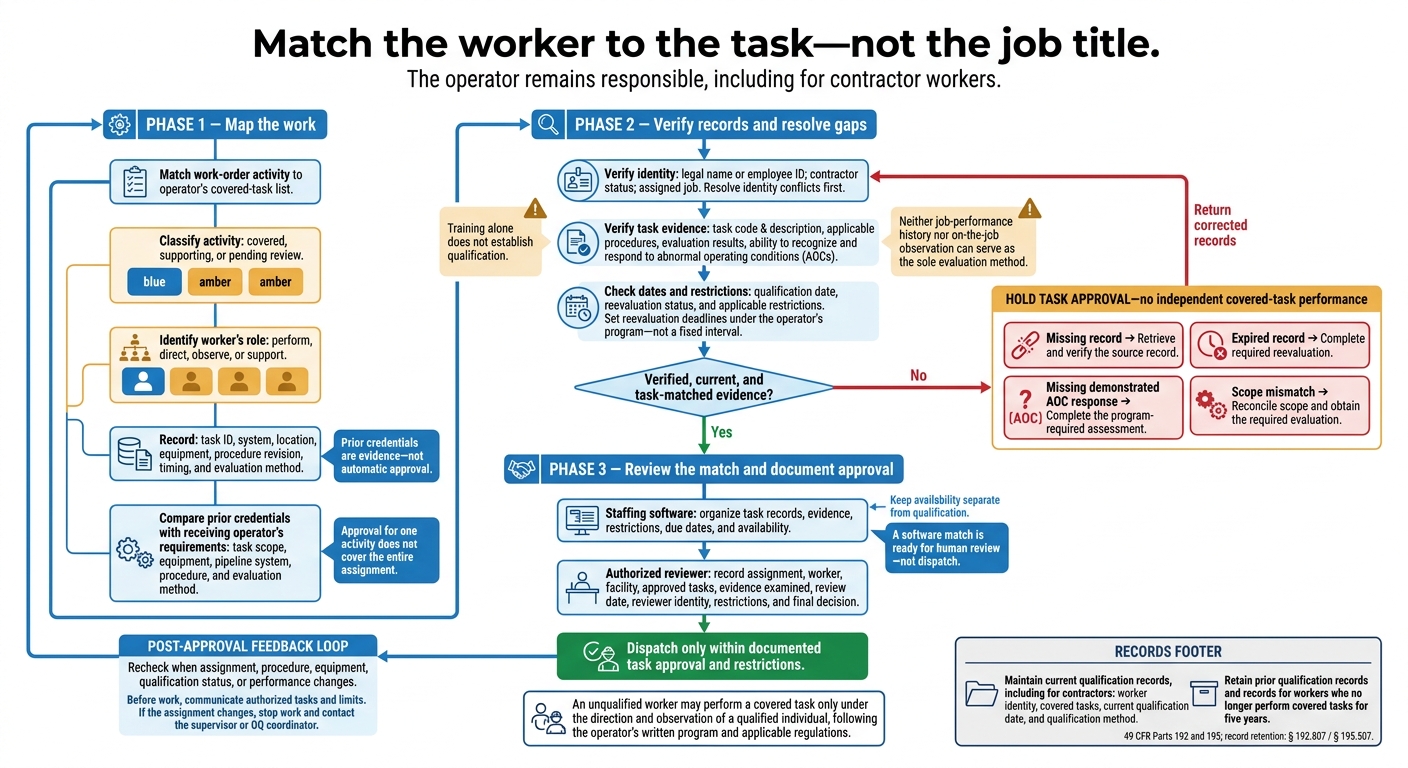
Pipeline OQ Task Coverage: Approval Before Dispatch
2022 CPUC Pipeline Safety Seminar – Part 5 – Understanding OQ Requirements (August 2022)
sbb-itb-aa28329
Step 1: Map Assignments to Covered Tasks
Map each work order to the covered-task list before assigning workers. Job titles do not establish task qualification.
Build a worksheet using the operator’s covered-task list and procedures. List each activity separately, mark it covered, supporting, or pending review, and state whether the worker will perform, direct, observe, or support it.
List Task Requirements Before Selecting Workers
Record the task ID, system, location, equipment, procedure revision, timing, and evaluation method. Set clear task boundaries: approval for one activity does not cover the entire assignment. Qualification records must connect each worker to specific covered tasks, current qualification dates, and qualification methods.
Examples are hypothetical. Replace them with the receiving operator’s task codes and requirements.
Job assignment Covered-task ID and description Applicable pipeline system Procedure Required qualification evidence Emergency gas-line repair GT-04: Isolate and verify a gas-line segment Natural-gas transmission Current isolation and lockout procedure Current task qualification, passing evaluation record, and abnormal-condition response evidence Valve-station maintenance VS-02: Operate and return a mainline valve to service Gas transmission valve station Valve-operation and return-to-service procedure Task-specific evaluation, current qualification date, and procedure-training record Pipeline excavation support Supporting work: excavation, access, and spoil-placement controls Worksite adjacent to pipeline Excavation, damage-prevention, and site-safety procedures Excavation-competent-person or site-required evidence; not automatically OQ qualification
Keep non-OQ permits and authorizations separate from task qualification. Classify excavation by its scope, not its label. Then use the worksheet to compare each worker’s records with the task requirements.
Check Whether Prior Credentials Meet Requirements
Treat prior credentials as evidence, not automatic approval. Compare the previous task’s scope, equipment, pipeline system, procedure, and evaluation method with the receiving operator’s requirements. Verify the worker’s identity, credential date, evaluator, restrictions, and requalification status. A welding credential or familiar job title alone does not establish OQ qualification. Qualification also addresses the ability to recognize and respond to abnormal operating conditions.
Clear workers for assignment only after confirming a task-by-task record match. If the records do not show an acceptable match, mark the worker pending review and identify the missing evidence. Get operator approval or the required evaluation before allowing independent performance. Apply this review to employees, contractors, subcontractors, and mutual-aid personnel.
Route unmatched records to gap review – not dispatch – regardless of job title.
Step 2: Verify Qualifications and Resolve Gaps
Review every pending match from Step 1, one record at a time. Confirm the record belongs to the worker before checking qualifications. Match the legal name or employee ID, then verify contractor status and the assigned job. Resolve identity conflicts before accepting qualification evidence. Only verified records can move to assignment approval.
Review Qualification Evidence for Each Task
Check the documented evaluation. Evaluation methods may include written or oral examinations, a review of job-performance history, observation, or simulation. Review the task code and description, applicable procedures, results, and evidence that the worker can recognize and respond to abnormal operating conditions (AOCs). Neither job-performance history nor on-the-job observation can serve as the sole evaluation method.
Use this format for each required task. Enter actual dates from validated records, and calculate reevaluation deadlines under the operator’s program – not a fixed interval.
| Required task | Record status | Task evidence reviewed | Qualification date | Reevaluation due date where applicable | Decision |
|---|---|---|---|---|---|
| Complete record | Verified | Written or oral evaluation, procedure alignment, and AOC assessment | Validated record date | Operator-program deadline | Approve only the documented scope |
| Missing record | Incomplete | Available record; identify missing result, date, or assessment | Record date, if validated | Confirm before approval | Hold task approval |
| Expired record | Expired | Prior qualification and reevaluation requirement | Prior record date | Overdue deadline | Require reevaluation |
| Scope mismatch | Unacceptable or mismatched | Record compared with required task and procedure | Date on reviewed record | Does not resolve scope mismatch | Reject evidence for this task |
Set Actions to Close Qualification Gaps
Separate missing records from missing skill. Retrieve and validate existing evaluation records before assigning more training. If the worker has not demonstrated the required knowledge, skill, task performance, or AOC response, arrange the required assessment and any preparation needed. Training alone does not qualify a worker to perform covered tasks independently.
For records that fail review, assign a corrective action before dispatch.
| Missing requirement | Corrective action | Responsible reviewer | Target completion date | Assignment restriction |
|---|---|---|---|---|
| Evaluation record or required signature | Retrieve and verify the source record | OQ coordinator | Before task approval | No independent covered-task performance |
| Current reevaluation | Complete the required reevaluation | Authorized evaluator | Before dispatch to the task | Remove from covered assignment |
| Demonstrated AOC response | Complete the program-required assessment | Authorized evaluator and operations supervisor | Before task approval | Non-covered support work only, if otherwise authorized |
| Correct task or procedure coverage | Reconcile scope and obtain the required evaluation | Compliance reviewer | Before assignment approval | No independent performance of the unmatched task |
Follow the operator’s approved process for failed evaluations, performance concerns, suspected falsification, and incident-related qualification concerns. The operator must evaluate a worker when it has reason to believe the person is no longer qualified or that their covered-task performance contributed to an incident. Keep assignment restrictions in place until the authorized reviewer documents the correction.
Step 3: Review Worker Matches With Staffing Software
Once records are verified, use staffing software to sort them by task and assignment. Each job record should identify the operator, facility, location, dates, supervisor, and every covered task the assignment requires. Link each task to its qualification standard, evaluation method, acceptance criteria, and supervision status.
For each worker, track the task, status, evaluation date, next due date, evaluator, evidence, restrictions, and availability. Keep availability separate from qualification: a software match is ready for human review – not dispatch.
Use ABLEMKR to Support Staffing Reviews
Staffing software must display that record structure before a match reaches dispatch. ABLEMKR matches pre-vetted workers using certifications, safety training, availability, and geolocation. Its status and compliance views can help with staffing reviews.
Before using ABLEMKR for an OQ review, confirm that it stores task IDs, evaluation methods, evidence files, approval history, expiration rules, and access controls. Reviewers must also have access to the source evidence behind every match.
Document Task Approval Before Dispatch
When the system flags a match, an authorized reviewer must make the final assignment decision. Under the operator’s written OQ program, the reviewer must record the assignment, worker, facility, approved tasks, evidence examined, review date, reviewer identity, restrictions, and final decision.
Use qualification filters and reevaluation reminders if the software supports them. Otherwise, follow a documented review process with a named owner. Set reminders to the operator’s intervals – not the software default.
Keep unresolved tasks out of independent assignment. An unqualified worker may perform a covered task only under the direction and observation of a qualified individual, following the operator’s written program and applicable regulations.
Conclusion: Keep Task Coverage Verified
After reviewing the software, match each assignment to covered tasks, check the records, and document approval before dispatch. Final approval must link the worker to the task – not the job title. Experience, training, and software matches alone do not prove task qualification.
Review Changes and Retain Qualification Records
Keep the approval record current as conditions change. Recheck coverage whenever an assignment, procedure, equipment, qualification status, or performance changes. Before work starts, explain each worker’s authorized tasks and limits. Instruct workers to stop work and contact their supervisor or OQ coordinator if the assignment changes.
Maintain current qualification records for everyone performing covered tasks, including contractors. Each record must identify the worker, covered tasks, current qualification date, and qualification method. Keep prior qualification records and records for workers who no longer perform covered tasks for five years, as required by 49 CFR § 192.807 for gas pipelines or § 195.507 for hazardous-liquid pipelines.
FAQs
How do I determine whether a pipeline task requires OQ?
Don’t rely on job titles. Match each job assignment to the tasks it covers, then list the credentials required for each task, including OQ.
ABLEMKR lets you publish trade and site credential requirements, then checks worker records against verified certification data, including expiration and verification status. These rule-based checks shortlist only workers who meet every requirement and help flag training gaps before you select workers.
When can I accept another operator’s OQ records?
You can accept another operator’s OQ records when they’re part of a pre-vetted worker’s verified profile and meet your project’s requirements. One-time vetting covers identity verification and certification tracking, allowing verified records to carry from job to job.
Use a system that filters for required credentials, including OQ, to check site-specific compliance before assigning workers – without restarting the compliance process for each job.
How can staffing software distinguish record gaps from training needs?
Staffing software tracks certification issue dates, expiration dates, and verification status. It flags missing, expired, or unverified records. Missing or expired required certifications automatically keep workers off shortlists for roles that require them.
Employers can review flagged records to check whether paperwork is missing or an otherwise qualified worker needs a specific safety certification. This helps them spot training gaps and budget for the development workers need.


