
Battery storage safety under OSHA comes down to three things: control gas, control electrical risk, and plan for fire. If you install, charge, inspect, commission, or maintain a stationary battery system, you need to match each task to the right OSHA rule, use PPE that fits the battery type, and keep records that show the site is being checked.
Here’s the short version:
- OSHA does not use one single battery storage standard. Employers often have to apply rules from 29 CFR 1910 or 29 CFR 1926, based on the work.
- Battery jobs can involve three hazards at once: electrical shock/arc flash, chemical exposure, and fire or thermal runaway.
- Ventilation is a core issue. Charging can release hydrogen, and some guidance targets gas levels below 25% of the lower flammability limit or 1.0% hydrogen by volume.
- Some battery tasks must be treated as energized work, especially when circuits cannot be fully shut down.
- Fire planning matters. NFPA 855 is often used for detection, suppression, explosion control, and thermal runaway planning.
- Training must be task-specific. General electrical training alone may not cover battery chemistry, leak response, SDS use, or overheating signs.
- Emergency gear must be on hand. Eyewash and body-flush stations, spill response steps, and clear access rules all matter.
- Paperwork is part of the job. Inspection logs, worker qualifications, hazard reviews, and system listings should stay current from start to finish.
If I had to sum up the article in one line, it would be this: battery storage compliance is less about one rule and more about making ventilation, electrical safety, fire controls, training, and documentation work together.
A few jobsite numbers stand out:
- 3 feet (914 mm) of space between arrays and walls
- 25% of LFL as a gas-control target
- 1.0% hydrogen by volume as another ventilation target
- Check listings such as UL 1973, UL 9540, UL 1564, and UL 1741 before energizing
This article is mainly about stationary battery storage systems on U.S. jobsites, not residential setups, and it focuses on what employers and crews need to do before work starts and while the work is being done.
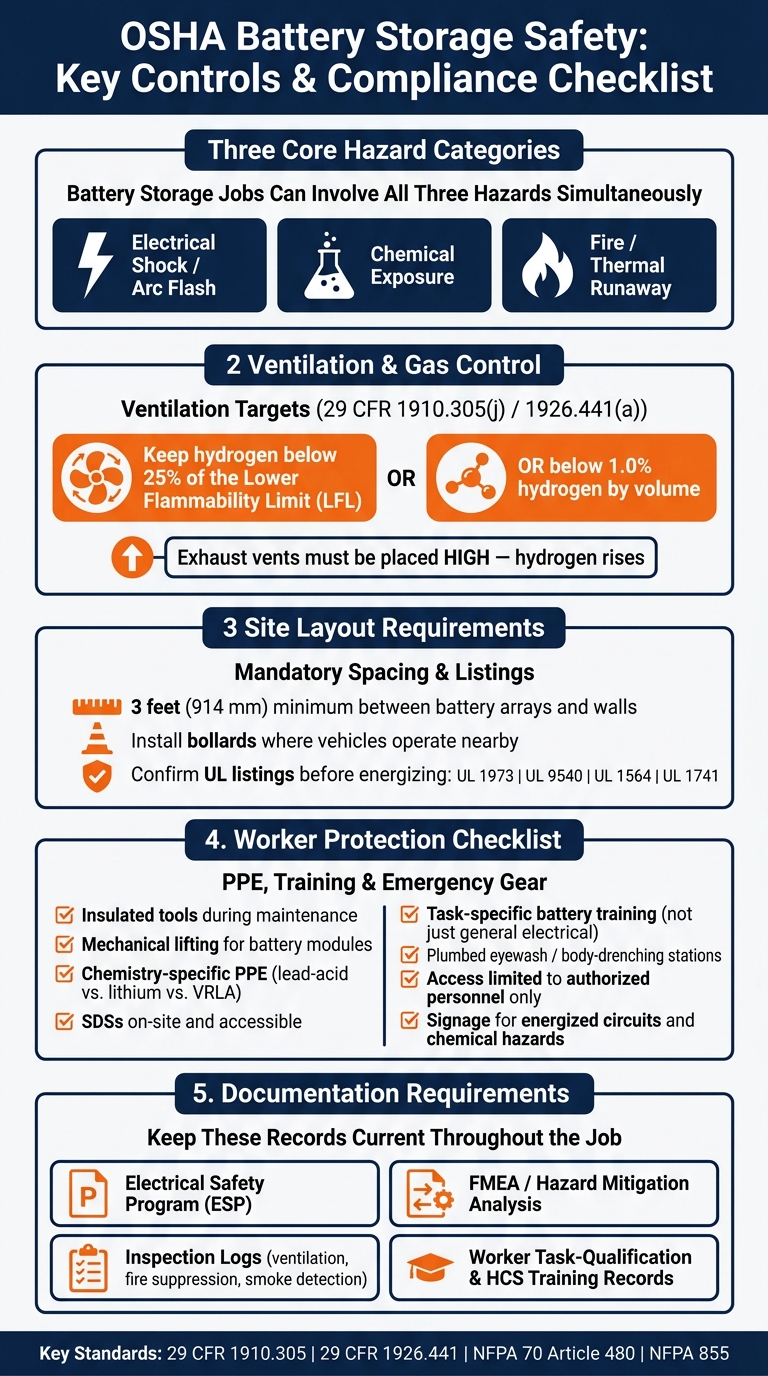
OSHA Battery Storage Safety: Key Controls & Compliance Checklist
Webinar: Energy Storage and Electrical Safety
sbb-itb-aa28329
Core OSHA Requirements for Battery Storage Installations
Battery storage compliance comes down to three things: ventilation, electrical safety, and fire control.
Ventilation and Gas Control Under OSHA Battery Rules
29 CFR 1910.305(j) says employers must provide ventilation that stops flammable gas from building up in battery rooms or enclosures. 29 CFR 1926.441(a) applies the same ventilation rule to construction sites.
Exhaust should be placed high in the room so hydrogen doesn’t collect near the ceiling, since hydrogen rises. Charging areas also need to stay free of ignition sources because batteries can give off hydrogen and oxygen while charging.
Once gas control is handled, the next step is reducing shock and arc-flash risk.
Electrical Safety, Grounding, and Lockout/Tagout Requirements
Use 29 CFR 1910.304(f) for grounding and bonding, and follow NFPA 70 Article 480 for battery installation details.
If equipment can’t be de-energized, treat the task as energized work. That means doing shock and arc-flash assessments and using lockout/tagout whenever circuits can be isolated.
After electrical controls are set, attention shifts to fire and thermal runaway.
Fire, Explosion, and Thermal Runaway Controls
NFPA 855 covers fire detection, suppression, explosion control, exhaust ventilation, gas detection, and thermal runaway for stationary energy storage systems. Chargers should be listed and labeled for the battery chemistry being used. A Failure Modes and Effects Analysis (FMEA) can help teams review risks like ventilation failure, short circuits, and thermal runaway. An Energy Management System (EMS) can track cell voltage, current, and temperature, then trigger alarms when conditions turn unsafe.
These controls shape how workers install, charge, and maintain battery systems safely.
Worker Protection During Installation, Charging, and Maintenance
PPE and Safe Handling for Electrical and Chemical Hazards
Once system-level controls are in place, day-to-day worker safety comes down to the right PPE, solid training, and clear emergency steps.
PPE and handling procedures should match both the battery chemistry and the job at hand. Vented lead-acid batteries need electrolyte controls, while lithium and VRLA systems call for protection tied to leak or failure conditions. OSHA’s Hazard Communication Standard applies during storage, handling, maintenance, and during leaks, fires, and other foreseeable emergencies. Damaged, defective, or leaking batteries do not fall under the HazCom article exemption, which means SDSs and task-specific training are required.
During maintenance, use insulated tools. Battery modules should be moved with mechanical lifting equipment, not by hand. If a hand hoist is used, uncovered batteries should be covered with plywood or another nonconductive barrier so the chain can’t bridge terminals.
Training, Hazard Communication, and Qualified Worker Requirements
Safe battery work depends on trained people, not just listed equipment.
General electrical training by itself doesn’t cut it. Battery work often can’t be placed into an electrically safe work condition at the cell level, so workers need training on shock, arc-flash, electrolyte exposure, and thermal runaway indicators. They also need to know where Safety Data Sheets (SDS) are stored and how to use them before handling batteries during maintenance or repair.
Access should be limited to authorized personnel. Signs should identify energized circuits and chemical hazards based on battery type.
Emergency Equipment, Spill Response, and Incident Planning
Training needs to line up with a clear emergency plan.
Emergency plans should cover electrolyte spills, flammable-gas release, and damaged or overheating modules. Fire protection also needs to match the battery chemistry. Water-reactive chemistries may need options other than standard sprinklers.
Those controls should show up in job planning, inspections, and maintenance records.
How Contractors Can Apply OSHA Guidance on Real Projects
Pre-Installation Planning, Site Layout, and Commissioning Checks
Those OSHA controls stop being ideas on paper once a battery storage project moves into the field. At that point, they become jobsite rules.
Pre-job planning cuts down most compliance issues on battery storage work. Start with the project documents: room layouts, fire-rated assemblies, battery type and quantity, and EMS specs. Then require a registered design professional to prepare a site-specific FMEA that covers thermal runaway, EMS failure, ventilation failure, and short circuits.
Site layout also comes with fixed spacing rules. Keep 3 feet (914 mm) between battery arrays and walls, and install bollards where vehicles may operate nearby. Ventilation must keep flammable gas below 25% of the Lower Flammability Limit, or keep hydrogen below 1.0% by volume. Before the system is energized, confirm listings for UL 1973, UL 9540, UL 1564, and UL 1741. Battery rooms should be limited to authorized personnel who have been trained for battery work.
Documentation, Inspections, and Maintenance Records
Once the plan is in place, the paperwork and inspection log need to line up with it. No gaps. No guesswork.
Keep a current project file for every battery storage job. Project-specific records should stay up to date through the full job, including the Electrical Safety Program (ESP), the FMEA or hazard mitigation analysis, inspection logs, and task-qualification records.
| Category | What to Verify or Maintain |
|---|---|
| Documentation | ESP, FMEA/Hazard Mitigation Analysis |
| Worker Qualifications | Task-specific battery training, HCS training completion |
| Inspections | Ventilation (LFL < 25%), smoke detection, fire suppression systems, eyewash stations, PPE, UL listings |
| Site Layout | Signage at entrances, access control, seismic support verification |
Inspection logs and maintenance history should be updated during the project, not only at turnover.
Using Workforce Compliance Tools to Support Battery Safety Programs
Staffing controls should make sure every worker who enters the site is cleared for battery-specific tasks.
Platforms like ABLEMKR can help dispatch pre-vetted workers based on certification, safety training, availability, and location, while tracking compliance in real time. That extra check helps keep unqualified workers out of battery rooms.
Conclusion: Key OSHA Priorities for Battery Storage System Safety
OSHA battery safety is a coordinated set of controls, not one rule. Once you identify the right standards, jobsite compliance comes down to execution, checks, and paperwork. If one part slips, the whole job gets weaker.
For most projects, OSHA sets the baseline. Then NFPA 70 Article 480, NFPA 855, and manufacturer SDSs fill in the job-specific details. Start with ventilation and PPE. Under 29 CFR 1910.305(j), ventilation must prevent explosive gas mixtures, and 29 CFR 1910.132 requires proper PPE when chemical hazards are present. NFPA 855 addresses fire suppression, explosion control, and thermal runaway mitigation. Manufacturer SDSs spell out chemistry-specific hazards, PPE, and emergency actions.
State Plans can be stricter than federal OSHA, so check local rules before work begins. If a contractor works across state lines, those state-by-state checks need to happen before mobilization.
Key Takeaways for Employers and Workers
- Identify the right OSHA standard: use 29 CFR 1910.305 for general industry or 29 CFR 1926.441 for construction
- Check the controls: make sure ventilation stays below 25% of the Lower Flammability Limit, verify grounding under 29 CFR 1910.304(f), confirm UL 1973, UL 9540, UL 1564, and UL 1741 listings, train qualified workers on battery-chemistry hazards, keep SDSs on-site, and place plumbed eyewash/body-drenching stations next to battery service areas
- Document the program: keep records of inspections and testing for fire protection, smoke detection, and ventilation systems
FAQs
Which OSHA rules apply to my battery project?
Battery projects usually fall under 29 CFR 1926.441 for construction and 29 CFR 1910.305(j)(7) for general industry.
The core rules are pretty direct: battery areas need enough ventilation to stop explosive gases from building up, and batteries must sit on substantial, acid-resistant racks or trays.
Employers also need to provide PPE, including face shields and rubber gloves. On top of that, workers must have access to emergency eye and body flushing within 25 feet.
Charging areas should be clearly designated, protected from vehicle damage, and set up with secured vent caps. NFPA 70 may also apply.
When is battery work considered energized work?
Work on a battery system should always be treated as energized electrical work. That’s the starting point.
Unlike many other types of electrical equipment, an operating battery or cell usually can’t be put into an electrically safe work condition. In plain terms, the system stays live even while work is being done.
Because of that, workers need to follow safety rules for energized work. They also need training that covers the specific hazards found in battery rooms.
What records should we keep for compliance?
Keep records that show your safety program, worker qualifications, and installation details.
That means holding on to a written electrical safety program, employee safety training records, and installation documents such as hazard mitigation analyses, manufacturer specifications, layout diagrams, and fire-protection and ventilation system details. ABLEMKR can help track worker certifications and safety training.


