
If I learn that a worker died from a job-related incident, I have 8 hours to tell OSHA – and that clock starts when my company learns of the death, not when the incident happened.
Here’s the short version:
- Report within 8 hours after I learn of a work-related fatality
- The death must happen within 30 days of the incident or exposure
- I do not need to wait for a full review, final hospital records, or every missing fact
- If I already reported a related inpatient hospitalization, and the worker later dies from that same incident within 30 days, OSHA does not require a second fatality report
- On staffing and multi-employer sites, the duty usually falls on the employer with day-to-day supervision
- OSHA usually asks for basic facts only: who, where, when, how many workers, a contact person, and what happened
The main risk is delay. In many cases, the report is late because no one knows who owns the call, the job site is remote, or teams wait too long to sort out work-relatedness.
A few points matter most:
- 8 hours for a fatality report
- 30 days is the outer limit for a death to be reportable
- 24 hours applies to inpatient hospitalizations, amputations, and loss of an eye
- OSHA accepts reports by hotline, Area Office, or online form
| Event | OSHA deadline | Time limit tied to the incident |
|---|---|---|
| Fatality | 8 hours after I learn of the death | Death happens within 30 days |
| Inpatient hospitalization | 24 hours after I learn of it | Happens within 24 hours |
| Amputation or loss of an eye | 24 hours after I learn of it | Happens within 24 hours |
The bottom line: I need a written process, a clear owner, and a fast way for field teams to pass along facts the moment a death is known.
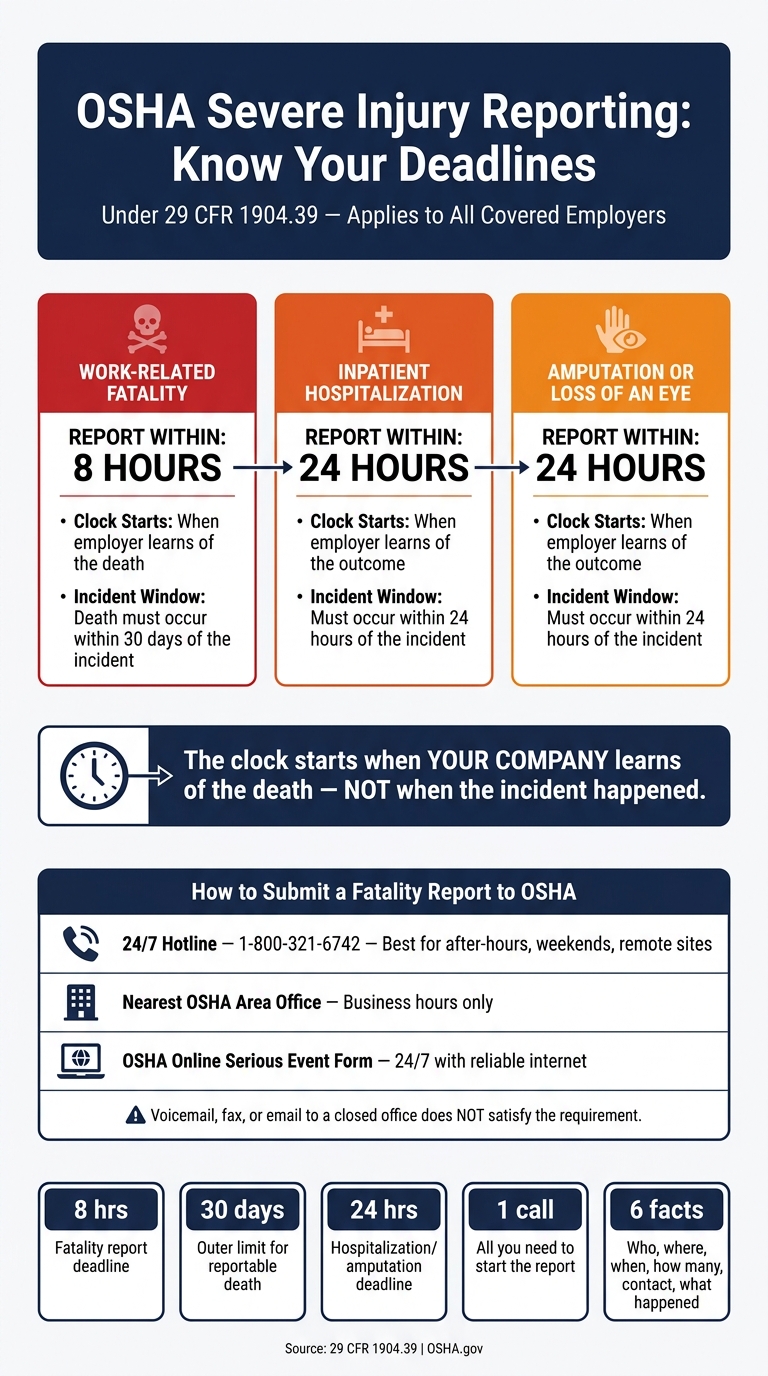
OSHA Fatality & Severe Injury Reporting Deadlines at a Glance
When (and How) to report an accident to OSHA
sbb-itb-aa28329
When the 8-Hour Clock Starts and Which Fatalities Count
Once it’s clear who has to report, the next issue is timing.
The Clock Starts When the Employer Learns of the Death
The 8-hour window does not start when the incident happens. It starts when the employer, or an agent such as a supervisor or manager, learns that a worker has died from a work-related incident.
Here’s a simple example: if a hospital calls a site manager at 11:00 p.m. and says an injured worker has died, the 8-hour reporting window starts at 11:00 p.m. It does not start when the original injury took place.
You also do not need to wait for a full investigation or a final medical report. If the known facts point to a work connection – like a fall from scaffolding, a struck-by incident, or heat illness that started on the job – the employer should report within 8 hours and update the report later if new facts come in.
Only Work-Related Fatalities Within 30 Days Are Reportable
Not every death at or after work sets off the 8-hour rule. First, decide whether the death is work-related. Then ask whether it happened within 30 days of the incident or exposure.
For example, if a worker is hurt on August 1 and dies from those injuries on August 20, the fatality is reportable. The employer must notify OSHA within 8 hours of learning of the death. But if that same worker dies on September 5 from the August 1 incident, the 30-day period has expired, so no fatality report is required under 29 CFR 1904.39.
It also helps to separate fatality reporting from OSHA’s other severe-injury rules. Inpatient hospitalizations, amputations, and loss of an eye follow a 24-hour reporting rule. And in most cases, those outcomes must happen within 24 hours of the work-related incident to be reportable. If an employer already reported a hospitalization and the worker later dies within 30 days from that same incident, OSHA does not require a second, separate fatality report.
| Outcome | Report Within | Incident Window |
|---|---|---|
| Work-related fatality | 8 hours after learning of the death | Death occurs within 30 days of the incident or exposure |
| Inpatient hospitalization | 24 hours after learning of the outcome | Outcome occurs within 24 hours of the incident |
| Amputation or loss of an eye | 24 hours after learning of the outcome | Outcome occurs within 24 hours of the incident |
Multi-Employer Sites and Supervised Workers Create Reporting Confusion
On sites where several companies work side by side, the reporting duty follows daily control of the work. In plain English, it rests with the employer directing the worker’s day-to-day tasks, not whatever label appears in the contract.
On a construction project, that might be the general contractor or a subcontractor, depending on who is directing the crew each day. In a staffing setup, it could be the staffing agency or the host employer – again, whichever one is managing the worker’s daily job duties.
The best way to cut through the confusion is to set this out in writing before work starts. A written agreement should name who will handle reporting, and all parties should follow a shared incident notice process so any fatality triggers immediate cross-notification.
That keeps one company from assuming another already made the call, and it makes sure there’s a clear reporting lead when time is short.
Once the clock and reporting duty are clear, the next step is gathering the facts OSHA will ask for.
What OSHA Will Ask for in a Fatality Report
Once the reporting duty is clear and the clock is ticking, the next issue is simple: what does OSHA actually need from you? The short answer: only the basic facts.
Incident Details to Gather Right Away
OSHA does not need a finished investigation report at this stage. It asks for the basics: the business name, incident location, date and time, affected employee names if known, number of employees involved, a contact name and phone number, and a short description of what happened. As soon as you have that information, you can file the report.
That description should stick to facts. Don’t guess at root cause or assign blame. If the exact time or sequence is still unclear, share the best information you have and note that it is preliminary. In practice, the slowdown usually isn’t the report itself. It’s getting the right facts from the field to the person who can make the call. File with what you know, then update OSHA later if needed. Supervisors should be trained to pass along the facts they have and call OSHA right away.
How to Submit the Report to OSHA
OSHA accepts fatality reports through three channels.
| Channel | Availability | Best Used When |
|---|---|---|
| 24-hour hotline: 1-800-321-6742 | 24/7, nationwide | After hours, weekends, holidays, or remote sites |
| Nearest OSHA Area Office (by phone or in person) | Business hours only | During business hours when you can reach the local office |
| OSHA’s online Serious Event Reporting form | 24/7 | Use when internet access is reliable |
Voicemail, fax, or email sent to a closed Area Office does not satisfy the rule. If the office is closed, use the hotline or the online form instead. For remote sites, night shifts, and weekend incidents, the hotline is often the fastest path. In many cases, it comes down to one thing: use whichever option gets the report in first.
The report itself is simple. The hard part is having a process in place so someone at any job site can file it on time.
How to Build a Reliable 8-Hour Reporting Process Across Job Sites
Once OSHA’s required facts are clear, the next step is getting those facts to the right person FAST. The report itself isn’t hard. Delay is the problem. A clear process makes that much easier. It tells crews who makes the call, what details to collect, and how to reach the right person across remote teams and multi-site operations.
Assign Roles, Escalation Steps, and Internal Deadlines
Every site should have named responsibilities: a supervisor, a site safety lead, a corporate safety manager, and a designated OSHA reporter. Each role also needs a backup. And the escalation path should be written down so if the main contact can’t be reached, the next person steps in right away.
Set an internal deadline that gives your team enough time to check facts and submit before the 8-hour limit runs out. If there’s any doubt about whether an incident is reportable, escalate it at once instead of waiting for total certainty.
Use One Incident Intake Method and a Standard Fact Checklist
Use one required intake path across all sites. That could be a dedicated phone hotline, a mobile form, or an incident workflow inside your safety platform. What matters is that every location uses the same route.
That intake channel should require a standard set of fields before the report is treated as complete. At a minimum, the first report should capture:
- Site or business name and job number
- Exact location
- Date and time of the incident
- Names and job titles of affected workers
- A short description of what happened
- Whether emergency services were called
- The on-site contact’s direct phone number
Log the time the employer first learned of the death. That’s when OSHA’s clock starts.
Comparing Common Internal Reporting Methods
A single intake path cuts down on delay and keeps every site working from the same standard.
| Method | Speed | Fact Consistency | After-Hours Reliability | Remote/Multi-Site Fit |
|---|---|---|---|---|
| Hotline | High, if the number is known | Medium – depends on the call-taker’s script | High if monitored 24/7 | Good if the number is universal across all sites |
| Mobile form | High, if workers have device access | High – structured fields enforce completeness | High if alerts are automated | Very good for dispersed crews and field reporting |
| Supervisor relay chain | Variable – multiple handoffs slow it down | Low to medium – facts can be distorted as messages are relayed | Medium to low after hours | Weak without clear backup roles and escalation rules |
Many employers use a hybrid setup: supervisors report at once through the hotline or form. That keeps supervisor judgment in the loop while making sure the facts come in the same way every time.
How ABLEMKR Can Support Reporting Readiness in High-Risk Industries
ABLEMKR centralizes worker assignments, certifications, and site data, which makes it easier to identify who was on site, what role they were performing, and who was supervising the work. On remote shutdowns, pipeline repairs, and multi-site projects, that record can help speed OSHA fatality reporting. It gives teams a direct path from incident to report without losing time.
Conclusion: Know the Trigger, the Facts, and the Process to Avoid Late Reports
Three things decide whether your team files on time: knowing when the clock starts, confirming the fatality counts, and having a written process in place before an incident happens.
The 8-hour window starts when your company learns of the death, not when the incident happened and not when the investigation wraps up. That’s why timestamps and fast internal escalation matter.
If the death happens within 30 days of the work-related incident, report it within 8 hours of learning of the death. If it happens after 30 days, the fatality report does not apply.
Once the fatality qualifies, file with the facts you have at that point. OSHA wants the basics: employer name, location, date and time, fatalities, affected employees, contact information, and a short factual description. Treat the OSHA report and the internal investigation as two separate tracks.
A simple process goes a long way:
- Assign named roles
- Set internal deadlines shorter than 8 hours
- Use one intake method
- Keep a standard fact checklist
- Train supervisors
- Audit the process on a regular basis
FAQs
What if we’re not sure the death was work-related yet?
If you’re not sure whether a death was work-related, start gathering the facts right away. And keep OSHA’s eight-hour reporting window front and center.
In general, a case is work-related if an event or exposure in the work environment caused the condition, added to it, or made it worse. Write down the incident details, where it happened, and the employee’s status as soon as you can.
Still not sure? Check OSHA guidance or talk with your safety officer.
Who must report a fatality on a staffing or multi-employer site?
On a multi-employer worksite, the employer that usually carries the reporting duty is the one handling the worker’s day-to-day supervision. In most cases, that’s the host employer or the contractor directing the worker’s daily tasks.
OSHA says that employer must report a work-related fatality within 8 hours of learning about it, as long as the death happens within 30 days of the incident.
What happens if an OSHA fatality report is filed late?
Filing an OSHA fatality report late can put your company in serious legal and financial trouble. If you miss the 8-hour deadline, OSHA may issue fines of up to $16,500 for serious violations. Penalties can be far higher for willful or repeated offenses.
A late report can also hurt your safety record and draw more attention from OSHA. If the deadline slips by, send the required information right away and review OSHA’s guidance to help limit problems.


