
OSHA excavation training and competent person certification are both essential for excavation and trench safety, but they serve different roles:
- OSHA excavation training: Teaches workers to recognize hazards and follow safety protocols under OSHA’s 29 CFR 1926 Subpart P. It focuses on general safety knowledge for anyone working in or around trenches.
- Competent person certification: Designates a specific individual with advanced training and the authority to identify and address hazards immediately. This person ensures compliance and can halt work if unsafe conditions arise.
Key Differences:
- Purpose: Training ensures hazard awareness; certification grants authority to act on hazards.
- Audience: Training is for all workers; certification is for supervisors or foremen.
- Authority: Certified individuals can stop work and enforce safety measures.
- Requirements: OSHA mandates a competent person on-site for any excavation work.
Quick Comparison:
| Feature | OSHA Excavation Training | Competent Person Certification |
|---|---|---|
| Primary Focus | General hazard awareness | Supervisory hazard control |
| Target Group | All workers near trenches | Supervisors, foremen, safety officers |
| Authority Level | None | Full authority to stop work |
| Training Depth | Basic safety protocols | Advanced soil analysis, inspections |
| On-Site Requirement | Recommended | Mandatory during excavation |
Both are crucial for maintaining safety and compliance. Employers must ensure workers are trained and a certified individual is present to manage risks effectively.
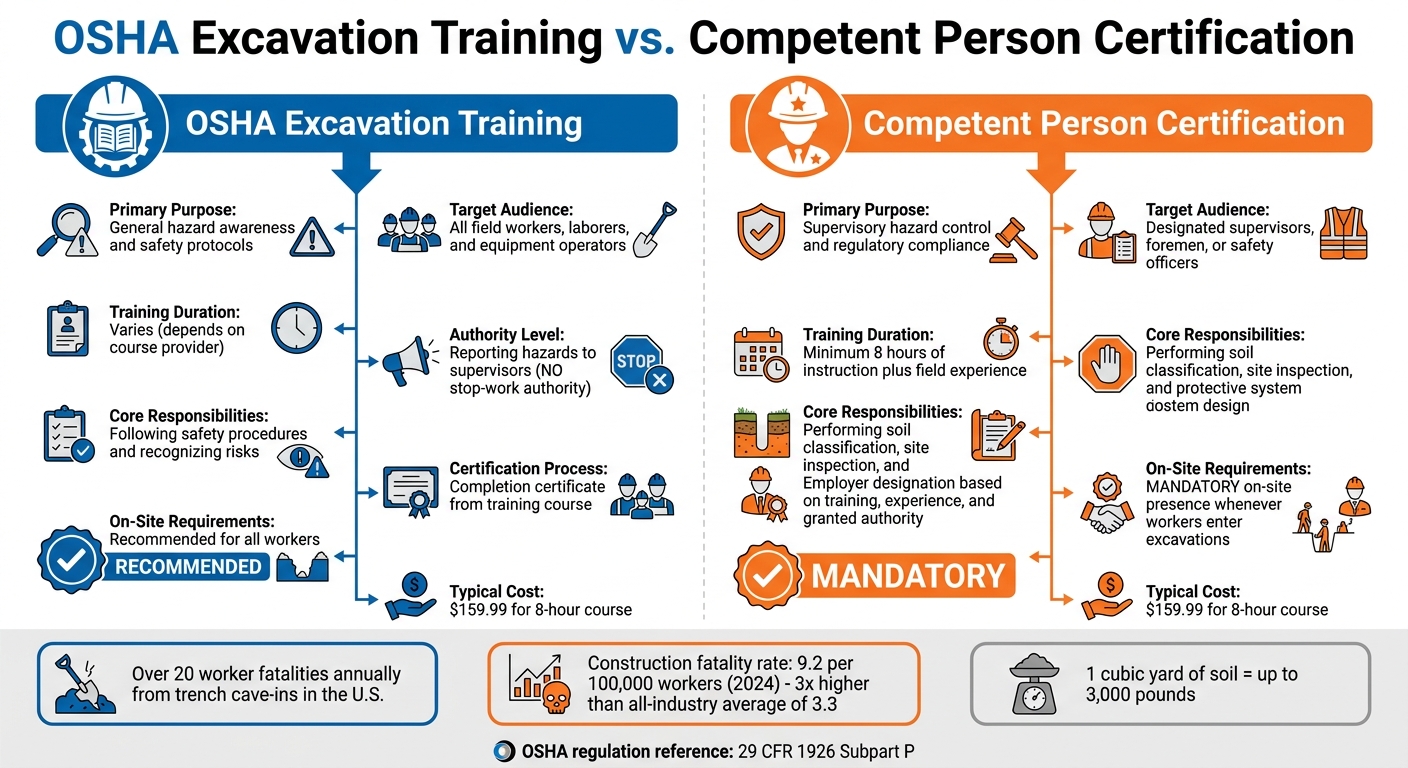
OSHA Excavation Training vs Competent Person Certification Comparison
OSHA Excavation Competent Person Training
sbb-itb-aa28329
What Is OSHA Excavation Training?
OSHA excavation training focuses on identifying and preventing hazards in trenches and excavations. Required under 29 CFR 1926 Subpart P, this training applies to all open excavations at construction sites, aiming to prevent cave-ins, which tragically cause over 20 worker fatalities each year in the U.S.. Considering that a cubic yard of soil can weigh up to 3,000 pounds, even a partial burial can be deadly. To address this, OSHA mandates protective systems for trenches 5 feet or deeper, and for trenches 20 feet or deeper, these systems must be designed by an engineer.
The training addresses both structural and environmental risks. Workers are trained to recognize unstable soil, hazardous atmospheres (like hydrogen sulfide or carbon monoxide), water accumulation, and threats from underground utilities. Additionally, they learn about their rights, such as refusing to enter an unprotected trench, and the importance of staying within protected areas like trench boxes. Below, we’ll explore the core topics covered and who is required to complete this training.
Topics Covered in OSHA Excavation Training
The training curriculum covers essential safety topics, starting with soil classification. Workers are taught to identify four soil types: Stable Rock, Type A (the most stable), Type B, and Type C (the least stable). Each type has specific maximum allowable slopes, ranging from vertical cuts for Stable Rock to a 1½:1 slope ratio for Type C soil. Protective systems, often referred to as the "three S’s", are a key focus – these include sloping/benching, shoring, and shielding.
A critical point emphasized is that while trench boxes protect workers during a collapse, they do not prevent the collapse itself. The training also details daily inspection requirements, which must occur before each shift and after events like rainstorms that could increase risks. Other practical safety measures include:
- Ensuring egress points (like ladders, ramps, or steps) are within 25 feet of workers in trenches 4 feet or deeper.
- Keeping spoil piles at least 2 feet away from trench edges.
- Calling 811 at least two business days prior to digging to locate underground utilities.
Who Needs OSHA Excavation Training?
Anyone working in or around excavations or trenches needs basic training to recognize hazards, understand emergency procedures, and know the limits of protective equipment. Workers designated as competent persons receive advanced instruction, including soil analysis, protective system design, and basic structural engineering principles.
This training benefits all crew members – general laborers, equipment operators, and utility workers – by fostering a safety-conscious team that can identify risks early. For example, an 8-hour course costs $159.99, a small investment when compared to the potential cost of OSHA fines or, more importantly, the loss of life.
What Is Competent Person Certification?
Competent person certification goes beyond general excavation training by assigning a specific individual the authority to identify hazards and take immediate corrective actions on job sites. According to OSHA’s 29 CFR 1926.32(f), a competent person is defined as someone "capable of identifying existing and predictable hazards in the surroundings or working conditions which are unsanitary, hazardous, or dangerous to employees, and who has the authorization to take prompt corrective measures to eliminate them".
This role is especially important in excavation work, where quick action can prevent cave-ins and save lives. OSHA highlights the need for these specialized individuals because trenching and excavation involve technical challenges and inherent risks that demand more training and experience than a typical worker might have. Competent person certification ensures immediate hazard mitigation, complementing OSHA’s broader excavation training requirements.
OSHA’s Definition of a Competent Person
To qualify as a competent person, three key attributes are required: the ability to recognize current and potential hazards, a detailed understanding of OSHA excavation standards (specifically 29 CFR 1926 Subpart P), and employer-granted authority to implement safety measures without delay. For excavation tasks, this also includes expertise in soil analysis and protective systems like shoring, shielding, and sloping.
OSHA does not specify a universal certification program for competent persons. Instead, it’s up to employers to designate individuals based on their formal training, field experience, and demonstrated capabilities. Simply completing training isn’t enough – the employer must officially authorize the person. Once authorized, the competent person assumes critical responsibilities to safeguard workers and ensure compliance with safety regulations.
Competent Person Duties on Job Sites
The duties of a competent person go far beyond general safety practices. They are responsible for conducting daily inspections of excavation sites, surrounding areas, and protective systems before each shift begins. Inspections are also required after any event that could increase risks, such as heavy rain. Their tasks include:
- Classifying soil through both visual and manual testing.
- Monitoring water removal systems to ensure proper function.
- Inspecting damaged protective systems to determine if they remain safe to use.
- Designing structural ramps for safe employee access.
Perhaps most importantly, a competent person has the authority to remove workers from hazardous areas immediately if they detect risks like potential cave-ins, protective system failures, or unsafe atmospheric conditions. This authority allows them to act without waiting for permission, a distinction that sets them apart from other workers. Without a designated competent person on-site, excavation projects risk worker injuries, OSHA penalties, and even work stoppages. Their role is a cornerstone of compliance, ensuring excavation sites meet federal safety standards while prioritizing worker safety.
Main Differences Between OSHA Excavation Training and Competent Person Certification
This section dives into the key distinctions between OSHA excavation training and competent person certification, highlighting their unique purposes and roles on a job site.
The main difference lies in purpose and authority. OSHA excavation training equips workers with general knowledge about hazards and safety protocols related to trenches. It’s about recognizing risks and following established rules. On the other hand, competent person certification is for a specific individual tasked with supervisory authority. This person has the legal power to act immediately, including halting work if dangerous conditions arise. These contrasting roles are crucial to maintaining safety on excavation sites.
While general excavation training is aimed at all workers to ensure they can identify hazards, the competent person role is reserved for supervisors or foremen. These individuals undergo advanced training and must demonstrate expertise in tasks like soil classification and site inspections. As OSHA puts it, “Trenching and excavation work is dependent on these specialized employees because its highly technical nature… require a greater level of training and experience than a normal worker would possess”.
The depth of training also sets them apart. General workers focus on personal safety and hazard awareness, while a competent person needs to handle more technical tasks. These include classifying soil using both visual and manual methods, designing structural ramps for safe access, and inspecting protective systems to ensure they’re effective.
Employers must officially designate the competent person based on their proven skills and authorize them to act decisively. This designation carries significant legal and safety responsibilities.
Side-by-Side Comparison: OSHA Excavation Training vs. Competent Person Certification
Here’s a breakdown of the major differences:
| Feature | OSHA Excavation Training | Competent Person Certification |
|---|---|---|
| Primary Purpose | General hazard awareness and safety protocols | Supervisory hazard control and regulatory compliance |
| Target Audience | All field workers, laborers, and equipment operators | Designated supervisors, foremen, or safety officers |
| Training Duration | Varies (depends on the course provider) | Minimum 8 hours of instruction plus field experience |
| Authority Level | Reporting hazards to supervisors | Full authority to stop work and implement corrective actions |
| Core Responsibilities | Following safety procedures and recognizing risks | Performing soil classification, site inspection, and protective system design |
| Certification Process | Completion certificate from training course | Employer designation based on training, experience, and granted authority |
| On-Site Requirements | Recommended for all workers in/around trenches | Mandatory on-site presence whenever workers enter excavations |
| Typical Cost | Varies by provider | Varies by provider |
When Each Is Required on Job Sites
Building on the roles outlined earlier, this section explains the specific circumstances that call for each requirement. Knowing when these types of training are legally necessary helps contractors stay compliant and, most importantly, maintain worker safety. OSHA Standard 1926 Subpart P outlines clear rules for both general worker training and the presence of a competent person on excavation sites. While these requirements serve different purposes, they collectively uphold the safety standards essential for excavation and trenching work.
When OSHA Excavation Training Is Required
Every worker operating in or near trenches must complete training to identify specific hazards. This includes dangers like cave-ins, equipment accidents, falling debris, drowning risks, and hazardous atmospheres. The training ensures workers know how to safely enter and exit trenches, report potential hazards, and follow established safety procedures. This applies to all roles, from laborers to equipment operators, regardless of how much time they spend in or near the trench. However, certain conditions also require the presence of a competent person on-site.
When Competent Person Certification Is Required
OSHA mandates that a competent person be present whenever workers are entering trenches or excavations. This individual is responsible for performing inspections at the start of each shift and after any event that changes site conditions, such as rainstorms, thawing, or gas leaks. For excavations deeper than 4 feet, atmospheric testing must be conducted before workers enter if there’s a reasonable risk of hazardous gases or low oxygen levels.
"The single most important measure contractors can take to avert trench accidents and injuries is to designate a Competent Person. It’s not just a smart idea but a legal obligation." – Bruce Magee, Regional Product Development Manager, United Rentals Trench Safety
Failing to assign a competent person can lead to serious consequences, including OSHA fines, immediate site closures, increased insurance costs, and even criminal liability if a fatality occurs.
How This Affects Construction Compliance
Staying compliant with OSHA regulations is crucial to avoid delays and costly disruptions in construction projects. In 2024, the construction industry reported 1,034 fatal work injuries, with a fatality rate of 9.2 per 100,000 full-time equivalent workers – nearly three times higher than the all-industry rate of 3.3. When OSHA inspectors visit a site, their top priority is ensuring that the designated competent person not only understands excavation standards but also has the authority to address and eliminate hazards. Without proper documentation of worker qualifications, companies risk non-compliance, increased insurance premiums, and even project shutdowns.
These compliance requirements can be operationally demanding. Employers must ensure they have qualified personnel and verifiable records before excavation work begins. Accurate documentation is key – not just for avoiding fines but also for improving safety on-site. To simplify these challenges, solutions like ABLEMKR provide automated tools for compliance and worker verification.
How ABLEMKR Helps Meet OSHA Requirements

ABLEMKR tackles these challenges by connecting projects with pre-vetted workers who have the necessary excavation training and competent person certifications. Through its mobile-first platform, ABLEMKR verifies certifications and quickly matches qualified workers to meet OSHA’s competent person requirements. This eliminates the last-minute scramble to verify qualifications when inspectors show up or when emergency excavation work arises.
For urgent projects like pipeline repairs or utility emergencies, ABLEMKR’s real-time matching ensures that certified crews can be deployed immediately without compromising safety standards. Additionally, its compliance tracking feature keeps certification records up-to-date, making audits easier and reducing the administrative workload of managing qualifications across various job sites.
What Employers and Workers Gain
Employers gain real-time insights into worker qualifications, including up-to-date certifications and training expiration dates. Automated tracking ensures that workers meet OSHA’s ongoing training requirements, helping companies stay compliant with evolving safety standards. Beyond compliance, this system strengthens the overall safety culture on-site.
For workers, ABLEMKR opens access to well-paying opportunities tailored to their specific certifications. Instead of waiting for general labor assignments, certified competent persons can directly connect with projects that require their expertise. ABLEMKR also ensures reliable payments and transparent cost structures, creating financial stability for workers who have invested in advanced certifications – like the 8-hour OSHA Competent Person for Excavation, Trenching, and Shoring Training, which costs $159.99.
Conclusion
OSHA excavation training and competent person certification serve distinct but equally important purposes in maintaining safe and compliant job sites. The training equips workers with the essential knowledge to identify hazards, understand protective measures, and follow safety protocols. On the other hand, competent person certification empowers individuals to take immediate action, such as halting operations and addressing unsafe conditions on the spot.
This division of responsibilities ensures that hazards are addressed swiftly and effectively. While excavation training prepares workers to follow established safety guidelines, competent persons take on critical tasks like soil classification, designing protective systems, and conducting daily safety inspections. OSHA regulations require that competent persons have the authority to stop work immediately when hazards arise. With construction fatality rates reaching 9.2 per 100,000 workers in 2024 – almost three times the average across all industries – strict adherence to these roles is essential. Employers must ensure that competent persons complete the necessary training to fulfill their responsibilities. Without both trained workers and certified competent persons, job sites are at a higher risk of accidents.
Implementing these protocols effectively is key to managing workforce safety and compliance. However, keeping track of certifications and deploying qualified personnel can be complex. ABLEMKR simplifies this process by offering real-time tracking of worker qualifications and ensuring certified competent persons are assigned to excavation sites as needed. This approach reduces compliance risks and ensures that every project begins with the right expertise on-site. By adhering to these standards, companies can protect their workers while meeting regulatory requirements.
FAQs
Does OSHA require a “competent person” certification card?
OSHA doesn’t mandate a "competent person" certification card. Instead, it’s up to employers to appoint someone as a competent person. This individual must have the authority to address and correct workplace hazards and the expertise to recognize them. The selection is based on the person’s qualifications and experience, not on holding a specific certification.
Can one competent person cover multiple trench crews at once?
Yes, a qualified individual can oversee multiple trench crews at the same time, provided they can efficiently recognize hazards, inspect site conditions, and take swift corrective action for each crew under their supervision. They must be capable of handling safety responsibilities across all the locations they are managing.
How often must a competent person inspect an excavation?
A qualified individual needs to examine an excavation frequently enough to spot potential dangers and confirm that safety precautions are effective. This usually means conducting routine inspections during the entire work process to manage both current and foreseeable risks.


