
If I had to boil this down to one point, it’s this: OSHA compliance on renewable energy sites depends on simple habits done the same way every day.
If I’m running solar, wind, BESS, or substation work, I need to do four things from the start:
- Match the job scope to the right OSHA rules, mainly 29 CFR 1926 for construction and 29 CFR 1904 for recordkeeping
- Flag the highest-risk tasks, especially the Fatal Four: falls, electrocutions, struck-by, and caught-in/between hazards
- Keep proof ready: worker training records, daily safety talks, PPE checks, and incident logs
- Report and track injuries on time, including OSHA 300, 300A, and 301 forms, plus 8-hour and 24-hour reporting deadlines for severe events
The article’s main message is simple: fast-moving crews create paperwork gaps. And those gaps can lead to trouble during an inspection, after an injury, or when crews shift from one phase to another.
A few facts stand out:
- The 300A summary must be posted from 02/01 through 04/30
- OSHA logs must be kept for 5 years
- One wind-farm dataset found that 52% of reported incidents were near misses
- A fall protection training record must be in writing under 29 CFR 1926.503(b)
So if I want crews ready on day one, I need a clear process for:
- scope review
- hazard review
- training checks
- toolbox talk sign-offs
- PPE inspection logs
- incident follow-up
- document ownership across each project phase
In short: the work changes fast, so the safety system has to stay steady.
How Does Solar Affect Your Fall Protection?
sbb-itb-aa28329
1. Identify the OSHA Rules and Hazards That Apply to Your Project
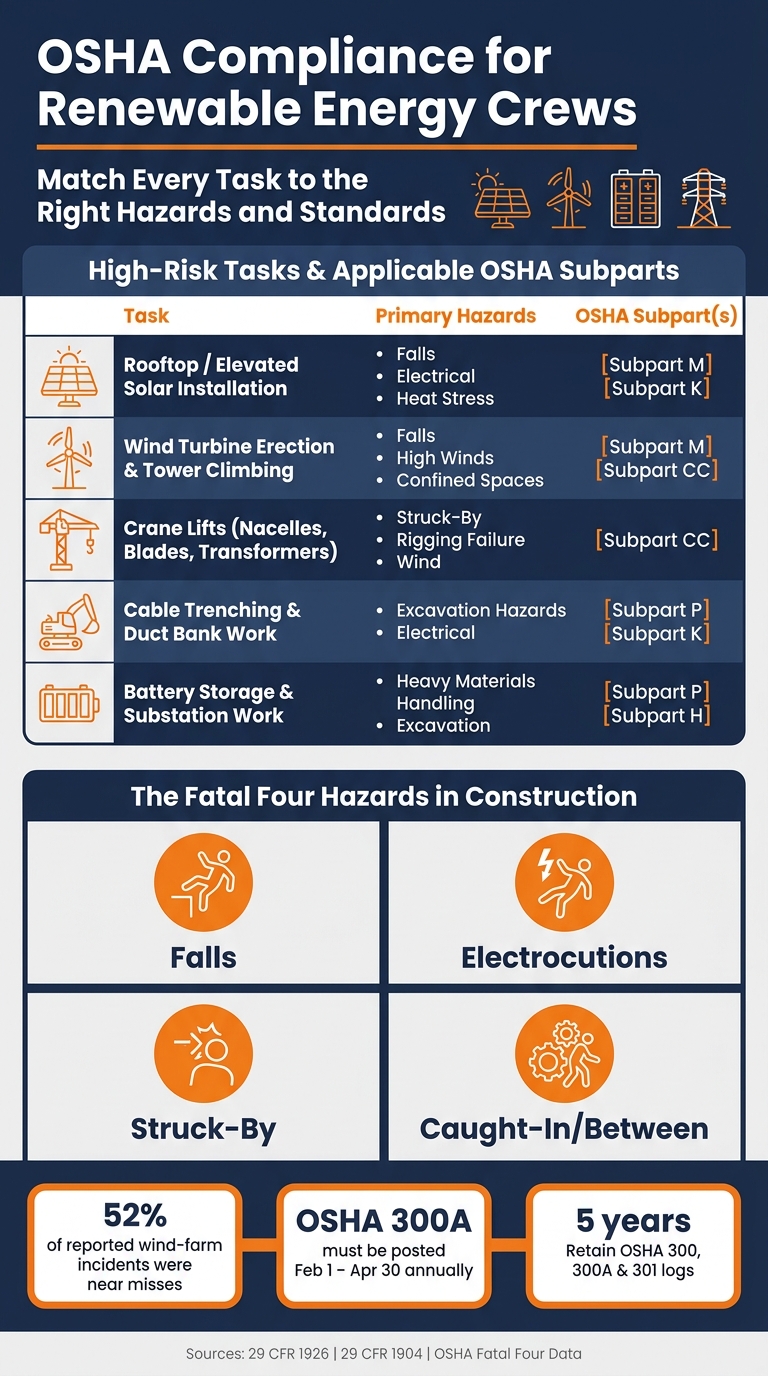
OSHA Compliance for Renewable Energy: Task Hazards & Standards at a Glance
1.1 Match Your Project Scope to OSHA Construction and Recordkeeping Standards
Define the work scope before crews show up: is it new construction or routine servicing?
New construction work – solar mounting, wind turbine erection, battery rack installation, substation builds, and cable trenching – falls under 29 CFR 1926. Routine servicing of existing systems falls under 29 CFR 1910. That call affects the governing standard and the fall-protection threshold. If a work package gets classified the wrong way, the crew may start the job under the wrong rules on day one.
For most utility-scale solar, wind, battery storage, and substation projects, the key 1926 subparts are:
- Subpart M for fall protection
- Subpart K for electrical safety
- Subpart CC for cranes and derricks
- Subpart E for PPE
- Subpart P for excavations
You’ll also need to pair 29 CFR 1926 with 29 CFR 1904 and the required OSHA Forms 300, 300A, and 301. On renewable job sites, scope can shift fast. When that happens, the standard has to match the work package in front of the crew.
A simple matrix helps here: work type → governing standard → fall protection trigger. Build it during pre-job planning. It gives supervisors a fast reference point and cuts down confusion when the scope changes mid-project. That single classification then drives training, PPE, and recordkeeping.
1.2 List the High-Risk Tasks That Drive Your Compliance Requirements
This step shapes almost everything else – training, PPE, and the topics covered in daily safety talks.
Start with the Fatal Four. Falls, electrocutions, struck-by, and caught-in/between hazards drive much of the fatal construction risk and should sit at the center of your JHA.
Here’s how common renewable energy tasks line up with their main hazards and the OSHA subparts that apply:
| Task | Primary Hazards | Applicable OSHA Subpart |
|---|---|---|
| Rooftop / elevated solar installation | Falls, electrical, heat stress | Subpart M, Subpart K |
| Wind turbine erection and tower climbing | Falls, high winds, confined spaces | Subpart M, Subpart CC |
| Crane lifts (nacelles, blades, transformers) | Struck-by, rigging failure, wind | Subpart CC |
| Cable trenching and duct bank work | Excavation hazards, electrical | Subpart P, Subpart K |
| Battery storage and substation work | Heavy materials handling, excavation | Subpart P, Subpart H |
These hazards should guide every crew briefing and inspection routine. Document them in a JHA or pre-task plan, then adjust that plan to fit site conditions like heat, wind, or cold stress. Use the JHA to set training topics, the daily talk agenda, and PPE checks.
2. Build a Repeatable System for Training Records, Daily Talks, and PPE Checks
Once you’ve mapped hazards and matched them to OSHA standards, the next step is turning that plan into something the field team can use every day. That means role-based training records, documented toolbox talks, and start-of-shift PPE checks.
The idea is pretty simple: the right people doing the right work, with records that hold up during an inspection. Use your matrix to control who is cleared for each task. Then back that up with daily talks and PPE checks so that control stays active on site.
2.1 Track Worker Qualifications and Training by Role
Start with the hazard list from Section 1 and use it to decide who is cleared for each task.
A training matrix is the backbone of this setup. Build it as a table with rows for workers and columns for the training each job role needs.
For each training entry, record at least:
- Full legal name
- Job role
- Course name
- Training provider
- Completion date (MM/DD/YYYY)
- Expiration date, if it applies
- Trainer or supervisor approval
OSHA’s fall protection rule, 29 CFR 1926.503(b), requires a written certification record. To make that record easier to check, add the CFR reference, trainer qualifications, and certificate ID so auditors can verify it fast.
On fast-moving projects, ABLEMKR can help verify crew readiness before mobilization by matching pre-vetted workers to jobs based on certifications, safety training, availability, and location.
Once roles are confirmed, use the next shift start to reinforce the day’s hazards and controls in the toolbox talk.
2.2 Run and Document Daily Safety Talks Before Work Starts
Hold a short, documented toolbox talk before work starts. Get the crew together, review the day’s tasks, and walk through the site-specific hazards from your JHA. That can include falls, electrical exposure, rigging, and excavation. Confirm the controls and PPE. Then cover weather conditions like temperature, wind speed for lifts or tower work, and lightning risk. Finish by inviting questions and near-miss reports.
Each talk record should include the date (MM/DD/YYYY), site name and location (city, state), crew lead name, the topics and tasks discussed, the hazards and controls reviewed, and the full names of everyone present. If the crew is bilingual, note the language used. If something needs follow-up – like ordering replacement harnesses or repainting guardrails – log it right away instead of trying to piece it together later.
After the talk, inspect the PPE tied to those hazards before work begins.
2.3 Inspect PPE at the Start of Each Shift and Pull Damaged Gear from Service
Inspect PPE at the start of each shift under Subpart E. The record is what shows the check actually happened.
Work through the full set of gear tied to the high-risk tasks you’ve already identified: hard hats, eye protection, gloves, hearing protection, high-visibility clothing, and task-specific gear like harnesses, lanyards, and arc-rated clothing for electrical and battery storage work. For hard hats, check shell condition, suspension integrity, and manufacture date. For gloves, make sure the type matches the task. For high-visibility clothing, confirm the ANSI class fits the traffic exposure.
If something fails inspection, the process should be direct: log the item type, brand, and serial number; describe the defect; tag it "do not use"; and issue a replacement. Record the replacement too, including size and model. Fit matters just as much as condition. If a harness can’t be adjusted the right way for a worker, log it and fix the issue before that person works at height.
Industry guidance is clear that harnesses and lanyards involved in a fall should be retired immediately, even if no damage is visible. After that, handle them based on the manufacturer-specified lifespan and inspection intervals. Keep these records tied to the project and date so they’re easy to pull during an audit or incident review.
3. Record Incidents Correctly and Close Out Corrective Actions
Once PPE checks and toolbox talks become part of the day, incident response needs to be just as consistent. This is the feedback loop for the hazards flagged in the JHA and reinforced during daily talks.
3.1 Classify Events and Complete OSHA Recordkeeping on Time
Start by separating incidents into four event types:
| Category | What it means | OSHA requirement |
|---|---|---|
| Near miss | No injury or illness, but potential for harm existed | Not recordable; investigate internally |
| First-aid case | Minor treatment only | Not recordable unless another criterion applies |
| Recordable injury/illness | Work-related death, days away, restricted duty, medical treatment beyond first aid, loss of consciousness, or significant diagnosed injury/illness | Enter on OSHA 300 and 301 |
| Reportable event | Fatality, in-patient hospitalization, amputation, or loss of an eye | Report to OSHA within 8 hours for a fatality or within 24 hours for the other events |
Under 29 CFR Part 1904, the OSHA 300A annual summary rolls up the year’s recordable cases, must be certified by a company executive, and has to be posted from February 1 through April 30 at each establishment.
For crews that move between sites, log each case under the right establishment before entering it. One safety coordinator or compliance lead should keep the master logs, and crew leads should send incident details right away through standard mobile forms. That setup cuts down on confusion and helps keep records clean.
3.2 Report Serious Incidents and Assign Corrective Actions
When a serious event happens, the order of response matters just as much as the paperwork. Stop work. Isolate the area. Lock out or tag out hazardous energy sources. Give first aid or arrange emergency medical care, then notify the site supervisor and safety manager at once. Before anything is moved, photograph conditions, note equipment settings, and record witness names and statements.
Once the scene is stable, report any OSHA-notifiable event at once. Fatalities must be reported within 8 hours of learning of the death, as long as the death occurs within 30 days of the work-related incident. In-patient hospitalizations, amputations, and loss of an eye must be reported within 24 hours of the incident.
You can report by phone, through the nearest OSHA Area Office, or by using OSHA’s online form. Have these details ready:
- Business name
- Site location
- Incident time
- Brief description
- Names of affected employees
- Contact name
OSHA asks for that information up front, so having it ready saves time when things are already tense.
After the immediate response, run a root-cause analysis that looks at why the system allowed the event to happen, not just who made the last mistake. Methods like 5 Whys or a fishbone diagram work well in the field. OSHA frames this review around four questions: what happened, how it happened, why it happened, and what needs to be corrected.
Each corrective action should have one owner, one due date, and one completion check. Near misses need the same level of attention. A wind-farm safety dataset found that 52% of reported incidents were near misses, which makes them one of the best early warning signs you have. Update the JHA, retrain the affected crews, and confirm that the fix worked.
Record every action in the same system you use for site documents and review dates.
4. Standardize Site Safety Documentation for Mobile Crews and Multiple Projects
Good field documentation helps control hazards and supports OSHA recordkeeping. When crews move from one site to another, scattered paperwork can turn into a compliance problem fast.
4.1 Keep Required Site Documents Ready and Accessible
After training, toolbox talks, and inspections are documented, crews need one system that keeps those records current and available on site.
Every renewable energy site should have the core records crews need in the field:
- A site-specific safety plan
- Current JHAs/THAs
- An emergency response plan
- Task-specific permits
- Equipment inspection logs
- Training and PPE records
- Incident logs
Any document needed to make a stop-work or evacuation call should be on site and available in real time. Keep digital copies on mobile devices, and keep printed backups in the site office or trailer. Archived records should live in one central system.
Version control is a big deal here. Each document should include a version number, an effective date, and a next review date. Mark old copies as superseded and pull them from active folders. That way, crews don’t end up using an old emergency plan or a JHA that no longer matches a new crane lift or energization step.
4.2 Assign Document Ownership and Set Review Dates Across Project Phases
A safety manager usually owns the master safety program and templates. A superintendent handles project-level use. A foreman or crew lead manages daily documents like JHAs, toolbox talk sign-offs, and inspection checklists. Every document should have a named main owner and a backup, so updates don’t stop when someone moves to another site.
Set review triggers at key points in the project, including:
- Mobilization
- Scope changes
- Major equipment arrival
- Commissioning
- Maintenance transitions
- Incident follow-up
At mobilization, confirm the safety plan, emergency procedures, and training status. When a crane shows up or electrical energization starts, update the JHA and permits to match the new hazards. After any incident or near miss, update the affected JHA and training records.
For employers running multiple active projects, ABLEMKR can help connect worker status, onboarding, certifications, and compliance tracking in one place, which makes it easier to confirm that required records are current before crews are sent to a new site.
That ownership model keeps the phase-by-phase checklist below current across the project.
4.3 Documentation Matrix: Project Phases and OSHA Records
The table below maps project phases to the documents required at each stage and the OSHA framework they support.
Use it to check what needs to be ready before each phase begins.
| Project Phase | Required Documents | Related OSHA Framework |
|---|---|---|
| Mobilization | Site-specific safety plan, emergency response plan, site orientation materials, training verification | OSHA construction safety requirements; 29 CFR Part 1904 |
| Construction | Active JHAs/THAs, equipment inspection logs, fall protection records, lift plans, task-specific permits, PPE records | OSHA construction safety requirements |
| Commissioning | Energized-work controls, lockout/tagout documentation, test procedures, special access permits | OSHA electrical safety and lockout/tagout requirements |
| Maintenance | Task-specific hazard analyses, service logs, updated training verification, incident follow-up records | OSHA recordkeeping and task-specific safety requirements |
Retain OSHA 300, 300A, and 301 records for 5 years after the covered calendar year. During an inspection, compliance officers can ask for the current year plus the three prior calendar years. Put that timeline into your document ownership log so the team isn’t scrambling to find records when pressure hits.
Conclusion: Use Simple, Consistent Processes to Keep Renewable Energy Crews OSHA Ready
OSHA compliance on renewable energy projects comes down to a simple, steady system. Before crews mobilize, match each project to the OSHA standards and job hazards that apply.
Once the scope is clear, move straight to worker qualifications. Make sure role-specific certifications are tied to the actual assignment, not just sitting in a general personnel file. For distributed solar, wind, and BESS crews, ABLEMKR can match pre-vetted workers to sites by certification, training, availability, and location, while keeping compliance status visible in real time.
After the right workers are assigned, day-to-day controls do the heavy lifting. A documented safety talk before each shift, a PPE check at the start of every workday, and an incident log updated that same day are the habits that help crews stay ready as conditions change.
When crews move between sites or project phases, training logs, daily talk sign-offs, PPE checks, incident logs, and corrective-action follow-ups should stay current and move with the crew.
Consistency, not complexity, keeps renewable energy crews OSHA ready.
FAQs
How do I tell if my project falls under OSHA 1926 or 1910?
It depends on the type of work.
29 CFR 1926 covers construction work, while 29 CFR 1910 applies to general industry.
So, if you’re dealing with a new system installation – like the first construction or assembly of a solar panel system – that usually falls under 1926.
But ongoing servicing, repairs, and routine maintenance on an existing system usually fall under 1910.
For some tasks tied to electric power generation, transmission, and distribution, 1910.269 may also apply.
What records should I keep on site for an OSHA inspection?
Keep site records organized, time-stamped, and easy to find. That means storing written safety programs, job hazard analyses, incident and near-miss logs with corrective actions, and training records like OSHA 10- or 30-hour cards, certifications, orientation sign-ins, and proof of PPE training.
Daily paperwork matters too. Hold onto toolbox talk attendance sheets, equipment inspection checklists, maintenance logs, and active OSHA 300 and 300A logs. Since many of these records need to be kept for at least three years, it helps to store everything in one central digital repository.
Who should own safety documents when crews move between projects?
When crews move from one project to another, the employer is still on the hook for keeping safety records up to date.
That’s where a centralized digital platform helps. It keeps certifications, training records, and inspection logs in one place, which makes handoffs cleaner and cuts down on missing paperwork during transitions.
It also helps teams stay ready for audits and maintain the same safety standards across every job site.


