
OSHA certification renewal rules are stricter in 2026, especially for construction and energy sectors. Here’s what you need to know:
- Federal Updates: While OSHA 10-hour and 30-hour Outreach cards don’t officially expire, new industry standards recommend refresher training every 3–5 years. Mandatory updates include heat illness prevention, stricter PPE rules, and electronic recordkeeping.
- State-Specific Rules: Some states, like New York and Nevada, enforce stricter renewal timelines. Workers crossing state lines must meet local requirements.
- Trainer Changes: Outreach trainers must renew certifications before expiration – no more 90-day grace period.
- Penalties: Fines for expired certifications range from $5,000 to $25,000 in states like New York. Non-compliance can also increase insurance costs.
- Tracking Tools: Automated systems like ABLEMKR reduce certification lapses by 97% and streamline compliance.
Key Takeaway: Stay ahead by scheduling renewals early, verifying training providers, and using automated tracking tools to avoid costly fines and compliance risks.
Lancaster Safety – Whats New With OSHA 2026

sbb-itb-aa28329
OSHA Certification and Renewal Requirements
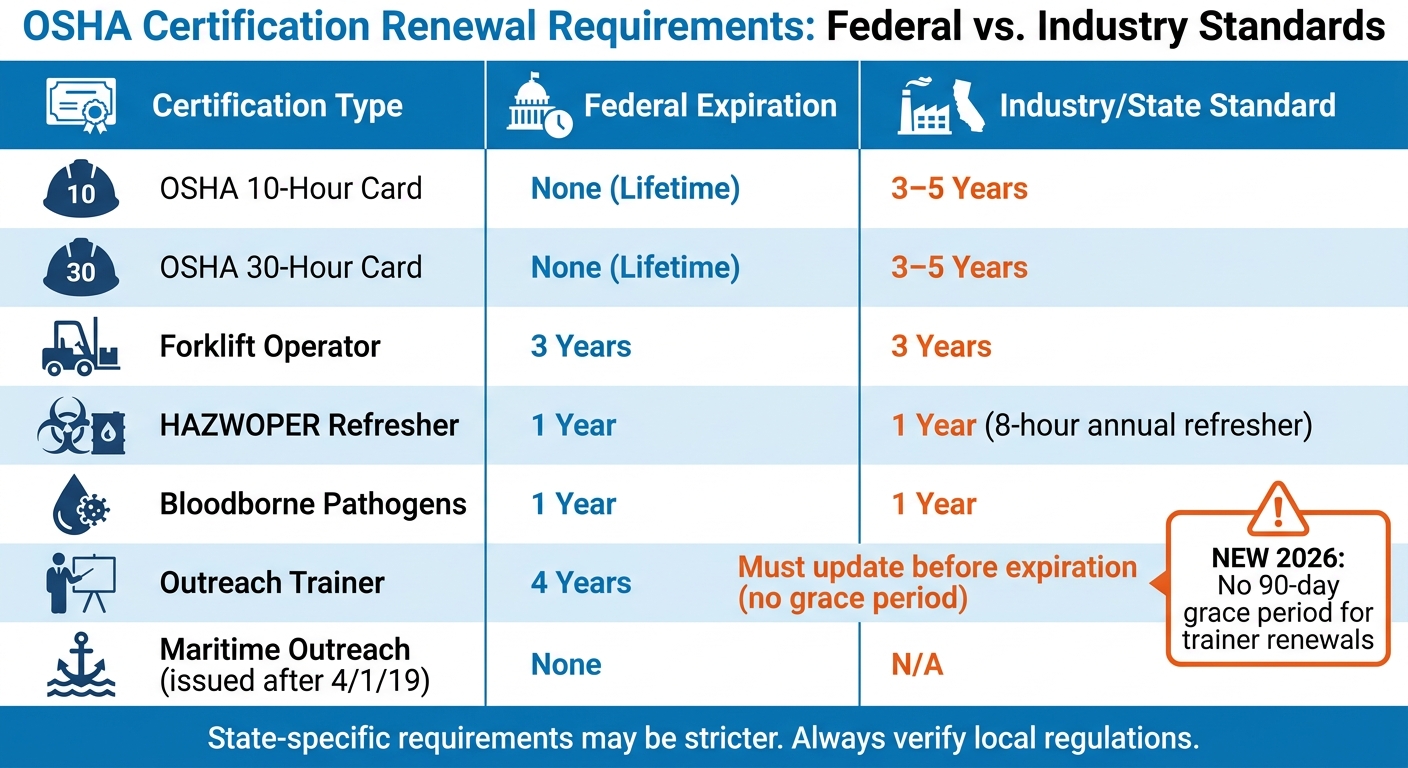
OSHA Certification Renewal Timeline Requirements 2026
Federal OSHA Certification Rules
Federal OSHA considers OSHA 10-hour and 30-hour Outreach cards as lifetime credentials – they technically don’t expire. According to OSHA, "This program is voluntary and does not meet the training requirements for any OSHA standards… None of the courses within the Outreach Training Program is considered a certification". While these credentials are valid for life, OSHA recommends a refresh every 3 to 5 years, though this remains a suggestion, not a requirement.
Certain certifications, however, have stricter timelines. For instance:
- Forklift and Powered Industrial Truck (PIT) operators must undergo competency evaluations and recertifications every three years.
- HAZWOPER certifications (both 24-hour and 40-hour programs) require an 8-hour annual refresher course to stay valid.
- Maritime course cards issued after April 1, 2019, do not have an expiration date.
Additionally, Outreach Trainers must now complete their update courses before their current authorization expires, as the 90-day grace period has been eliminated.
These federal guidelines provide a baseline, but state-specific requirements often go beyond these standards.
State-Specific Renewal Requirements
In addition to federal rules, many states enforce stricter renewal protocols. Twenty-one states operate their own OSHA-approved plans, often requiring more frequent renewals than federal regulations. For example:
- Nevada, Connecticut, and New York require construction workers to refresh their OSHA training every five years.
- New York City has additional Site Safety Training (SST) requirements.
Some states have also implemented heat safety programs – including California, Colorado, Maryland, Minnesota, Nevada, Oregon, and Washington – while the federal Heat Illness Prevention Standard is still under consideration for 2026. Workers crossing state lines must confirm local requirements, as a valid card in one state might not meet another state’s standards, potentially delaying access to job sites until additional training is completed.
| Certification Type | Federal Expiration | Industry/State Standard |
|---|---|---|
| OSHA 10-Hour Card | None (Lifetime) | 3–5 Years |
| OSHA 30-Hour Card | None (Lifetime) | 3–5 Years |
| Forklift Operator | 3 Years | 3 Years |
| HAZWOPER Refresher | 1 Year | 1 Year |
| Bloodborne Pathogens | 1 Year | 1 Year |
2026 OSHA Regulatory Changes for Construction and Energy Workers
Updated Equipment and Safety Standards
Starting in 2026, OSHA will require more detailed evaluations for crane operators. These evaluations must cover safety devices, operational aids, load chart specifications (such as lifting capacity, boom length, and counterweight setup), and equipment software. The goal is to ensure operators are trained for specific equipment models rather than broad categories. For instance, being certified to operate a scissor lift will no longer automatically qualify someone to operate an articulating boom lift without a documented evaluation.
"The certification provides an independent assessment of general baseline knowledge and skill and the employer evaluation focuses on specific knowledge and skills needed for the safe operation of particular equipment for particular tasks." – OSHA
In New York City, the Department of Buildings imposes fines ranging from $5,000 to $25,000 for uncertified workers who lack a valid OSHA 10-Hour card. These stricter penalties highlight the importance of accurate documentation. However, 43% of construction fleet managers still rely on manual tracking methods like spreadsheets, which increases compliance risks under the new requirements.
Additionally, OSHA has revamped its Heat National Emphasis Program (NEP) for 2026, adding more specific construction and energy sectors to its target list. New safety technology standards will also mandate features like vehicle kill switches and dashcam monitoring to reduce operational risks.
These changes are expected to influence trainer protocols, ensuring they stay aligned with current industry standards and compliance needs.
Trainer Certification Course Updates
Trainers must now complete their OSHA 502 (Construction) or OSHA 503 (General Industry) update courses before their four-year authorization expires, as the 90-day grace period has been removed. If their authorization lapses, trainers will lose their eligibility to conduct Outreach training or issue student completion cards. To regain eligibility, they must retake the initial course (OSHA 500 or 501) and meet updated prerequisites, including completing an OSHA Standards course within the past seven years.
The updated curriculum reflects a broader focus on worker well-being. It now includes topics like mental health, workplace stress, heat illness prevention, and advanced machinery safety, covering robotics and automation. For workers, recertification through the Outreach Training Program will also feature mandatory modules on mental health and wellness. This change addresses stress-related accidents and recognizes the unique challenges faced by the estimated 53 million "lone workers" in North America and Europe.
"OSHA will evaluate good faith efforts taken by employers in their attempt to meet the new documentation requirements for operators of cranes used in construction." – OSHA Memorandum
During the adjustment period, OSHA may offer compliance assistance rather than enforcement if employers demonstrate active efforts to meet the new documentation standards. Trainers are encouraged to schedule their refresher courses at least six months before their authorization expires to avoid losing their ability to train altogether.
Managing OSHA Certification Tracking with ABLEMKR

ABLEMKR’s Certification Compliance Features
ABLEMKR simplifies compliance tracking for OSHA regulations, particularly those outlined under 29 CFR 1926. This includes crucial safety training for areas like scaffolds and fall protection. The platform excels at monitoring renewal dates for specialized certifications, such as crane operator credentials and evaluations required by § 1926.1427. With upcoming deadlines, like the January 19, 2026, Hazard Communication (HazCom) training update, ABLEMKR ensures businesses stay ahead of requirements.
For industries with typical 3–5 year certification renewal cycles, ABLEMKR streamlines the process. It also supports the annual March 2 submission of injury and illness data to OSHA’s Injury Tracking Application (ITA), reducing administrative burdens.
As 2026 approaches, the system is equipped to handle new regulatory requirements, such as federal heat illness prevention protocols. This includes tracking and documenting measures for shade access, rest breaks, hydration, and acclimatization for both new and returning workers. Workers can store all valid credentials digitally under § 1926.29, eliminating the hassle of misplaced paperwork and enabling instant verification on job sites.
By automating these processes, ABLEMKR integrates compliance management directly into workforce deployment, ensuring operational needs align with regulatory standards.
Platform Benefits for Employers and Workers
Beyond compliance tracking, ABLEMKR enhances workforce management, especially with the upcoming 2026 OSHA updates. The mobile-first platform not only tracks certification renewals but also optimizes how workers are assigned to job sites.
The platform’s smart technology matches pre-vetted, certified workers to job locations based on their training, availability, and proximity. This capability allows employers to quickly assemble crews for urgent tasks like last-minute shutdowns, remote pipeline repairs, or scheduled mining projects. Employers gain real-time insights into certification statuses, reducing the chances of manual errors and compliance lapses.
Additionally, ABLEMKR integrates payroll workflows with compliance monitoring. Workers benefit from flexible, well-paying opportunities with reliable, on-time payments. For employers, automated alerts for expiring certifications help reduce the risk of non-compliance, ensuring smoother operations and peace of mind.
How to Renew OSHA Certifications in 2026
Documentation and Scheduling Preparation
Start by locating your OSHA course completion card. This card shows the date of your initial training and helps determine if you need to retake the course. OSHA-authorized trainers and online providers only keep student records for five years. If your training was completed more than five years ago and you’ve misplaced your card, you’ll need to retake the entire course to renew your certification.
Check your state and employer renewal requirements, as these often mandate renewal every 3–5 years. For instance, New York City’s Site Safety Training (SST) program has its own renewal rules, which may differ from federal standards.
If you’re an OSHA Outreach Trainer, make sure to schedule your update course before your certification expires. As of October 1, 2024, the 90-day grace period for reauthorization has been removed. According to OSHA:
"If a trainer’s authorization has expired, the trainer will be unable to conduct Outreach training and receive student course completion cards. Extensions to the trainer’s expiration date will not be granted".
For those holding HAZWOPER certifications, completing an 8-hour annual refresher course is mandatory to keep your certification valid. Be sure to retain proof of your annual refresher training, as it’s required for site access.
Once your documentation is squared away, you can move forward with selecting an authorized training provider for your renewal.
Approved Online Training Providers
After organizing your documents, the next step is choosing a verified online training provider. OSHA’s "Find a Trainer" tool (osha.gov/training/outreach) and its list of Authorizing Training Organizations (ATOs) at osha.gov/otiec/text can help you confirm the provider’s current authorization status. Keep in mind, unauthorized courses won’t result in a valid Department of Labor card.
One example is the OSHA Education Center, which partners with the University of South Florida. It boasts a 4.7/5 rating from over 92,000 reviews and trains more than 1.5 million participants annually. Prices for OSHA 30-hour online training typically range between $150 and $300, depending on the industry and provider.
When selecting a provider, ensure they include updates for 2026, such as changes to Heat Illness Prevention and Hazard Communication standards. These updates are especially relevant for construction and energy workers, who may face stricter inspections and recordkeeping requirements in higher-risk industries.
| Certification Type | Federal Expiration | Industry Standard Renewal |
|---|---|---|
| OSHA 10-Hour (Outreach) | None | 3–5 Years |
| OSHA 30-Hour (Outreach) | None | 3–5 Years |
| HAZWOPER | 1 Year | Annual 8-Hour Refresher |
| Outreach Trainer | 4 Years | Must update before expiration |
| Maritime Outreach | None (if issued after 4/1/19) | N/A |
Keep both digital and physical copies of your credentials to avoid delays or compliance issues. Since OSHA doesn’t maintain a central database for outreach training, it’s up to you to manage your records. Once renewed, provide updated certifications to your employer promptly to ensure compliance.
Conclusion
The 2026 OSHA updates bring significant changes to how construction and energy employers handle certification compliance. These updates include mandatory heat illness prevention protocols, stricter PPE standards aligned with ANSI/ISEA 105-2024, and expanded digital recordkeeping requirements that make manual tracking methods outdated. Right now, about 43% of construction fleet managers still rely on spreadsheets to track operator certifications, which often leads to missed expiration dates and unnoticed compliance gaps.
Switching to automated certification management can drastically reduce penalties and improve efficiency. For example, digital platforms can cut the time needed to generate compliance reports from several hours down to just 60 seconds. They can also prevent 97% of certification lapses compared to manual processes. This shift not only minimizes financial risks but also simplifies daily operations. ABLEMKR’s built-in compliance tracking provides real-time updates on worker certification statuses by automatically matching qualified, pre-vetted workers to job sites based on their credentials, safety training, and location. This ensures every team member on-site is fully certified for their specific equipment.
For workers in high-risk industries, keeping audit-ready documentation is now more critical than ever. With the removal of the 90-day grace period for authorized trainers, expired credentials will immediately disqualify individuals from conducting or receiving training.
The regulatory landscape for 2026 calls for a proactive approach. Conducting a thorough compliance gap assessment now can help identify weaknesses in your PPE, training, and safety protocols before the new standards take effect.
These updates highlight the importance of adopting a modern, integrated system for certification management in high-risk industries. ABLEMKR’s mobile-first platform centralizes certification data, integrates payroll workflows, and provides instant access to worker credentials. This allows employers to manage projects – whether it’s a remote pipeline repair or a scheduled mine development – without risking costly shutdowns, all while staying aligned with the latest OSHA standards.
FAQs
Do I need to renew my OSHA 10 or OSHA 30 card in 2026?
If you hold an OSHA 10 or OSHA 30 card, you’ll need to renew it in 2026. Updates have been made to the OSHA 30-hour program, and it’s essential for most workers and supervisors to keep their certifications current to meet the latest safety and compliance requirements.
What if I work in multiple states – whose renewal rules apply?
If your work spans multiple states, the renewal rules you need to follow depend on whether those states have OSHA-approved programs. While OSHA provides coverage for most private sector workers across the country, public sector workers are only covered in states that have their own approved programs. It’s essential to understand and adhere to the specific regulations outlined by each state’s program.
What documents should I keep to prove my training on a job site?
To show that training on a job site has been properly conducted, it’s important to maintain detailed records. These should include:
- Training dates: Clearly document when the training sessions took place.
- Topics covered: List the specific subjects or skills addressed during the training.
- Trainer qualifications: Include information about the trainer’s credentials to establish their expertise.
- Employee verification: Ensure employees acknowledge their participation, typically with a signature or other form of confirmation.
Keeping these records is crucial for demonstrating compliance with OSHA regulations and ensuring workplace safety standards are met.


