
If you’re deciding between OSHA 10 and OSHA 30 training, the choice depends on your job role and responsibilities:
- OSHA 10: A 10-hour course for entry-level workers focusing on personal safety and basic hazard awareness. Ideal for laborers, apprentices, and helpers.
- OSHA 30: A 30-hour course for supervisors and safety personnel, covering advanced safety management, compliance, and hazard control. Suited for foremen, project managers, and safety coordinators.
Both courses provide a U.S. Department of Labor wallet card upon completion, widely recognized across the U.S. While OSHA 10 offers a quick introduction to workplace safety, OSHA 30 delivers deeper training for those managing teams and ensuring site-wide safety.
Quick Comparison
| Aspect | OSHA 10 | OSHA 30 |
|---|---|---|
| Course Length | 10 hours | 30 hours |
| Target Audience | Entry-level workers | Supervisors and safety managers |
| Purpose | Basic hazard awareness | Advanced hazard control and management |
| Completion Time | 1–2 days | 4–5 days or split sessions |
| Prerequisite | None | None |
Choose OSHA 10 for a quick introduction to safety or OSHA 30 for more in-depth training if you’re in a leadership role.
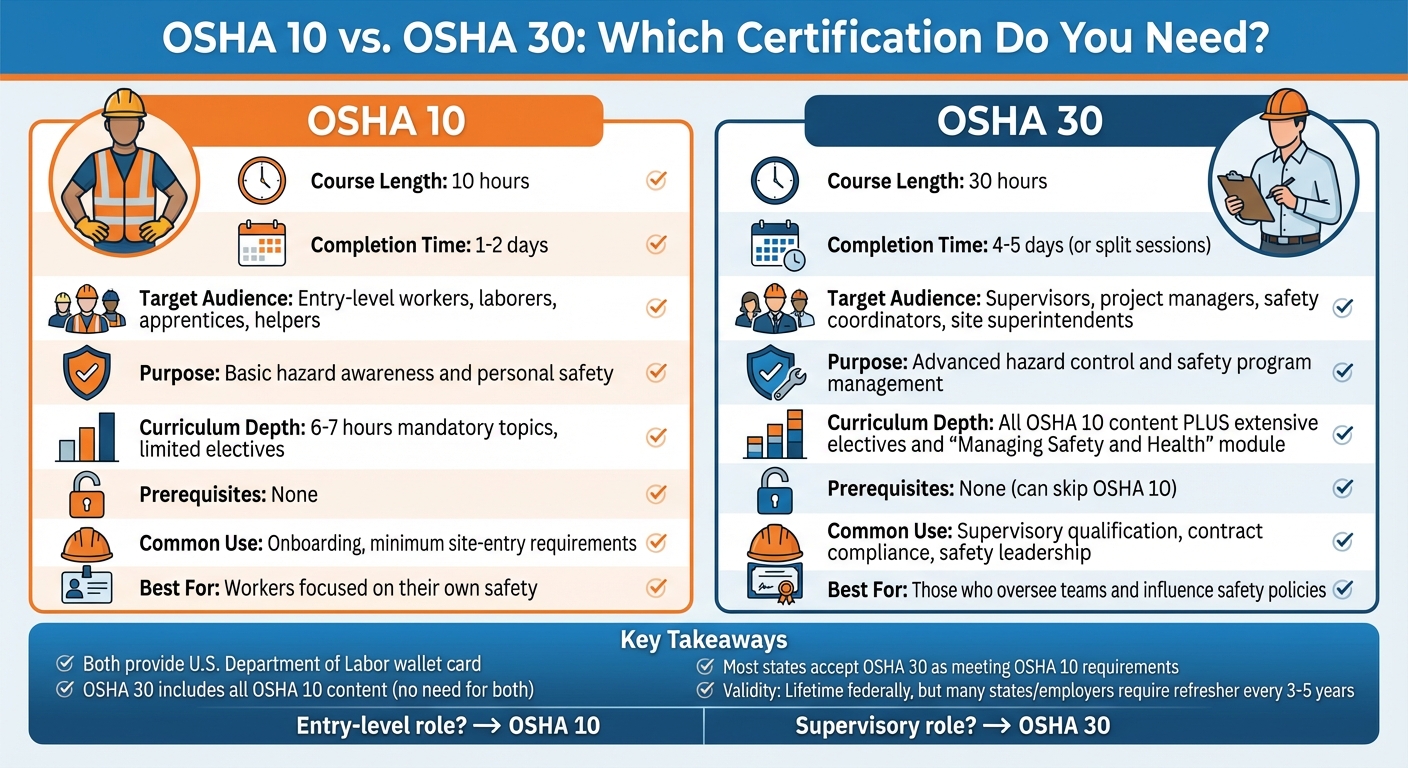
OSHA 10 vs OSHA 30 Training Comparison Chart
Main Differences Between OSHA 10 and OSHA 30
Course Length and Time Required
The most obvious difference between OSHA 10 and OSHA 30 is the time commitment. OSHA 10 involves 10 hours of instruction, while OSHA 30 requires 30 hours. OSHA 10 is usually completed in 1–2 days, making it a quick option for basic safety training. OSHA 30, however, often takes 4–5 days or is broken into shorter sessions to fit around work schedules and project demands.
Both courses can be taken in-person or online through authorized OSHA Outreach providers. Many U.S. employers include OSHA 10 as part of onboarding for new hires, while OSHA 30 is frequently offered as part of a supervisor’s training path. To minimize downtime on active projects, companies sometimes spread OSHA 30 over several weeks, balancing training with worksite needs.
These scheduling approaches highlight the distinct levels of depth and responsibility each course is designed to address.
Who Should Take Each Course
The audience for each course differs based on job responsibilities. OSHA 10 is geared toward laborers, apprentices, helpers, and other entry-level workers. These individuals need to identify hazards and practice basic safety measures but aren’t tasked with managing teams or enforcing safety policies.
OSHA 30, on the other hand, is designed for supervisors and safety personnel who oversee teams and ensure compliance with safety standards. This includes roles like forepersons, project managers, site superintendents, safety coordinators, and engineers with field responsibilities. In high-risk industries such as construction, oil and gas, utilities, and heavy infrastructure, many contractors now require OSHA 30 for decision-makers who influence crew safety. The extended training is necessary to equip these professionals with the knowledge to manage safety programs, perform inspections, and address compliance issues across entire teams.
Comparison Table: OSHA 10 vs. OSHA 30
| Aspect | OSHA 10 | OSHA 30 |
|---|---|---|
| Course Length | 10 hours of instruction | 30 hours of instruction |
| Typical Completion Time | 1–2 days | 4–5 days (or split sessions) |
| Primary Audience | Entry-level workers, laborers, apprentices, helpers | Supervisors, project managers, safety coordinators, site superintendents |
| Core Purpose | Personal safety and basic hazard recognition | Comprehensive hazard control and safety program management |
| Curriculum Depth | 6–7 hours on mandatory topics, limited electives | All OSHA 10 content plus extensive electives and "Managing Safety and Health" module |
| Prerequisite | None | None (OSHA 10 not required first) |
| Common Use Cases | Onboarding, minimum site-entry requirements | Supervisory qualification, contract compliance, safety leadership development |
It’s worth noting that OSHA 10 is not a prerequisite for OSHA 30. Workers can directly enroll in the 30-hour course without completing OSHA 10 first. Since OSHA 30 includes and expands upon OSHA 10 content for the same industry, taking both courses is unnecessary. In fact, most states recognize OSHA 30 as meeting OSHA 10 requirements, so supervisors typically don’t need separate certifications for each course.
What Each Course Covers
Topics Covered in Both OSHA 10 and OSHA 30
Both OSHA 10 and OSHA 30 start with an introduction to OSHA, explaining its role, worker rights, employer responsibilities, and essential standards. After this foundational overview, the courses dive into core safety topics that address the most frequent and severe hazards in specific industries. For example, in construction, both certifications cover fall protection, ladder and scaffold safety, electrical safety, personal protective equipment (PPE), struck-by and caught-in hazards, materials handling, and crane safety. This shared curriculum ensures that all workers – whether new to the field or in supervisory roles – grasp the fundamental safety practices and hazard awareness relevant to their industry.
The primary distinction lies in the depth and scope of the material. OSHA 10 focuses on the basics, with limited flexibility for electives, while OSHA 30 includes the same mandatory topics but goes further, offering more extensive and detailed coverage across the additional hours. OSHA 30’s added content is particularly geared toward preparing supervisors for their expanded responsibilities.
Additional Topics in OSHA 30
OSHA 30 goes beyond the basics to include advanced topics like hearing conservation, respiratory protection, lead and crystalline silica safety, asbestos awareness, GHS hazard communication, heavy equipment operation, forklift safety, fire safety protocols, welding and cutting safety, concrete and masonry work, steel erection guidelines, and ergonomics. These modules are designed to address complex safety challenges that supervisors and experienced workers are more likely to encounter.
One standout feature of OSHA 30 is the "Managing Safety and Health" module, which is exclusive to this course. This section focuses on supervisory responsibilities, including:
- Conducting thorough job site inspections
- Developing and implementing injury and illness prevention programs
- Creating accident prevention strategies
- Identifying and mitigating workplace hazards
- Leading effective safety meetings
- Enhancing communication skills for supervisory roles
This content is vital for supervisors, as they must oversee compliance with safety requirements for all workers under their management – not just those relevant to a single role. While entry-level employees don’t need to master these management-focused areas, this advanced training is critical for ensuring a safe and compliant work environment at the supervisory level.
How to Get Certified and Maintain Certification
Steps to Get OSHA 10 or OSHA 30 Certified
Getting OSHA-certified is a straightforward process, but it’s important to follow the right steps. First, determine which course fits your role. OSHA 10 is designed for entry-level workers, while OSHA 30 is geared toward supervisors and safety personnel. Make sure to choose the course that matches your industry – Construction, General Industry, or another sector-specific category.
Next, pick an OSHA-authorized training provider. You can complete the course either in person or online through an approved platform. Both formats are widely accepted by employers as long as the provider is authorized under OSHA’s Outreach Training Program.
Once enrolled, you’ll need to complete all required instructional hours, quizzes, and follow attendance guidelines. If you’re taking an online course, keep in mind that OSHA limits daily training to 7.5 hours, so plan accordingly. After completing the course, your training provider will issue an official OSHA Department of Labor (DOL) wallet card. This card is typically mailed to you within a few weeks, though some providers may also offer a digital version.
Be cautious of non-authorized or "free" courses that don’t provide a valid DOL card. Similarly, avoid attempting to speed through online training in a single day, as OSHA’s time-tracking rules require multiple sessions. Always verify that your provider is OSHA-authorized and that the course aligns with your specific industry needs. Keep both digital and physical copies of your DOL card and completion certificate handy – they’re essential for job applications and credential verification. Platforms like ABLEMKR allow employers to confirm safety certifications and match workers to high-risk projects in fields like construction, energy, and mining.
After earning your certification, it’s critical to stay on top of renewal requirements to maintain compliance.
How Long Certifications Last and Renewal Rules
Under federal OSHA guidelines, OSHA 10 and OSHA 30 certifications are considered valid for a lifetime. However, many states and employers have their own rules, often requiring refresher training every three to five years. For example, states like New York and Massachusetts require OSHA 10 for construction workers on public projects, with a typical validity period of five years. In industries like energy – covering oil and gas, utilities, and mining – OSHA 30 is often treated as a baseline, and refresher courses may also be required every three to five years, especially for supervisory roles.
If your OSHA card is older, most employers will accept it as proof of training. However, they may ask you to retake the course if it’s over five years old or if specific state or project requirements apply. While federal rules don’t mandate refresher training, many high-risk industries follow a practice of annual or biennial safety training. Topics like fall protection, lockout/tagout, and hazard communication are commonly revisited to maintain compliance and promote a strong safety culture.
sbb-itb-aa28329
Which Certification Should You Choose?
Choosing Based on Your Job Role
The certification you choose should align with your job responsibilities. OSHA 10 is tailored for workers focused on their own safety, such as general laborers, helpers, flaggers, and craft workers on residential or light commercial projects. If your role doesn’t involve managing safety protocols, OSHA 10 provides the basic hazard awareness needed to meet state or contractor requirements.
On the other hand, OSHA 30 is designed for those who oversee others or influence safety policies. This includes foremen, crew leads, site supervisors, project managers, engineers with field authority, and safety professionals. OSHA 30 builds on the basics of OSHA 10, covering topics like jobsite inspections, incident prevention, hazard identification, and leading safety meetings. For example, a concrete foreman managing a 15-person crew or a maintenance supervisor in a refinery could use OSHA 30 training to develop job safety analyses, coach workers, and reduce safety incidents – practical tools that directly improve workplace safety and help manage regulatory risks.
If you’re aiming for a supervisory or safety-focused role, you can skip OSHA 10 and go straight to OSHA 30. This saves time and money while giving you a stronger credential for career growth. Many states accept OSHA 30 as a substitute for OSHA 10 for regulatory compliance, offering flexibility as project requirements evolve.
Before enrolling, always review your project’s specific requirements. For instance, public and large private projects often include OSHA training in their contracts. Depending on local regulations, all on-site workers might need OSHA 10, while supervisors may require OSHA 30. Some trades could even have contractual obligations for OSHA 30 certification. Check bid specifications, union agreements, and local labor department rules to ensure you choose the certification that meets your current project needs and supports your career goals.
Certification Requirements for Construction and Energy Workers
Understanding how OSHA certifications apply across industries can help you stay compliant and prepare for career advancement. In heavy civil, industrial construction, and large EPC projects, OSHA 30 is increasingly expected for supervisors, key trades, and sometimes all on-site personnel due to the risks associated with cranes, confined spaces, process equipment, and simultaneous operations. For example, a crane operator, heavy equipment operator, or lead carpenter – while not formal supervisors – might still be required to earn OSHA 30 to better understand equipment-specific hazards, signaling, and task planning.
In the energy, oil and gas, and large industrial sectors, OSHA 30 is often preferred for a larger portion of the workforce. Contractors working in refineries, chemical plants, power plants, and pipeline operations typically require OSHA 30 for foremen and team leads as a baseline, often supplemented with site-specific safety or contractor-qualification training. If you’re transitioning from general construction into energy or heavy industrial roles, earning OSHA 30 early can strengthen your resume and make you more competitive.
For employers with widespread operations, platforms like ABLEMKR simplify compliance by centralizing OSHA card verification during onboarding. This ensures that only properly trained workers are dispatched to high-risk jobs.
The general rule is straightforward: assign OSHA 10 to general workers and OSHA 30 to supervisors. This layered approach ensures safety knowledge aligns with authority on-site. Having multiple OSHA 30-trained leaders on each crew improves the implementation of pre-task plans, toolbox talks, and hazard controls. This not only reduces incidents but also lowers workers’ compensation costs and minimizes the risk of OSHA citations and fines.
OSHA 10 vs OSHA 30 Explained | Which Safety Course Do You Need?
Conclusion
OSHA 10 and OSHA 30 certifications play an essential role in improving workplace safety by increasing hazard awareness and equipping workers with the skills to respond effectively to risks. OSHA 10 provides 10 hours of foundational training tailored for entry-level workers, focusing on personal safety. On the other hand, OSHA 30 offers an in-depth, 30-hour program designed for those in supervisory roles, such as foremen, site leads, project managers, and safety professionals, covering broader safety management responsibilities.
The choice between these certifications depends heavily on your role. If you’re an employee without supervisory duties, OSHA 10 provides the basic safety knowledge needed for your job. However, if you oversee others or play a role in shaping safety protocols, OSHA 30 prepares you to handle tasks like conducting inspections, leading safety meetings, and implementing hazard controls. This distinction is especially important in industries like construction, oil and gas, utilities, and mining, where improper training can lead to safety gaps, higher injury risks, or even OSHA violations.
While OSHA 10 ensures workers meet basic safety standards, OSHA 30 sets supervisors apart and can open doors to career advancement. Many employers now use digital tools to confirm certifications during onboarding, ensuring that trained personnel handle critical tasks.
Selecting the right OSHA training – whether 10 or 30 hours – can enhance your safety knowledge, meet employer expectations, and support your long-term career goals. Evaluate your current responsibilities and project needs to determine the certification that aligns with your role, helping to create safer job sites and a more secure future in high-risk industries.
FAQs
How do I decide between OSHA 10 and OSHA 30 training?
When deciding between OSHA 10 and OSHA 30, think about your job responsibilities and the level of safety training your role demands.
OSHA 10 is tailored for entry-level workers, offering a basic overview of workplace safety and addressing common hazards. It’s a great starting point if you’re new to the field or need essential safety knowledge.
OSHA 30, however, goes deeper. It’s designed for supervisors or those in leadership positions, covering advanced safety topics and regulatory requirements. This course is ideal if you’re responsible for managing teams, implementing safety procedures, or working in environments with higher risks.
Before making a decision, consult your employer or review project requirements to ensure the certification aligns with your role.
Do I need to complete OSHA 10 before enrolling in OSHA 30?
No, you don’t have to complete OSHA 10 before signing up for OSHA 30. These are two separate courses tailored to different needs. OSHA 10 is meant for entry-level workers and focuses on the basics of workplace safety. On the other hand, OSHA 30 dives deeper, providing more comprehensive training for supervisors or employees responsible for safety oversight.
You can pick the course that aligns with your job responsibilities and career objectives without worrying about taking them in any particular order.
Do I need to renew my OSHA certification?
OSHA certifications, like OSHA 10 and OSHA 30, don’t come with an expiration date and don’t need to be renewed. That said, some employers or industries might require workers to retake the training every so often to stay informed about updated safety standards and practices.
To make sure you’re meeting any specific requirements, it’s smart to check with your employer or review your industry’s guidelines.


