
If an oilfield job involves an uncontrolled spill, emergency response, or hazardous cleanup, HAZWOPER training must be in place before the crew goes out. In oil and gas, the fatality rate is 21.6 deaths per 100,000 workers – about 6x the all-industry average. And when records are expired or missing, crews can be turned away at the gate, jobs can slip by hours or a full shift, and employers can face OSHA trouble.
Here’s the short version:
- Routine oilfield work usually does not fall under HAZWOPER.
- Spill response, air monitoring, respirator use, decontamination, and hazardous cleanup often do.
- A worker’s 8-hour refresher must be current within 12 months.
- If records are missing, OSHA may treat the worker as not trained.
- The fix is simple: check training level, refresher date, fit test, medical clearance, and job match before dispatch.
I’d boil the article down to one point: HAZWOPER is not just a training item; it’s a dispatch filter. If you wait until the truck is rolling – or worse, until the worker hits the gate – you’re already late.
A few facts stand out:
- Benzene peaks near open tank hatches have been found above 200 ppm
- Some tank and separator areas have reached 40% of the lower explosive limit
- In one chemical spill case near Houston, proposed penalties across three companies topped $3.5 million
That tells me the risk is not just paperwork. It’s worker exposure, lost time, and OSHA action tied to the wrong crew showing up for the wrong job.
| What to check before dispatch | Why it matters |
|---|---|
| HAZWOPER 24-hour or 40-hour course | Must match the job |
| 8-hour annual refresher date | If overdue, the worker is not current |
| Respirator fit test and medical clearance | Needed for jobs that require respiratory protection |
| Site-specific training | Covers hazards like H2S, NORM, confined space, or pressure |
| Role match | Spill tech, driver, operator, and safety lead may need different training |
So if I were advising a field team in plain terms, I’d say this: know whether the job is routine work or hazardous response, then confirm every record before travel is booked. That one habit can cut gate denials, idle labor, and last-minute crew swaps.
What Is HAZWOPER Training and Who Needs It
sbb-itb-aa28329
When Oilfield Work Falls Under HAZWOPER Rules
Not every oilfield job falls under HAZWOPER. The rule applies to uncontrolled releases, emergency response, and hazardous waste cleanup. It does not cover routine production, drilling, completions, or servicing.
That line matters in the field. It also matters back at dispatch. Before a worker heads to site, the team needs to know whether the job calls for HAZWOPER training or not.
Common Hazards: Crude Oil, Fuels, Distillates, and Chemical Releases
Crude oil, condensate, fuels, produced water, and flowback fluids can create more than a messy cleanup. They can release toxic vapors, increase fire risk, and expose workers through skin contact or inhalation.
NIOSH field studies found benzene peaks above 200 ppm near open tank hatches and atmospheres reaching 40% of the lower explosive limit near separators and flowback tanks. That’s not a minor detail. It’s why training status becomes a dispatch check, not just something the safety team worries about later.
Tasks That Require Advanced HAZWOPER Training: Spill Response, Air Monitoring, PPE, and Decontamination
Once a release goes beyond incidental cleanup, the work usually calls for 24- or 40-hour HAZWOPER training.
That can include:
- Spill containment
- Air monitoring
- Respirator use
- Zone control
- Decontamination
- Contaminated-waste handling
Extended post-emergency cleanup also falls under HAZWOPER. That includes soil remediation, sludge removal, and shoreline recovery. If the job has moved into that kind of cleanup, formal training is part of the deal.
Routine Work vs. OSHA Emergency Response
In practice, the dividing line comes down to a few plain questions. How large is the release? Is it spreading? Does it create fire or toxic vapor hazards? Does the crew need specialized PPE? Does the impact extend beyond the immediate work pad?
If the answer points to a bigger, less controlled event, the job may shift from incidental work to HAZWOPER-covered response.
| Situation | Classification | HAZWOPER Required? |
|---|---|---|
| Small fuel drip, contained on pad, cleaned with absorbents | Incidental release | No |
| Tank overfill with spreading pool and vapor hazard | Emergency response | Yes |
| Crude pipeline rupture with multi-day containment and recovery | Emergency response + hazardous waste operations | Yes |
| Produced water breach into soil requiring remediation | Post-emergency cleanup | Yes |
| Routine production monitoring, no release | Standard operations | No |
OSHA is clear on this point: emergency response to hazardous substance releases is covered regardless of location. That means remote drilling sites, tank batteries, and pipeline rights-of-way can all fall under HAZWOPER when crews respond to uncontrolled releases.
When crews get misclassified, the issue doesn’t stop at field safety. It turns into a records problem too, because someone has to confirm the right training before dispatch.
What Happens When Workers Arrive Without Valid HAZWOPER Records
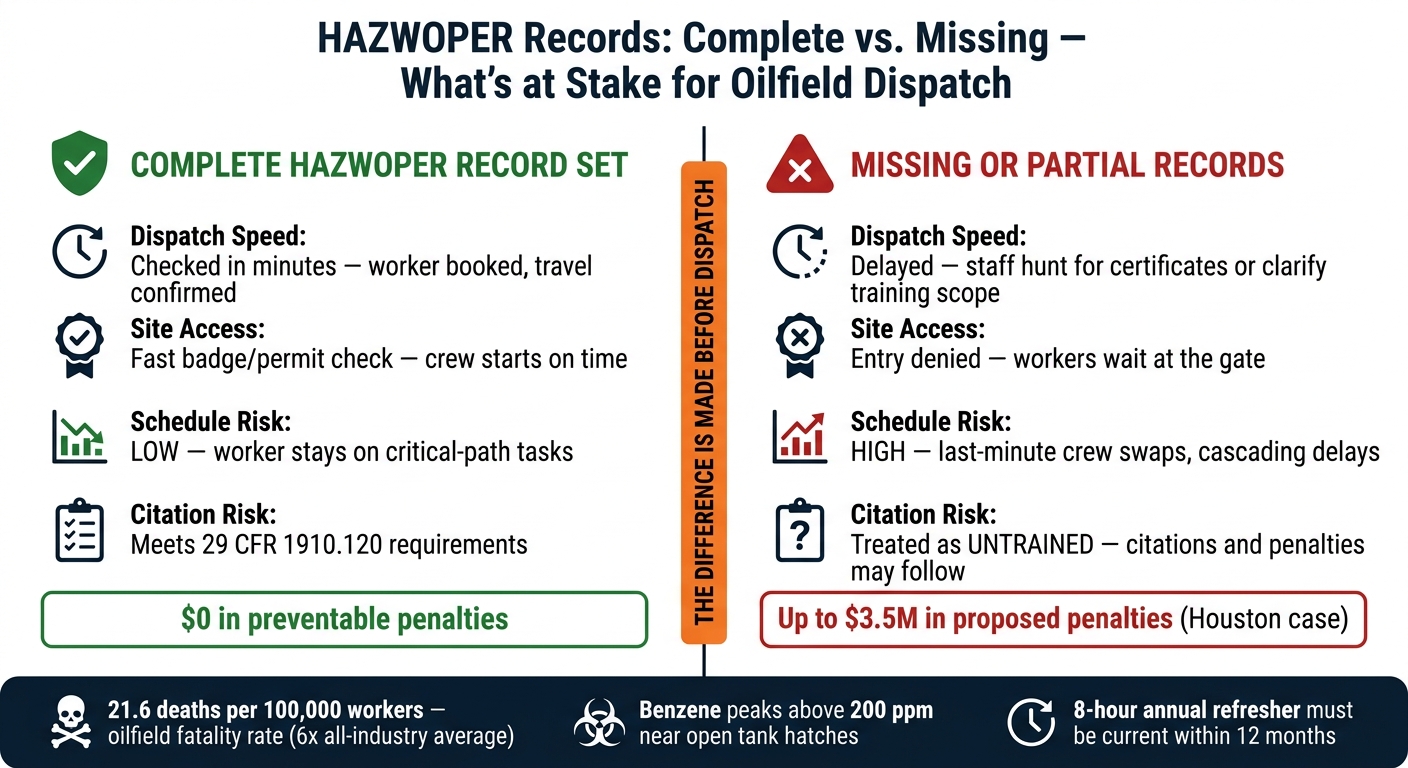
HAZWOPER Compliance: Complete vs. Missing Records Impact on Oilfield Dispatch
Once a job falls under HAZWOPER, the next place things often go wrong is paperwork. Missing records can stall work, add labor cost, and open the door to compliance trouble. And it usually happens at the worst time: right at the gate, just before the shift starts.
Rejected Site Access and Delayed Project Starts
At U.S. refineries, tank farms, and upstream production sites, gate security often treats HAZWOPER records as a hard entry requirement. If a worker’s 8-hour refresher is past the 12-month mark, many operators won’t let that person in.
That sounds like a small paperwork issue. It rarely stays small.
When the problem shows up at the gate instead of before dispatch, workers can end up sitting in a holding area while safety staff call training providers or ask managers for an override. On critical-path jobs like tank cleaning, spill remediation, or well control rig-up, a few lost hours can knock a milestone back by an entire shift. Then the delay spreads. Other crews waiting for that area to open up get stuck too, so one expired refresher can slow much more than one worker.
Compliance Exposure and Admin Rework
Under OSHA’s HAZWOPER standard, undocumented training is treated as incomplete for citation purposes. In plain terms, the employer has to show that each worker was trained and that the training was documented before hazardous work starts.
A full, audit-ready HAZWOPER file usually includes:
- The worker’s name
- Course level and duration
- Training date
- Trainer or provider
- Employer competency sign-off
- Supervised field experience
For jobs that involve respirators or confined-space entry, teams often attach fit-test records and task-specific training too.
If any part of that file is missing, the scramble starts fast. Safety staff may need to chase down replacement certificates from training vendors. Payroll may have to sort out idle time. HR may need to rush workers into retraining. If the operator or OSHA challenges a worker’s qualifications, the contractor may also have to review the whole crew again and revise the written HAZWOPER program. That can pull safety and management staff away from other work for days.
The cost can get ugly in a hurry. In one hazardous chemical spill case near Houston, proposed penalties across three companies topped $3.5 million, which shows how far HAZWOPER record failures can go.
Complete Record Set vs. Missing Record Set: A Side-by-Side Comparison
You see the difference first in dispatch, gate access, and inspection prep.
| Stage | Complete HAZWOPER Record Set | Missing or Partial Records |
|---|---|---|
| Dispatch Speed | Checked in minutes; worker is booked and travel is confirmed | Slowed down while staff hunt for certificates or sort out training scope |
| Site Access | Fast badge or permit check; crew starts on time | Entry denied or limited; workers wait at the gate |
| Schedule Risk | Low; worker stays on critical-path tasks | High; removal during the job forces last-minute crew swaps |
| Citation Risk | Meets 29 CFR 1910.120 requirements | Treated as untrained; citations and penalties may follow |
A complete file helps a worker get through the gate fast. Missing pieces slow each checkpoint and can stop work during an inspection.
The Training and Documentation Workflow That Prevents Job Delays
The table in the previous section shows the price of missing records. The fix is simple: check everything before dispatch. Then make sure each worker has the right training level for the job they’re being sent to do.
Match Training Level to Job Duties
Not every oilfield role needs the same HAZWOPER training. The right credential depends on the hazard and the work involved.
Workers entering exclusion zones or handling contaminated material will usually need 40-hour HAZWOPER plus supervised field experience. Roles with lower exposure may fit 24-hour HAZWOPER. And across the board, everyone needs an 8-hour annual refresher.
For pumpers, roustabouts, and drivers who may be the first to spot or report a release, First Responder Awareness (FRA) is the right place to start. If those workers may need to take defensive actions, like diking, damming, or diverting a spill, First Responder Operations (FRO) is a better fit. Dedicated spill response crews will usually need Hazmat Technician or Specialist credentials on top of 40-hour HAZWOPER.
That’s why role-based screening matters. It stops bad assignments before they ever make it to the truck.
| Role | Typical Training Level |
|---|---|
| Spill response technician | 40-hour + Hazmat Technician |
| Production operator / well service hand in contaminated zones | 40-hour + annual refresher |
| Maintenance tech with limited exposure | 24-hour or 40-hour, based on task |
| Truck driver / tank farm personnel | First Responder Awareness |
| Site safety officer | 40-hour + Specialist |
Once the role is matched to the training level, record checks get much easier.
Review the Full Readiness File Before Dispatch
After training level is set, review the full file before travel gets booked. A HAZWOPER-covered oilfield worker should have a readiness file that includes:
- Initial HAZWOPER certificate for the 40-hour or 24-hour course, with completion date and provider
- 8-hour refresher record dated within the past 12 months
- Project safety plan and site-specific orientation records covering H2S, NORM, confined space, or high-pressure work
- PPE assignment, respirator fit-test records, and medical clearance records
- Air monitoring plan and baseline logs
- Decontamination procedures that apply to the job
If even one item is missing or expired, flag the worker before travel is booked. That’s much better than finding out at the gate. OSHA also says that if refresher training slips past the anniversary date, employers must document the reason and the planned completion date.
Use Expiration Tracking and Role-Based Screening
Expired refreshers are one of the easiest ways to lose site access. A good tracking system gives each worker a deployable or not deployable status based on certification dates. It should also send alerts at 60, 30, and 7 days before a credential expires.
For longer projects, check one more thing: will any key certification expire during the assignment? A lapse in the middle of a job can throw off work just as badly as a denial at check-in.
Role-based screening adds another filter. It checks workers against the exact needs of the role before assignment. For example:
- A spill tech slot needs 40-hour HAZWOPER, Hazmat Technician credentials, a current fit test, medical clearance, and documented cleanup experience
- A driver slot needs FRA and H2S awareness
If a worker doesn’t meet those requirements, they shouldn’t show up as an eligible candidate.
These checks work best when staffing teams can verify credentials in real time.
How ABLEMKR Helps Oilfield Teams Close Compliance Gaps

Once a job calls for HAZWOPER-level coverage, the next problem is simple: sending workers with expired or missing records. A labor ops platform only matters if it helps keep those records current before dispatch.
Worker Matching Based on Training, Availability, and Location
ABLEMKR matches pre-vetted workers to oilfield job orders based on certification level, location, and availability – not availability alone. If a job requisition calls for HAZWOPER 40-hour training, spill response experience, and a current respirator fit test, the platform narrows the pool to workers whose profiles show those credentials as active and verified. It also screens out workers whose HAZWOPER or fit-test records are no longer current.
That becomes especially important in urgent situations. If a pipeline operator needs a qualified response crew within 24 hours, ABLEMKR can pull up nearby workers with current HAZWOPER credentials instead of leaning on phone calls and verbal confirmation that often falls apart at the site gate.
Of course, matching is only part of the story. It works only if those credentials are being checked in real time.
Real-Time Credential Tracking Before Crews Mobilize
ABLEMKR gives staffing coordinators a real-time view of each worker’s readiness file before anyone is dispatched. They can spot expired HAZWOPER records and missing fit-test documents before a crew is sent out. If a worker’s HAZWOPER refresher has expired or a fit-test record is missing, the platform flags the issue and blocks the assignment until it’s fixed.
HAZWOPER is one of the certifications most likely to lapse because it needs annual renewal. That makes automated expiration alerts a big help for catching gaps before dispatch.
Conclusion: Fewer Delays and Better Compliance Control
When oilfield work shifts into HAZWOPER territory, clear visibility into worker status is what keeps crews from getting stopped at the gate. Crude oil releases, spill response, and other high-risk field tasks can push routine oilfield work into that category fast. If crews show up without valid records, the result is gate rejections, project delays, and compliance exposure. Real-time credential tracking helps close that gap and lets operators dispatch HAZWOPER-ready crews faster.
FAQs
How do I know if a spill is incidental or an emergency?
An incidental spill is a small leak or drip that workers can safely contain and clean up with standard supplies, such as spill kits. It doesn’t create major safety or health risks for the people nearby.
An emergency spill is different. It involves a larger release or a more dangerous substance, and it goes beyond basic awareness training. It calls for advanced training, such as HAZWOPER, along with special response and decontamination methods.
What happens if a worker’s HAZWOPER refresher has expired?
If a worker’s HAZWOPER refresher has expired, they’re generally out of compliance. In most cases, that means they can’t enter high-risk sites or take part in hazardous waste operations.
That can lead to compliance problems, project delays, penalties, and safety concerns. Platforms like ABLEMKR help stop those gaps before they turn into bigger issues by flagging expiring credentials and blocking assignments for workers who don’t have current, verified training.
Who on an oilfield crew usually needs 24-hour vs. 40-hour training?
Under OSHA rules, the HAZWOPER level a worker needs depends on the kind of hazardous work they do.
40-hour training usually applies to employees with higher-risk exposure, such as hazardous waste site cleanups or some oil and gas roles.
24-hour training is more common for workers with less frequent or lower-level exposure.
Both options require an annual 8-hour refresher to keep workers compliant and qualified.


