
If you work on Ohio nonresidential construction jobs, you may need E-Verify now – and mistakes can cost from $250 to $25,000 per violation.
I’d boil the whole article down to this: starting in March 2026, Ohio requires many contractors, subcontractors, and labor brokers on nonresidential projects to use E-Verify in addition to Form I-9. The main pressure points are simple: know if the project is covered, add the right contract language on public jobs, open cases by the third business day, keep records, and make sure lower-tier subs follow the same rule.
Here’s the short version of the 7 rules:
- Rule 1: Check whether the job is nonresidential construction. Homes and other residential work are generally out.
- Rule 2: If it’s a public improvement job, the contract must include an E-Verify clause.
- Rule 3: Enroll the right company in the federal E-Verify system before covered hiring starts.
- Rule 4: Complete Form I-9 first, then open the E-Verify case on time and save proof.
- Rule 5: Push the duty down to subcontractors and labor brokers in writing.
- Rule 6: Know the penalty range: $250, $1,000, $1,500, and up to $25,000 in some cases, plus possible debarment for up to 2 years.
- Rule 7: Get timing right: don’t open cases too early, too late, or again when a worker simply moves to another covered Ohio project under the same employer.
Ohio E-Verify Penalties & Violations: Fine Schedule for Contractors
Quick Comparison
| Topic | What I’d watch |
|---|---|
| Covered work | Commercial, industrial, infrastructure, public improvement |
| Exempt work | Single-family and other residential jobs, plus listed exempt categories |
| Main deadline | E-Verify case by the 3rd business day after paid work starts |
| I-9 vs. E-Verify | I-9 first; E-Verify is an extra step |
| Public contracts | Clause must flow down through subcontract tiers |
| Record retention | 3 years after hire or 1 year after termination, whichever is later |
| Top risk | Late cases, bad records, weak subcontract follow-through, poor TNC handling |
If I were reading this for a fast answer, that’s the part I’d want first: figure out coverage, lock down contract terms, verify on time, and keep clean proof.
sbb-itb-aa28329
What Ohio Contractors Should Know Before the 7 Rules
Before getting into the seven rules, it helps to nail down four basics. These are the moving parts that shape how Ohio’s E-Verify mandate works on the ground.
What counts as nonresidential construction in Ohio
Covered projects include commercial, industrial, and infrastructure work. That means offices, warehouses, factories, roads, bridges, and utilities.
Residential construction is exempt, including single-family homes and multifamily housing. But there’s a catch: if your company handles both residential and nonresidential jobs, the mandate still applies to employees hired for the nonresidential side. That line matters because it decides whether the rules below apply at all.
Which employers and contracts are covered
Ohio’s rules reach general contractors, subcontractors at every tier, and labor brokers that supply workers to covered projects. If you manage workers or provide labor for a covered project, you’re likely covered.
Public improvement contracts also require E-Verify clauses that flow down to the prime contractor and subcontractors. So this isn’t just a prime-level issue. It can follow the job all the way down the chain.
How E-Verify differs from Form I-9
Form I-9 is required for every new hire. E-Verify is the extra step for covered Ohio contractors.
The process is simple in theory: complete the I-9 first, then create the E-Verify case by the third business day after the employee starts work. Think of E-Verify as a follow-up check, not a substitute for the I-9.
It’s also worth being clear on what E-Verify does not do. You can’t use it to reverify expiring work authorization. That still has to be handled in Form I-9 Section 3.
Why local public entities matter
Cities, counties, school districts, townships, and public utilities must place E-Verify clauses in public improvement contracts. Those clauses can affect bid eligibility and create flow-down duties for each subcontractor on the project.
That’s why these local contract terms matter so much. They’re the reason the flow-down duties in Rule 2 and Rule 5 show up in the first place.
These definitions set the stage for the seven rules below.
1. Know Which Nonresidential Projects Require E-Verify
Start with the project type. That’s the first filter, and it tells you whether the E-Verify rule applies at all.
Ohio’s E-Verify mandate applies to nonresidential construction and renovation tied to buildings, highways, bridges, utilities, and related infrastructure.
Some projects are exempt. Residential work does not fall under the mandate, and neither do listed agricultural or manufactured-home projects. If a job clearly fits one of those exempt categories, E-Verify is not required.
Mixed-use jobs need a closer look. A building with ground-floor retail and apartments above, for example, may mean the commercial portion counts as covered nonresidential work. If the classification isn’t obvious, write down how the call was made and send it for review before work begins.
For mixed-use projects and bid-stage reviews, keep the check simple. Focus on three things:
- The project’s use
- The scope of work
- Whether a listed exemption plainly applies
Use project descriptions, permits, owner contracts, and zoning or use classifications to back up the file. Estimators and project managers should make this call during bid review and record the result in case of an audit.
| Project Type | E-Verify Required? |
|---|---|
| Commercial office or retail building | Yes |
| Hospital or school building | Yes |
| Highway, bridge, or interchange | Yes |
| Water, sewer, or utility line | Yes |
| Single-family or multifamily residential | No |
| Agricultural barn or farm storage | No |
| Manufactured or mobile home | No |
| Industrialized unit | No |
If the project is public improvement work, Rule 2 also requires the contract clause.
2. Know When Public Improvement Contracts Require E-Verify Clauses
Once you’ve confirmed the project is nonresidential, the next step is figuring out whether it also counts as a public improvement. If the owner is a state agency or political subdivision, and the work involves construction or maintenance of a public improvement, the contract must include an E-Verify clause.
This is a contract requirement, not just a general hiring rule. In plain terms, the public owner places the clause in the agreement, and the prime contractor has to follow it once the job is awarded. Before signing, check the bid package for that clause in the solicitation, general conditions, or compliance exhibits.
The clause should require both the prime contractor and every subcontractor tier to use E-Verify for workers hired during the contract term and for workers assigned to the Ohio project. That also includes current employees who are later reassigned to the job.
Before any subcontractor mobilizes, make sure the subcontract includes the E-Verify obligation and lines up with Ohio’s E-Verify rules. A verbal agreement won’t cut it. The flow-down has to be in writing.
That written flow-down sets up the enrollment step in Rule 3.
3. Enroll Correctly in the Federal E-Verify System
After the contract clause is in place, enroll the right entity before the first covered hire starts work. For covered Ohio contractors, this is the admin step that lets you use E-Verify at all. Go through the federal E-Verify site before you create any case tied to a covered Ohio project.
Before you begin, pull together the key details you’ll need:
- Legal name
- EIN
- Physical and mailing addresses
- Ohio and out-of-state hiring sites
- Current headcount
- NAICS code
- Signatory and Program Administrator contacts
Then work through the online prompts, verify your email, add hiring sites, assign the signatory and Program Administrator, and sign the MOU. The MOU is the required federal enrollment agreement. Save the signed MOU in your project file.
Choose the account type that fits who will handle case creation and account management for the project. Most Ohio contractors should select Employer. Use Corporate Administrator if oversight sits in one central group, Employer Agent if a third party will handle verifications, and Web Services if you’re connecting E-Verify to your own system.
Once enrollment is confirmed, the Program Administrator needs to log in, reset the password and security questions, and finish the mandatory tutorial and knowledge test before the account can be used to create cases or add other users. It’s smart to name at least two Program Administrators so onboarding doesn’t get stuck if one person is out. Once the account is live, the next move is on-time case creation.
4. Run E-Verify on Time and Keep Proof
Start the clock when paid work begins. You need to create the E-Verify case by the third business day after the employee starts work for pay.
Here’s the simple version: if someone starts on Monday, open the case by Thursday. A smart move is to set an internal Day 2 deadline so you have a buffer and don’t miss the window. If the deadline slips, open the case right away, use the employee’s actual hire date, and add a short note explaining the delay.
Once the case is open, save the proof right then and there. After each case, keep the result screen or PDF that shows:
- Employee name
- Case number
- Hire date
- Final result
If the case leads to a Tentative Nonconfirmation, keep the notice, the employee’s response, and the final resolution timeline too. Hold these records for three years after hire or one year after termination, whichever is later.
It also helps to keep one log for every worker and project. A spreadsheet or compliance system works fine, as long as each entry includes the employee’s name, hire date, case creation date, case number, result, and any TNC notes. Then match that log against payroll records so an auditor can connect project assignments to workers who were verified.
Don’t lean on the portal as your only record. Export the proof as soon as the case is done. Download and store case result PDFs at the time of verification, tagged with the employee ID and project number, so the compliance file is complete and easy to review.
5. Handle Subcontractor and Labor Broker Compliance
Your E-Verify duty doesn’t end with your own payroll. Under Ohio law, nonresidential construction contractors, subcontractors, and labor brokers must verify the work eligibility of the workers they hire or supply for covered projects.
And Ohio reads subcontractors broadly. So this duty flows down across tiers. Each company checks its own workers, but the general contractor still has to make sure the rule is built into the project and followed all the way down the chain. In plain English: this is a contract-management job, not just an HR task.
Start with the contract language. Before anyone shows up on site, add a clear E-Verify clause to every subcontract and labor broker agreement. Use flow-down language that binds each subcontractor and labor broker to the same Ohio E-Verify duties. For public improvement work, Ohio law already requires the prime contract to include E-Verify language for the contractor and subcontractors, so your downstream agreements should match that rule.
Before work starts, collect proof of enrollment. Ask each subcontractor and labor broker for a copy of its E-Verify Memorandum of Understanding (MOU) with the Department of Homeland Security. Don’t let the subcontractor or broker mobilize until you confirm enrollment.
Labor brokers need extra scrutiny. Ohio law calls them out by name. If a broker sends workers to your site, your contract should require E-Verify completion before dispatch. It should also require the broker to replace any worker who has a pending verification case.
Tie payment approval to written certifications submitted with each pay application, showing that newly added workers have been verified. That paperwork gives you the record you’ll need to deal with penalty risk in Rule 6.
6. Know the Penalties, Fines, and Debarment Risks
Most penalties come from the same trouble spots: missed case deadlines, poor nonconfirmation handling, and weak subcontractor oversight. In Ohio, E-Verify penalties go up based on the type of violation and the employer’s enforcement history during a three-year lookback period.
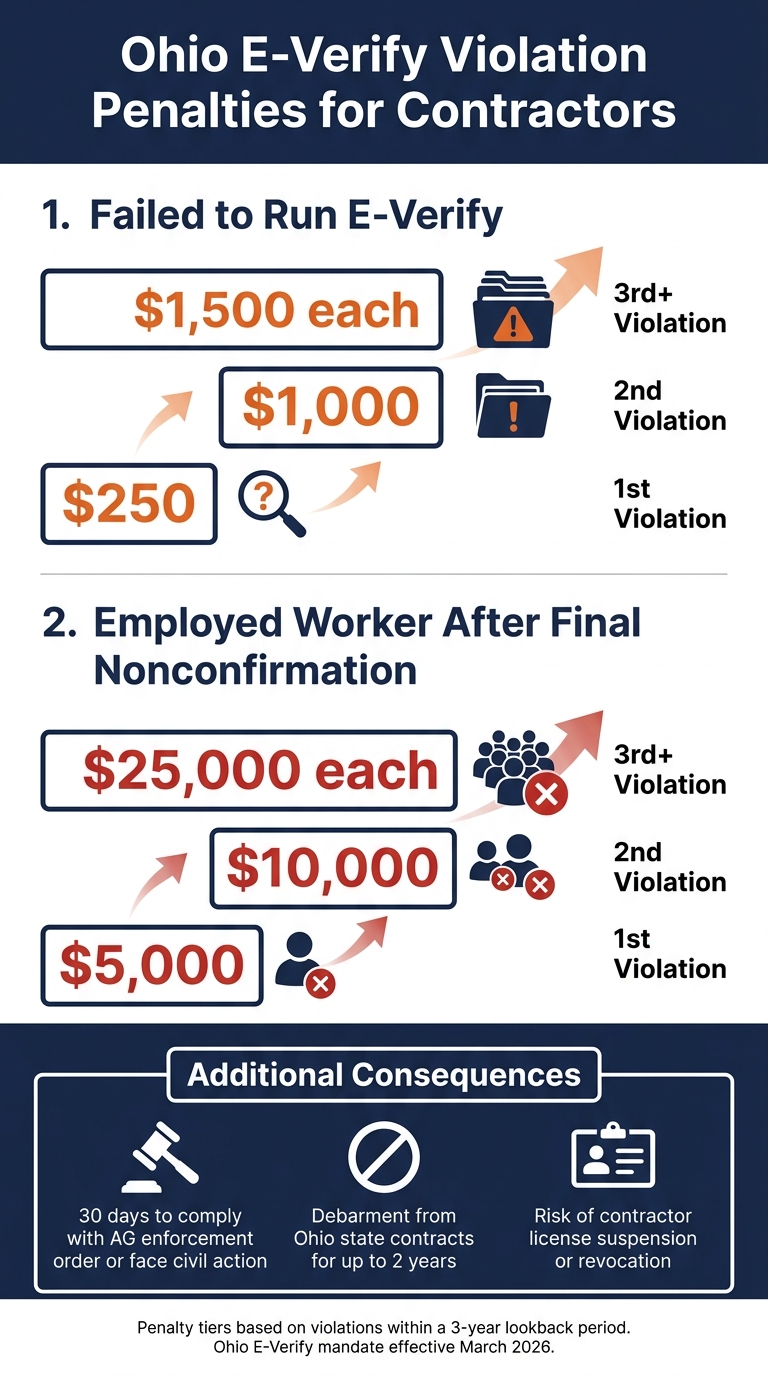
If a contractor, subcontractor, or labor broker fails to verify a covered employee in E-Verify, the fines start at $250 for a first violation, jump to $1,000 for a second, and reach $1,500 for each later violation. The stakes get much higher if the employer keeps a worker on payroll after a final nonconfirmation: $5,000 for a first violation, $10,000 for a second, and $25,000 per violation after that.
Things can move fast once a violation is found. If the Attorney General finds a violation, the employer gets 30 days to comply with an enforceable order. If that does not happen, the Attorney General must file a civil action in the court of common pleas. At that point, the court must add $1,000 per violation and may bar the contractor, subcontractor, or labor broker from state contracts for up to two years.
There is also a direct business risk here. Knowingly employing unauthorized workers can lead to license suspension or revocation, which can put future projects – and the company itself – in a tough spot.
7. Get Verification and Reverification Timing Right
The last rule comes down to timing: when to open an E-Verify case, and when not to.
Create the E-Verify case no later than the end of the third business day after paid work begins.
Just as important, don’t open the case too early. You can’t create a case before the employee starts paid work and completes Form I-9. That same timing rule also affects reverification.
Ohio adds a narrower rule for current workers. Don’t open a new E-Verify case just because a worker who was already verified moves to another covered Ohio project, unless federal reverification is required. U.S. citizens and lawful permanent residents do not need reverification.
Here’s how that plays out in common cases:
| Situation | New E-Verify Case Required? | Notes |
|---|---|---|
| New hire starts work for pay | Yes – by the end of day 3 | Count from the first paid workday. |
| Worker reassigned to a new project, same employer, continuous employment | No | No new case is required. |
| Rehire within 3 years, prior I-9 and E-Verify result can be reused | No | Reverify on Form I-9 only if required. |
| Current employee has expiring work authorization | No | Reverify on Form I-9 by the expiration date. |
This is one of those areas where small timing mistakes can cause trouble. A case opened too soon is a problem. A case opened too late is also a problem. The safe move is simple: tie E-Verify to the employee’s first paid day of work and use Form I-9 reverification rules only when they apply.
Key Records and Documents to Keep
Once the case is filed, the file becomes the proof. For each covered project, keep one audit-ready compliance file. If someone asks for support later, this file is what you’ll lean on.
Employee verification records
Keep the employee’s I-9, the E-Verify case number, the final case result, and any TNC notice and resolution records. In plain terms, you want the full paper trail from start to finish.
Company enrollment and policy records
Keep your enrollment confirmation, the signed MOU, your written timing and TNC procedures, and a user log that shows training dates and user roles. This is the part that shows your company didn’t just sign up – it also followed the process the right way.
Subcontractor and labor broker records
Keep records showing that each subcontractor tier followed the same rule. That includes:
- subcontract flow-down language
- written compliance attestations
- each subcontractor’s proof of enrollment
One point matters here: do not complete I-9s for subcontractor workers.
How long to keep records
Keep records for three years after hire or one year after termination, whichever is later.
Also, download the Historic Records Report before older cases age out of E-Verify. That report includes case numbers, employee names, key dates, final statuses, and closure details, and you can file it with the matching I-9s.
Store all I-9 and E-Verify records separately from general personnel files in a secure system with access controls. It also helps to sort them by project, employee, and current versus terminated status. That way, if an auditor asks for one record, you’re not digging through a messy folder stack. Weak files turn into audit trouble fast.
Common Risk Areas for Ohio Contractors
The most common Ohio E-Verify failures usually come down to four issues: misreading project coverage, missing deadlines, weak subcontract controls, and sloppy records.
Mistakes in project coverage
Misclassifying a job is a common mistake. Before mobilizing, document whether the work is nonresidential, covered by contract, and subject to E-Verify. That simple step gives you a solid file if questions come up later.
Once you’ve confirmed project coverage, timing becomes the next pressure point.
Missed deadlines and late case creation
The three-business-day clock starts the moment a worker begins paid work, not when HR gets around to finishing the paperwork. On busy jobs, supervisors often focus on getting crews on-site first and admin tasks done later. That’s where problems start.
Use a hard rule: no paid work on a covered project until Form I-9 is complete and the E-Verify case is opened on time. Auditors compare hire dates with case timestamps, so late cases are easy to spot.
And once timing slips, recordkeeping often slips right behind it.
Subcontract flow-down failures
Ohio’s public improvement rules require E-Verify clauses in the prime contract, but that’s only the start. The requirement needs to pass down to every lower-tier party. Each subcontract and labor broker agreement should require E-Verify compliance, proof of enrollment before mobilization, and audit access during the project.
If that flow-down is not in writing, it usually won’t stand up in an audit.
Poor recordkeeping during audits
Enrollment alone won’t save you. If you can’t quickly pull case results, TNC records, and subcontractor proof, the file can look out of line. Keep records by project, make them easy to search, and store them safely.
That same approach applies to TNCs and final nonconfirmations.
Improper handling of nonconfirmations
A TNC is not a firing order. Notify the worker in private, provide the Further Action Notice, and do not take adverse action while the case is still pending. After a Final Nonconfirmation, remove the worker from the covered project at once.
Keeping a worker on payroll after a Final Nonconfirmation creates serious risk for knowingly employing an unauthorized worker, which can lead to fines of $5,000 to $25,000 per worker for repeat offenses and may also feed into debarment proceedings.
The fix is pretty simple: set a clear internal process so HR closes the case, notifies the manager, and ends the assignment right away with full documentation.
Conclusion
Ohio’s E-Verify rules affect bid eligibility, staffing, and penalty exposure. Miss an E-Verify case, and civil penalties can start at $250 per violation. Keep employing a worker after a Final Nonconfirmation, and that figure can climb to $25,000 per violation. Repeat willful violations can also lead to disqualification from Ohio state contracts for up to two years.
The next move is straightforward: before each bid, confirm whether the project is covered, whether it counts as public work, and whether the E-Verify clause is required. Then put that decision in the job file. Simple step, big difference.
After the bid is in place, make the process tight. Complete Form I-9 first. Then create the E-Verify case within three business days. Pass the duty down to subcontractors, ask for enrollment proof before mobilization, and run periodic audits. That may sound like a lot, but it beats sorting out a penalty issue later.
The contractors who stay out of trouble usually treat E-Verify as a pre-mobilization checkpoint, not a last-minute admin task. For teams juggling rotating crews across Ohio sites, ABLEMKR can centralize worker status, certifications, and compliance checks across jobsites.
FAQs
Does this apply to mixed-use projects?
Yes. It can apply to mixed-use projects if the specific work falls into an Ohio E-Verify-triggering category, such as covered public work or private construction that meets the stated dollar thresholds.
What matters is the part of the project treated as public work or private construction under the rules, not the overall mixed-use label.
Who has to use E-Verify on a covered job?
It depends on your contract and any state rule that applies.
If your company has a federal contract with the FAR E-Verify clause issued on or after September 8, 2009, you must use E-Verify for:
- new hires
- current employees assigned to that contract
State rules change based on location, industry, and the type of project. Some states require E-Verify for all employers. Others only require it when a business is above certain company-size or project-value limits.
What happens if a case is filed late?
If you miss the three-business-day deadline to create an E-Verify case after an employee’s start date, the system will ask why the case was delayed.
Choose a reason from the dropdown menu or enter your own explanation. Then document it clearly in your records for future reference and compliance.


