
If crews are not cleared before mobilization, the project slips. In offshore wind, I need four things locked in early: headcount, training, pay rules, and site-readiness checks.
Here’s the short version:
- I plan labor by project phase and by work location: port, vessel, or turbine
- I account for offshore rotations like 14 days on / 14 days off and 12-hour shifts
- I book training early, because GWO Basic Safety Training can take 3 to 5 days, and group lead times can run 4 to 8 weeks
- I verify each worker’s certifications, medical status, and job fit before dispatch
- I set payroll rules for overtime, per diem, and travel time before anyone leaves shore
- I track state payroll rules for onshore work and federal rules for offshore work
- I prep crews for yard safety, personnel transfer, weather limits, fatigue, and emergency response
A few numbers show why this matters. Offshore installation vessels can carry 70 to 100 people. If I need 20 technicians on site at all times, a 14/14 rotation can mean planning for 40 workers, not 20. And under FLSA rules, a worker at $35.00 per hour earns $52.50 per hour for overtime after 40 hours in a workweek.
This guide is about one thing: making sure people are ready before the vessel schedule, weather window, and payroll clock start working against me.
Quick comparison
| Area | What I need to lock down |
|---|---|
| Labor planning | Roles, crew size, shifts, rotations, phase timing |
| Staffing | Direct hire, labor pool, or deployment platform |
| Worker clearance | Training, medical, fit-for-duty, assignment match |
| Pay and compliance | Overtime, per diem, travel time, state and federal rules |
| Site prep | Port access, transfer steps, emergency plans, fatigue control |
That is the core of the article: plan early, clear each worker, and tie staffing, payroll, and site controls into one process.
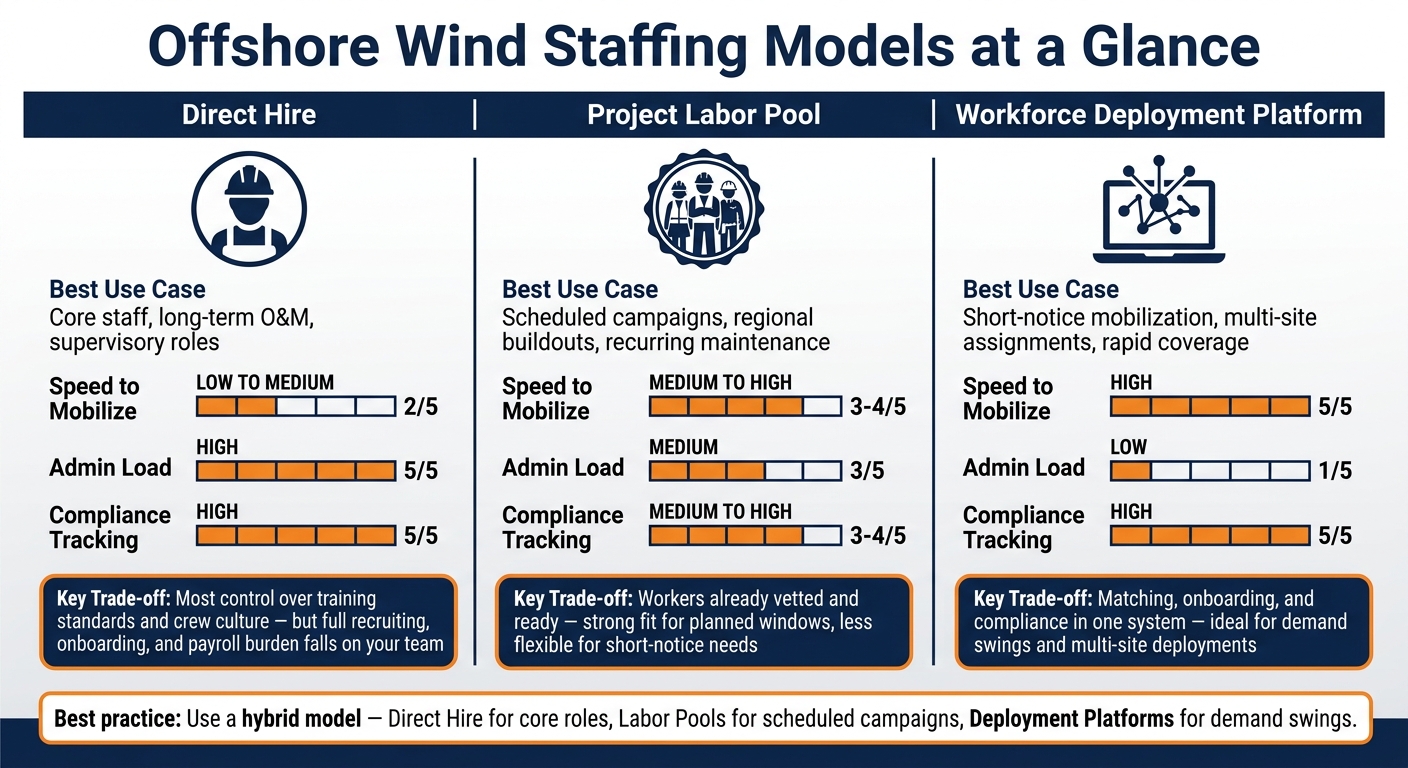
Offshore Wind Staffing Models: Direct Hire vs. Labor Pool vs. Deployment Platform
A New American Workforce – Building a Diverse, Skilled Offshore Wind Workforce
sbb-itb-aa28329
1. Plan labor demand by project phase and work location
Workforce planning for offshore wind starts with a basic question: who do you need, where do you need them, and when do they need to be there? The best place to start is the project schedule. From there, assign roles, headcount, and timing by phase and worksite.
Labor demand changes as the project moves from port staging to installation to operations and maintenance. So your hiring plan can’t stay static. It has to move with the job. Once that labor map is in place, you can match each role to the staffing model that fits.
Map work packages to crew sizes, shifts, and rotations
Start by breaking the project into major work packages: port staging and marshaling, heavy lift and load-out, cable installation, turbine erection, commissioning, and operations and maintenance.
Each package has its own staffing logic. And timing matters. Miss a crew window by even a few weeks, and the whole mobilization can slip.
For example, a port staging site that moves nacelles and blades each week may need cargo handlers, riggers, inspectors, and logistics coordinators on every 12-hour shift. An installation vessel may carry offshore technicians, marine crew, and lifting specialists, with total onboard personnel often reaching 70 to 100.
For vessel and turbine crews, a common planning baseline is a 14-on/14-off rotation with 12-hour shifts. That has a direct effect on total headcount. If you need 20 technicians on site at all times, you don’t hire 20. You plan for 40 so the rotation holds. That multiplier should be built into the model from the start.
Separate labor needs for ports, vessels, and turbine sites
Code every open role to a single work environment before you post it. Port, vessel, and turbine jobs are not interchangeable. Each one comes with its own credentials, shift pattern, and dispatch rules.
That sounds simple, but it’s where teams often get tripped up. A role may look similar on paper, yet the work setting changes who can actually do the job and when they can be deployed.
Build training lead times into the hiring schedule
Training needs to sit on the critical path. If it doesn’t, hiring can look fine on a spreadsheet and still fail in the field.
GWO Basic Safety Training (BST) covers Working at Height, Manual Handling, Fire Awareness, First Aid, and Sea Survival. It takes three to five days per worker to complete. For large crew bookings, lead times often run 4 to 8 weeks. Specialized electrical and high-voltage training is often offered less often, which can push lead times to six to twelve weeks for groups that need HV switching or cable jointing credentials.
The practical move is to back-calculate from the first offshore mobilization date. Figure out when trained workers must be on site, subtract the training time, then add buffer for rescheduling or retraining. Those dates should sit directly inside the project schedule, right next to procurement and equipment delivery.
Treat training records the same way you’d treat gear delivery: no record, no mobilization.
After headcount and training windows are locked in, the next step is picking the staffing model that can fill those roles on time.
2. Choose the right staffing model and deployment process
Once you’ve mapped labor demand, the next move is deciding how you’ll source and deploy the crew. The right choice depends on scope, timeline, and compliance burden. At a basic level, the trade-off comes down to control, speed, or admin work.
Direct hire, project labor pools, and workforce deployment platforms compared
Direct hire gives you the most control over training standards and crew culture. But there’s a catch: your team has to handle recruiting, onboarding, payroll, and compliance from the ground up.
Project labor pools, often run through specialty staffing firms or union halls, can move faster because workers are already vetted and ready to go. They’re a strong fit for planned maintenance windows and scheduled campaigns.
Workforce deployment platforms bring matching, onboarding, and compliance into one system. That makes them a good option for short-notice mobilization and multi-site assignments.
| Staffing Model | Best Use Case | Speed to Mobilize | Admin Load | Compliance Tracking |
|---|---|---|---|---|
| Direct hire | Core staff, long-term O&M, supervisory roles | Low to medium | High | High (if managed internally) |
| Project labor pool | Scheduled campaigns, regional buildouts, recurring maintenance | Medium to high | Medium | Medium to high |
| Workforce deployment platform | Short-notice mobilization, multi-site assignments, rapid coverage | High | Low | High |
For most offshore wind employers, a hybrid setup makes the most sense: direct hire for core roles, labor pools for scheduled campaigns, and deployment platforms for swings in demand.
What to check when screening staffing partners
Not every staffing partner is built for offshore wind crew deployment. Before you sign anything, check the details that matter on the ground:
- Verified worker records and training status: Can they confirm identity, related work history, incident history, certifications, and expiration dates?
- Workers’ compensation coverage: Does the coverage match the project’s risk level and geographic footprint?
- Payroll handling: Can they handle overtime, per diem, and rotating schedule premiums under U.S. federal and state labor law?
- Multi-state employment capability: Are they registered and compliant in each state where your project operates?
- Relevant field experience: Ask for examples from energy or heavy-infrastructure work.
If a partner can’t show timestamped training records or clearly explain how they manage multi-state payroll, that’s a red flag for offshore wind work. Once a partner can prove they’re ready, the next checkpoint is the worker’s own training and fit-for-duty status.
How ABLEMKR supports offshore wind crew deployment

ABLEMKR supports offshore wind crew deployment by matching pre-vetted workers to roles based on certification, safety training, location, and availability. It also gives teams live visibility into worker status, payroll, and compliance. That kind of visibility matters before dispatch, when delays can cost the most.
3. Verify training, safety readiness, and assignment fit
Partner screening only gets crews to the gate. Dispatch depends on each worker’s current clearance.
Once staffing is mapped, the next move is worker-level clearance: confirm that each person is qualified for the exact job, site, and transfer method.
Check required training before dispatch
Before dispatch, verify current GWO BST, Sea Survival, medical clearance, and any site-specific transfer training. Add OSHA 10 or 30, lockout/tagout, confined space, hazard communication, electrical safety, rigging, signalperson, and heavy-equipment training when the worksite calls for them.
Each assignment type should have a clear pre-dispatch checklist that a dispatcher must complete before confirming a worker.
Training gets someone through the door. Competency decides where they should work.
Match worker competencies to the actual job scope
Port, vessel, and turbine roles call for different skills. A worker cleared for one is not automatically ready for the others.
| Work Environment | Core Skills | Key Certifications |
|---|---|---|
| Port / Yard | Rigging, crane signaling, load securing | Rigging qualification, signalperson training, OSHA 10- or 30-hour Construction |
| Vessel | Deck work, marine emergency procedures | GWO Sea Survival, STCW basic safety (where applicable) |
| Turbine | Climbing, rescue at height, high-voltage work | GWO Working at Heights, OEM-specific training, IRATA, high-voltage authorization |
Use a role-by-role competency matrix to match each assignment with the exact skills and credentials it requires.
Keep a live record of certifications, expirations, and fit-for-duty status
Manual credential tracking breaks down fast with rotating offshore crews. A centralized worker record system should keep each person’s training completions, expiration dates, medical clearance status, and assignment history in one place – and flag problems before dispatch, not after arrival.
Turbine climbing, vessel transfers, and heavy lifting all depend on current physical clearance. Store medical clearance with a validity date, and block any worker whose restrictions conflict with the assignment.
ABLEMKR embeds training-status checks directly into worker profiles and job-matching workflows, so employers can see live readiness indicators before confirming dispatch. That includes signals like whether all required certifications are current or whether a medical clearance will expire within 14 days. In plain English: credential checks become part of dispatch itself.
Use those live readiness indicators to clear or block dispatch before mobilization.
4. Manage payroll, labor compliance, and offshore work rules
Once a worker is cleared for mobilization, the pay rules and compliance setup should already be set in stone.
Set up pay rules for overtime, per diem, and rotating schedules
Put written pay policies in place before the first crew heads out. Under the Fair Labor Standards Act (FLSA), non-exempt workers must be paid 1.5× their regular rate for hours over 40 in a workweek. So if a technician earns $35.00 per hour, overtime pay comes out to $52.50 per hour. One point trips people up all the time: overtime is based on the workweek, not the rotation.
That matters a lot with schedules like 14 days on / 14 days off. Those setups can get messy fast. Off-rotation days usually don’t count as hours worked, and the overtime clock still resets by workweek, not by the full rotation cycle.
Per diem needs the same level of detail. Spell out the per diem amount, who qualifies, and whether lodging is provided directly or paid back later. Per diem that stays within federal locality limits can be non-taxable when it’s backed up the right way. Travel time during normal work hours is also usually compensable, and those hours count toward overtime.
Account for the Jones Act, vessel crewing, and multi-state employment
The Jones Act (46 U.S.C. § 55102) limits cargo transport between U.S. points to qualifying vessels. In offshore wind, the usual setup is pretty clear: move turbine parts on Jones Act-compliant barges, then use foreign-flag wind turbine installation vessels (WTIVs) to handle the installation. CBP rulings have confirmed that this setup is allowed.
Payroll gets tougher when crews move across more than one state in the same month. Each state brings its own income tax withholding, unemployment insurance, and workers’ compensation rules based on where the work is physically done. For Outer Continental Shelf work, federal wage rules apply, while state wage-and-hour laws generally do not. But time spent onshore at ports and marshaling yards still triggers state-level duties.
That’s why payroll systems need clear location codes tied to each state’s rules. If the location data is wrong, the payroll data usually is too.
Use integrated payroll and compliance tracking to cut admin delays
Manual timekeeping and spreadsheet-based payroll tend to fall apart when work is split across ports, vessels, and offshore sites. Digital time capture with location codes for port, vessel, and turbine work gives cleaner data for overtime calculations and billing checks. Audit trails and daily worker sign-offs also help cut down on retroactive edits that wipe out overtime or distort actual hours.
Integrated payroll works best when time, compliance, and worker status sit in one system instead of being scattered across tools.
ABLEMKR uses a W-2 employment model, with payroll taxes, withholdings, and benefits handled through the platform. For offshore-adjacent employers dealing with high-risk crew assignments, that setup can help lower misclassification exposure and remove a big chunk of back-office work. Integrated payroll workflows tie together timecard collection, rate rules, and payment processing in one place, giving operators real-time labor visibility and audit-ready records across port, vessel, and turbine assignments.
5. Prepare workers for port, vessel, and turbine operations
Once pay and compliance are handled, the next step is getting people ready for the jobsite. And that starts before anyone shows up at the yard, vessel, or turbine. Safety doesn’t begin at dispatch. It begins in the prep work.
Port readiness: staging, heavy lift coordination, and yard safety
Port work comes down to logistics, timing, and tight safety control. Port rules cover staging activity, not offshore work, so these checks need to happen before any worker steps into an active area.
Start with the basics: PPE, access badges, and port-specific rules. Badge checks should confirm TWIC status, site access, and any role-based credentials. If a worker doesn’t have the right badge or the right PPE, they don’t enter the operational area.
Pre-shift briefings should cover the day’s arrivals, lift windows, laydown space, and traffic flow. The yard also needs a written traffic management plan that spells out truck lanes, pedestrian walkways, speed limits, and exclusion zones around cranes and stacked components. Post it at the yard, then review it during toolbox talks. Staffing has to line up with the lift schedule, not just the time people clock in.
Quayside lifting needs clear go/no-go rules. Stop lifts above 10 m/s, or about 22 mph. That limit should be part of daily planning from the start, not something the team debates in the moment. In plain terms, make the call early – before the yard gets busy.
Vessel and turbine readiness: transfers, emergency response, and work-hour control
Offshore transfer is the highest-risk handoff on the project. Each personnel transfer should be treated as its own risk-assessed event. Before departure, crews need a clear briefing on the exact transfer method, the communication protocol, stop signals, and emergency actions.
Go/no-go rules should cover wind speed, wave height, visibility, vessel motion, and whether conditions are steady or getting worse. Transfers should not begin in increasing marginal weather. During the transfer, keep both radio and visual contact the whole time.
Emergency duties also need to be locked in before the vessel leaves port. That includes who calls for help, who leads first aid, who handles muster, and who coordinates a man-overboard response. A fast rescue boat with crew should be nearby and ready to launch.
Fatigue is another problem that can sneak up fast offshore. Research shows that long work hours, heavy physical effort, night shifts, and repeated ladder climbs all add to fatigue during offshore turns. So work-hour limits and rest periods have to live in the schedule, not just in a policy binder. Supervisors need a clear view of actual hours worked versus planned hours so they can step in before fatigue turns into an incident.
Conclusion: Build a repeatable workforce readiness system
Planning demand, staffing crews, checking readiness, managing pay, and controlling site activity should all sit on the project plan as scheduled milestones. This can’t be loose or improvised.
A standard readiness packet for every assignment helps keep that process tight. It should include:
- Job scope
- Required competencies
- Site rules
- Emergency contacts
- Transfer procedure
- Weather criteria
- A documented sign-off showing the worker is cleared to deploy
Track KPIs such as the share of workers fully ready at dispatch and the number of delays tied to readiness issues. Then feed lessons from port incidents and vessel near-misses back into updated procedures. That’s how the system gets sharper over time.
ABLEMKR shows what this looks like in practice by combining hiring, onboarding, compliance tracking, and payroll in one labor operations engine. The result is simple: employers can mobilize pre-vetted crews fast without giving up safety or regulatory discipline. When planning, staffing, compliance, and site controls run as one system, crews get out the door faster – and with less risk.
FAQs
How early should I start workforce readiness planning?
Start workforce readiness planning early in the pre-construction phase so your staffing plan lines up with project schedules and local labor market conditions. This is also the right moment to bring key stakeholders into the room, including field superintendents, union representatives, and training providers, for focused planning workshops.
Use predictive analytics to forecast skill needs three to five years out and tackle gaps with early reskilling. This shouldn’t be a one-time exercise. It works best as an ongoing, data-driven process.
What can block offshore dispatch?
Offshore dispatch often gets held up for one simple reason: the worker’s credentials aren’t current, complete, or verified.
To get site access, workers need valid safety certifications, including BOSIET, along with a current, approved OEUK Offshore Medical Certificate.
Other common blockers include:
- failed physical fitness assessments
- gaps in role-specific training
- incomplete mandatory safety inductions
There’s also a systems side to this. Many digital compliance platforms automatically deny access when records are out of date, which can stop deployment before it even starts.
How do I handle payroll for mixed onshore and offshore work?
Use one system to connect worker IDs, project codes, and pay rates in a single workflow. Mobile, GPS-verified timecards make it easier to log hours with accuracy across onshore and offshore jobs, even when internet service is spotty.
That means teams can track base pay, overtime, and per diems with less manual input and fewer data-entry mistakes. It also helps support FLSA compliance and gives managers a clearer, up-to-date view of labor costs. ABLEMKR helps automate payroll and credential verification so workers can get paid on time.


