
Here’s the short answer: offshore wind training deals are turning hiring needs into direct factory job pipelines. I see three main things driving that shift: skill-specific training, recognized credentials, and job matching after training ends.
Right now, factory employers want more than general shop experience. They are looking for workers with skills like FCAW welding, robotics, prefabrication, controls work, and 3D printing. One clear example came in August 2026, when Autodesk put $1 million into a new lab at the University of Florida to train students in robotics, 3D printing, and prefabrication. At the same time, employers still handle some harder job skills in-house, such as crane work, rigging, hydraulics, and inspection.
If I boil the article down, it says this:
- Training is getting closer to hiring
- Local schools can cover core factory skills
- Employers still train for site-specific work
- Portable credentials help workers move between plants
- Deployment tools matter when plants need people fast
A second point stands out: local labor supply is not just about new students. These programs can pull in career changers, union apprentices, recent graduates, and workers from shipbuilding and heavy fabrication. That gives employers a bigger nearby talent pool, which matters when labor is tight.
One simple way to look at it is this:
| Area | What’s happening |
|---|---|
| Core training | Schools and labs teach welding, CNC, blueprint reading, robotics, and prefabrication |
| Employer training | Plants teach crane work, rigging, hydraulics, electrical work, inspection, and plant safety |
| Hiring impact | Employers get workers who can start sooner with less basic instruction |
| Worker impact | Workers get a clearer path from class to a factory role |
| Example | Autodesk + University of Florida, $1 million, Gainesville, FL |
For me, the big takeaway is simple: these deals are not just about training people. They are about getting people into offshore wind factory jobs with less delay, especially when plants are spread across different sites and some workers may need to relocate.
Recent Offshore Wind Training Agreements
Who Is Partnering and Which Factory Skills Are Covered
Recent agreements are starting to turn hiring needs into actual training pipelines. In practice, that means trade workers are being prepared for advanced factory roles in additive manufacturing, 3D printing, robotics, prefabrication, and quality control.
Major Deals by Location, Partners, Roles, and Workforce Impact
A clear example comes from a university-industry lab built around those same skills. In August 2026, Autodesk donated $1 million to the University of Florida for a new Design and Make Laboratory in Gainesville. The lab trains students in robotics, 3D printing, and prefabrication. Those skills line up directly with offshore wind component fabrication work.
You can see the same pattern in local training investments linked to advanced manufacturing.
| U.S. Location | Participating Organizations | Target Factory Roles | Training Focus | Expected Workforce Impact |
|---|---|---|---|---|
| Gainesville, FL | Autodesk; University of Florida | Robotics, 3D Printing, Prefabrication | $1 million Design and Make Laboratory | Builds a local pipeline for robotics, 3D printing, and prefabrication roles |
sbb-itb-aa28329
What Factory Employers Gain From These Programs
Faster Onboarding and Better Skill Matching
When training programs are built around offshore wind component plant needs, employers spend less time fixing skill gaps after someone is hired. Workers who already understand safety rules and quality standards can start contributing sooner than people who still need basic instruction on the job.
As ABLEMKR puts it: "Match trade skills to AM roles, train for safety and quality, and track credentials to deploy 3D-printing workers in renewables." That kind of fit can shorten ramp-up time, especially when hiring picks up fast.
A Broader Local Candidate Pool in Tight Labor Markets
Training partnerships also expand the local hiring pool. They bring in career changers, recent graduates, union members, and workers from shipbuilding, heavy fabrication, and industrial construction.
Many of these workers already have FCAW welding and prefabrication experience. That lines up well with offshore wind manufacturing and helps cut onboarding time. The bigger issue is getting those workers into the right roles without delay.
Where ABLEMKR Fits in Workforce Deployment
That’s where the deployment piece matters. After training ends, ABLEMKR matches pre-vetted workers to plant demand based on certification, safety training, availability, and location.
Employers can also see real-time worker status, payroll, and compliance tracking. In practice, that helps place crews faster during plant ramp-up.
Piledrivers, Millwrights, Techs and More: Inside Offshore Wind | 16: Wind Turbine Technicians
Local Labor Supply, Community Pipelines, and In-Demand Credentials
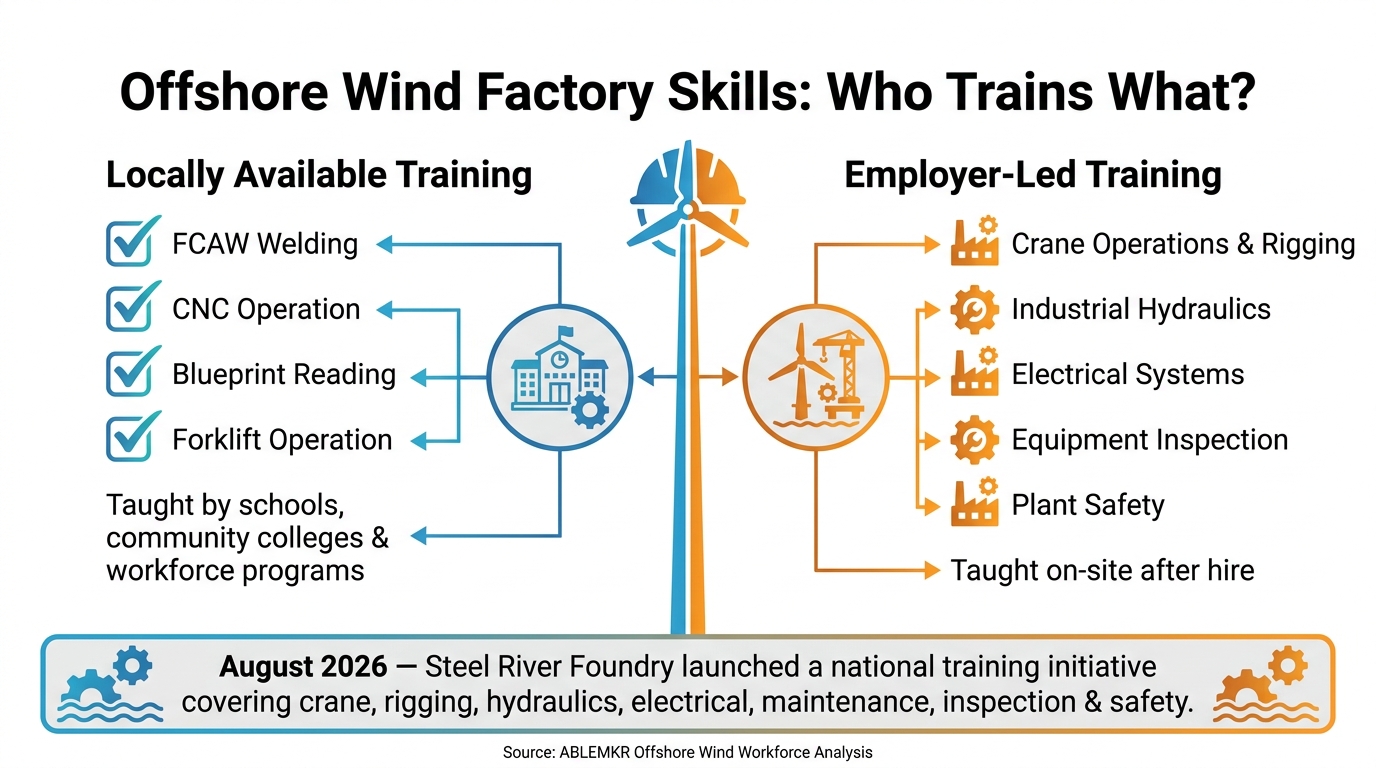
Offshore Wind Factory Skills: Local Training vs. Employer-Led Training
Which Worker Groups These Programs Reach
The next hurdle is local pipeline depth. These deals only work when nearby schools and workforce agencies can move trainees into plant-ready jobs for offshore wind component production, from welding bays to fabrication lines.
These pipelines tend to reach technical students, incumbent workers, union apprentices, and career changers. When programs offer accessible certification paths and direct employer ties, more people can step into factory roles. But there’s still a catch: employers often have to close higher-skill gaps after hire.
The Skills Employers Most Often Need
There’s a clear split between what local programs can teach and what usually has to happen on the job. Local institutions can supply core skills like FCAW welding, CNC operation, blueprint reading, and forklift operation. Those skills transfer well to component factory floors.
The more specialized work – crane operations, rigging, industrial hydraulics, and equipment inspection – usually comes from employer-led training after someone is hired.
In August 2026, Steel River Foundry launched a national training initiative covering crane operations, rigging, industrial electrical systems, hydraulics, maintenance, inspection, and safety.
The table below shows where that divide usually falls:
| Skill Area | Typically Available Locally | Usually Employer-Led |
|---|---|---|
| Welding (FCAW) | ✓ | |
| CNC Operation / Blueprint Reading | ✓ | |
| Forklift Operation | ✓ | |
| Crane Operations & Rigging | ✓ | |
| Industrial Hydraulics | ✓ | |
| Equipment Inspection | ✓ |
What These Training Deals Signal for U.S. Offshore Wind Growth
After local pipelines and in-demand credentials, the next hurdle is getting trained workers into open factory jobs fast. That’s where these agreements start to matter in a bigger way.
They move offshore wind hiring beyond training by itself and toward deployment-ready labor pipelines. In plain English, that means tying credentials, relocation support, and job matching together so people can move from the classroom to the plant floor with less delay.
Portable, industry-recognized credentials also make a big difference. Workers can move across sites more easily, and employers get access to a larger labor pool instead of hunting in one area at a time.
Even with these programs in place, the toughest gaps still come from coordinating specialized labor across multiple plant sites. Jobs are spread out. Skills can be narrow. And remote offshore wind plants often need people to relocate on short notice. Training, credentials, relocation aid, and deployment tools help employers fill those dispersed plant jobs faster.
Key Takeaways for Employers and Workers
For employers, the main lesson is how to judge training partnerships. Look for programs that:
- offer recognized credentials
- connect workers straight to open jobs
- help deal with relocation barriers for remote offshore wind plants
For workers, the strongest programs tie credentials to specific plant jobs, not just general placement.
FAQs
How do these training deals shorten factory hiring?
They cut factory hiring time by swapping slow, old-school recruiting for faster workflows that match pre-vetted, certified workers to projects in days instead of weeks or months.
With platforms like ABLEMKR, employers can verify certifications fast, automate compliance tracking, and simplify onboarding and payroll. That means crews can get on-site sooner while still meeting project requirements.
Which skills are taught locally versus on the job?
Local programs at community colleges and trade schools teach the basics: core theory, safety certificates like GWO Basic Safety Training, and hands-on lab work with turbine parts and climbing methods.
Then the learning shifts to the job site. Most technicians spend up to 12 months in mentorship and field training, working alongside more experienced techs as they build troubleshooting and maintenance skills. That guided practice matters, especially when the work happens 100 to 400 feet above the ground.
Who can benefit from offshore wind training programs?
Offshore wind training programs can help two main groups: workers moving over from oil and gas, and people who are just getting started in renewable energy.
These programs give candidates the technical know-how and safety credentials they need to work offshore. That often includes GWO Basic Safety Training and GWO Sea Survival, which are common requirements for many roles in the field.
They also help people get ready for more specialized marine jobs, such as:
- Turbine maintenance
- Rigging
- Crane operation


