
If you work on solar, wind, or battery sites, you need both OSHA and NFPA 70E. OSHA is the law. NFPA 70E is the work rulebook crews use for shock, arc flash, PPE, approach limits, and energized tasks.
Here’s the short version:
- OSHA tells me what my company must do
- NFPA 70E shows me how electrical work should be done
- OSHA rules can change by project phase: construction, commissioning, or maintenance
- NFPA 70E stays tied to the electrical task itself
- Arc flash is a big gap point: OSHA requires protection, while NFPA 70E lays out the risk assessment, labels, boundaries, and PPE steps
- Lockout/tagout, worker training, and qualification records must be current
- One worker can fall under different OSHA rules on the same site, based on the task
Electrocution remains one of construction’s top fatal hazards. On renewable sites, crews can also face arc flash, shock, and burn risks from PV systems, wind equipment, switchgear, inverters, and high-voltage battery systems. That’s why I’d treat compliance as a worker + equipment + site issue, not just a policy in a binder.
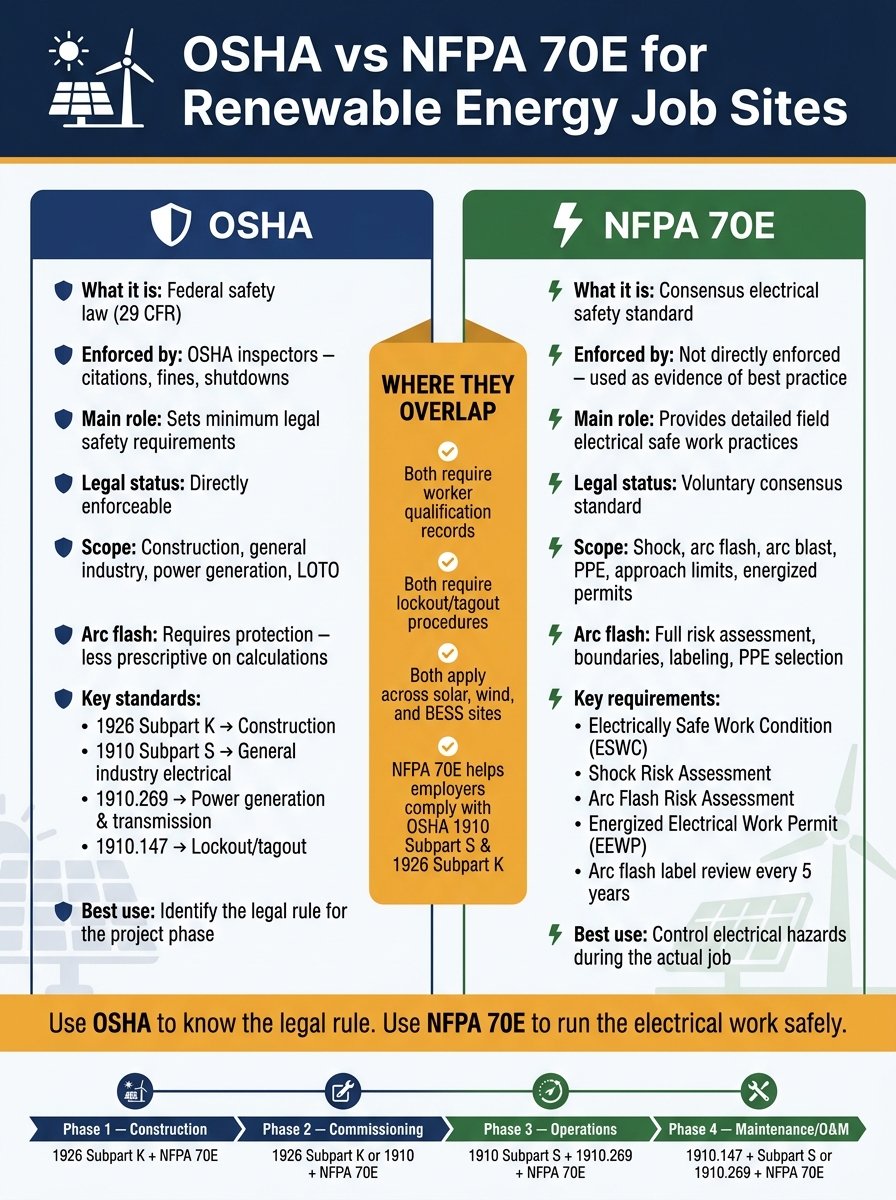
OSHA vs NFPA 70E for Renewable Energy Job Sites
OSHA vs. NFPA 70E: What Each Really Does
sbb-itb-aa28329
Quick Comparison
| Topic | OSHA | NFPA 70E |
|---|---|---|
| What it is | Federal safety law | Consensus electrical safety standard |
| Main job | Sets minimum legal rules | Gives field electrical work practices |
| Enforced by | OSHA inspectors | Not directly enforced by OSHA |
| Best use | Identify the rule for the project phase and task | Control shock and arc flash during the job |
| Covers | Construction, general industry, power generation, LOTO | ESWC, shock risk, arc flash risk, PPE, approach limits, energized permits |
| Common renewable use | 1926 for construction; 1910 Subpart S, 1910.269, and 1910.147 for in-service work | Inverter work, switchgear, turbine circuits, BESS testing, live diagnostics |
If I had to boil the whole article down to one line, it would be this: use OSHA to know the legal rule, and use NFPA 70E to run the electrical work safely.
NFPA 70E: The Electrical Safety Standard for Field Work
NFPA 70E is the standard for electrical safety in the workplace. For renewable crews, it shapes day-to-day work on PV arrays, wind turbines, and battery energy storage systems. The starting point is simple: de-energize the equipment when the job allows it.
The standard says crews should de-energize whenever possible. Before maintenance or repair, they should set up an Electrically Safe Work Condition (ESWC): disconnect, isolate, lock out/tag out, verify zero voltage, and ground when required. Energized work is the exception, not the norm. It’s allowed only when shutting equipment down would create a greater hazard or when de-energizing isn’t feasible.
After crews identify the hazards, NFPA 70E requires two checks before work starts: a shock risk assessment and an arc flash risk assessment. The arc flash assessment determines incident energy, boundaries, labels, and PPE. On renewable sites, that may mean arc-rated clothing and voltage-rated gloves for inverter work, or heavier protection for medium-voltage wind equipment.
Approach boundaries are another major control. NFPA 70E uses Limited Approach and Restricted Approach boundaries based on voltage and equipment type. Unqualified workers have to stay outside those zones. If energized work has to happen, qualified workers must use an Energized Electrical Work Permit (EEWP) that spells out the reason, hazards, boundaries, PPE, and work plan. In renewable work, that often comes up during live diagnostic testing on a PV inverter or while troubleshooting turbine control circuits that need to stay powered long enough to catch an intermittent fault. For contractors, this isn’t paperwork for paperwork’s sake. They need a clean way to track these rules by worker, task, and equipment.
Core NFPA 70E Requirements Crews Must Follow
It helps to treat the program, training, and review cycle as one connected system. Every renewable contractor needs a documented Electrical Safety Program (ESP) that ties together policies, procedures, risk assessments, job safety planning, and auditing.
NFPA 70E also draws a clear line between qualified persons and unqualified persons. Qualified persons are trained to work on or near electrical hazards. Unqualified persons must remain outside approach boundaries. That line matters most during commissioning, troubleshooting, and O&M, when energized equipment is often more exposed and easier to access.
Arc flash studies and labels can’t sit on a shelf and go stale. NFPA 70E requires the arc flash risk assessment to be reviewed at least every five years and updated after major system changes. Adding PV capacity, changing inverter sizes, reworking a wind farm collection system, or adjusting protective relay settings can change fault current and make old labels wrong.
Contractors should track these NFPA 70E items by crew, equipment, and site:
| Requirement | What It Covers | Renewable Application |
|---|---|---|
| Electrically Safe Work Condition | De-energize, LOTO, test, ground | PV disconnects, turbine breakers, BESS isolation |
| Shock Risk Assessment | Shock hazards, boundaries, protective measures | Tasks near exposed conductors and terminals |
| Arc Flash Risk Assessment | Incident energy, boundaries, labels | Inverters, switchgear, battery switchboards |
| Energized Work Permit | Justification, hazards, PPE, procedures | Live diagnostics, control circuit troubleshooting |
| Job Briefing | Scope, hazards, controls, emergency response | Pre-task planning for electrical work |
| Safety Program | Policies, training, auditing | Site-wide electrical compliance framework |
| Arc Flash Review | Five-year review and updates after system changes | Capacity additions, relay or breaker changes |
OSHA sets the legal baseline. The next section shows where those rules apply on renewable sites.
OSHA: Legal Safety Requirements for Renewable Job Sites
OSHA is the legal floor for renewable job sites. NFPA 70E can make an electrical safety program stronger, but OSHA is the set of rules inspectors enforce. Under Title 29 of the Code of Federal Regulations (29 CFR), violations can bring citations, fines, or even shutdowns.
Here’s where it gets tricky: there isn’t one OSHA standard that covers every job on a renewable site. The rule depends on the task. On a utility-scale solar or wind project, that can change fast as the site moves from construction to commissioning, then into operations and maintenance.
The four OSHA standards that come up most often are:
- 29 CFR 1910 Subpart S for general industry electrical work
- 29 CFR 1910.269 for electric power generation, transmission, and distribution
- 29 CFR 1926 Subpart K for construction electrical work
- 29 CFR 1910.147 for lockout/tagout and hazardous energy control
That matters because renewable projects don’t sit still in one phase for long.
1910 Subpart S covers facility wiring, switchboards, inverters, and other plant electrical systems. That includes de-energizing circuits, guarding live parts, and PPE. Subpart S deals with plant wiring and equipment. 1910.269 is different. It applies to grid-connected generation and transmission work, like turbines, collector systems, substations, and other gear that feeds power to the grid.
1926 Subpart K applies to construction work. That includes temporary wiring, GFCI protection, and locking out circuits before electrical work starts. 1910.147 comes into play when workers service or maintain equipment where unexpected energization or stored energy release could hurt someone. That includes mechanical, hydraulic, and pneumatic energy sources in turbines, trackers, and similar equipment.
Some renewable sites fall under both 1910.269 and Subpart S, so each system and each task needs its own review. OSHA says that when qualified employees follow Subpart S work practices on installations that meet Subpart S design rules, OSHA will treat them as compliant with certain parts of 1910.269. In plain English: grid-connected generation and collector systems often land under 1910.269, while premises wiring and building electrical systems at the same site usually land under Subpart S. That overlap stands out even more when you compare OSHA side by side with NFPA 70E.
Which OSHA Rules Apply at Each Project Phase
| Project Phase | Governing OSHA Standard | Typical Work Covered |
|---|---|---|
| Construction | 29 CFR 1926 Subpart K | Installing arrays, turbines, battery energy storage systems; temporary power; GFCI; circuit lockout |
| Commissioning | 29 CFR 1926 Subpart K (or 1910 depending on activity) | Energizing new equipment, testing, correcting deficiencies before handover |
| Operations | 29 CFR 1910 Subpart S + 1910.269 | Running generation systems, monitoring substations, managing feeders |
| Maintenance / O&M | 29 CFR 1910.147 + Subpart S or 1910.269 | Servicing inverters, turbine maintenance, corrective repairs, LOTO procedures |
The same site can move between standards as crews shift from construction to commissioning to O&M. OSHA draws that line pretty clearly: employers whose crews perform construction work on electric power lines or equipment follow Part 1926, while employers who operate or maintain those systems follow 1910.269. So a new wind farm build starts as a Part 1926 job. Once the farm is energized and in service, routine switching, inspections, and repairs move into Part 1910.
For contractors handling multi-phase renewable projects, the smart move is to map each worker’s current task to the right standard. A wind technician maintaining an operating turbine falls under 1910.269 and 1910.147. If that same technician goes over to help install a new turbine string in an expansion area, the work shifts back under 1926 Subpart K. The task, not the trade, decides the rule. That task-by-task split is what leads into the OSHA-versus-NFPA 70E comparison.
NFPA 70E vs. OSHA: Overlap, Differences, and When to Use Each
Once the OSHA phase is set, the next step is figuring out which standard governs the electrical task. A simple way to think about it is this: OSHA is the enforceable rule set; NFPA 70E is the electrical work method. OSHA issues legally enforceable federal rules under 29 CFR, so violations on a solar or wind site can lead to citations and penalties. NFPA 70E is a voluntary consensus standard developed at OSHA’s request to help employers comply with 1910 Subpart S and 1926 Subpart K. OSHA has not adopted NFPA 70E into its rules, but it can still point to it as evidence of recognized good practice when building a citation case, including under the General Duty Clause when needed. That split matters a lot on renewable sites.
OSHA says employers must protect workers from electrical hazards. NFPA 70E shows crews how to do that in the field: assess the hazard, set boundaries, and choose PPE. That includes arc-flash studies, boundaries, PPE, and energized work permits.
Here’s where the two standards differ in day-to-day use:
| Topic | OSHA | NFPA 70E |
|---|---|---|
| Legal status | Federal regulation; directly enforceable | Voluntary consensus standard; not directly enforced |
| Main role | Sets minimum legal safety requirements | Provides detailed electrical safe work practices |
| Scope | Electrical hazards in construction and general industry | Shock, arc flash, and arc blast controls for electrical work |
| Arc flash requirements | Requires PPE and controls, but is less prescriptive on calculations | Provides arc-flash risk assessment, boundaries, labeling, and PPE selection |
| Program records | Training records, injury logs, hazard assessments; qualified-worker designation | Risk assessments, equipment labels, worker qualification records; task-specific retraining |
| Enforcement | Direct; citations, penalties, and General Duty Clause use | Indirect; may be used as evidence in OSHA enforcement |
For field decisions, a good rule is to use OSHA to decide which rules apply to the current phase of work, and use NFPA 70E when crews are about to touch or work near electrical equipment. During a battery storage commissioning activity, for example, OSHA general industry standards govern the site, while NFPA 70E is what you use to write the energized work permit, set the arc-flash boundary, and specify PPE for technicians doing live testing.
What Renewable Crews Commonly Get Wrong About These Two Standards
This is where crews tend to slip up.
One common mistake is assuming OSHA by itself covers arc flash. OSHA requires arc-flash protection. NFPA 70E provides the assessment, boundary, and PPE method. If a solar O&M crew leans on a generic PPE policy and skips NFPA 70E arc-flash risk assessments for inverter rooms and combiner boxes, they have no solid way to know whether their PPE is rated for the incident energy at that equipment.
Another mistake is treating construction and O&M rules like they’re the same thing. NFPA 70E stays in place as the electrical safety framework whether the site falls under 1926 or 1910. But the OSHA duties underneath it do change, and crews that don’t track that shift can apply the wrong controls to the phase they’re in.
The third mistake is assuming any licensed electrician is qualified for any system. Both OSHA and NFPA 70E expect workers to be trained and qualified for the hazards they actually face. Qualification is task-specific. A building electrician is not automatically qualified for medium-voltage turbines or BESS switchgear.
What Contractors Need to Track for Crew Compliance
Contractors need to track compliance by worker, asset, and site before dispatch. If something is missing, the result can be a stop-work order or even lost contract work. Once the right standard is set, the next job is simple in theory but easy to mess up in practice: prove that the crew, the equipment, and the site are all current.
Here’s the tricky part. OSHA can shift by project phase, and NFPA 70E can shift by task. That means records can’t sit in one generic file. They need to follow the worker, the asset, and the site.
A Compliance Checklist by Worker, Equipment, and Site
Track compliance at three levels: worker, asset, and site. Use this checklist before dispatch so there are no surprises when the crew shows up.
| Category | What to Track |
|---|---|
| Worker | OSHA 10/30 training, CPR/First Aid (annual renewal), NFPA 70E qualification, required state or local electrical license, NABCEP certification for solar roles, and GWO Safety training for wind technicians |
| Equipment/Asset | NFPA 70E arc-flash labels and maintenance logs for energized assets |
| Project Site | Site safety orientation, electrical permits, emergency response records, and site-specific safety certifications |
One item that often slips through the cracks is CPR/First Aid renewal. On a big crew, it’s easy for one expired card to go unnoticed until the last minute. Automated expiration reminders help catch those gaps before they turn into a dispatch problem.
After that, record control becomes the main issue. Manual logs can still work for small crews. But as headcount grows, digital systems tend to do a better job because they can flag expired training, missing permits, and assigned PPE without someone digging through spreadsheets or paper files.
| Feature | Manual Tracking | Technology-Enabled Tracking |
|---|---|---|
| Training Records | Manually entered; prone to data entry errors | Automated uploads with digital registry verification |
| Certifications | Periodic checks of physical cards or PDFs | Real-time dashboards with automated expiration alerts |
| PPE Status | Visual inspection and manual site logs | Digital checklists with equipment assignment tracking |
| Permits | Physical copies in trucks or site trailers | Mobile-accessible digital permit repositories |
ABLEMKR can support this workflow by matching pre-vetted workers to jobs based on certifications, safety training, availability, and location, with real-time compliance tracking.
Conclusion: OSHA Sets the Floor, NFPA 70E Fills in the Details
OSHA is the enforceable baseline. NFPA 70E fills in the day-to-day electrical safety details crews need on site.
For renewable contractors, the bigger risk usually isn’t mixing up one rule. It’s assuming one policy covers both OSHA and NFPA 70E, or assuming a worker cleared for one system is cleared for another. A repeatable tracking system for training records, certifications, equipment labels, and site permits helps crews stay compliant as they move from project to project.
FAQs
When does OSHA switch from 1926 to 1910 on a renewable site?
OSHA uses 29 CFR 1926 when crews install new renewable energy systems. That’s the construction phase.
Once the job moves into servicing, repairs, or maintenance, 29 CFR 1910 takes over.
For grid-connected projects, 29 CFR 1910.269 may apply too. It covers electric power generation, transmission, and distribution.
That line matters. A project can start under one standard and later fall under another, so teams need to track each phase closely and make sure crews follow the right rule for the task in front of them.
Does NFPA 70E apply if the equipment is already labeled?
Yes. Equipment labels give important hazard details, but they do not take the place of NFPA 70E rules or normal safety steps.
If equipment has not been properly de-energized, locked out, and tagged, it must be treated as energized. That means workers still need to follow NFPA 70E safety boundaries and use the required arc-rated PPE.
Who counts as a qualified person for solar, wind, or BESS work?
Under NFPA 70E and OSHA, a qualified person is someone with the skills and knowledge to construct, install, operate, or maintain electrical equipment. That person also needs safety training so they can spot electrical hazards and reduce the risk.
For solar, wind, or BESS work, that means more than general electrical knowledge. Workers need equipment-specific knowledge, task-specific training, shown competence, and supervised on-the-job training. Employers decide who meets that standard. They also must make sure workers can identify live parts, understand voltage levels, maintain safe approach distances, and use PPE and insulated tools the right way.


