
Language barriers cause 25% of job-related accidents in the U.S., especially in industries like construction, where 75% of the workforce primarily speaks Spanish. Miscommunication around safety protocols, hazard warnings, and emergency procedures leads to injuries, fatalities, and unaddressed risks. Multi-language tools are changing this by improving communication through real-time translation, visual aids, and language-specific job matching.
Key takeaways from this article:
- Accidents drop by 25% in workplaces using multilingual signage.
- AI-powered tools provide instant translations for safety alerts and manuals.
- Visual aids like diagrams and standardized symbols simplify safety communication.
- Platforms like ABLEMKR match workers based on language skills, reducing miscommunication.
These tools not only prevent accidents but also ensure compliance with OSHA regulations, improve hazard reporting, and strengthen safety measures on multilingual job sites.
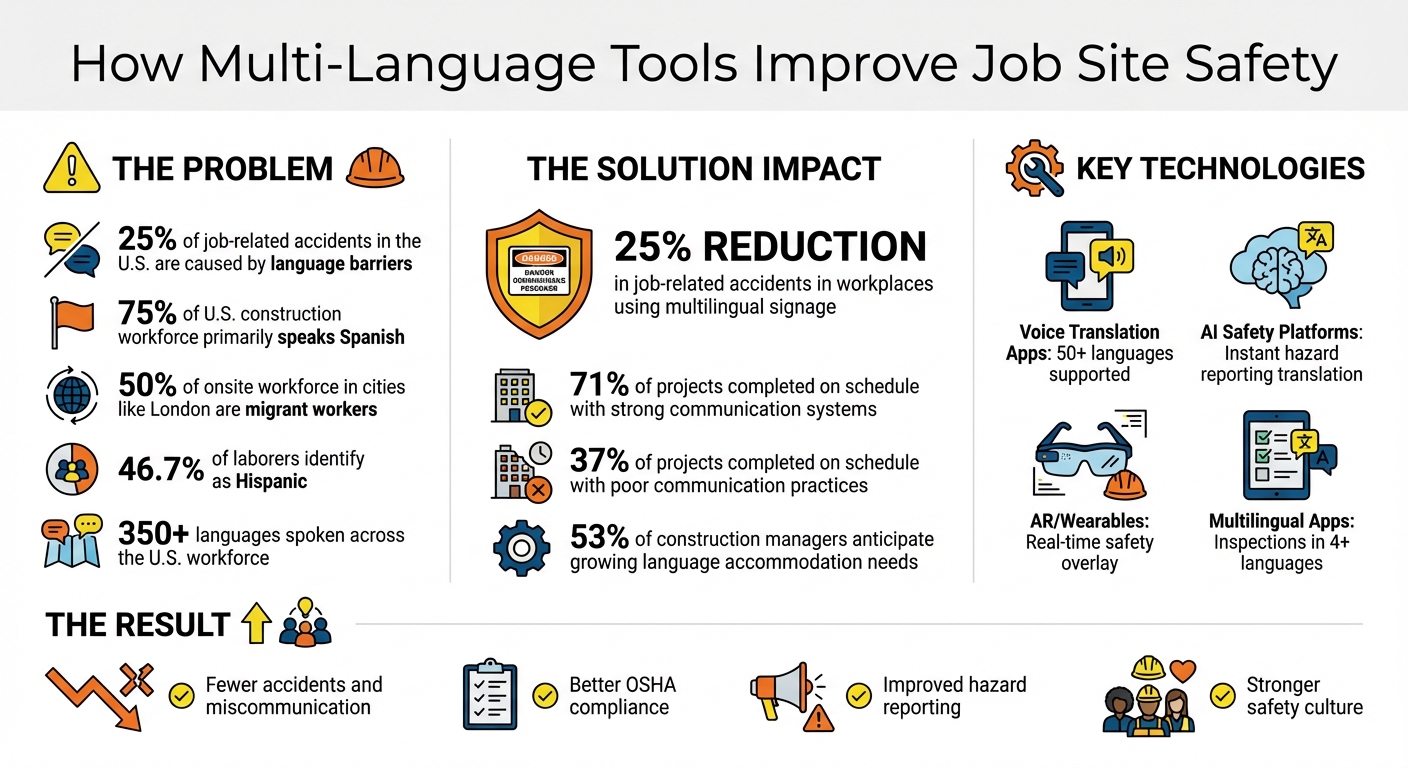
Multi-Language Tools Impact on Job Site Safety Statistics
Communication Problems on Multilingual Job Sites
Language Barriers and Safety Risks
Misunderstood safety instructions can have devastating consequences, ranging from serious injuries to fatalities. Workers with limited English proficiency often face challenges understanding critical details during toolbox talks, safety briefings, and equipment operation guidelines. A single misinterpreted directive, especially during high-risk tasks, can result in catastrophic outcomes.
The problem becomes even more pronounced when job sites rely on informal translation methods. Often, the crew member with the best grasp of English is asked to act as an untrained interpreter . This approach leaves no guarantee that essential information is accurately communicated. Dr. Morwenna Fellows, a researcher in construction management, highlights the severity of the issue:
"Workers from a non-English-speaking background are at a higher risk of accidents than their local counterparts".
In emergencies, the inability to communicate clearly and quickly can turn manageable situations into disasters. On high-risk job sites, where every second matters, language barriers amplify the danger.
Beyond physical risks, poor communication creates psychological hurdles that erode a site’s safety culture. Workers who feel excluded or unable to voice concerns may stop reporting near misses or hazards altogether. Monique Lewis, CEO of Next 2 Native Language Learning, underscores this challenge:
"When you have a Hispanic worker on site and they have a near miss, they need to be able to unpack that. They need to be able to say to their supervisor, ‘This almost happened’".
Without open communication, safety hazards often go unaddressed until a serious incident occurs. These language gaps are particularly dangerous in high-risk industries, where clear communication is critical.
The Impact on High-Risk Industries
In industries like construction and energy, even small miscommunications can lead to severe safety failures. Take the 2010 Deepwater Horizon explosion, for example – one of the deadliest workplace disasters in U.S. history. Communication breakdowns among the crew played a significant role in the tragedy. In such environments, understanding subtle distinctions – like whether to "secure the valve" or "check the valve" – can literally mean the difference between life and death.
From a compliance standpoint, the stakes are just as high. OSHA mandates that safety training be delivered in a "language and vocabulary" that workers can understand. Yet, many employees attend mandatory safety sessions without fully grasping the material. When critical documents like safety data sheets, operation manuals, and employee handbooks are available only in English, they become practically useless for those who need them most .
Miscommunication also impacts productivity and efficiency. It wastes valuable time and resources, which are often in short supply on tight project schedules. In cities like London, where migrant workers can make up as much as 50% of the onsite workforce, these inefficiencies not only hurt profitability but also compromise overall site safety. Addressing these challenges is essential for creating safer, more efficient multilingual workplaces.
How Multi-Language Tools Solve Safety Challenges
Real-Time Translation for Safety Alerts
Modern translation tools are changing the game when it comes to workplace safety by making sure critical warnings reach workers instantly and in their native language. For example, voice-activated alerts on devices like smartwatches or apps such as Zello can automatically translate instructions into over 50 languages. This means that when emergencies strike – like equipment failures or hazardous conditions – workers can hear what they need to do immediately, without wasting precious time reading a screen or struggling with a language barrier.
AI-powered platforms have also made it possible for workers to ask safety-related questions in their native language. Tools like "Ask Mojo" can search through English manuals and provide answers in the worker’s spoken language. Similarly, conversational AI simplifies hazard reporting. A Spanish-speaking worker, for instance, can verbally report a safety issue, and the system will translate it into English for the supervisor. This eliminates misunderstandings and speeds up the resolution process.
Taking it a step further, Augmented Reality (AR) devices like glasses and headsets overlay safety instructions and real-time translations directly into a worker’s field of vision. This hands-free approach ensures that workers stay focused on high-risk tasks while still receiving vital safety guidance.
To complement these audio solutions, visual aids also play a crucial role in bridging language gaps and reinforcing safety practices.
Visual Aids for Better Communication
While voice translation tools are powerful, visuals can often communicate safety information even more effectively. Picture Process Mapping, for example, uses images and diagrams to break down procedures step by step. Since about 80% of human learning happens through visual processing, these tools can make safety protocols much easier to understand than traditional text-based instructions.
Standardized symbols, such as those defined by ANSI Z535 and ISO, ensure that colors and pictograms consistently represent hazards like "Danger" or "Caution" across all languages. Additionally, bilingual diagrams and visual scoreboards help ensure that critical safety messages reach every worker, regardless of their language.
Automated Job Matching with Language Filters
Beyond communication tools, workforce management systems are now using language filters to improve safety even further. These platforms match workers with teams and supervisors who speak the same language, reducing the risk of miscommunication when it comes to safety directives. Companies can also use these systems to identify language needs and deploy translated materials – like manuals, signage, and training guides – where they’re most needed.
Another benefit of these systems is their ability to place bilingual supervisors in leadership roles. This ensures that safety protocols are communicated clearly and effectively. Frank Meilinger, Communications Director at OSHA, highlights the importance of this approach:
"People trust messages from people they can relate to – those with similar backgrounds, cultures, appearances".
When workers feel understood and can easily communicate with their team, they’re more likely to report hazards and participate in safety discussions. This not only improves safety but also fosters a stronger safety culture across the workplace.
| Tool Type | Safety Application | Key Feature |
|---|---|---|
| Voice Translation Apps | Real-time field instructions | Instant voice-to-voice translation for 50+ languages |
| AI Safety Platforms | Hazard reporting & manuals | Translates verbal inputs and searches English manuals |
| AR/Wearables | High-risk task guidance | Overlays translated safety data onto worker’s field of vision |
| Multilingual Apps | Inspections & checklists | Completes audits in English, Spanish, French, or Portuguese |
Benefits of Multi-Language Tools for Job Site Safety
Fewer Accidents and Miscommunication
When workers struggle to fully grasp safety protocols, the risk of accidents and severe injuries rises significantly. Multi-language tools tackle this issue head-on. For instance, workplaces that introduced multilingual signage saw a 25% drop in job-related accidents. Teri Hale, Operations Manager at UL Workplace Health and Safety, emphasizes the impact of this approach:
"Comprehension increases when learners can give their complete attention to the content without first needing to mentally convert the information into their first language."
Additionally, enabling workers to report hazards in their native language ensures that supervisors can address potential dangers promptly, reducing the likelihood of injuries.
Better Compliance and Safety Training
Multi-language tools do more than prevent accidents – they also improve compliance with safety regulations and make training more effective. OSHA mandates that safety training be provided in a way that employees can clearly understand. By offering training materials, signage, and documentation in multiple languages, these tools simplify meeting such requirements.
Training becomes more impactful when workers receive information in their native language. Mobile safety apps that support multiple languages further enhance compliance efforts. Workers can conduct inspections or complete audits in their preferred language, while managers can review all data in English.
Better Coordination in Remote and High-Risk Environments
The value of clear communication extends to remote and high-risk job sites, such as those in construction, energy, or mining. These environments often lack immediate supervisory support, making instant access to safety information critical.
AI-powered platforms help bridge language gaps by allowing workers to ask safety-related questions in their native language and get answers from English-language manuals. For example, a Spanish-speaking worker repairing a remote pipeline can quickly get guidance on equipment use without stepping away – potentially avoiding accidents when every second matters. By integrating language tools for both training and real-time support, job sites can uphold safety standards even in the most challenging conditions.
Mobile-first tools also streamline onboarding, giving workers immediate access to essential safety information. With an estimated 75% of the U.S. construction workforce primarily Spanish-speaking and 53% of construction managers anticipating growing language accommodation needs, multilingual onboarding fosters a sense of inclusion from the start. When workers can access safety information in their own language, they feel respected and are more likely to engage in safety discussions and report hazards.
sbb-itb-aa28329
Using ABLEMKR for Multi-Language Safety Solutions
ABLEMKR’s Role in Workforce Deployment
ABLEMKR tackles the challenge of language barriers head-on by incorporating multi-language capabilities into its workforce deployment process. The platform ensures that workers are matched to high-risk job sites based on key factors like certifications, safety training, availability, location, and language skills. This means that crews arriving at construction sites, remote pipeline projects, or mining operations are ready to communicate effectively from day one.
With its mobile-first design, ABLEMKR simplifies hiring and onboarding in industries where safety risks are high. Since language barriers are a common factor in workplace accidents, ensuring workers can understand and follow safety protocols is crucial. By verifying both technical qualifications and language abilities during the matching process, ABLEMKR helps eliminate the miscommunication risks that often arise on multilingual job sites. This seamless integration of language support is further enhanced by the platform’s robust safety features.
Multi-Language Support Features in ABLEMKR
Beyond deployment, ABLEMKR strengthens safety compliance through real-time, multilingual monitoring. The platform provides real-time visibility into worker status, tracking safety training and certifications for multilingual teams. Employers can use centralized dashboards to confirm that every worker – no matter their primary language – has completed required safety protocols before entering hazardous areas. This makes managing diverse teams more efficient and ensures compliance across the board.
ABLEMKR’s automated matching system also prioritizes language proficiency alongside technical expertise. As safety consultant Loretta Mulberry put it:
"If your life were on the line, you’d want this information in your native language."
Webinar: Overcoming Language Barriers for a Safer Workplace
Conclusion
Language barriers account for 25% of all job-related accidents, underscoring the importance of multi-language tools in industries like construction, energy, and mining, where safety risks are high. When workers can access safety guidelines, report hazards, and communicate with supervisors in their native language, the chances of critical miscommunication – and the accidents that follow – are drastically reduced.
ABLEMKR addresses this need by integrating multi-language support into workforce operations, ensuring that safety protocols are universally understood. This not only improves compliance but fosters psychological safety, encouraging workers to report near misses and safety concerns without fear. Such openness strengthens safety culture and creates a more secure environment for diverse teams.
Beyond safety, effective multi-language communication boosts project performance. For example, construction sites with strong communication systems complete 71% of projects on schedule, compared to just 37% for those with poor communication practices.
With a multilingual workforce on the rise – 46.7% of laborers identifying as Hispanic and over 350 languages spoken across the U.S. – investing in native language training and real-time translation tools is no longer optional. Companies that embrace these tools are better equipped to meet OSHA standards, reduce workplace accidents, and build more efficient and inclusive teams. The time to act is now, before preventable incidents occur.
FAQs
How can multi-language tools make job sites safer?
Multi-language tools are essential for enhancing safety on job sites with diverse teams. Miscommunication caused by language barriers often leads to workplace accidents, whether it’s due to unclear safety instructions, misunderstood hazard warnings, or improper use of equipment. By offering safety materials, training, and alerts in workers’ native languages, these tools help bridge communication gaps and reduce the risk of accidents.
Some practical examples include AI-powered translation apps, multilingual digital signage, and native-language safety briefings. These tools ensure workers can follow critical procedures such as lockout/tagout protocols, proper use of PPE, and identifying hazard zones. Additionally, real-time reporting platforms empower non-English-speaking employees to report risks directly from their devices. Compliance tools also play a role by tracking missed training sessions, allowing gaps to be addressed before they become issues. Platforms like ABLEMKR combine these features to keep workers informed and safe, significantly reducing accident rates on job sites.
How does real-time translation improve safety on job sites?
Real-time translation breaks down language barriers on job sites by instantly converting essential information – like instructions, safety alerts, and hazard warnings – into a worker’s native language. This ensures that everyone on-site understands critical details, helping to avoid delays and reducing the risk of accidents caused by miscommunication.
Take this example: if a foreman updates a lift plan or a worker reports a safety hazard, real-time translation ensures the message reaches the right people in their preferred language within seconds. This immediate clarity allows teams to act quickly, ensuring compliance and minimizing the chances of injury. In fact, research indicates that job sites using multilingual tools experience fewer communication mishaps and a noticeable decline in accidents.
Platforms like ABLEMKR take this a step further by using AI-powered translation to provide workers with safety training, checklists, and certifications in over 200 languages. This approach makes essential safety resources accessible to everyone, turning language differences into an advantage rather than a challenge.
How do visual tools improve communication and safety on multilingual job sites?
Visual tools such as safety signs, pictograms, color-coded warnings, and illustrated checklists offer a fast and universal way for workers to grasp hazards and the actions they need to take. These visuals cut down on the need for lengthy explanations, making critical safety information clear and accessible to everyone – no matter their language – while minimizing the chances of miscommunication.
Pairing these visuals with text in workers’ native languages takes safety communication a step further. This combination helps bridge language gaps, a factor often linked to workplace injuries. For example, multilingual safety signs provide clear, easy-to-follow instructions, significantly reducing communication errors and lowering accident rates.
Platforms like ABLEMKR build on this concept by delivering standardized, image-based alerts alongside bilingual instructions straight to workers’ devices. This ensures every team member gets consistent, real-time safety information, fostering safer and more efficient job sites for diverse teams.


