
Mobile apps are transforming hiring in the oil and gas sector by simplifying processes, reducing delays, and improving workforce management. Here’s how they help:
- Faster Hiring: Apps use real-time data to match workers to job sites quickly, cutting out manual processes.
- Simplified Applications: Workers can upload resumes, certifications, and apply for jobs directly from their smartphones.
- Geo-Location Technology: Employers can locate and deploy the nearest qualified workers for tasks, saving time and travel costs.
- Automated Compliance: Apps track certifications and alert workers about renewals, ensuring safety and regulatory standards are met.
- Efficient Onboarding and Payroll: Digital onboarding replaces paperwork, and time cards streamline payroll, reducing administrative burdens.
- Instant Communication: Built-in messaging and notifications improve coordination between workers and employers.
Platforms like ABLEMKR combine these features, helping companies deploy skilled workers quickly while ensuring compliance and efficiency. For workers, these tools provide direct access to opportunities, flexible scheduling, and timely payments.
GET CREW Mobile App | Oil & Gas Crew | Take control of your career |
How Mobile Apps Simplify Job Applications
Gone are the days when oil and gas workers had to rely on mailing physical resumes or endure long waits for document processing. Thanks to mobile apps, workers can now apply for jobs, upload certifications, and update their profiles directly from their smartphones. This shift not only cuts down on administrative delays but also opens up quick access to opportunities for workers in remote areas. It’s a game changer, making job applications faster and deployment more efficient.
Faster Application Process
Mobile apps let workers create comprehensive digital profiles. Instead of filling out new forms for every job, users can build a single profile that includes their skills, work history, and certifications such as OSHA, API, or H2S Alive. All this information is stored digitally, so applying for multiple jobs becomes as simple as a few taps on the screen.
Features like "Simple Onboarding" take the hassle out of traditional hiring processes. Workers can upload resumes in Word or PDF formats, while the app’s verification system keeps track of certification details, including issue and expiration dates. This allows employers to quickly identify qualified candidates without chasing down physical paperwork. Beyond simplifying applications, these platforms ensure workers in remote locations stay connected to opportunities.
Real-Time Access for Remote Workers
For those stationed on offshore rigs or working in isolated pipeline locations, staying updated on job openings used to be a challenge. Mobile apps solve this by sending instant notifications about new job opportunities. Workers can explore available positions, review requirements, and submit applications – all without leaving their current job site.
Direct messaging features also enhance communication, allowing workers to connect with hiring managers in real time. Whether it’s to clarify shift details or confirm start dates, this instant access ensures remote workers remain informed and don’t miss out on opportunities simply because they’re far from a traditional office setup.
Using Geo-Location to Deploy Workers Faster
Geo-location technology has become a game-changer for oil and gas employers who need to mobilize their crews quickly. Instead of wasting time manually searching through lists or guessing which workers are nearby, mobile apps now provide real-time updates on worker locations. This allows dispatchers to assign tasks to the closest qualified personnel in just minutes, significantly reducing travel time. The result? Faster response times and more efficient job site matching.
Take, for example, a case study from October 2023. A major independent oil and gas operator, managing over 400 wells, adopted a predictive dispatch system. This system used SCADA to monitor water tank levels and automatically assigned hauling orders to the nearest available unit based on geo-location data. The outcome was impressive: a 20% drop in cost per ticket and an estimated $1.4 million in annual savings.
Matching Workers to Nearby Job Sites
With GPS technology integrated into mobile apps, companies can easily identify which workers are closest to a specific well site, pipeline, or offshore rig. When a new task arises, the system calculates the distance and assigns the job to the nearest qualified worker. This proximity-based approach ensures minimal travel time and maximized efficiency.
Geofencing adds another layer of precision by setting up virtual boundaries around work sites or facilities. As workers enter or leave these predefined zones, the app automatically updates their status – no manual check-ins required. This feature not only provides transparency for employers and workers but also serves as reliable proof of service for billing purposes. Plus, geo-location technology can accommodate a variety of service types, making it a versatile tool for the industry.
Handling Emergency and Last-Minute Needs
When emergencies strike – like an unexpected equipment failure or an urgent shutdown – time is everything. Proximity-based dispatching becomes even more critical in these situations. Real-time location tracking helps employers pinpoint the closest available workers and, using integrated messaging, confirm their availability before dispatching them to the site.
One Water Dispatch Foreman highlighted the benefits of this approach:
We are seeing reduced hours per ticket by continuously (in real-time) monitoring our vendor routes, which helps us maintain cost at or below budget in this market.
This level of visibility is especially important for managing lone workers in remote locations. It not only helps companies comply with safety regulations, such as OSHA 1915.84, but also ensures a rapid and effective response during emergencies.
Platforms like ABLEMKR take this a step further by combining geo-location with worker certifications and availability. Whether it’s a last-minute shutdown or a remote pipeline repair, employers can quickly mobilize pre-vetted crews while maintaining full visibility into their status and progress. This streamlined process ensures that companies stay on top of both efficiency and safety.
Automated Certification and Skills Matching
Tracking certifications manually can lead to serious risks, including safety violations and non-compliance issues. These mistakes can be costly, with OSHA penalties reaching $16,131 per occurrence for serious violations and climbing to $161,323 for willful or repeated infractions. Mobile apps address this problem by automating credential verification and aligning workers with jobs that match their qualifications.
Verifying Compliance Automatically
Mobile platforms act as centralized hubs where workers can upload their certifications – like OSHA 30, Well Control, or H2S. Using AI and OCR technology, these platforms extract critical details such as expiration dates and certificate types, reducing the chance of manual errors.
These systems also enforce compliance by setting up automated "hard stops." For example, if a specialized operation like rig work requires a valid Fall Protection certification and an employee’s credential has expired, the system blocks the assignment. Companies using digital HSE management tools have reported productivity gains between 20% and 30% thanks to fewer disruptions and better compliance systems.
To ensure timely renewals, the system sends multi-stage notifications – 90, 60, and 30 days before a certification expires – giving workers and supervisors plenty of time to schedule required training. In remote areas with limited internet access, field supervisors can scan QR codes on worker ID badges to instantly access digital certificates and training records. This functionality has proven especially useful for companies operating in connectivity-challenged regions.
Once compliance is verified, the focus shifts to matching the right candidates with the right jobs.
Ranking Qualified Candidates
After certifications are validated, mobile apps use AI algorithms to match workers to specific project needs. Each worker’s qualifications, such as OSHA 10 or Crane Operator certification, are tagged for quick filtering during hiring or dispatch. For urgent tasks, like a pipeline repair, the app generates a ranked list of candidates who meet all safety and technical requirements.
Automated scorecards take this process a step further. These tools weigh strategic criteria and apply filters to disqualify candidates who don’t meet minimum standards. For instance, if a job requires an active H2S Clear certification and at least three years of offshore experience, the system immediately removes unqualified candidates. Companies using this approach, combined with geographic optimization, have reported reducing scheduling time by nearly 50%. Additionally, identifying qualified workers for emergency jobs has boosted customer satisfaction by up to 68%. These digital systems also reduce administrative tasks by over 70%, allowing managers to focus on more critical operations.
ABLEMKR’s platform builds on these capabilities by combining certification verification with real-time availability and geo-location data. This integration allows employers to quickly spot pre-vetted workers who are not only qualified and compliant but also nearby and ready to deploy. Whether it’s a planned mine development or an unexpected shutdown, the process becomes seamless and efficient.
Instant Communication and Interviews
After identifying qualified candidates, the next hurdle is connecting with them quickly – especially in remote work environments. Mobile hiring apps solve this issue by replacing sluggish email exchanges and endless phone tag with instant communication tools, keeping recruiters and candidates aligned. These tools help bridge the gap between spotting talent and securing their placement.
Built-In Messaging and Alerts
Modern hiring apps come equipped with in-app messaging that allows direct communication between workers, recruiters, and employers. Instead of waiting endlessly for email responses, candidates can resolve issues like document errors in real time through chat.
Push notifications play a crucial role by delivering updates on job shifts, application statuses, and compliance deadlines. This ensures workers don’t miss out on time-sensitive opportunities, even when they’re away from their email.
Platforms like ABLEMKR take this a step further. Recruiters can message candidates directly within the app, cutting out traditional communication delays. The platform’s centralized appointment management system also simplifies scheduling across time zones and shift rotations, making coordination much smoother.
These features naturally pave the way for efficient virtual interviews.
Conducting Virtual Interviews
Video tools have revolutionized the early stages of hiring for energy companies. Many large firms, for instance, use platforms like HireVue to conduct remote pre-screen interviews, saving considerable time during initial evaluations. Enbridge Inc., for example, uses HireVue for prescreening and advises candidates that "related correspondence will come from interviews@hirevue.com."
ABLEMKR further streamlines this process by allowing recruiters to review profiles and verify candidates’ skills against customer requirements. This ensures only qualified individuals move forward, keeping virtual interviews focused on compatibility and availability rather than basic qualifications. For workers juggling busy schedules or dealing with limited connectivity, the option to complete interviews at their convenience – without the need to travel – makes the hiring process far more efficient.
sbb-itb-aa28329
Managing Onboarding, Payroll, and Compliance
Once job offers are accepted, mobile platforms take over the post-hire workflow, replacing cumbersome paper forms and manual tracking with a seamless digital process. This transformation is particularly helpful in the oil and gas industry, where employees often begin work in remote locations far from corporate offices.
Digital Onboarding for New Hires
Mobile apps make onboarding faster and easier, cutting down what used to take days into a smooth digital experience. Instead of juggling stacks of paperwork, new hires can now complete employment forms, access safety training, and upload necessary documents – all from their smartphones, often before they even arrive at the job site. For instance, ABLEMKR’s Simple Onboarding feature simplifies this process, significantly reducing the administrative burden on HR teams.
Another key tool is the Verified Skills feature, which ensures that workers have the required certifications and expertise for specific projects before their first day. This automated check helps avoid costly delays by flagging compliance issues early.
Real-Time Payroll and Invoicing
Digital time cards have revolutionized payroll accuracy. Workers can log their hours directly through a mobile app while on-site, creating a reliable record for payroll processing. ABLEMKR’s Easy Time Cards feature integrates seamlessly with the onboarding system, allowing workers to move from new hire status to active payroll without needing to switch platforms.
On top of that, real-time location tracking ensures transparency. Employers can confirm that workers are present during their logged hours, reducing payroll errors common with traditional paper-based systems. This level of accuracy is especially valuable for companies managing multiple remote sites, like drilling locations or pipeline projects. Workers also benefit from timely payments and fewer administrative delays.
Tracking Compliance and Safety
Safety and compliance are non-negotiable in the oil and gas sector, where strict regulations must be followed. Mobile platforms centralize all certification, training, and regulatory records, creating a clear and accessible audit trail that meets both internal and external compliance standards.
Traditional Hiring vs. Mobile App Hiring
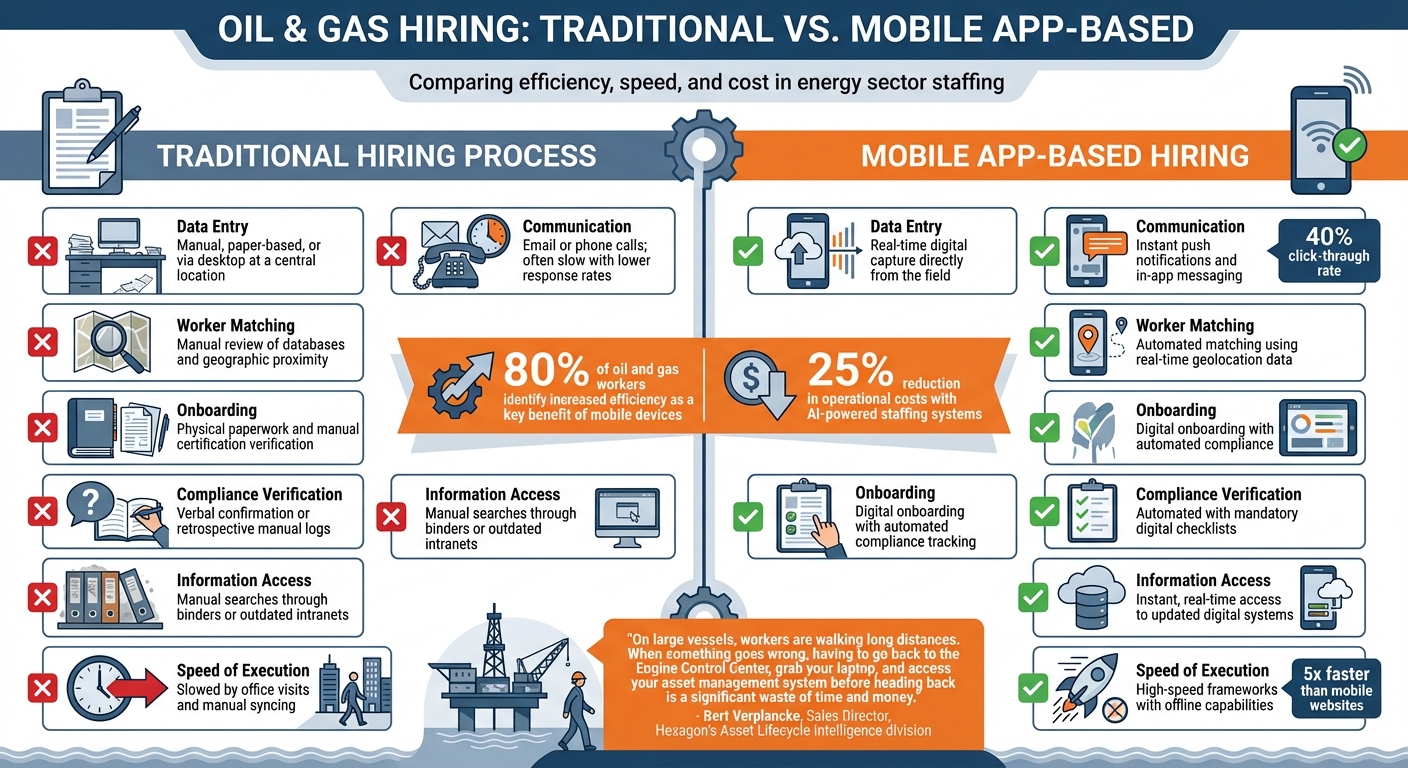
Traditional vs Mobile App Hiring in Oil and Gas: Key Differences
The transition from traditional hiring methods to mobile app-based hiring marks a major transformation in how oil and gas companies recruit and deploy workers. Traditional hiring processes often involve cumbersome paper forms, manual data entry, and reliance on desktop computers located in central offices. Workers may even need to return to these offices just to update paperwork, leading to wasted time and unnecessary costs.
"On large vessels, workers are walking long distances. When something goes wrong, having to go back to the Engine Control Center, grab your laptop, and access your asset management system before heading back is a significant waste of time and money." – Bert Verplancke, Sales Director, Hexagon’s Asset Lifecycle Intelligence division
This kind of inefficiency highlights the clear advantage of real-time digital updates.
Mobile apps address these delays by enabling workers to capture and share information directly from the field. Tasks like logging hours, uploading certifications, and communicating with dispatchers can now happen without leaving the job site. Push notifications, with click-through rates of 40%, ensure workers stay engaged and responsive.
Another advantage? Mobile app frameworks operate roughly five times faster than the JavaScript code often used for mobile websites. This speed boost helps workers complete tasks more efficiently. In fact, 80% of oil and gas workers surveyed identified increased efficiency as a key benefit of using mobile devices in the field. Additionally, younger workers prefer mobile-first communication, valuing the ability to manage work remotely.
Comparison Table
| Feature | Traditional Hiring Process | Mobile App-Based Hiring |
|---|---|---|
| Data Entry | Manual, paper-based, or via desktop at a central location | Real-time digital capture directly from the field |
| Communication | Email or phone calls; often slow with lower response rates | Instant push notifications and in-app messaging |
| Worker Matching | Manual review of databases and geographic proximity | Automated matching using real-time geolocation data |
| Onboarding | Physical paperwork and manual certification verification | Digital onboarding with automated compliance tracking |
| Compliance Verification | Verbal confirmation or retrospective manual logs | Automated with mandatory digital checklists |
| Information Access | Manual searches through binders or outdated intranets | Instant, real-time access to updated digital systems |
| Speed of Execution | Slowed by office visits and manual syncing | High-speed frameworks with offline capabilities |
AI-powered staffing systems further enhance these processes by reducing operational costs by 25%. They automate compliance checks and minimize the need for manual paperwork. Mobile apps also provide real-time visibility into worker status and progress, filling the information gaps that often plague manual systems.
Next, take a closer look at how ABLEMKR’s mobile features are reshaping oil and gas hiring.
ABLEMKR‘s Mobile Features for Oil and Gas Hiring
ABLEMKR is a mobile-first platform designed specifically for high-demand and high-risk industries like oil and gas. It connects pre-vetted workers to critical projects across U.S. energy corridors, handling everything from matching to payment. By leveraging geo-location technology, automated certification matching, and real-time communication, ABLEMKR tackles the hiring challenges unique to this sector. These features work together to streamline hiring processes and minimize delays.
Connecting Workers to Critical Projects
ABLEMKR’s mobile app uses real-time geo-location to connect workers with job sites nearby. Employers can track workers’ exact locations through the app, simplifying coordination for tasks like remote pipeline repairs or urgent shutdowns. Before deployment, the platform ensures workers meet specific customer requirements through a vetting and interview process. Employers can view worker profiles, ratings, and certifications directly in the app, making it easy to book and manage appointments without leaving the platform. This automated system allows operators to quickly assemble crews for emergencies or scheduled maintenance, saving valuable time.
Reducing Administrative Work for Employers
ABLEMKR doesn’t just match workers to jobs – it also simplifies the administrative side of hiring. The platform integrates payroll management, compliance tracking, and workforce oversight into one system. Employers can track worker status in real-time using digital time cards, while built-in messaging enables direct communication with field workers, eliminating the inefficiencies of phone calls or long email threads. Onboarding and verification are automated, ensuring workers meet safety and certification requirements before deployment. With features like automated compliance checks and streamlined time tracking, ABLEMKR significantly reduces HR workloads, making it easier to manage teams across multiple job sites.
Providing Workers with Flexible Job Access
ABLEMKR also benefits workers by giving them direct access to well-paying job opportunities. Through the app, workers can browse postings and apply directly to roles in industries like oil and gas, mining, utilities, and heavy infrastructure. The platform guarantees on-time payments and offers W2 employment with workers’ compensation coverage, addressing the financial uncertainties often tied to fieldwork. Flexible scheduling options let workers choose assignments that align with their availability, helping them maintain a consistent income. With its transparency and reliability, ABLEMKR empowers skilled laborers to manage their careers more effectively, all from their mobile devices.
Conclusion
Mobile apps are transforming how the oil and gas industry manages hiring and workforce deployment. By replacing outdated manual processes with efficient digital workflows, these tools cut down delays and provide real-time insights into workforce operations. This means quicker crew mobilization, less administrative hassle, and better compliance – key factors in an industry where even brief downtime can hit profitability hard.
These advancements address critical operational needs like emergency staffing, verifying certifications, and coordinating remote teams. Features like automated scheduling and geo-location ensure that the right worker gets to the right site when needed, streamlining day-to-day operations.
Platforms like ABLEMKR take this a step further by connecting pre-screened workers with vital projects across U.S. energy hubs. The platform automates certification checks, simplifies onboarding, and guarantees timely payments. For employers, it boosts efficiency and reduces friction in deployment, while workers enjoy flexible, high-paying opportunities without the usual hurdles of traditional labor systems.
FAQs
How do mobile apps make hiring faster in the oil and gas industry?
Mobile apps have revolutionized the hiring process in the oil and gas industry, making it faster and more efficient. By automating key steps, these apps enable employers to notify pre-vetted workers about open positions instantly through push notifications. This approach can cut fill times by as much as 80% and significantly reduce no-show rates.
Geo-location technology adds another layer of efficiency by ensuring that only workers near the job site receive alerts. This means crews can be assembled and ready to go within hours rather than days.
On top of that, certification-matching tools automatically confirm that candidates meet the required safety and technical qualifications. This eliminates the need for time-consuming manual resume reviews. Together, these features turn what used to be a lengthy hiring process into a streamlined system, allowing operators to quickly staff critical projects like shutdowns or remote repairs.
How does geo-location technology help deploy workers faster and more efficiently?
Geo-location technology empowers mobile-first platforms to pinpoint workers’ locations in real time, making it easier to match them with nearby job sites quickly. Using GPS-based geofencing, these systems can automatically clock workers in as they arrive, monitor attendance, and keep tabs on crew locations. This streamlines coordination, helps prevent payroll mistakes, and boosts on-site safety.
Beyond that, the platform can send location-specific push notifications to notify workers about urgent shifts or emergencies in their vicinity. This allows for quicker responses, reduces downtime, and ensures operations stay on track.
How do mobile apps help ensure safety and regulatory compliance in oil and gas hiring?
Mobile-first hiring platforms simplify compliance management by centralizing worker certifications, safety training records, and medical clearances. This setup ensures that only properly qualified workers are assigned to job sites, significantly lowering the risk of regulatory violations. These platforms also monitor training completion dates and send timely reminders about upcoming expirations, helping both workers and supervisors stay ahead of requirements.
With tools like GPS-based geofencing, compliance gets another layer of support. These tools automatically record when workers enter or leave specific zones, creating an accurate audit trail without the need for manual tracking. On top of that, these platforms often integrate with payroll and incident reporting systems, allowing real-time identification and resolution of non-compliance issues. This not only simplifies audits but also ensures alignment with OSHA, EPA, and other industry standards.
By combining these features, mobile apps like ABLEMKR offer an efficient and reliable way to maintain safety and regulatory compliance while cutting down on administrative work.


