
If I want to become a master plumber in the U.S., I should plan for years of field work, two license steps, and state-by-state rules. In most cases, I’m looking at 4–5 years as an apprentice, about 8,000 hours of paid job-site training, then 2–5 more years as a journeyman before I can sit for a master exam. There is no national plumbing license, so my timeline depends on where I work.
Here’s the short version:
- Step 1: Start as an apprentice and log supervised hours
- Step 2: Pass the journeyman exam
- Step 3: Work the extra years my state wants
- Step 4: Pass the master plumber exam
- Step 5: Keep my license current with continuing education
- Step 6: Build skills in code, safety, supervision, and planning
- Step 7: If I want to run work or a business, check whether I also need a contractor or responsible master license
The exam is not just about installs. I need to be ready for code lookup, plumbing math, pipe sizing, venting, drawings, and job supervision topics. After licensing, the work often shifts toward permits, crew oversight, inspections, and customer or inspector communication.
A few numbers stand out:
- Plumbing jobs are projected to grow about 4%
- The BLS expects about 44,000 openings per year through 2034
- Safety still matters every day: specialty trade contractors recorded 2.3 injury cases per 100 workers
- OSHA penalties can reach $16,550 for serious violations and $165,514 for willful or repeated ones
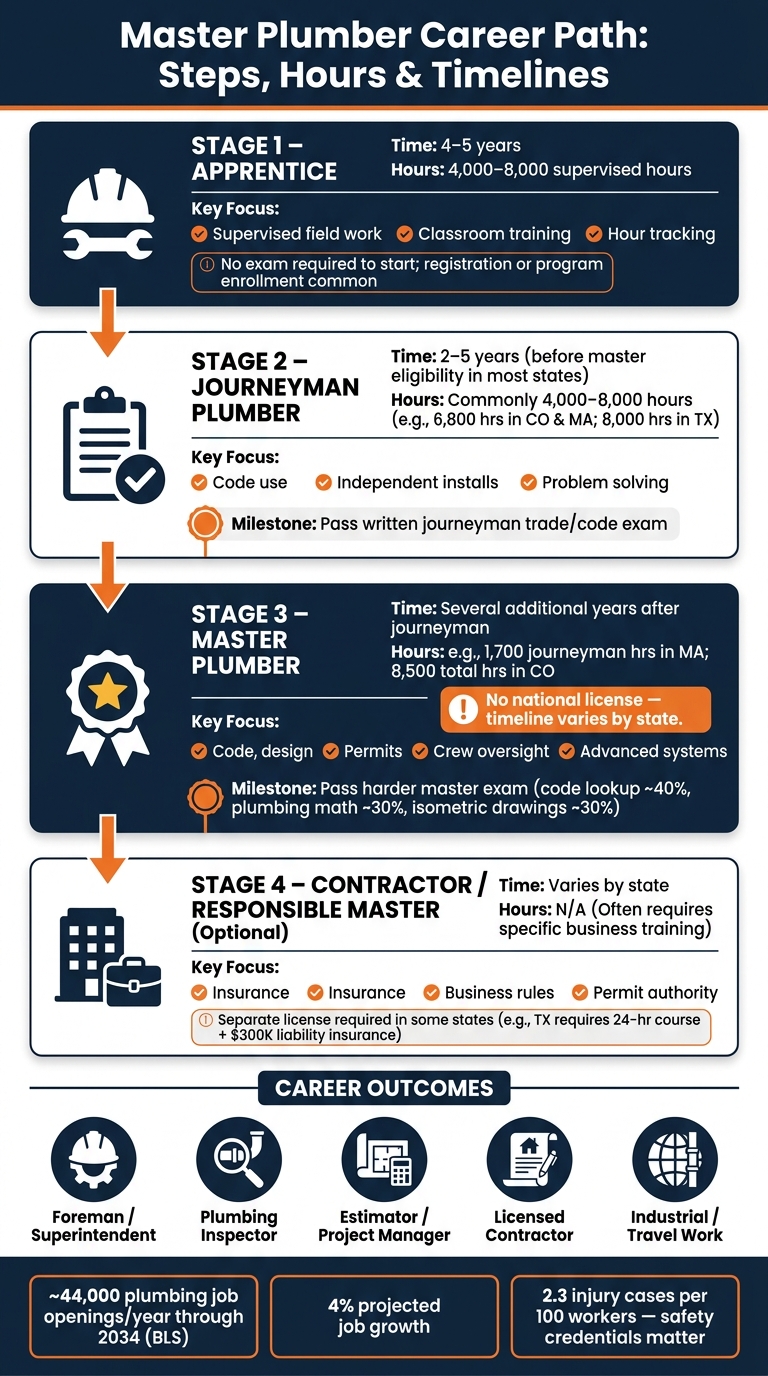
Master Plumber Career Path: Steps, Hours & Timelines
Apprentices, Journeyman, Master – Plumber Licenses Explained
sbb-itb-aa28329
Quick Comparison
| Stage | Main Goal | Common Time Frame | What I’m Focused On |
|---|---|---|---|
| Apprentice | Learn the trade and log hours | 4–5 years | Supervised field work, class time, hour tracking |
| Journeyman | Work with more independence | 2–5 years before master eligibility in many states | Code use, installs, problem solving |
| Master Plumber | Move into top trade license level | After journeyman requirements and exam | Design, code, permits, crew oversight |
| Contractor/Responsible Master | Run a business or pull permits in some states | Varies by state | Insurance, business rules, permit authority |
The main point: if I track my hours, study the right code book edition, stay current on CE and safety, and build leadership skills, a plumbing license can lead to field leadership, inspections, estimating, project management, or travel work.
The License Path From Apprentice to Master Plumber
In most of the U.S., the plumbing path goes from apprentice → journeyman → master plumber. Some states also add a separate contractor or responsible-master license if you want permit authority or plan to own a plumbing business. Once you know what your state asks for, you can map out the hours, exams, and renewal steps.
Apprentice, Journeyman, and Master Roles Compared
The table below shows the main differences in scope of work and testing.
| License Level | Typical Hours | Common Exam | Work Authority |
|---|---|---|---|
| Apprentice | 4,000–8,000 supervised hours to progress | No exam required to start; registration or program enrollment is common | Works under a licensed journeyman or master |
| Journeyman | Commonly 4,000–8,000 hours; examples include 6,800 hours in Colorado and Massachusetts and 8,000 hours in Texas | Written trade/code exam | Works with more independence; some states limit permit authority |
| Master Plumber | Usually several additional years after journeyman; examples include 1,700 hours of journeyman experience in Massachusetts and 8,500 total hours in Colorado | Harder exam covering code, design, and supervision | May supervise crews; pulling permits or running a plumbing business depends on state |
One thing trips people up all the time: master plumber and plumbing contractor do not always mean the same thing. In some states, the master license covers skill level, while a separate contractor or responsible-master license controls permits or business ownership. That detail can change your plan in a big way.
How State and Local Requirements Affect Your Timeline
Your timeline usually comes down to a few moving parts:
- Total hour requirements
- Board approval
- Exam scheduling
- Renewal rules
- Extra city or county rules
Some local governments stack their own supervisor, contractor, or exam rules on top of the state license. So even if the state path looks clear, your city may add another step.
It also pays to be a little obsessive with paperwork. Track every hour, every employer sign-off, and every classroom record. Keep copies of employer sign-offs, classroom records, and a running hour log. If something is missing, your license process can stall and cost you time.
With your timeline mapped, the next step is building the code knowledge needed for the master exam.
How to Prepare for the Master Plumber Exam and Build Code Knowledge
The master plumber exam is a different animal from the journeyman test. It goes past basic install work and leans hard on code lookup, sizing, design, and supervision. One exam-prep outline puts the mix at about code lookup (~40%), plumbing math (~30%), and isometric drawing interpretation (~30%). So if your plan is to memorize a bunch of facts and hope for the best, that’s probably not enough.
For people working in the field, the test rewards three things: fast code use, clean math, and solid plan reading under a time limit.
A 4-8 Week Study Plan That Fits Around Field Work
A 6-week schedule is a good middle ground if you’re working full-time: 45–60 minutes on weeknights and 2–3 hours on weekends.
In Week 1, pull the official exam content outline from your licensing board. Then take a short diagnostic practice test. The goal is simple: find your weak areas early, whether that’s venting, fuel gas, or something else.
Weeks 2–3 should center on DWV systems and water supply. A steady pace of 20–30 targeted questions each night works well here. Week 4 is a good time to move into fuel gas piping and core field math. Week 5 should shift toward plan reading, isometric drawings, and timed code-lookup drills. In Week 6, take at least one full-length practice exam under timed conditions, then spend the rest of your study time drilling the two areas where you scored lowest.
This kind of plan works because it doesn’t ask you to study for hours every night after a long day. It gives you a routine you can stick with.
Code Books, Practice Materials, and Open-Book Exam Strategy
A lot of states use open-book exams. That sounds easier than it is. You still need to move fast.
Before test day, tab the main chapters and mark the sizing tables you know you’ll use a lot. A one-page personal index can save time too. Put common lookups on it, such as circuit vent limits, minimum vent sizing, and WSFU tables. On this exam, shaving even a little time off each question adds up.
That is why tabbed code books and timed drills matter so much.
The table below shows the prep resources that tend to help master candidates most.
| Resource Type | What It Covers | Estimated Cost (USD) | Best Fit |
|---|---|---|---|
| Official code books (IPC/UPC + commentary) | Full code text, tables, explanatory notes | $80–$200+ per volume | Both journeyman and master; especially useful for master candidates |
| Printed or PDF study guides | DWV, water supply, gas, plan reading, business/law, formula sheets | $40–$150 | Master candidates needing an exam-specific roadmap |
| Online practice tests and question banks | All exam domains; timed simulations; 200+ master-level questions available | Free–$100 (subscription) | Both levels; masters benefit from longer mixed-topic sets |
| Mobile apps | Flashcards, 1,440–1,500+ IPC/UPC-tagged questions, progress tracking | Free–$30 | Both levels; ideal for commute or lunch-break drills |
| Business and law courses | Contracts, OSHA, licensing law, estimating, bid prep | $50–$200 | Master candidates in states with a separate business/law section |
Before buying anything, check your state’s adopted code edition. That’s a big deal. Your exam may be based on the 2018, 2021, or 2024 IPC or UPC, and the table values and section numbers can change from one edition to the next.
Field Math, Drawings, and Design Problems on the Exam
This is where master exams start to pile things together.
A journeyman exam will often test one calculation at a time. A master exam may ask you to total drainage fixture units (DFU) across a multi-bathroom layout, choose the correct pipe diameter and slope from a code table, and then check whether the vent layout is legal – all in one problem.
There are also slope numbers you should know cold:
- 1/4 inch per foot for pipes under 3 inches in diameter
- 1/8 inch per foot for 3-inch pipe and larger
Water supply questions add another step. You’ll often total water supply fixture units (WSFU) for hot and cold lines together, then size the service and distribution piping based on available pressure and allowed pressure loss.
Plan reading questions can feel like a race. The more you practice reading riser diagrams and isometric drawings, the better you’ll get at spotting undersized vents, bad slopes, and code violations before the clock beats you.
Code Compliance, Safety Training, and Leadership Skills
Passing the master plumber exam is a big step. But it’s not the end of the road. Once you’re licensed, the job changes. You’re no longer focused on passing a test. You’re focused on staying current with code, running safe job sites, and leading people well.
Continuing Education and Keeping Up With Code Changes
In many states, license renewal depends on documented continuing education hours. The rules change by state, so you can’t assume one standard applies everywhere.
Minnesota requires 16 hours every two years, and at least 8 of those hours must cover the State Plumbing Code. Massachusetts requires 12 clock hours for each renewal period and says you must keep those certificates for three full renewal cycles. Georgia requires 8 hours every 24 months, with topics that may include state codes, safety, technical updates, and work-related legal issues. Montana keeps it simple with 4 hours each year.
Here’s how those requirements compare:
| State | CE Requirement | Code-Specific Hours | Notes |
|---|---|---|---|
| Minnesota | 16 hrs / 2 years | At least 8 hrs on State Plumbing Code | All 16 hrs may be code-focused |
| Massachusetts | 12 hrs / 2 years | Board-approved CE required | Keep records for 3 renewal cycles |
| Georgia | 8 hrs / 24 months | Topics may include state codes | Exemptions for newer licensees |
| Colorado | 8 hrs / year | At least 4 code hrs per 24 months | Safety credit rules can be narrow |
| Montana | 4 hrs / year | Board-approved CE | Simple annual requirement |
Before each renewal cycle, check the board’s current rules. It’s smart to track the course title, provider, date, hours, and topic for every class you take. A simple reminder system at 90, 60, and 30 days before renewal can save a lot of stress.
Safety Credentials That Matter on High-Risk Job Sites
In 2024, specialty trade contractors recorded 2.3 injury cases per 100 full-time workers. That number is a good reminder: plumbing work can be dangerous, especially on commercial and industrial jobs.
OSHA 10-Hour Construction is the usual starting point for field workers. OSHA 30-Hour Construction is often expected for supervisors, foremen, and anyone in charge of crew safety. From there, the job often calls for more focused training. Trenching and excavation, confined space awareness, fall protection, hot work, and hazard communication all matter. On many sites, the master plumber is the person who has to spot a problem, call a stop, and make sure the crew doesn’t work in unsafe conditions.
The stakes are high. As of January 15, 2025, OSHA serious violations can cost up to $16,550 per violation, while willful or repeated violations can reach $165,514. Keeping credentials current and documented helps cut risk and shows that you’re ready for harder, more demanding projects.
Supervision, Crew Communication, and Job Planning
The City of Chicago‘s Foreman of Plumbers job specification gives a clear picture of what this role looks like day to day: studying blueprints and work orders, estimating labor and materials, scheduling jobs, supervising safety compliance, inspecting completed work for code compliance, training staff, and keeping daily reports and material usage logs. That’s management work, not just top-level field work.
A lot of this comes down to communication. You need to explain code requirements to inspectors, flag scope changes to project managers, and walk customers through what was done and why in plain English. That kind of steady, clear communication builds the sort of reputation that can lead to promotions.
Mentoring apprentices is part of the role too. That usually means giving them harder tasks over time, checking their work at key points, and tying hands-on instruction back to the right code section. Done well, this helps apprentices learn faster and cuts down on rework. A track record of training apprentices can also help when you’re aiming for foreman or superintendent roles.
Those habits also matter when you work across state lines.
Multi-State Licensing and Advanced Career Options
Reciprocity, Endorsement, and Working Across State Lines
Plumbing licenses are issued at the state level, and some cities add their own rules on top. So a master license from one state does not automatically let you pull permits or supervise jobs in another. Each new place is its own compliance job.
There are a few ways states handle out-of-state plumbers:
- Reciprocity: a formal agreement that may waive the main trade exam, though you may still need to pass a state law or code test.
- Endorsement: a board reviews your license and work history case by case.
- No reciprocity: you file a full new application and start the process from scratch.
Before you take travel work or commit to a shutdown project, make sure your home-state license is active and in good standing. Then request a license verification letter from your board. Many states want that letter dated within 30 to 90 days. You should also gather your exam history and documented work hours, because some boards will only accept licenses earned through a state-level exam, not a city exam.
City rules can trip people up too. In Colorado, Denver, Boulder, and Fort Collins each have their own registration systems, and those licenses do not transfer between cities.
| Strategy | Documentation Burden | Possible Exam Requirement | Typical Approval Timeline | Cost Range |
|---|---|---|---|---|
| Reciprocity | Moderate – proof of good standing, exam history | Trade exam often waived; law/code exam may still be required | 2–8 weeks | $100–$500 |
| Endorsement | High – detailed hour logs, exam records, references | At least one state-specific exam is likely | 6–12 weeks or more | $200–$600+ |
| New Application | Very high – full documentation, business records | Full trade plus law/code exams | Several months | $300–$1,000+ |
One rule is simple: don’t book travel or promise a start date until the new state has formally approved your license or registration.
Next-Step Roles for Master Plumbers
Once you can work across state lines, the next move is figuring out where your license pays off most. A master license can open doors to foreman, superintendent, inspector, estimator, project manager, or contractor roles. The best fit depends on what kind of work you want day to day – field leadership, code work, bidding, project coordination, or running a company.
Plumbing inspectors usually work for city, county, or state agencies and check jobs for code compliance. That makes the role a good fit for plumbers who lean more toward compliance and public safety than production pressure.
Estimators and project managers sit more on the operations side. They deal with bids, budgets, schedules, and subcontractor coordination. In these jobs, being good with software and paperwork matters just as much as knowing pipe, fittings, and field work.
If you want to run your own shop, the next step is becoming a licensed plumbing contractor. In Texas, for example, that means getting the Responsible Master Plumber (RMP) designation. That requires a 24-hour training course and $300,000 in commercial liability insurance, on top of holding the master license. Other states use similar contractor-level endorsements.
Then there are industrial and energy-sector roles. Think refineries, power plants, utilities, and large water infrastructure. These jobs can pay well, but they also ask for strong safety credentials and comfort working on high-pressure process piping systems.
Finding Industrial and Travel Work Through ABLEMKR
Travel and shutdown work tends to reward plumbers who can show their credentials fast and move when a project opens up. In many cases, getting into this kind of work is harder than earning the license itself. Shutdowns, pipeline repairs, and energy-sector builds often move on short timelines, so employers want people who are already screened and ready to go.
ABLEMKR connects pre-vetted workers with mission-critical projects across the U.S. using certifications, safety training, availability, and GPS location. For master plumbers with multi-state credentials, that can mean access to well-paid project work without the usual hassle of cold outreach and manual onboarding.
Employers also get real-time worker status, payroll workflow, and compliance tracking. That can make short-notice industrial work much easier to take without slowing down the compliance side.
Conclusion: Build a Long-Term Master Plumber Career With a Clear Plan
You’ve got the path, the exam prep, and the leadership basics. Now it comes down to doing the work.
Becoming a master plumber starts with a clear plan: track your hours, set your exam dates, and stay in step with your state’s rules. Break your required hours into realistic time frames based on your current schedule. Then put target dates on each exam so the goal feels concrete, not vague.
After you pass the exam, the job doesn’t stop. Stay on top of continuing education and safety training so your license and job-site readiness stay current. Treat both as part of the job, not as extras you can put off.
Technical skill helps you get licensed. Leadership is what gets you trusted with bigger jobs and more responsibility. The master plumbers who move into foreman, superintendent, or project manager roles are usually the ones who can plan job scope, communicate clearly with crews and inspectors, and make safety calls without hesitation.
The BLS projects about 44,000 plumbing job openings per year through 2034. A large part of the workforce is getting close to retirement, so demand for experienced, licensed master plumbers should stay strong. Workers who pair current licensing with safety credentials and leadership experience are in a strong spot to step into those roles, including industrial work through ABLEMKR. That’s how a license becomes a long-term career.
FAQs
How long does it usually take to become a master plumber?
It depends on your state because licensing rules are set at the state level.
In most cases, you start by finishing an apprenticeship and becoming a journeyman. That step usually takes 3 to 5 years.
From there, you’ll need more on-the-job time before you can qualify for a master license. For example, Colorado requires 8,500 hours. For the exact rules where you live, check with your local licensing board.
What should I study most for the master plumber exam?
Focus first on the plumbing codes, statutes, and administrative rules required by your state’s licensing board. A plumbing license is tied to the state where you work, so you need a clear grasp of the rules that govern both plumbing work and day-to-day business operations in your area.
You should also spend time on scenario-based study. That means working through jobsite situations that test safety protocols, project management, and technical problem-solving. Why does that matter? Because a master-level license isn’t just about doing the work yourself. It also shows you can lead jobs, make sound calls under pressure, and handle the kind of issues that come up when a project doesn’t go exactly as planned.
Can I use my plumbing license in another state?
Usually not. In the United States, plumbing licenses are state-specific. That means if you want to work in another state, you’ll usually need to get a new license there.
That said, some states have reciprocity agreements that make the process easier. If you’re planning a move, start the transfer paperwork 3 to 6 months in advance and check the licensing board rules in your new state.


