
Clear communication is the backbone of leadership in energy projects. In high-risk environments like oil and gas operations, even small missteps in communication can lead to costly errors, safety hazards, and delays. Energy leaders spend nearly 90% of their time communicating, yet many struggle to do it effectively. This guide breaks down how to improve leadership communication, focusing on:
- Active listening: Detect potential issues early by prioritizing listening over speaking. Use open-ended questions and summarize what’s been shared to ensure clarity.
- Tailored communication: Different stakeholders – executives, field workers, and regulators – require distinct approaches. For example, executives need concise updates, while field crews need clear, actionable instructions.
- Storytelling: Use narratives to align teams with project goals and inspire motivation.
- Crisis management: In emergencies, clarity and consistency are crucial. A strong communication plan can prevent chaos and build trust.
- Technology tools: Platforms like ABLEMKR and mobile-first solutions streamline updates, improve safety, and enhance team alignment.
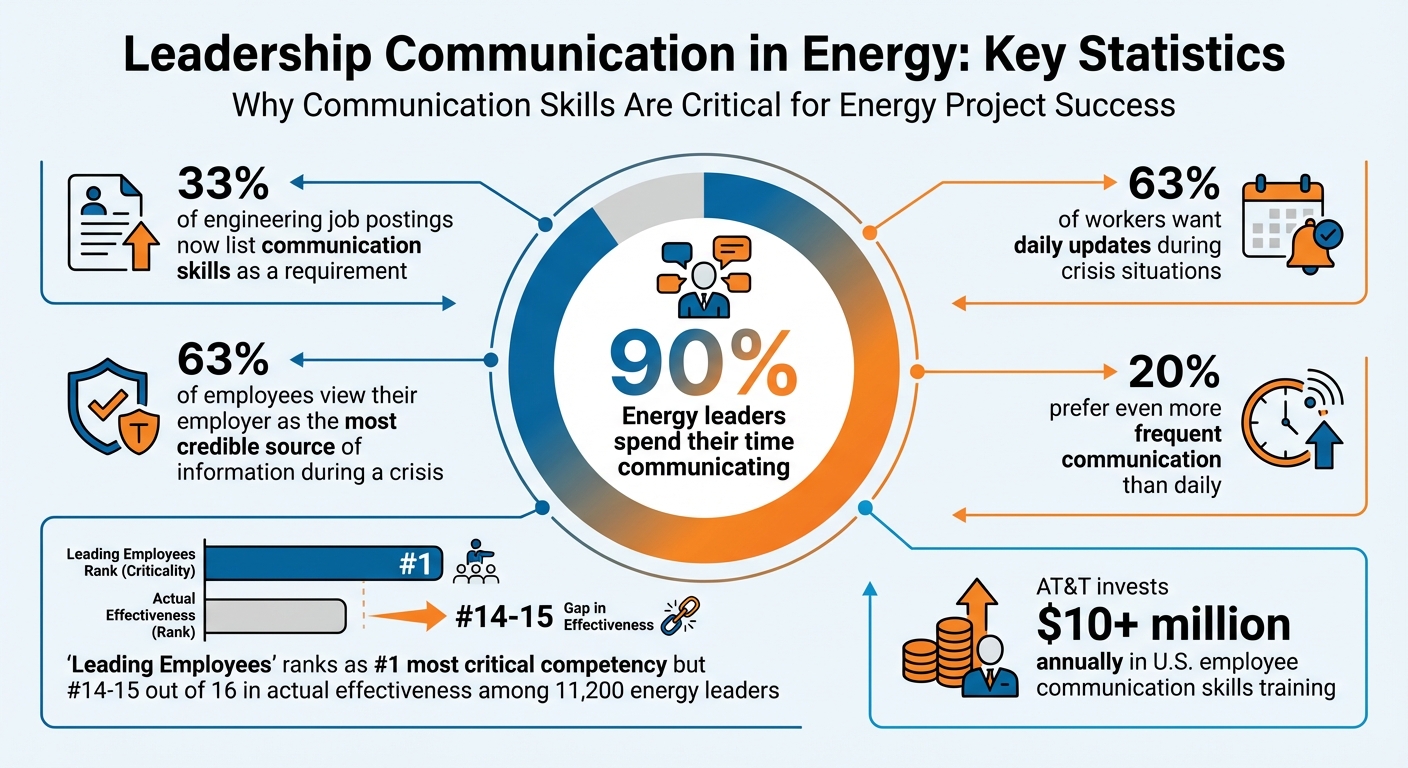
Leadership Communication Statistics in Energy Sector
Absolutely essential communication skills for great leadership | SHUBHA MADHUKAR | TEDxSGRR
Core Communication Skills for Energy Project Leaders
Excelling in active listening, clear technical communication, and storytelling helps energy leaders tackle the challenges of high-stakes environments. Interestingly, energy project leaders spend nearly 90% of their time communicating, yet many struggle to apply these skills effectively. This shortfall can result in overlooked safety issues, disjointed teams, and projects that stray from their goals.
Active Listening in High-Stakes Environments
Active listening isn’t just polite – it’s a safeguard. When energy leaders genuinely listen, they can detect operational problems and safety risks before they escalate. In high-pressure scenarios involving drilling, gas emissions, or chemical exposure, this skill becomes even more critical.
"Communication isn’t just about speaking; it’s about listening. Active listening allows project managers to fully understand concerns, suggestions, or challenges… [and] uncover problems before they escalate." – Keystone Energy Tools
Adopting an 80/20 rule – spending 80% of the time listening and 20% speaking – can help leaders fully understand issues before jumping to conclusions. Open-ended questions like “Can you explain that further?” or “What do you mean by that?” encourage detailed responses. Summarizing what you’ve heard and pausing to reflect ensures clarity and minimizes misunderstandings.
Clear and Precise Technical Communication
In oil and gas operations, unclear instructions can lead to safety hazards and costly mistakes. Whether managing drilling operations or pipeline repairs, precise communication is essential. The "Six C’s" framework – Compassion, Clarity, Conciseness, Connection, Conviction, and Courage – offers a practical way to deliver effective messages.
Different stakeholders need tailored communication: engineers require detailed technical data, while executives prefer concise summaries that highlight key actions. It’s worth noting that 33% of engineering job postings now specifically list communication skills as a requirement. Replace vague feedback with actionable specifics, such as “Include more details about equipment specifications”. After technical discussions, a written summary helps clarify points and serves as a reference. Establishing regular communication routines, like scheduled updates or using project management tools, keeps everyone aligned. Transparent conversations about delays, budgets, or other challenges also help build trust over time.
Clarity in technical communication is crucial, but leaders must also inspire their teams through storytelling.
Using Storytelling to Align Teams on Project Goals
While precision ensures safety and efficiency, storytelling fosters unity and motivation. Data informs, but stories inspire. A well-crafted narrative can resonate more deeply than a dry mission statement, helping field workers, engineers, and executives rally around a shared goal. Stories are not only easier to remember but also more likely to be shared.
"To get people on board, they need to grasp what you’re conveying, so they’re excited to join you in turning that direction into a reality." – Anthony Mayo, Professor, Harvard Business School
Effective storytelling ties individual tasks to a broader purpose. For example, when team members understand how their work contributes to energy security or a major infrastructure achievement, they’re more likely to make informed, mission-driven decisions. Incorporating data storytelling – blending narratives with visuals – transforms raw numbers into a compelling vision that unites teams, even across remote locations. This approach strengthens coordination and keeps everyone focused on the bigger picture.
Adapting Communication for Different Stakeholder Groups
Effective leaders know that communication isn’t one-size-fits-all. In energy projects, where leaders spend a staggering 90% of their time communicating, tailoring messages for different stakeholder groups is essential. Executives, field crews, and regulatory teams each require a distinct approach. For example, executives need concise, strategic updates, field crews thrive on actionable instructions, and regulatory teams expect transparency and factual accuracy. Leaders who excel in adapting their communication style stand out by fostering alignment and trust.
Communicating with Executives and Senior Leaders
When addressing executives, the focus should be on the big picture. Avoid overwhelming them with technical jargon or granular details. Instead, zero in on how the project aligns with business goals, impacts the budget, and supports the organization’s broader strategy. AT&T, for instance, invests over $10 million annually in the U.S. to improve employee communication skills – a testament to the importance of clear messaging.
"One must be conscious that most executives are not trained in PM lingo." – Carlye Adler
After verbal briefings, follow up with a concise written summary to document decisions and outline next steps. When presenting updates, provide enough background to help them understand the broader context without diving into unnecessary technicalities. Always end interactions by clearly summarizing decisions and specifying what actions will follow, along with timelines. In the high-pressure energy sector, maintaining a calm and composed demeanor reassures senior leaders that the project is on track.
While executives require high-level clarity, field teams need communication that’s grounded in operational details.
Engaging Field Workers and On-Site Crews
For field crews, clarity and precision are non-negotiable. Miscommunication can lead to costly errors, missed deadlines, or even safety hazards. Interestingly, while "Leading Employees" is ranked as the most critical competency for energy leaders, studies of 11,200 industry leaders show it often ranks near the bottom in real-world effectiveness (#14 or #15 out of 16).
One proven technique is the "playback" method – asking workers to repeat instructions in their own words to confirm understanding. Replace vague feedback like "this needs improvement" with actionable specifics, such as "this report needs more detail on equipment specifications". Additionally, explain the importance of safety protocols by linking them to overall operational success. This not only ensures compliance but also fosters a sense of purpose among team members.
While field crews require hands-on, actionable guidance, regulatory teams demand a transparent and methodical approach.
Working with Regulators and Compliance Teams
When working with regulators, transparency is key to building trust. Be upfront about challenges, whether they involve delays, budget constraints, or operational issues. This level of openness is critical for managerial roles, where communication skills are often a deciding factor.
"Transparency is a fundamental part of this process. When team members are informed about potential risks or challenges, they’re better equipped to adapt, and trust is built." – Keystone Energy Tools
Avoid alienating regulators with overly technical language. Instead, use simple, clear terms and employ the playback technique – rephrasing their concerns and seeking confirmation to ensure mutual understanding. After meetings, provide written summaries to create a consistent record and establish accountability. This practice not only reinforces trust but also aligns with the same communication principles used in field and executive interactions. Regular updates and composure during high-pressure situations further demonstrate your commitment to keeping regulators informed and engaged.
sbb-itb-aa28329
Crisis Communication for Energy Infrastructure Incidents
In times of crisis, clear and effective communication can mean the difference between control and chaos. Take BP‘s situation in April 2010: a drilling platform explosion in the Gulf of Mexico caused 11 tragic fatalities and unleashed an oil spill at a staggering rate of 43 barrels per minute. Managing a technical issue is one thing; steering an organization through a crisis of this magnitude is entirely different. Research highlights that poor leadership, more than a lack of resources, often undermines an institution’s ability to handle crises effectively. Strong crisis leaders communicate transparently, keep teams focused, and adjust swiftly as new information surfaces.
Creating a Clear Crisis Response Plan
A well-prepared crisis response plan is essential, and it starts long before an emergency arises. Preparation goes beyond having the right tools and checklists – it’s about readiness, awareness, and anticipation. Your plan should include defined communication protocols, a network of key contacts, and clear escalation procedures. Structured tools, like role cards and board processes, can help. For instance, one role card might assign someone to liaise with regulators, while another could focus on ensuring field crew safety.
Walmart’s COVID-19 safety protocols in March 2020 are a great example of simplicity in action. They introduced the "6-20-100" rule: stay 6 feet apart, wash hands for 20 seconds, and stay home if your temperature hits 100°F. This gave their frontline workers clear, actionable guidance. To be effective, your plan should also account for human factors like stress, cognitive biases, and behavior under pressure. During crises, key messages often need to be repeated multiple times to sink in. Frequent updates – whether through radio, mobile platforms, or in-person briefings – can help bridge information gaps. In one study, 63% of workers wanted daily updates, while 20% preferred even more frequent communication.
Be upfront about what you know and what you don’t. Avoid speculation or sugarcoating. As the situation evolves, shift your focus from immediate safety messages to long-term recovery plans. Interestingly, 63% of employees view their employer as the most credible source of information during a crisis. Use that trust wisely by maintaining consistent updates and avoiding communication voids that can lead to rumors.
"The lack of clarity and the existence of a communication vacuum and meaning deficit of a crisis create a discursive space that is filled by narratives, often multiple and conflicting." – Seeger and Sellnow
Maintaining Team Morale During High-Stress Situations
In a crisis, keeping your team motivated and focused requires more than just issuing directives. Leaders need to provide emotional support, clear guidance, and a steady presence. During the early days of the COVID-19 pandemic, Best Buy CEO Corie Barry set a dual priority: protecting employees while continuing to serve customers. Employees were told to work only if they were healthy, and the company introduced contactless curbside service to emphasize safety.
Your demeanor as a leader has a ripple effect. Field crews often mirror leadership behavior – if you appear calm and confident, it reassures the team. Creating opportunities for two-way dialogue is equally important. Dedicating 15 to 30 minutes during meetings for team members to voice concerns – whether through open discussions or quick pulse surveys – can make a big difference. Including team members in decision-making also builds trust and keeps morale high.
Frame instructions positively to encourage compliance. Instead of saying, "Don’t skip safety checks", try, "Complete safety checks to ensure everyone gets home safely tonight". This kind of positive reinforcement keeps teams focused on actionable steps and reinforces the overall mission. Sharing stories of recovery and hope can also help teams find meaning amid the chaos. Once the immediate crisis subsides, take time to reflect on lessons learned, celebrate the team’s efforts, and reaffirm your commitment to safety and improvement. These strategies not only help navigate the crisis but also integrate seamlessly into broader communication practices outlined in this guide.
Using Technology to Improve Leadership Communication
Energy leaders often face challenges in bridging communication gaps, especially when managing teams across multiple locations. Technology steps in to provide the clarity and structure needed for efficient workforce coordination. Tools like workforce deployment platforms and mobile-first solutions allow leaders to communicate effectively, mobilize teams quickly, and maintain accountability, even across dispersed sites. By integrating advanced digital tools, leaders can strengthen the communication strategies already discussed, ensuring every team member stays informed and aligned.
Using Workforce Deployment Platforms like ABLEMKR

Real-time visibility into worker status is a game-changer for team coordination. Platforms like ABLEMKR offer insights into worker certifications, availability, and geo-location, enabling leaders to mobilize crews efficiently. Instead of juggling phone calls and spreadsheets, managers can instantly identify which workers are qualified, available, and closest to the job site. This ensures the right skills are deployed exactly where and when they’re needed.
When compliance data, safety certifications, and project updates are consolidated into one platform, leaders can shift their focus from micromanaging to outcome-oriented oversight. Field workers know their responsibilities, while managers can track progress without constant check-ins. As the Center for Creative Leadership points out, “The top priority for leadership development in the energy sector is to improve the ability to lead employees”. Platforms like ABLEMKR support this goal by providing the tools needed for seamless communication and alignment with project objectives.
While centralized platforms enhance overall management, mobile-first solutions address the immediate needs of on-site teams.
Implementing Mobile-First Solutions for On-Site Teams
Mobile technology ensures instant and reliable communication with crews working in remote or high-risk environments. Features like push notifications deliver critical updates, such as safety alerts or schedule changes, directly to workers’ phones. Voice messaging and hands-free tools enable smooth communication during manual tasks – especially important when workers are wearing gloves or operating heavy machinery. Even in areas with poor network connectivity, offline functionality keeps technical manuals and safety protocols accessible.
Additional features, such as read receipts and delivery analytics, confirm that messages are received and understood, ensuring compliance and accountability. Integrated tools for scheduling and payroll simplify operations – workers can manage their schedules and access payslips directly within the same app they use for daily updates. As Keystone Energy Tools highlights, “Consistent communication, whether through regular emails, scheduled calls, or project management platforms, eliminates guesswork”. Mobile-first solutions make this consistency achievable, keeping communication clear and reliable across various sites and time zones.
Conclusion
Your leadership can drive energy projects to success by applying the communication strategies and technology solutions discussed earlier. As Keystone Energy Tools aptly states, "Communication is more than just a tool – it’s a competitive advantage". In an industry where even minor miscommunications can lead to safety risks, budget overruns, or regulatory setbacks, clear and consistent communication is what sets successful leaders apart.
Technical know-how is only part of the equation. Leaders must actively refine their communication skills to bridge the gap between what their teams need and what they deliver. By focusing on strategies like active listening, precise instructions, and regular updates for stakeholders, you can enhance safety and project outcomes.
During crises, your ability to maintain calm, clear communication will directly influence your team’s response. Consistency is key – routine updates via scheduled calls or project management tools help eliminate confusion and keep everyone on the same page.
Technology can amplify these efforts. Tools like ABLEMKR, with its mobile-first approach, simplify workforce coordination and ensure real-time communication across distributed teams. These platforms don’t replace strong leadership; instead, they support it by removing barriers and keeping information flowing seamlessly.
Investing in clear and effective communication now ensures safer, more efficient, and higher-performing projects. Use this guide as a foundation to strengthen your leadership and communication practices in the energy sector.
FAQs
What are the best ways for energy leaders to practice active listening in high-pressure situations?
In high-pressure energy settings, leaders need to prioritize active listening to ensure effective communication and decision-making. The first step? Be fully present. This means shutting out distractions – whether it’s a ringing phone or racing thoughts – and focusing entirely on the speaker’s words and tone. This level of attentiveness becomes especially vital when tackling safety issues or operational hurdles.
But active listening doesn’t stop at just hearing the words. Pay attention to nonverbal signals like body language and facial expressions. These subtle cues often reveal concerns that might not be explicitly stated. When leaders commit to this kind of listening, they foster trust and open communication, creating an environment where team members feel safe to voice their thoughts.
The result? Better teamwork, fewer risks, and smoother project execution.
What are the best ways to adapt communication for different stakeholders in energy projects?
Adapting how you communicate with different stakeholders in energy projects is crucial for building trust, aligning goals, and ensuring everything stays on track. The first step? Understand your audience. Take time to learn about each stakeholder’s role, interests, and how much technical knowledge they have. This helps you shape your message in a way that resonates with them.
Clarity and consistency are key. Set expectations from the start, be transparent in your updates, and stick to consistent messaging to avoid confusion or mixed signals. The way you deliver information should also match your audience’s needs. For example, technical teams might need in-depth updates with data and specifics, while community groups might appreciate simpler explanations that focus on the bigger picture. Using various communication tools – like meetings, emails, or even visual aids – can help make sure your message gets through.
When tensions run high, keep your messaging calm and solution-focused. A clear and collaborative approach can go a long way in maintaining trust and ensuring everyone stays on the same page. By tailoring your communication to each group, you’ll strengthen relationships, minimize conflicts, and help your energy projects move forward smoothly.
How can storytelling improve team alignment and motivation in energy projects?
Storytelling can be a game-changer for boosting team alignment and motivation in energy projects. Why? Because it takes complex ideas and turns them into something clear, relatable, and engaging. When leaders share compelling narratives, they inspire teams, reinforce safety measures, and unite everyone around shared goals.
In the high-pressure world of energy projects, storytelling helps make technical or safety details stick. It’s not just about sharing information – it’s about making it memorable and actionable. Plus, stories build trust and encourage collaboration by celebrating wins and creating an environment where team members feel safe to contribute. When people see how their work fits into the bigger picture, they’re more driven and focused, which leads to smoother execution and stronger results.


