
Miss the 1099 deadline, and the cost can add up fast. For 2026 payments, I’d keep one date front and center: Form 1099-NEC is due by January 31, 2027. After that, penalties can run from $60 to $340 per form, and intentional disregard can mean at least $680 per form or 10% of the amount that should have been reported.
Here’s the short version of what matters:
- 1099-NEC usually covers payments to contractors and subcontractors
- 1099-MISC often covers items like rent
- The IRS can penalize you for filing late with the IRS
- The IRS can also penalize you for sending recipient copies late
- Those are separate penalty tracks, so one missed form can trigger two penalties
- Common trouble spots include missing W-9s, bad TINs, duplicate vendors, off-system payments, and worker misclassification
- If you’re already late, the best move is simple: file now, fix errors, and review whether reasonable cause relief may apply
A missed batch of forms can turn into a large bill. For example, 50 forms filed 45 days late can mean $6,500 for the IRS filing failure alone, and another $6,500 if recipient statements were also late.
| Delay | Penalty per form |
|---|---|
| Up to 30 days late | $60 |
| 31 days late through August 1 | $130 |
| After August 1 or not filed | $340 |
| Intentional disregard | At least $680 or 10% |
If I were handling year-end filing, I’d focus on four things first: clean vendor records, W-9 review, payment reconciliation, and filing method checks. That’s the core of this guide.
Master 1099 MISC & NEC Filing | Don’t Risk IRS Penalties In 2026 | WEBINAR
sbb-itb-aa28329
2026 1099 penalty tiers: how costs rise with each delay
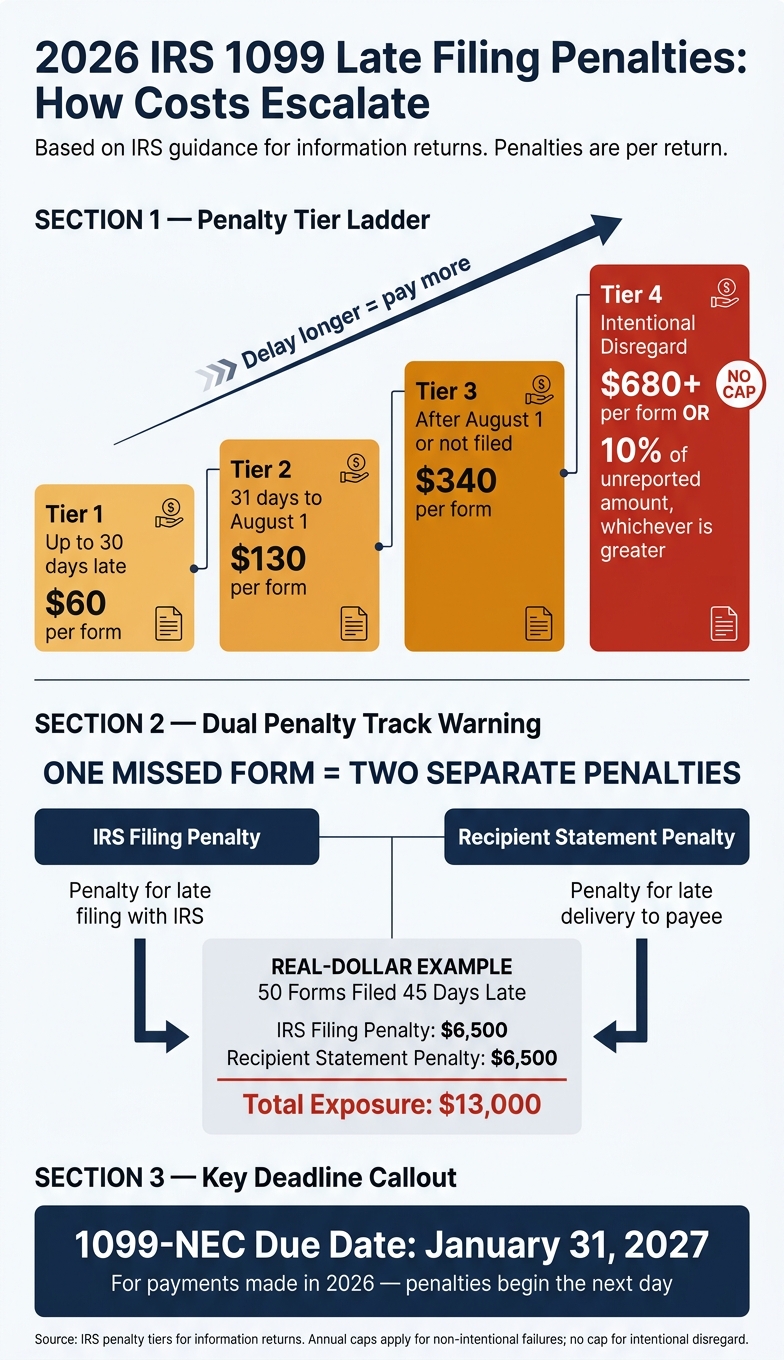
2026 IRS 1099 Late Filing Penalty Tiers & Cost Calculator
Miss the filing deadline, and the price goes up fast. Each late 1099 falls into a penalty tier, and the per-form charge climbs the longer the return stays unfiled.
Per-form penalty amounts by how late you file
For 2026, the IRS uses four timing tiers for late 1099 filings:
- Up to 30 days late: $60 per return
- 31 days late through August 1: $130 per return
- After August 1 or not filed: $340 per return
- Intentional disregard: at least $680 per return, or 10% of the amount required to be reported, whichever is greater
If the IRS decides the failure was intentional, the penalty begins at $680 per return, and there is generally no annual cap.
Annual penalty caps for small and large filers
The per-form charge is only part of the picture. The IRS also applies annual maximum caps based on how many forms you file. Smaller filers get lower caps. Larger filers face higher ones. Intentional disregard does not have an annual cap.
Before you file, check the current limits in the IRS instructions for Form 1099-NEC, Form 1099-MISC, and Form 1096.
How IRS filing and recipient delivery penalties can stack up
Filing with the IRS and furnishing the payee statement are two separate duties. Miss both, and each one can trigger its own penalty track.
Here’s what that looks like in dollars. Say a regional energy services firm files 50 Form 1099-NEC returns with the IRS 45 days late. That lands the returns in the $130-per-form tier, which means an IRS-filing penalty of $6,500. If the same firm also sends the worker copies late, and those statements fall in the same tier, that adds another $6,500 for the furnishing failure. Total exposure: $13,000 for 50 forms.
In plain English, the trouble often starts earlier than the deadline itself. Missing W-9s, bad vendor data, and worker misclassification are usually where things begin to go off the rails.
Where construction and energy employers face the most 1099 risk
Construction and energy teams run into extra 1099 risk for a simple reason: work moves fast, sites shift, and payments don’t always flow through one clean system. In that kind of setup, year-end vendor cleanup matters even more than the penalty rules.
Common reporting breakdowns on job-based crews
These problems usually start at the job site, right when people are brought on and paid. The biggest issue is delayed onboarding. Crews get to work before AP has the worker’s legal name, entity type, and TIN. From there, things can snowball. Duplicate vendor records and name mismatches can split payments across multiple records or set off IRS notices and backup withholding.
Then there’s the payment side. Local check stock, field cards, and ad hoc ACH transfers can lead to off-book payments that never make it back to AP. If AP never sees those payments, they can easily get missed during year-end 1099 review. That’s how companies end up with a late, missing, or incorrect 1099.
Those same onboarding gaps can also lead to a worker being classified the wrong way from day one.
Worker misclassification risk beyond late 1099 penalties
Misclassification can cost more than a late 1099. It can also bring payroll tax, wage, and benefit exposure. For year-end review, start with one question: does the company control how, when, and where the worker does the job? If the answer is yes, the role likely points to employee status. Sending a 1099 does not fix a classification mistake.
These same record gaps are what AP has to sort out before year-end filing. The next move is to reconcile vendors, payment totals, and worker status before filing.
Year-end steps to lower your 1099 penalty risk
Close the gaps before forms are filed. These record issues rarely fix themselves. The safest move is a focused review before forms go out, not after.
Check reportable vendors, payment totals, and taxpayer data
Start with the records that feed the return. Pull a full vendor and payee list from every system that touches payments, including accounts payable, job-costing or project management tools, and any field-level disbursement records. Filter for subcontractors and other nonemployee vendors who are not on W-2 payroll, then flag anyone at or above the filing threshold.
Next, reconcile payment totals across systems. This is where problems often show up. A vendor may exist under two records. Card charges may be coded to subcontractor expense categories but never tied back to the vendor master. Petty cash or field card payments may never make it into AP at all. Track the vendor name, totals by system, the variance, the reason for it, and the final amount that should be reported.
Then check the tax data behind each reportable vendor. Match the legal name, TIN, and entity type to the W-9 on file. Flag any missing or old W-9s. If you find duplicate records tied to the same TIN, combine them before filing. For high-dollar or higher-risk payees, the IRS TIN matching program can help you verify name-and-TIN pairs and catch mismatches before the return is filed.
Review worker classification and filing method before the deadline
Once the vendor file is clean, take another look at worker classification. If a contractor’s role looks tightly tied to day-to-day operations, review it again. A worker who seems like a contractor on paper may look like an employee in practice. Misclassification can turn a normal 1099 issue into a payroll tax issue.
At the same time, confirm whether you must e-file. IRS e-filing rules can apply when your total information returns hit 10 or more. Construction and energy companies often pass that mark without noticing, especially when they run several crews and job sites at once. If you’re at 10 or above, choose an e-file process now, test your data format against IRS Publication 1220, and assign one clear owner – inside your company or outside it – to handle transmissions and acknowledgments.
How ABLEMKR can support cleaner workforce and payment records

Tools that put worker and payment data in one place can cut filing mistakes. ABLEMKR can centralize worker profiles, assignments, and payment records, which makes it easier to reconcile contractors and confirm who should get a 1099. Assignment logs can also help support classification decisions if the IRS asks.
If filings are already late, move right away to correction and penalty relief review.
What to do if your 1099 filings are already late
File quickly, fix errors, and check for reasonable cause relief
If your year-end cleanup is already behind, stop thinking about prevention and start limiting the damage.
The most important step is simple: file now. Once you’re late, penalties begin right away and increase as the delay stretches into the next tier. The same vendor and TIN gaps that caused the missed filing can also slow down corrections. File the late IRS returns and send payee copies at the same time. If any forms show the wrong TIN, name, or payment amount, correct them right away. Then clear up any mismatches before the IRS processes the return.
If the delay came from a real disruption – like a documented system failure, a natural disaster, or the sudden loss of the person who handled filings – start pulling records now. The IRS can waive penalties for reasonable cause when you used ordinary care but still could not file on time because of events outside your control.
For job-based crews, that means documenting the outage or staffing gap as soon as it happens. Save IT incident logs, vendor support tickets, internal timelines that show when the issue was found, and records showing how fast you moved to fix it. If your request lays out those facts clearly, the IRS may abate the penalties.
Key takeaways for 2026 1099 reporting
Late filing gets expensive fast. Penalties increase with each delay tier, and the penalty for filing with the IRS is separate from the penalty for recipient statements. So one late 1099 can lead to more than one charge.
Construction and energy employers face extra exposure because contractor data often lives in different places – job sites, project cost codes, and field systems. That’s where trouble starts. Scattered job-site records can turn one missed form into a costly filing mess.
The best way to cut filing risk is pretty straightforward:
- Keep a clean vendor file
- Confirm W-9s
- Reconcile payment totals
- Use a clear e-filing process
When filings are already late, clean records and fast action give you the best shot at limiting the fallout.
FAQs
Do all contractors need a 1099-NEC?
No. A business usually sends Form 1099-NEC only to independent contractors who were paid at least $600 for services during the tax year. For the 2026 tax year, that threshold goes up to $2,000.
If a contractor is paid less than the amount that applies for that year, the business does not have to issue a 1099-NEC. Even so, it’s smart to collect a Form W-9 when the working relationship starts.
Can I avoid penalties if I file late?
Sometimes.
The best way to avoid penalties is to stay organized and file on time. That matters because IRS penalties can be steep, and they may go up if the IRS sees an intentional violation.
The IRS may give employers a little wiggle room for Forms 940, 941, 943, 944, and 945 if the taxes were deposited on time. That can include an automatic 10-day extension.
If you spot an error, don’t sit on it. File correction forms right away, and deal with worker classification or reporting problems as soon as you can.
What records should I review before year-end?
Review workforce records for accuracy and compliance. Check work locations, confirm state registrations, and make sure worker classifications match current role descriptions, invoices, and other records that show independent status.
Also gather and organize Form W-9, Form W-4, payment records, timesheets, current certifications, safety training records, trade licenses, and, if needed, certified payroll reports (Form WH-347).


