
If you get labor coverage wrong at the start, you can lose money at the end. For renewable energy employers, the big issues are simple: know if prevailing wage rules apply, track subcontractors, keep payroll and apprentice records, and be ready for audits.
I’d boil the article down to this:
- Check coverage early. Federal funding, Davis-Bacon rules, and IRA tax credit labor rules can all apply to solar, wind, storage, and grid projects.
- Pay the right rate. Covered workers must get the local prevailing wage, including fringe benefits, based on what they actually do on site.
- Watch subcontractors closely. A prime contractor can still owe back wages when a lower-tier subcontractor makes mistakes.
- Keep clean records. Weekly certified payrolls, timecards, wage determinations, apprentice files, and ratio records matter.
- Do not wait for an audit. Worker complaints, late payrolls, and mismatched data can trigger a review.
- The costs can be high. One Illinois solar case led to more than $110,000 in back wages and penalties. A New Jersey case led to $429,846 in back wages and fringe benefits. IRA correction rules can also add $5,000 per underpaid worker and $50 per missing apprentice hour, or $500 if the IRS says the issue was intentional.
A few points stand out. First, worker classification depends on duties, not job titles. Second, for many IRA projects that began construction in 2024 or later, apprentice hours must equal at least 15% of total construction labor hours. Third, if more than one wage law applies, employers may need to use the highest rate.
The bottom line: I see this as a budget, contract, and tax credit issue as much as a labor issue. If you line up wage rates, subcontract terms, and recordkeeping before crews arrive, you cut the chance of back pay, penalties, withheld funds, or lost credit value.
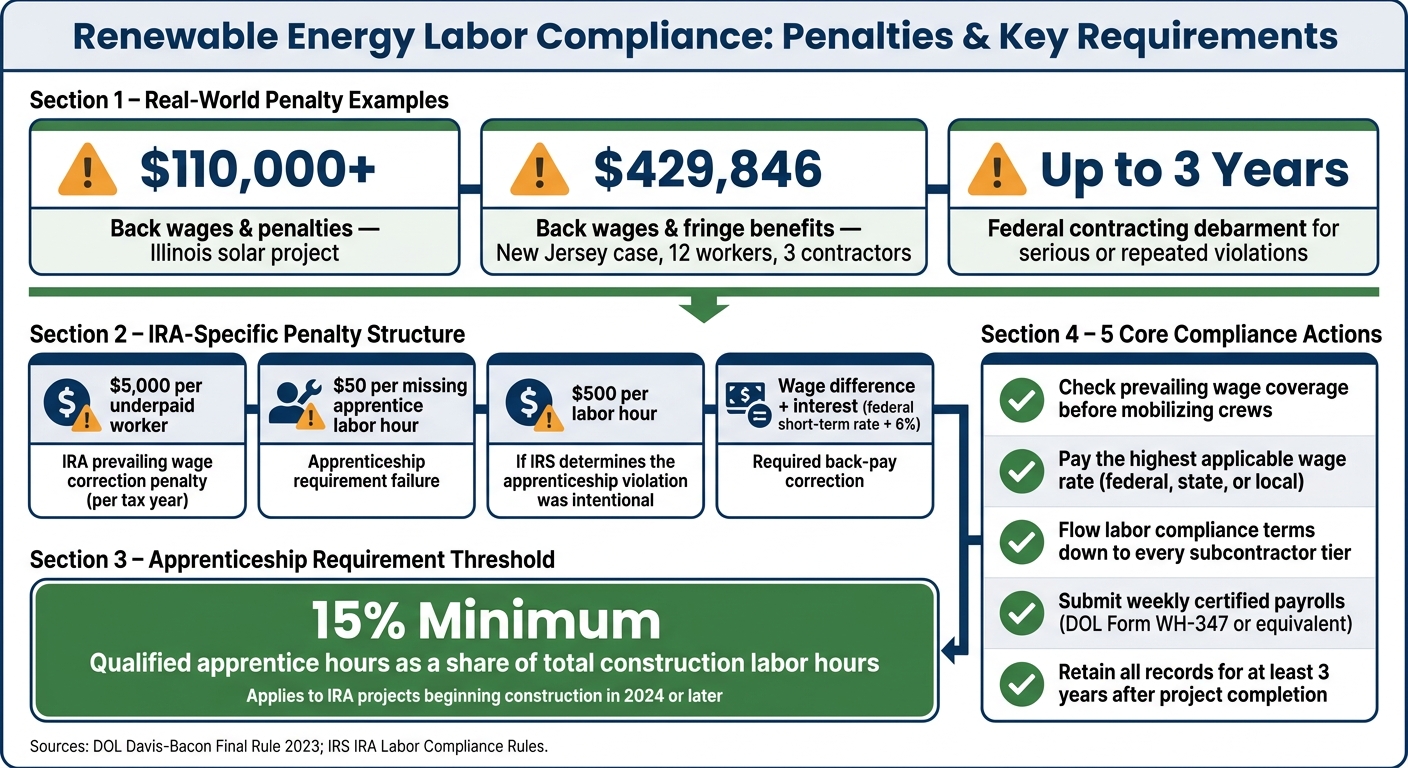
Renewable Energy Labor Compliance: Key Penalties & Requirements at a Glance
May 7, 2024 Prevailing Wage and Apprenticeship Meeting the Criteria
sbb-itb-aa28329
Prevailing wage: who is covered and when it applies
Prevailing wage means the required base hourly pay plus fringe benefits for covered laborers and mechanics, based on the local wage determination. On covered projects, contractors have to pay that wage-and-fringe package for each covered classification in the right locality.
Federal prevailing wage rules apply to projects with Davis-Bacon coverage or IRA labor rules. State and local laws can set a higher bar. When more than one rule applies, use the highest wage and fringe standard.
Which renewable energy projects trigger prevailing wage requirements
The most common triggers are federally funded or federally assisted construction that falls under Davis-Bacon, plus clean energy projects that must meet prevailing wage rules to qualify for higher IRA tax incentives. In the renewable energy space, that often means solar farms, wind facilities, battery storage projects, transmission upgrades, and qualifying repair or alteration work on existing energy assets.
| Project Type | Common Trigger |
|---|---|
| Utility-scale solar | Federal funding, federal contract terms, or IRA tax incentives |
| Wind facilities | Federal funding, federal contract terms, or IRA tax incentives |
| Battery storage | IRA incentives and state prevailing wage rules in some jurisdictions |
| Transmission upgrades | Federal contracts and IRA-eligible grid projects |
| Alterations and repairs | Qualifying repair or alteration work under IRA prevailing wage rules |
Which workers count as laborers or mechanics
The DOL defines a laborer or mechanic as a worker whose duties are mainly manual or physical. That can include many tradespeople, equipment operators, helpers, trainees, and apprentices. Administrative, executive, professional, and off-site support roles usually are not covered unless they perform covered physical work on site.
This is where companies often get into trouble. The risk is classifying workers by job title instead of by what they actually do. A title can say one thing, while the daily work says something else. Pay classification should follow the worker’s actual duties, because that choice affects wages, reporting, and how subcontractors are monitored later on.
How to find the correct wage determination before mobilizing crews
The right wage determination depends on the county or locality where the work happens, the type of construction, and the labor classification involved. DOL publishes current wage determinations, and utility-scale solar is usually treated as heavy construction. For IRA projects, the rates are locked in when the construction contract is signed, not when work begins.
Sometimes the published schedule doesn’t list the classification you need. When that happens, DOL has a process for requesting supplemental wage determinations or added classifications. Those requests generally should be filed no more than 90 days before construction starts.
The smart move is to settle classification and locality issues before crews show up on site. That way, payroll codes and staffing plans match the project from day one. Once the rates are set, the next issue is who carries the blame when a subcontractor makes payroll mistakes.
Subcontractors and staffing: who is responsible for compliance
After wage rates are set, the next issue is simple: who pays when a subcontractor gets payroll wrong?
Prime contractor liability for subcontractor wage mistakes
The prime contractor is on the hook in the end. Under DBRA, prime contractors can be liable for subcontractor wage errors even when they weren’t directly involved. The 2023 Davis-Bacon Final Rule also made it clear that upper-tier subcontractors can be liable for lower-tier violations too. In plain English, the duty starts in the contract and carries through to payroll records.
That can get expensive in a hurry. In one New Jersey case, an administrative law judge ordered three contractors, including the prime, to pay $429,846 in back wages and fringe benefits to 12 workers after a subcontractor underpaid carpenters.
On IRA-related projects, the risk can stretch beyond wage liability. If a downstream firm underpays workers, the enhanced tax credits the project owner expects may be at risk, and the owner may then seek indemnification from the prime.
What to include in subcontract and staffing agreements
Every subcontract and staffing agreement should spell this out up front:
- Flow-down compliance terms: direct reference to federal, state, and local wage laws, prevailing wage determinations, and apprenticeship rules, with all labor provisions passing down to every subcontracting tier
- Certified payroll submissions: weekly submissions in a format that covers job classification, straight-time and overtime hours, rate of pay, fringe benefits, work location, and time records
- Audit access: access to payroll, time, training, apprentice, and job-site records
Just as important, tie payment to paperwork. Withhold payment until certified payroll is submitted and reconciled. Put that right into the contract before mobilization. Waiting until there’s a payroll problem is like trying to install guardrails after the truck has gone off the road.
Once those terms are set, the job shifts to tracking labor data across every employer on site.
Using workforce systems to track labor data across employers
A workforce platform such as ABLEMKR can pull worker status, certifications, time data, and payroll into one place across subcontractors and sites. That same record set can support payroll review and help defend audits.
Records employers should keep for payroll, apprenticeship, and job-site compliance
Good contracts and solid subcontractor agreements help. But when an auditor walks in, your records do the talking. On covered projects, documentation is what shows wages, apprentice use, and site hours were handled the right way.
Payroll records and certified payroll documents to retain
Every payroll file should answer four simple questions: who got paid, how much they got paid, when they got paid, and why they were classified that way. That means keeping each worker’s name, address, classification, base rate, fringe benefits, hours, deductions, gross pay, net pay, pay period dates, and payment date. Those records should match timesheets, job-site logs, and subcontractor invoices, so an auditor can trace one labor hour back to one paid worker without missing links.
For Davis-Bacon-covered work, employers must submit weekly certified payrolls, usually on DOL Form WH-347 or an equivalent, along with a signed Statement of Compliance. Keep certified payrolls, timecards, fringe statements, and correction records for at least three years after the prime contract is complete. In practice, these are often the first documents auditors ask to see.
Apprenticeship and prevailing wage support files for IRA-related projects
IRA projects need more than payroll records alone. Employers also need proof of apprenticeship participation. Enhanced IRA credits depend on showing prevailing wage and apprenticeship compliance.
That proof should include:
- The applicable wage determination
- Payroll records showing hours worked in each classification, plus wages and fringe benefits paid
- Apprentice registration documents
- Program approvals
- Apprentice agreements
- Daily apprentice-to-journeyworker ratio records
For projects that begin construction in 2024 or later, qualified apprentice hours must equal at least 15% of total construction labor hours. Employers should also keep any written requests sent to registered apprenticeship programs, along with the responses they received. If a required ratio was not met, those records can help show a good-faith effort.
These files are not just HR paperwork. They are the records that support credit eligibility.
How digital documentation reduces errors on large multi-site projects
Paper systems can fall apart fast on large jobs, especially when crews move between site areas during the same pay period. One missing timesheet or one mismatch between payroll and field logs can snowball into a problem.
Digital systems make that easier to control. They keep timekeeping, job assignments, apprentice status, and payroll data together, so teams can reconcile hours across contractors and locations and spot missing records before an audit brings them to light.
ABLEMKR keeps timekeeping, payroll, worker status, and compliance records in one system, which helps cut errors across multi-site projects.
Audits, enforcement, and a practical compliance closeout
What can trigger a labor audit or investigation
When payroll records are missing, late, or don’t line up, agencies tend to look closer. The U.S. Department of Labor’s Wage and Hour Division (WHD) may open an investigation after a worker complaint, a referral, or a data mismatch on a covered project.
Worker complaints are one of the most common triggers. A crew member working for a subcontractor might report underpayment, misclassification, or missing fringe benefits. That single complaint can turn into a much broader review of the prime contractor’s records. Other common triggers include:
- Missing or late certified payrolls
- Inconsistent worker classifications
- Misclassified independent contractors
For IRA-related projects, the IRS may also flag returns that show large credits when labor records or headcount data do not match unemployment filings.
Agency data sharing adds another risk point. DOL, state prevailing wage offices, and contracting agencies can compare records, including certified payrolls, apprentice logs, and wage determinations. So if something looks off on one project, that issue can spill into a review of other projects held by the same prime. And once that kind of review starts, the cost of mistakes can add up fast.
What penalties employers can face for noncompliance
Davis-Bacon and IRA violations can lead to back pay, fringe-benefit shortfalls, and, if overtime rules were also violated, liquidated damages. If workers were paid less than the wage determination required, employers owe the difference along with any missing fringe amounts.
IRA credit failures come with set correction rules. To fix a prevailing wage shortfall, a taxpayer must pay affected workers the wage difference plus interest at the federal short-term rate plus 6 percentage points, and a penalty of $5,000 per underpaid worker for the tax year. Apprenticeship failures carry a separate penalty of $50 per labor hour where requirements were not met, rising to $500 per labor hour if the IRS determines the violation was intentional.
The financial hit doesn’t stop there. Contracting agencies can withhold funds not only from the project where the violation happened, but also from other federal contracts held by the same prime. Serious or repeated violations can lead to debarment from federal contracting for up to three years. And falsifying certified payroll records can bring both debarment and criminal prosecution.
Key takeaways for renewable energy employers
Closeout is the moment when a compliance file either stands up or falls apart. Across this article, the pattern is pretty clear: it almost always costs less to prevent labor issues early than to fix them later. Back wages, penalties, lost credits, and debarment risk usually trace back to problems that could have been handled near the start of the job – using the wrong wage determination, failing to keep apprenticeship records, or letting subcontractors work without written labor standards.
At closeout, the file should show that all corrections were paid, the full compliance record is complete, and the IRA and tax teams can get to the records they need. In practice, that means confirming:
- All workers and subcontractors were fully paid for any identified corrections
- The project file includes wage determinations, certified payrolls, apprenticeship records, fringe documentation, and any internal audit findings
- IRA tax and finance teams have access to the same organized records
If IRA credits or long-term power purchase agreements are involved, records should be kept for a longer period.
FAQs
How do I know if my project is covered?
First, identify the funding source and the size of the project. Federal labor rules often apply to work funded through the Bipartisan Infrastructure Law or other federal programs when the project goes over $2,000. At that point, Davis-Bacon prevailing wage and fringe benefit rules kick in.
A Project Labor Agreement is generally required for government construction projects estimated at $35 million or more under Executive Order 14063. That said, agencies can also require one on smaller jobs. Check SAM.gov for wage determinations.
What if state and federal wage rules conflict?
When state and federal wage rules clash, employers usually have to follow the rule that gives the worker more.
Federal laws like the Davis-Bacon Act set a baseline for prevailing wages and benefits on federally funded projects. But if a state requires higher pay rates, tighter overtime rules, or extra benefits, the state rule will often control.
That’s why it helps to keep wage rate tables up to date for each job location and use automated payroll tools to apply the right rates without guesswork.
How can I reduce audit risk before work starts?
Reduce audit risk before work starts by tightening your paperwork and checking key details up front. Review sample worker records to confirm proper classification and wage progression. Then use ABLEMKR to keep worker data in one place, automate compliance checks, verify certifications, and maintain audit-ready records.
Before deployment, make sure workers are pre-vetted, complete site-specific hazard training, and work under clear supervision and scheduling policies. That helps support accurate classification under IRS and DOL standards.


