
A project can be ready to build and still fall behind if the crew is gone. That is the core issue here: delays push workers to other jobs, and labor shortages then make the restart slower and more expensive.
If I boil the article down, the message is simple:
- Delays and labor shortages feed each other
- A short pause can turn into a staffing problem
- Labor gaps hit budgets fast through overtime, re-mobilization, idle equipment, and penalties
- Hard-to-fill trades like electricians, welders, equipment operators, and concrete crews are under the most pressure
- Employers need labor plans for more than one schedule, not just the best-case version
A few numbers make the point fast:
- The industry needs 499,000 more workers in 2026
- 83% of construction firms say skilled labor is hard to find
- Filling a key equipment operator role takes about 45 days
- Idle machinery can cost $2,500 to $4,000 per day
- Catch-up overtime can push labor costs up by 25% to 50%
- A short staffing delay on a large project can cost more than $200,000
What I take from this is clear: schedule control and labor planning are the same job. If you do not plan for delays, worker movement, licensing limits, and restart timing, you risk paying more and finishing later.
For me, the most useful takeaway is this short checklist:
- Plan crews for on-time, delayed, and accelerated timelines
- Track certifications, equipment skills, and worker location
- Keep recruiting active even when jobs are staffed
- Move workers between projects when one site slows down
- Give crews clear updates so they do not leave for steadier work
Here is a quick side-by-side view:
| Issue | What happens | Cost impact |
|---|---|---|
| Project delay first | Workers leave for other jobs | Re-mobilization, idle equipment, supervision costs |
| Labor shortage first | Critical work cannot start or finish | Wage premiums, schedule slip, penalty risk |
| Regional labor shift | Workers move to hotter markets | Local shortages get worse, rural jobs fall behind |
So if I had to sum it up in one line, it would be this: when infrastructure schedules slip, labor does not wait.
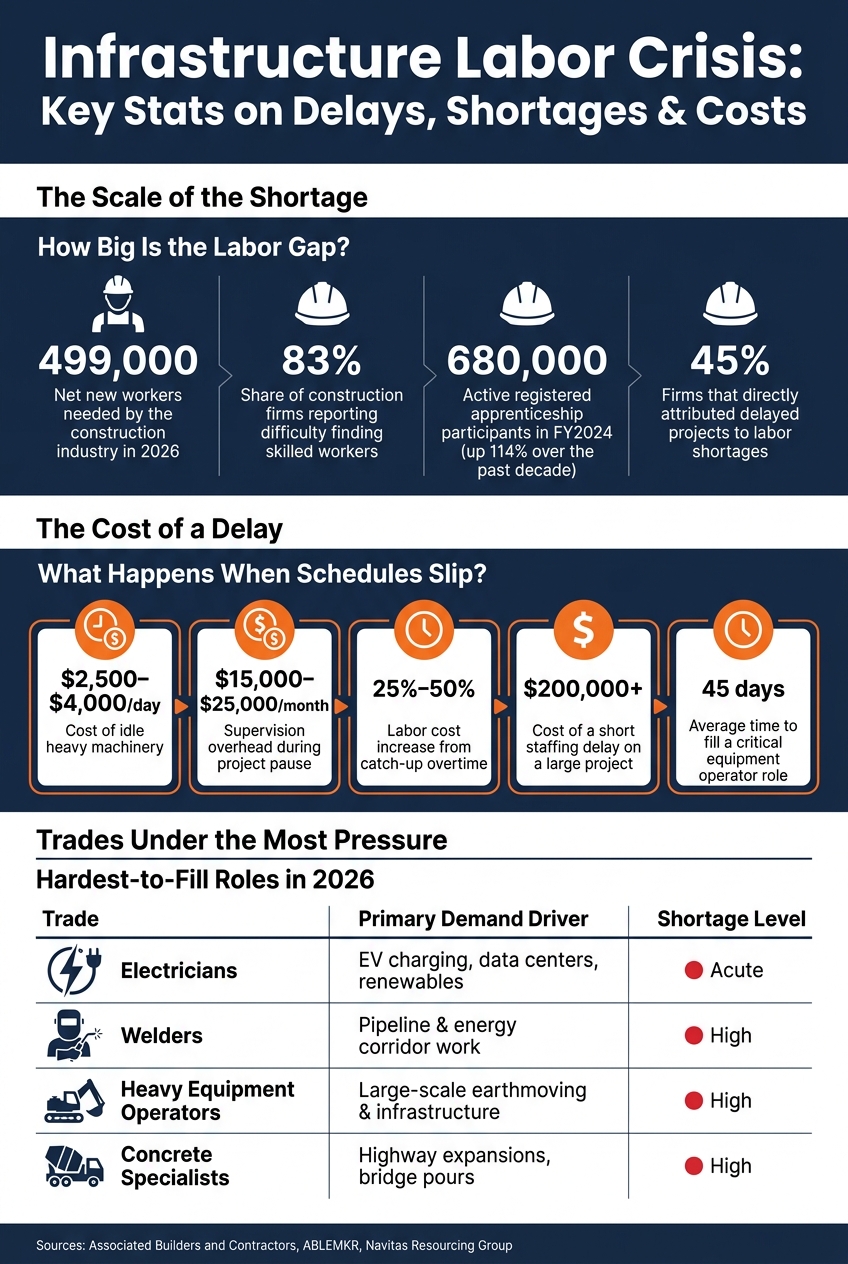
Infrastructure Labor Crisis: Key Stats on Delays, Shortages & Costs
Infrastructure Delays: Main Causes and Their Effect on Labor
Common causes of project delays
Most infrastructure delays don’t come from one big problem. They usually come from a pileup of smaller ones: funding pauses, permitting friction, design changes, procurement delays, bad weather, and site access issues. Federal and regulatory slowdowns can drag timelines out too, especially when funding disbursement, permitting, or Davis-Bacon compliance gets stuck. Skill gaps add another layer. If operators don’t have experience with GPS-guided and automated grade-control systems, work slows down.
The tough part is how these problems build on each other. One missed weather window can push the whole schedule off course, then lead to permit extensions and extra equipment rental costs. On paper, that may look like a scheduling issue. In practice, it changes who is still available to work the job.
How delays affect crews, budgets, and retention
When a project pauses, crews and subcontractors don’t just sit around waiting. They move to active jobs, which makes it much harder to bring the same team back later. And specialized workers tend to move fast. What starts as a short pause can turn into a lasting loss of hard-to-find labor.
Getting a crew back on site isn’t cheap either. Re-mobilization brings added travel, onboarding, and supervision costs. Idle heavy machinery can run $2,500 to $4,000 per day, while supervision overhead can add $15,000 to $25,000 per month. Liquidated damages can pile on top of that.
"Failure to attract needed workers will accelerate industrywide labor cost escalation, exacerbating already high construction costs and reducing the volume of work that is financially feasible." – Associated Builders and Contractors
Retention is another cost that often gets missed. Filling a critical equipment operator role now takes 45 days on average. That’s a long gap, and it can push completion dates back by weeks. In other words, delays don’t just happen because of labor shortages. Delays can create them too.
Regional labor imbalances when one market slows and another picks up
When one market slows down and another heats up, labor moves. Contractors then end up chasing available workers instead of matching labor to project demand. Crews often head to faster-moving regions, which leaves deeper shortages behind in the places they left.
Once that shift starts, the problem doesn’t stay local. It can spill into nearby markets too. California and Texas are facing especially severe equipment-operator shortages. Rural infrastructure jobs often get hit the hardest, since demand from nearby metro areas can pull workers away even faster.
The trades most exposed to these swings include:
- Electricians
- Welders
- Heavy equipment operators
- Concrete specialists
Mobility isn’t always simple, either. State licensing rules can limit movement for electricians and plumbers.
These roles are often the hardest to backfill when schedules slip:
| Trade Role | Primary Demand Driver in 2026 | Shortage Level |
|---|---|---|
| Electricians | EV charging, data centers, renewables | High (acute shortage) |
| Welders | Pipeline and energy corridor work | High (specialized skills) |
| Heavy Equipment Operators | Large-scale earthmoving, infrastructure | High |
| Concrete Specialists | Highway expansions, bridge pours | High |
sbb-itb-aa28329
Workforce Availability: When Labor Shortages Become the Delay
How skilled labor shortages push project timelines back
Sometimes the project is ready, but the crew isn’t. When labor becomes the bottleneck, the schedule starts to slide even if everything else is lined up. 83% of construction firms say they have trouble finding skilled workers for infrastructure projects.
This hits hardest on critical-path work. If a certified welder or crane operator is missing, that part of the job can stop cold. And some positions can’t be filled unless the worker has the right license or certification. Remote projects often get squeezed the most because local housing is limited, and temporary relocation adds more friction for crews.
U.S. factors behind tight labor supply
A lot of experienced tradespeople are getting close to retirement, and replacing those skills takes time. Apprenticeship programs are growing. Registered apprenticeships reached 680,000 active participants in FY2024, up 114% over the past decade. But there’s a catch: those programs still move on 3-to-5-year cycles, so new supply can’t match demand spikes happening right now.
At the same time, demand is piling up in fast-growing industrial regions that are all chasing the same trades. The industry still needs 499,000 new workers in 2026. On top of that, state licensing rules make it harder for workers to move where they’re needed most.
"The construction industry isn’t short on projects; it’s short on people." – ABLEMKR
Delay-driven labor disruption vs. labor-driven schedule disruption
These are two different problems, and they don’t hurt in the same way.
Delay-driven disruption leaves crews idle and adds re-mobilization costs. Labor-driven disruption is tougher: it stalls critical work, pushes up wage premiums, and adds safety risk. One problem burns time. The other can throw the whole schedule off track.
That’s why labor planning isn’t just a hiring issue. It’s a schedule-control issue.
How Companies Can Cut Delay-Driven Workforce Volatility
The fix starts before a delay hits the jobsite: plan for schedule swings early, not after the timeline breaks.
Plan labor for on-time, delayed, and accelerated schedules
Most teams build staffing plans around one schedule. That works fine until the schedule changes. Then the whole labor plan can wobble.
A better approach is scenario planning. Map hiring needs across three paths: on-time, delayed, and accelerated. For each one, spell out the certifications, equipment experience, and geographic preferences tied to the work. That way, you can spot labor gaps before mobilization begins.
Two field practices help make this stick:
- Build a skills matrix that links certifications, equipment experience, and location preferences to each project phase. This makes weak spots easier to see early.
- Keep a continuous recruitment pipeline running even when the team is fully staffed. As Navitas Resourcing Group puts it:
"The strongest delivery teams are not necessarily hiring more. They are planning earlier." – Navitas Resourcing Group
There’s also a control piece here. If you keep scarce trades in-house, it’s easier to manage crew timing when schedules move around.
Once the plan changes, the next challenge is simple: how fast can you shift crews?
Use real-time deployment tools to move crews faster
When a project pauses or restarts, time matters right away. Mobile-first deployment tools can cut response time in a big way. ABLEMKR’s mobile-first platform is built for this. It matches pre-vetted workers to job sites based on certifications, safety training, availability, and location, which helps employers mobilize crews faster when work restarts or shifts location. Mobile deployment tools can respond faster to urgent staffing needs.
The platform also includes compliance tracking, payroll workflow integration, and real-time visibility into worker status. That helps cut the admin drag that often slows crew mobilization. Projects using AI-powered candidate matching have reported 34% lower turnover rates in the first 90 days. That matters when schedule uncertainty is already putting pressure on retention.
Fast redeployment helps, but only if workers stay connected to the next job.
Keep workers when schedules are uncertain
Schedule uncertainty can wear a crew down fast. If workers don’t know when the next phase starts, many will start looking for steadier work elsewhere.
Clear updates and steady pay can help keep people engaged during stop-start schedules. Fast reassignment matters just as much. If one project pauses, the best move for both the worker and the employer is often to place that person on another active job instead of letting them sit idle. That takes cross-project visibility into open roles and worker availability.
As Navitas Resourcing Group notes:
"Delaying recruitment may reduce short-term spend, but waiting too long can introduce pressure elsewhere in the project." – Navitas Resourcing Group
The same idea applies to retention. In many cases, keeping a skilled worker through a short delay costs less than finding and training a replacement.
Conclusion: Align Schedules, Labor Supply, and Execution
These controls matter because delay and labor trouble don’t happen in separate lanes. They feed each other. When infrastructure work slips and crews aren’t there when needed, margins shrink, liquidated damages show up, and unplanned labor costs start piling on.
The numbers make that plain. 45% of firms directly attributed delayed projects to labor shortages, and the industry still needs 499,000 net new workers in 2026. That’s why labor can’t sit off to the side as an HR issue. It has to be managed as part of schedule control.
What separates steady operators from constant fire drills? Planning and visibility. Scenario planning, always-on recruiting, and real-time crew deployment shift workforce management from a reactive scramble to a more controlled process. As Anirban Basu, Chief Economist at Associated Builders and Contractors, put it:
"Failure to attract needed workers will accelerate industrywide labor cost escalation, exacerbating already high construction costs and reducing the volume of work that is financially feasible." – Anirban Basu, Chief Economist, Associated Builders and Contractors
Schedule, labor supply, and field execution need to be managed as one system. Companies that build that alignment through smarter planning, faster redeployment, and real-time crew deployment tools that match pre-vetted workers to active job sites cut volatility and keep projects moving. In this market, schedule risk and labor risk are the same problem viewed from two angles.
FAQs
Why do short project delays create long labor problems?
Infrastructure work runs on linked schedules. So when one phase slips, even a little, the delay can spread fast.
A holdup in one part of the job often forces firms into reactive hiring. Teams then get pushed past limits they can’t keep up for long, which increases burnout and turnover.
That pressure can also lead to early promotions, less supervision, and more risk around quality, safety, and productivity. And if a firm can’t mobilize fast, the fallout can last well beyond the first delay.
Which roles are hardest to replace when schedules slip?
When schedules slip, leadership roles like project managers, superintendents, and project executives are usually the toughest seats to fill. If one of those roles sits empty, the impact can hit fast – especially on scheduling, safety, and quality.
On the trade side, the pressure often shows up first in electrical, plumbing, ironworking, concreting, and masonry. When crews are short in those areas, work can stall on mechanical integration, steel erection, and electrical installation. And once that happens, the delays tend to spill into later phases and drive up costs.
How can contractors keep crews available during uncertain schedules?
Contractors can keep crews ready by moving from reactive hiring to proactive, data-driven workforce planning. In plain English: plan labor needs early instead of scrambling later.
That starts during bidding and pre-construction. At that stage, teams can look at labor demand, spot skill gaps, and flag seasonal limits before they turn into jobsite problems.
Tools like ABLEMKR can help by giving teams real-time visibility into worker certifications, safety training, and availability. At the same time, retention efforts such as career growth, competitive benefits, and more predictable scheduling can help support longer-term crew stability.


