
One worker classification mistake in Nevada can leave an injured person without workers’ comp and can cost an employer up to $5,000 per worker in fines.
If I had to sum up the issue in plain English, it’s this: most coverage gaps start with misclassification, uninsured subcontractors, or bad records. In Nevada construction, the rules are tighter than in many other industries, and the risk can move up the chain to the general contractor when a subcontractor has no coverage.
If you work in construction, mining, or energy in Nevada, here’s what matters most:
- Workers’ comp is required from the first hire
- Construction work gets stricter treatment than many other industries
- A 1099 label does not decide coverage
- General contractors may owe for injuries tied to uninsured subcontractors
- Missing COIs, wrong class codes, and payroll errors can leave claims in dispute
- Workers can face lost wages, unpaid medical bills, and long delays
- Employers can face fines, back assessments, license trouble, and direct claim costs
The short version: if you want fewer gaps, check licenses, verify coverage and hire reliable workers before work starts, use written subcontract terms, and match payroll to the work being done.
| Risk point | What it can lead to |
|---|---|
| Misclassified worker | Denied or delayed workers’ comp claim, fines, back assessments |
| Uninsured subcontractor | Claim costs shifting to the general contractor |
| Wrong payroll or class code | Audit problems and claim disputes |
| Missing paperwork | Delays, legal disputes, and out-of-pocket medical costs |
I’ll keep the rest focused on where these gaps show up in Nevada and what steps can help prevent them.
Do independent contractors get workers’ compensation in Nevada?
sbb-itb-aa28329
Nevada workers’ compensation rules and contractor classification
A lot of workers’ comp problems in Nevada come down to one thing: how the worker is classified.
Nevada requires workers’ compensation coverage for every employee, including part-time workers and day laborers. And that duty starts with the first hire. Independent contractors are outside that system only if they meet Nevada’s classification rules.
Under NRS 616A.255, an independent contractor is paid for a specific result, and the principal controls the result, not the way the work gets done. Outside construction, the worker also has to show a separate business identity, including a separate trade and business operation. That point matters most when classification decides who has to carry coverage on a job site.
Why construction gets stricter treatment in Nevada
Nevada takes a much harder line in construction.
Outside construction, the independent enterprise test applies. In construction, it does not. That shift is a big deal. For workers’ compensation purposes, Nevada generally treats most construction labor relationships as employee labor, even if the contract says something else.
That rule can push liability uphill. If a subcontractor does not have coverage, the general contractor may still be on the hook. So one misclassified crew can move risk across the whole project.
AB 227 tightens things even more. It requires licensed contractors, or their employees, to do work that calls for a contractor’s license. Recent rulings have also pushed staffing agencies on construction sites to change how they place labor. In plain English, one of the main routes for coverage gaps has gotten narrower.
How classification factors shape workers’ compensation exposure on job sites
Outside construction, Nevada looks at control over the result of the work, along with separate business identity, to help decide whether someone is an employee or an independent contractor. On construction sites, though, the statutory presumption carries more weight than whatever label the contract uses.
| Factor | General Nevada Industries | Nevada Construction Industry |
|---|---|---|
| 1099 labor | Allowed only if classification tests are met | Not allowed for work requiring a contractor’s license under AB 227 |
| Licensing requirement | Business license or separate business identity is a factor | Must be a licensed contractor or an employee of one |
Registered architects and licensed engineers are exempt. For everyone else on a construction site, Nevada starts with the presumption that the worker is an employee, and workers’ compensation coverage follows. That’s why Nevada enforcement data tends to show coverage gaps most clearly on jobs with layered subcontracting and mobile labor.
What studies and enforcement data show about coverage gaps
Nevada enforcement data points to a clear pattern: the biggest coverage gaps show up when licensed work is staffed outside a standard employee setup. You can see it most plainly in licensed construction, where misclassification can turn into uncovered labor fast.
Misclassification and uncovered payroll in high-risk industries
The Nevada State Contractors Board has gone after misclassification on licensed job sites. AB 227 was built to limit the use of unlicensed or misclassified labor on construction sites.
Private employment agencies send about 4,000 workers to Nevada construction sites each year, and litigation pushed enforcement back from October 2021 to July 2025. That delay helps explain why this issue carries so much risk for both contractors and workers.
How injuries shift costs when workers’ compensation does not apply
When a worker’s status is disputed, workers’ compensation coverage may be delayed or may not apply at all. When that happens, medical bills and wage-loss costs can end up in limbo.
Why subcontracting chains create classification gaps
Multi-tier contracting can make coverage harder to follow, especially when private employment agencies send labor to licensed projects. AB 227 cuts into that gap by tying licensed work to licensed contractors and their employees.
| Labor Arrangement | Pre-July 2025 Status | Current Requirement |
|---|---|---|
| 1099 or leased workers on licensed jobs | Used in a classification gap for licensed work | Must be employees of a licensed contractor |
Those gaps create direct costs for employers and workers alike.
Business impact for Nevada employers and workers
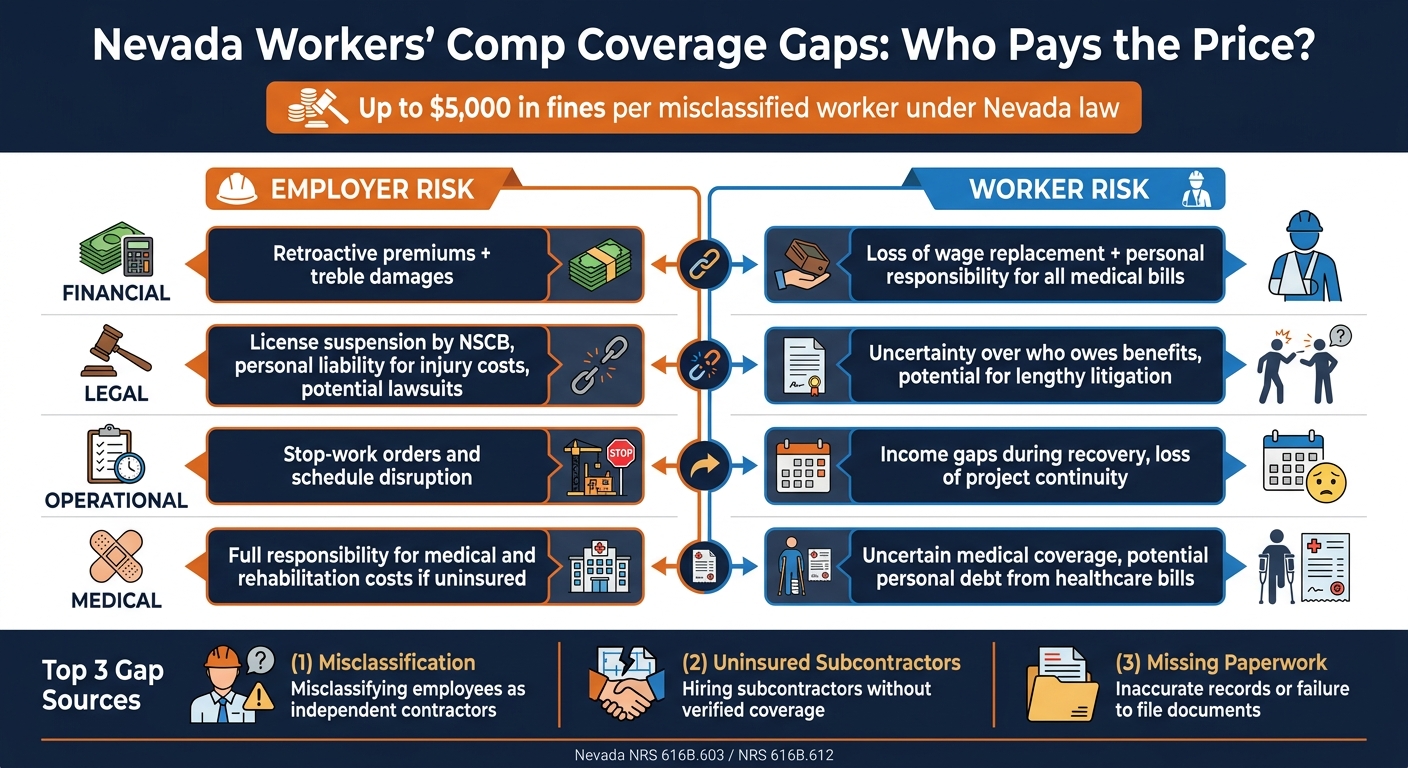
Nevada Independent Contractor Coverage Gaps: Employer vs. Worker Risk
When subcontracting muddies the insurance picture, both sides can get hit. If worker classification gets challenged after an injury, costs can pile up fast for the contractor and for the worker on the job.
Employer exposure: audits, penalties, and project disruption
This goes beyond fines. Under NRS 616B.612, employers that do not carry the required coverage can be held personally liable for medical treatment and wage-loss costs. Under NRS 616B.603, a general contractor may also be responsible for claims involving employees of an uninsured subcontractor, even when that subcontractor was hired independently.
That risk doesn’t stop with claims costs. The Nevada State Contractors Board (NSCB) can suspend or revoke a contractor’s license for insurance lapses or misclassification violations. On an active job site, that can lead to stop-work orders, stalled schedules, and project delays.
Worker exposure: income loss and uncertain medical coverage
For workers, the fallout is often immediate. Without coverage, an injured worker may be left with unpaid medical bills, lost wages, and delays in getting care.
Comparison table: employer risk vs. worker risk
| Issue | Employer Risk | Worker Risk |
|---|---|---|
| Financial | Retroactive premiums and treble damages | Loss of wage replacement and personal responsibility for all medical bills |
| Legal | License suspension by NSCB, personal liability for injury costs, and potential lawsuits | Uncertainty over who owes benefits and potential for lengthy litigation |
| Operational | Stop-work orders and schedule disruption | Income gaps during recovery and loss of project continuity |
| Medical | Full responsibility for medical and rehabilitation costs if uninsured | Uncertain medical coverage and potential personal debt from healthcare bills |
The next section shows how to close those gaps before crews mobilize.
Reducing coverage gaps through compliance systems and workforce visibility
Once the risk points are clear, the next step is to stop them before crews mobilize.
Controls companies can put in place before workers arrive on site
The best time to close a coverage gap is before mobilization. In Nevada construction, that means checking whether each worker or subcontractor is properly licensed and correctly classified before they ever enter the site.
General contractors should collect and verify Certificates of Insurance from every subcontractor before mobilization. Under NRS 616B.603, a general contractor can face contingent liability if a subcontractor is uninsured. A COI on file before work starts is a basic safeguard against that risk.
Written subcontractor agreements that require industrial insurance also help. They create a clearer record of who is responsible for coverage.
Periodic audits of NCCI classification codes matter too. If the class code doesn’t match the work being done, the policy may not cover the claim.
Put simply, these controls aim at the three biggest gap sources in Nevada high-risk work:
- status errors
- uninsured subcontractors
- mismatched payroll records
For employers that want tighter workforce visibility, platform-based deployment can help reduce classification drift.
How platforms like ABLEMKR can support cleaner worker classification

One way to lower misclassification risk is to deploy workers as W-2 employees. ABLEMKR reduces misclassification risk by deploying workers as W-2 employees and serving as the employer of record with workers’ compensation coverage.
The platform tracks verified certifications, safety training, and worker availability before a match is made. It also supports accurate payroll reporting to the correct Nevada class codes. Its onboarding tools document delivery of required Nevada workers’ compensation notices.
That matters because paperwork problems often don’t look serious at first. Then a claim happens, and suddenly a small recordkeeping miss turns into a major cost issue.
Comparison table: common gap sources and practical controls
| Gap Source | Practical Control | Nevada Regulatory Reference |
|---|---|---|
| Misclassification | Apply the multi-factor test; verify the worker or subcontractor is licensed for the exact trade being performed | NRS 616A.210 / NRS 616A.255 |
| Uninsured subcontractors | Collect COIs before site arrival; maintain contingent liability awareness | NRS 616B.603 |
| Out-of-state coverage gaps | Verify Nevada coverage applies to the work site and class | NRS Chapter 616B |
| Occupational disease liability | Use written contracts requiring subcontractors to maintain industrial insurance | NRS 617.203 |
| Sole proprietor exemption lapses | End the exemption when the business hires employees | NRS 616B.612 |
| Payroll reporting errors | Integrate digital time-tracking with payroll under correct Nevada class codes | NRS Chapter 616B |
| Worker misclassification in high-risk trades | Use W-2 deployment for crews that would otherwise be treated as contractors | NRS 616A.255 |
Conclusion: Key findings from the research
Nevada draws a clear legal line between employees and independent contractors, and that line carries direct financial consequences in high-risk industries. The research shows that misclassification, subcontracting layers, and missing documentation are the main drivers of workers’ compensation coverage gaps in construction, energy, and extractives.
For employers, the exposure can include audit adjustments, license suspension, and personal liability for injury costs. For workers, the result can be lost medical and wage protection when coverage is missing.
Stronger controls – verified licenses, written contracts, current COIs, and accurate payroll reporting – help reduce that exposure before it turns into a claim. Workforce systems that provide built-in coverage and real-time documentation can help close the gaps that manual processes often miss.
FAQs
How does Nevada decide who is an independent contractor?
Nevada looks at whether someone is hired for a set payment and a set result, while the principal controls the end result of the work rather than the way the work gets done.
The state also considers a few other factors, such as whether the worker has a business license, controls their own work methods, and has made a substantial capital investment.
When can a general contractor be liable for a subcontractor’s injury claim?
A general contractor can be liable when the injury happens within the scope of the subcontractor’s work and the contractor is treated as the statutory employer.
This often comes up when the subcontractor is doing work that would normally be handled by employees, not independent contractors. Think of tasks tied to the day-to-day business, rather than outside specialist jobs such as specialized maintenance that falls outside the normal course of business.
What documents should I verify before work starts?
Before work starts, verify:
- A written independent contractor agreement
- Proof of the right insurance coverage
- Documents that show the contractor controls how the work is done and runs an independent business


