
If you’re a contractor in Illinois, workers’ compensation insurance is non-negotiable. The state mandates coverage as soon as you hire your first worker – whether full-time, part-time, or seasonal. For construction contractors, the rules are stricter due to the industry’s higher risks. Misclassifying workers or failing to secure insurance can lead to severe penalties, including fines of $500 per day, felony charges, and even prison time.
Here’s what you need to know:
- Worker Classification: Illinois uses the ABC test to determine if someone is an independent contractor. Misclassification can result in hefty fines and legal consequences.
- Insurance Requirements: Employers must carry workers’ comp insurance for all employees. Construction contractors cannot opt out, even as sole proprietors or LLC members.
- Filing and Reporting Deadlines: Injuries must be reported within 45 days, and claims filed within three years. Employers must file accident reports for injuries leading to three or more missed workdays within 30 days.
- Consequences of Non-Compliance: Fines start at $10,000, and knowingly avoiding coverage can lead to felony charges and personal liability for corporate officers.
To stay compliant, classify workers accurately, secure insurance immediately, and keep detailed records. Tools like ABLEMKR can simplify compliance by managing worker classification, payroll, and insurance tracking in one platform.
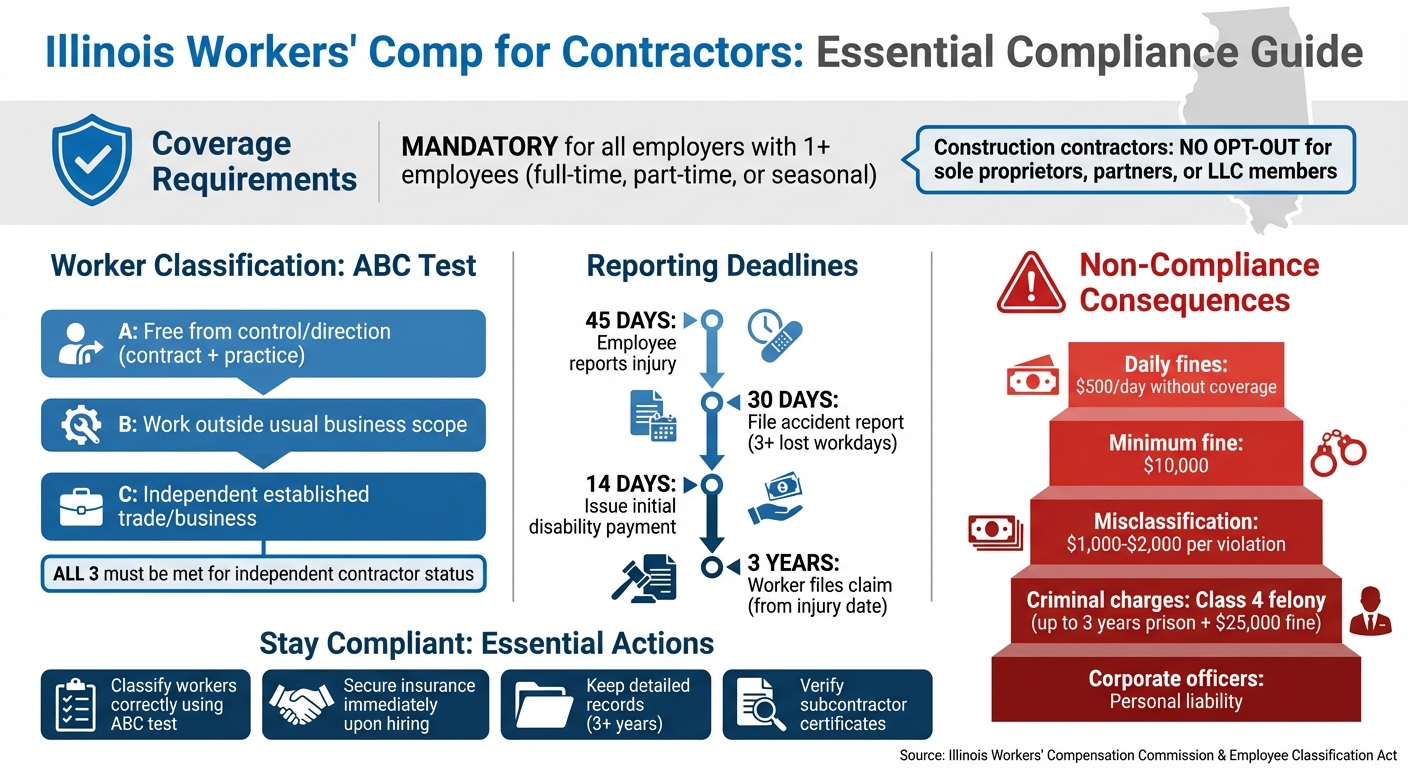
Illinois Workers’ Comp Compliance Requirements and Penalties for Contractors
Can I Get Workers Comp If I Am Not An Employee? | Independent Contractor? [Call 312-500-4500]
sbb-itb-aa28329
Classify Workers Correctly: Employee vs. Independent Contractor
Getting worker classification right is a must for Illinois contractors. According to the Illinois Employee Classification Act (ECA), all construction workers are considered employees unless proven otherwise.
“Designations and terminology used by the parties, as well as the individual’s status for tax purposes, are not controlling.” – Illinois Administrative Code
In simpler terms, the labels you use or a worker’s tax status won’t decide their classification. Illinois focuses on the actual working relationship, not just the paperwork.
Illinois Classification Criteria
To classify someone as an independent contractor, the ABC test must be satisfied. This means:
- A. The worker operates free from your control or direction – both in practice and as outlined in a contract.
- B. The service provided falls outside the usual scope of your business.
- C. The worker runs their own independently established trade, occupation, or business.
For subcontractors who are sole proprietors or partnerships, Illinois uses a stricter 12-point test. This includes requirements like owning their own equipment, providing tools without reimbursement, making their services available to the public, and having a transferable proprietary interest.
Forming an LLC or corporation doesn’t automatically qualify someone as an independent contractor. The entity must be legitimate – fully capitalized, with separate bank accounts and its own workers’ compensation insurance. Starting in July 2024, any independent contractor relationship in Illinois must also have a written agreement.
Additionally, Illinois considers 12 factors – such as benefits, work hours, and job control – that could tip the scale toward employee classification if they show employer oversight.
Court cases in Illinois emphasize that when employers control work specifics, the worker is classified as an employee. On the flip side, minimal oversight supports independent contractor status.
Failing to meet these standards can lead to serious consequences.
Consequences of Misclassification
Misclassifying workers in Illinois can land you in hot water. Each misclassified worker – and each day the misclassification continues – counts as a separate violation. Negligently failing to secure proper coverage is a Class A misdemeanor, while knowingly failing is a Class 4 felony.
Fines under the ECA can hit $1,000 for a first audit and $2,000 for repeat violations within five years. Intentional violations can double these amounts. A second violation within five years could even result in a four-year ban from state contracts.
Corporate officers and agents aren’t off the hook either – they can be held personally responsible for unpaid penalties or for knowingly allowing noncompliance. Misclassification isn’t just a legal issue; it can wreck your financial and legal standing.
Workers, competitors, and unions can also file private lawsuits against contractors. If a worker gets injured and the contractor lacks insurance, the worker can pursue unlimited damages in civil court. This could include lost wages, benefits, and an equal amount in liquidated damages.
To protect yourself, maintain detailed records for all workers – names, hours worked, and payment methods – for at least three years. Posting the required Department of Labor notice about the ECA in English, Spanish, and Polish at every job site and office can further demonstrate compliance and help during audits.
Obtain Required Workers’ Compensation Insurance
In Illinois, workers’ compensation insurance is mandatory for all employers – even if you only have one part-time employee. This requirement kicks in as soon as the worker is hired. Once you’ve classified your workers correctly, securing coverage right away is essential to stay compliant with Illinois law.
Illinois Coverage Requirements
For high-risk industries like construction, the rules are even stricter. Sole proprietors, partners, and corporate officers in these fields must carry workers’ compensation insurance from day one, with no option to opt out.
Coverage is required if a worker is hired in Illinois, if an injury occurs in the state, or if the work is primarily based there. Out-of-state contractors working in Illinois must obtain a policy specific to the state.
If you’re a general contractor, you need to verify that your subcontractors carry their own workers’ compensation insurance. Always check their Certificates of Insurance before work begins. If a subcontractor lacks coverage, their payroll might be added to yours during audits, which could lead to unexpected premium hikes.
Your policy must address all work-related injuries and illnesses, including emergency care, lost wages, and rehabilitation costs.
Failing to secure the required insurance comes with steep consequences. Employers face a minimum fine of $10,000, plus daily fines of up to $500 until coverage is obtained. Since 2006, the Illinois Workers’ Compensation Commission has collected over $8 million in fines for non-compliance. Knowingly avoiding coverage is classified as a Class 4 felony, punishable by up to three years in prison and fines reaching $25,000. Beyond meeting legal requirements, proper coverage protects you from these severe penalties.
How to Get Workers’ Compensation Insurance
To secure coverage, work with licensed agents who specialize in contractor policies. It’s a good idea to contact at least three agents to compare options for limits, deductibles, and pricing.
When choosing a carrier, check their financial ratings. For example, some cities – like Chicago – require carriers to have a minimum rating of B+ for licensing. Chicago also has tiered insurance requirements: Class A contractors need $5 million in coverage per occurrence, while Class C, D, and E contractors require $1 million per occurrence.
If private insurance isn’t an option, you can turn to Illinois’s assigned risk plan, which serves as a last resort. To enroll, contact the National Council on Compensation Insurance (NCCI) at 800-622-2413. Be aware that premiums in this plan are typically about 50% higher than those in the open market.
With around 91% of Illinois employees covered under the Workers’ Compensation Act, this insurance becomes mandatory the moment you hire your first worker.
Follow Reporting and Filing Deadlines
When a workplace injury happens, the clock starts ticking. Employees must notify you about the injury within 45 days of the incident. Failing to meet this deadline means they lose eligibility for benefits. Although oral notice is legally acceptable, it’s a good idea to require written documentation with all essential details to prevent disputes later on.
Injury Reporting Timeframes
Timely and accurate reporting is crucial to protect both your business and your employees.
The 45-day rule applies to most workplace injuries, but there are exceptions. For radiological injuries, employees have 90 days from the date of suspected excessive exposure to report the incident. When it comes to occupational diseases like carpal tunnel syndrome or repetitive stress injuries, the 45-day countdown starts on the date of the medical diagnosis, not the date of exposure.
If an injury results in more than three lost workdays, you must file an accident report with the Illinois Workers’ Compensation Commission (IWCC) within 30 days of being notified. Additionally, once you receive a doctor’s note, you’re required to issue the initial disability payment within 14 days.
Claim Filing Requirements
Workers must file an “Application for Adjustment of Claim” through the IWCC’s CompFile system. They have three years from the date of the injury or two years from the last payment – whichever comes later – to submit their claim. For minors, the statute of limitations doesn’t begin until they turn 18.
Employees should gather all necessary documentation, including their name, address, Social Security number, phone number, and a detailed account of how the injury occurred. It’s also important that they report injuries to a manager, supervisor, or HR representative. Informing a coworker doesn’t meet legal requirements. After a claim is filed, the IWCC schedules status calls every three months to track its progress.
Sticking to these deadlines ensures compliance with contractor terms and conditions and reduces legal risks for your company.
Prevent Misclassification Penalties
Misclassifying workers can lead to severe financial consequences that put your business at risk. Take, for instance, the case of Jack’s Roofing. In February 2014, the Illinois Supreme Court upheld a $1.6 million penalty against the company for misclassifying 10 workers as independent contractors. These violations, which spanned 8 to 160 days in 2008, were treated as separate offenses for each misclassified day, causing penalties to escalate quickly.
The penalties for misclassification under the Employee Classification Act are no small matter. First-time violations can result in civil penalties of $1,000 per violation, while repeat offenses within five years increase to $2,000 per violation. Beyond fines, there’s also the risk of criminal charges. Negligently failing to obtain insurance is a Class A misdemeanor, but knowingly doing so escalates to a Class 4 felony. Corporate officers who intentionally cause their company to miss payments can even face personal liability for penalties and missed payments.
“Worker misclassification is now a bet-the-company issue”.
To steer clear of these costly penalties, you’ll need to take proactive steps like those outlined below.
Review Worker Classifications Regularly
Consistent reviews of worker classifications are essential to maintaining compliance and identifying risks early. Under Illinois law, anyone performing services for a construction contractor is presumed to be an employee unless you can prove otherwise. The burden of proof is on you to demonstrate that a worker qualifies as an independent contractor.
Conduct regular audits of all independent contractor agreements using the 12-factor test. If even one factor isn’t satisfied, the worker should be reclassified as an employee. Pay close attention to indicators of “direction and control”, such as requiring specific work hours, providing tools or transportation, or mandating attendance at routine meetings.
“Designations and terminology used by the parties, as well as the individual’s status for tax purposes, are not controlling”.
For subcontractors claiming to be legitimate corporations or LLCs, verify their operations. Check for proper capitalization, separate business bank accounts, and up-to-date tax filings. Keep detailed records for all workers – no matter their classification – for at least three years. These records should include names, addresses, hours worked, and payment methods. Additionally, if you don’t meet “responsible bidder” requirements, you’re required to report all payments to non-employees electronically to the Department of Labor by April 30.
Provide Training for HR and Management
Your HR and management teams play a critical role in maintaining compliance, as their decisions can significantly impact your liability. Ensure they’re familiar with the ABC Test, which presumes a worker is an employee unless they meet three specific criteria: they must be free from control, perform work outside your usual business activities, and operate as part of an independently established trade.
Training should focus on the 12 factors the Illinois Department of Labor uses to assess “direction or control.” These include whether your company sets service prices, provides mandatory training, or requires attendance at meetings – any of which could indicate an employee relationship. Establish a “no waiver” policy forbidding workers from waiving their rights under the Employee Classification Act, as such agreements are void and could result in Class C misdemeanor charges.
It’s equally important to educate your team about personal liability risks. The Illinois Department of Labor has made it clear:
“Officers and employees who willfully cause a business to fail to make payments into the system can now be held personally liable for the payments due from the business”.
However, the Illinois Administrative Code offers some reassurance:
“An isolated incident of misclassification when the corporation otherwise operates with its own employees, or when a clerical mistake is made, is in and of itself insufficient to establish a knowing violation sufficient to impose individual liability”.
Use ABLEMKR for Workers’ Comp Compliance

ABLEMKR takes the hassle out of managing workers’ comp compliance by simplifying classification and ensuring timely insurance coverage. By employing all workers as W-2 employees, the platform ensures every job site worker is covered under its comprehensive workers’ comp and liability insurance plans.
In the construction industry, workers’ comp costs are no small expense. On average, companies pay 3.6% of payroll for workers’ comp – 71% higher than other goods-producing industries. These costs typically range between $24 and $80 per $100 of payroll and are bundled into an hourly rate that includes taxes, insurance, and overhead. The platform also offers tools to streamline compliance and payroll management, making the process smoother for businesses.
Automated Compliance and Hiring Tools
ABLEMKR saves time by automating key compliance tasks. It verifies worker certifications, such as OSHA 10/30 cards, state-specific licenses for plumbing or roofing, and EPA Lead RRP certifications. The system also tracks expiration dates and renewals digitally, keeping everything up to date.
The onboarding process is equally streamlined, covering identity verification, background checks, and I-9 work authorization compliance. When you post a job, you can specify exact requirements – like OSHA 30 certification or specific equipment licenses – and the platform filters candidates to match your needs with verified credentials.
Worker Tracking and Payroll Integration
With GPS-verified timecards, ABLEMKR provides real-time updates on worker status while maintaining an accurate payroll audit trail. The mobile app tracks work hours and breaks, which are directly tied to invoicing.
Payroll processing is automated, including tax withholding and insurance calculations, all consolidated into a single invoice. The platform also allows you to export data to your existing accounting or project management software for seamless integration. Need proof of insurance? Certificates of Insurance are readily available to meet compliance requirements for project owners or auditors.
These features ensure your workforce management stays organized, compliant, and efficient, helping your operations run as smoothly as possible.
Conclusion
Meeting Illinois workers’ compensation requirements isn’t just a legal obligation – it’s a way to safeguard your business and employees. If you have even one employee, you’re required to carry proper coverage, classify workers accurately using the ABC test, and stick to strict reporting deadlines. Missing the mark on any of these can lead to serious consequences.
Misclassifying workers can result in hefty penalties. Corporate officers may even face personal liability, and deliberate violations could escalate to Class 4 felony charges. These are risks no business owner wants to take.
To stay on track, focus on a few key practices: conduct regular audits of worker classifications, ensure your insurance coverage is up to date, and report injuries promptly. Posting required notices at job sites and keeping detailed records for at least three years are also essential steps to prepare for inspections or audits.
Tools like ABLEMKR make this process much easier. Its integrated platform handles worker classification, insurance verification, and payroll tracking, all while offering real-time geo-location tracking for workers. By using the right tools and sticking to the basics, you can avoid stop-work orders, permit denials, and costly penalties – and keep your business running smoothly.
FAQs
Do I need workers’ comp if I hire one part-time worker?
In Illinois, employing even a single part-time worker generally means you need to have workers’ compensation insurance. Part-time employees are entitled to benefits if they get injured on the job. Staying compliant with Illinois law is crucial to avoid penalties.
How do I prove someone is a 1099 contractor in Illinois?
To establish that someone is a 1099 contractor in Illinois, you need to confirm they meet both state and federal requirements. This involves demonstrating that they have control over how they perform their work, use their own tools or equipment, and have the freedom to work with multiple clients. A formal contract is also crucial – it should clearly outline payment terms and state their independent contractor status.
Additionally, supporting documentation is important. This might include tax filings, proof of independent scheduling, or other records that align with Illinois regulations. These steps help ensure compliance and clarify their contractor status.
What should I do first after a job-site injury?
If you get hurt while working on a job site in Illinois, the first thing you should do is get medical attention right away to treat your injuries. After that, make sure to report the incident to your employer as soon as you can – ideally in writing – within the 45-day deadline. This step is crucial to safeguard your workers’ compensation rights. Be sure to document the accident thoroughly and stick to any medical restrictions provided to ensure you receive the care you need and stay compliant with the reporting rules.


