
You do not need to start over to get into hydrogen work. If you already work in construction, oil and gas, maintenance, welding, pipefitting, or electrical, the shortest path is usually this: match your current trade to a hydrogen role, add a small set of hydrogen safety courses, and log field hours on site.
Here’s the main point in plain English:
- Trade experience already fits many hydrogen jobs
- The main gap is hydrogen safety, code awareness, and site time
- Entry roles often start with helper, trainee, or junior tech jobs
- Moving up depends on documented tasks, apprenticeship hours, and clean safety records
- DOE-backed hydrogen hubs could support tens of thousands of construction and plant jobs
- Some tax credit rules can increase clean hydrogen project value by 5x when apprenticeship and wage rules are met
If I strip the article down to its core, the job path looks like this:
- Start with the trade you already know
- Add OSHA and hydrogen basics
- Take one role-based module
- Get on site and track your work
- Use that record to move from helper to technician to lead
A few numbers stand out:
- Apprenticeships often run 3–5 years
- Many include 2,000+ OJT hours per year
- Apprentice pay often starts at 40%–60% of journeyperson pay
- Hydrogen hub plans point to large hiring needs across buildout and plant work
| Step | What matters most | Typical result |
|---|---|---|
| Match your trade | Welding, pipefitting, electrical, E&I, millwright, labor | Best first hydrogen role |
| Add training | OSHA, LOTO, hydrogen basics, NFPA 2 awareness | Site access and safer work |
| Build proof | Task logs, sign-offs, work orders, startup or test support | Better shot at technician roles |
| Move up | Apprenticeship hours, role training, code discipline | Lead, supervisor, or plant role |
Bottom line: hydrogen training works best when it builds on skills workers already have, not when it treats every worker like a beginner.
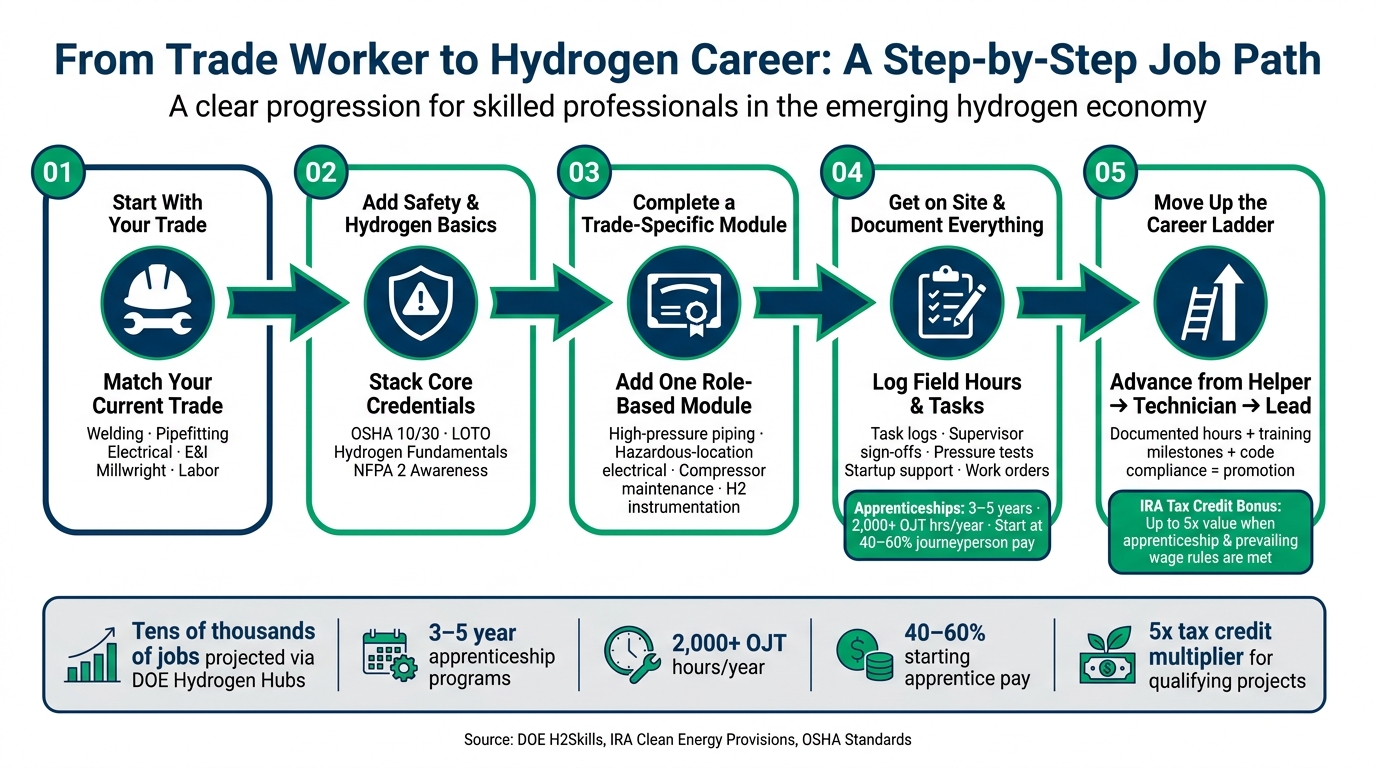
From Trade Worker to Hydrogen Career: A Step-by-Step Job Path
Green Skills for Hydrogen: Upskilling and reskilling for the hydrogen industry
sbb-itb-aa28329
Step 1: Map prior trade skills into hydrogen roles
Before you pay for training, pause and look at the skills you already have. In most cases, the smartest move is simple: match your current trade to the closest hydrogen job, then fill in the hydrogen-specific gaps.
That matters because hydrogen training usually works best as an add-on to trade experience you already bring to the table. You’re not starting from zero. You’re building on what you already do well.
Use this map to find the closest match.
| Prior Trade | Transferable Skills | Hydrogen Skills Needed | Typical Entry Titles | Recommended Credentials |
|---|---|---|---|---|
| Welding | Pipe joint fit-up, weld processes, pressure vessel work, code-compliant documentation | Hydrogen embrittlement awareness, leak-tight joints, material compatibility, hydrogen code awareness | Hydrogen Pipeline Welder, Hydrogen Storage and Vessels Welder, Pressure Systems Technician | AWS welding certifications, ASME Section IX quals, OSHA 10/30, hydrogen safety or high-pressure gas systems course |
| Pipefitting | Pipe layout, P&ID reading, joint fit-up, pressure testing, code-based work | Material compatibility for H2 service, high-pressure hydrogen safety, leak detection, ASME B31.12 awareness | Hydrogen Plant Pipefitter, Hydrogen Piping Fabricator, Hydrogen Pipeline Technician | NCCER Pipefitting, union journeyman card, OSHA 30, hydrogen materials and leak-testing course |
| Electrical | Power distribution, control panels, grounding, troubleshooting | Hazardous-location awareness, gas detection systems, emergency shutdown logic | Hydrogen Plant Electrician, Hydrogen Fueling Station Technician | State journeyman license, NCCER Electrical, NEC hazardous-location training, hydrogen safety course |
| Instrumentation/E&I | PLC wiring, sensor installation, loop testing, control system diagnostics | Hydrogen monitoring, alarm setpoints, shutdown logic, electrolyzer controls | Hydrogen E&I Technician, Plant Controls Technician | NCCER Instrumentation, ISA or vendor training, gas detection and shutdown module |
| Equipment/Millwright | Motors, pumps, compressors, valves, mechanical maintenance | High-pressure hydrogen compressor service, safety interlocks, storage system protocols | Compressor Technician, Hydrogen Systems Technician | NCCER Millwright, OEM compressor training, hydrogen safety fundamentals |
| Laborer/Helper | Hand and power tools, site safety, work order reading, multi-trade support | Basic hydrogen properties, LOTO in hydrogen environments, site-specific hazard awareness | Hydrogen Construction Helper, Assembly Helper, Commissioning Assistant, Materials Handler | OSHA 10, site safety orientation, hydrogen safety short course |
Welding and pipefitting skills that apply to hydrogen piping and pressure systems
Welders and pipefitters sit right in the middle of many hydrogen projects. The day-to-day tasks – routing pipe, making code-compliant welds, and running pressure tests – carry over well to hydrogen pipelines, manifolds, storage tanks, and process skids tied to electrolyzers and compression systems.
The gap is usually narrow, not huge. One of the biggest issues is hydrogen embrittlement. Hydrogen can affect some metals over time, so material choice and weld procedures carry more weight than they might in standard industrial piping. Hydrogen also leaks more easily than natural gas, which means joint fit-up and joint quality have to be tighter.
Workers in hydrogen service also need to know the codes tied to the work, including ASME B31.12.
A refinery pipefitter with experience on high-pressure natural gas systems already has a strong base for hydrogen transmission line work. Add training on hydrogen materials and leak-testing practices, and the jump becomes much more realistic. In many cases, a short hydrogen materials and safety course, plus OSHA 30 if it’s missing, closes most of the gap.
Electrical, instrumentation, and equipment experience that fits hydrogen plants
For electricians and E&I techs, the transfer is strong across plant and station work. Power distribution, control panels, grounding, sensor installation, and troubleshooting all apply to electrolyzer systems, hydrogen compression equipment, and fueling stations.
What changes is the safety layer. Hydrogen work adds hazardous-location awareness, hydrogen detection, alarm setpoints, and emergency shutdown logic. That means a licensed journeyman electrician doesn’t need to start over. They can stack a few focused modules onto an existing license and move into hydrogen plant or station roles.
A simple example: a commercial electrician can move into hydrogen fueling station controls and safety systems after adding hazardous-location training and a hydrogen safety course.
How helpers and laborers can find the first reachable hydrogen job
Helpers and laborers also have a clear path in. There are entry-level jobs on hydrogen projects right now, especially for people who show up on time, work safely, and pick things up fast.
Common starting points include:
- Construction helper roles supporting piping and electrical crews
- Assembly helper jobs on electrolyzer or compressor skids
- Commissioning assistant roles helping techs with checklists and tag verification
- Materials handler or site logistics jobs
At this stage, the main things employers look for are reliability, safe work habits, and a willingness to learn. OSHA 10 plus a short hydrogen safety course is often enough to help someone qualify for a first hydrogen site role. From there, the next step is to stack the credentials that fit the job you want.
Step 2: Build the right hydrogen training and certifications
The goal here is simple: build the shortest credential stack that fits the job you want.
The usual order looks like this: safety first, then hydrogen basics, then trade-focused modules, and after that, role-level training. Once that’s in place, field time is what turns coursework into a real career path.
| Training Stage | Typical Focus | Job Outcomes |
|---|---|---|
| Baseline Safety | OSHA 10 or OSHA 30, LOTO, confined space, hot work, HazCom | Hydrogen site laborer or helper roles |
| Hydrogen Fundamentals | Hydrogen properties, ignition risks, venting behavior, leak detection, emergency response, NFPA 2 awareness | Entry-level support roles on hydrogen sites |
| Trade-Specific Hydrogen Modules | High-pressure piping, hydrogen electrical systems, compressor maintenance, instrumentation in H2 environments | Field technician, hydrogen plant pipefitter, fueling station technician |
| Role-Specific Qualifications | Plant operator training, pipeline technician programs, fueling station operations, instrumentation and controls for hydrogen | Plant operator, pipeline technician, instrumentation technician, lead tech |
Start with OSHA, site safety, and hydrogen fundamentals
OSHA 10-Hour Construction is a common starting point for hydrogen construction sites. If you’re aiming for a lead or supervisor track, OSHA 30 is usually the better fit. On industrial sites across the U.S., these cards are standard expectations.
From there, site safety training covers the day-to-day risks tied to hydrogen work. That usually includes lockout/tagout (LOTO), confined space entry, hot work, and hazard communication (HazCom). In plain English, this is the stuff that helps you work around hydrogen systems without making a bad day worse. Many hydrogen employers also include NFPA 2: Hydrogen Technologies Code awareness in site orientation. That training often covers separation distances, ventilation rules, and emergency procedures.
Hydrogen fundamentals then give you the base layer: ignition risk, upward dispersion, leak detection, and emergency response. If you skip this part, the later modules can feel like trying to build a house on sand.
Add trade-specific hydrogen modules and stackable credentials
This is the point where your current trade starts to matter most.
If you’re a welder or pipefitter, short courses on high-pressure piping, hydrogen material compatibility, and code requirements make sense. If you’re an electrician, look for modules on hazardous locations, intrinsically safe equipment, and gas detection system integration. If you come from a mechanic or millwright background, the best fit is often compressor, valve, and rotating equipment maintenance in hydrogen service.
The key is to use each module to fill a gap in the trade you already know. You don’t need to collect every certificate under the sun. You need the ones that move you from general trade worker to someone who can work on hydrogen systems.
DOE-supported H2Skills and H2EDGE programs are building stackable curricula for technician and operator roles that call for a certificate or associate degree instead of a four-year degree. After that core stack, OEM and employer programs usually add equipment-specific training.
Match credentials to the job level you want next
Pick the shortest path that lines up with the next role you want, whether that’s operator, technician, or controls work.
A practical minimum stack looks like this:
- one safety card
- hydrogen fundamentals
- one trade-specific module
- one role-level credential
After that, the focus shifts from classroom time to logged site tasks and apprenticeship hours. That’s where the paperwork starts turning into job-ready experience.
Step 3: Use site experience and apprenticeships to move up
Training gets you in the door. Documented field work is what helps you move up.
Someone can finish hydrogen safety modules and still be an unknown on most jobs if they’ve never helped with a pressure test or a startup sequence. That’s the gap. Training matters, but documented site work and added responsibility are what turn training into a real career path.
Move from laborer or helper to technician through documented field tasks
The clearest path forward is to build a written record of what you’ve done on site. In plain terms, keep dated task logs, supervisor sign-offs, and copies of permits, work orders, and inspection records.
The tasks that tend to matter most are the ones that show you can work inside a procedure-driven hydrogen site. That includes:
- piping alignment
- cable pulls
- instrument mounting
- equipment setting
- pressure tests
- startups
- routine maintenance
Each of these tells a foreman or supervisor the same thing: you can follow process, work safely, and handle site rules without hand-holding.
The table below shows how that path usually plays out on the job:
| Starting Role | Next Role | Key Site Experience | Training Milestones |
|---|---|---|---|
| Laborer | Helper | Material handling, site rules, safety observation | Basic site safety, hydrogen site orientation |
| Helper | Apprentice | Piping assist, cable pulls, instrument support, equipment prep | Hydrogen fundamentals, trade-specific safety module |
| Apprentice | Technician | Pressure-test support, startup assist, maintenance routines, inspection prep | Documented OJT hours, supervisor evaluations |
| Technician | Lead/Supervisor | Independent task execution, permit management, code compliance, quality checks | Role-specific credential, NFPA 2 awareness |
Once those tasks are on paper, apprenticeship hours start to mean more. They become proof that you’re ready for the next step, not just proof that you were present.
How apprenticeships support long-term advancement
The best move for most workers is to use a registered apprenticeship in their main trade, then add hydrogen modules on top of it. That usually works better than trying to build a separate hydrogen path from zero, because a lot of the base skills already carry over.
In the U.S., construction and trade apprenticeships often run 3–5 years. They combine more than 2,000 on-the-job training (OJT) hours per year with classroom instruction before a worker reaches journey-level status. Pay also climbs over time, with apprentices often starting at 40–60% of journeyperson wages and moving up as they meet skill milestones.
There’s a business reason employers like this setup too. Under the Inflation Reduction Act, some clean hydrogen tax credits can increase by 5x if prevailing wage and apprenticeship hour rules are met. So putting formal apprentices on hydrogen facilities isn’t just about workforce growth. It can also make financial sense.
That progress still needs to be backed up by code compliance and a clean record on site.
Why codes, compliance, and safe work history affect promotion
Promotions don’t come from skill alone. Employers in regulated settings also look hard at paperwork, permit discipline, and safe execution.
Workers who follow lockout/tagout steps, keep records straight, and show up ready for inspection hold points are usually the ones trusted with higher-risk work. That trust matters. On hydrogen jobs, one sloppy habit can shut doors fast.
It also helps to know the code environment you’re working in. Familiarity with NFPA 2: Hydrogen Technologies Code and, on larger sites, OSHA Process Safety Management (PSM) rules shows that you understand more than the task right in front of you. It shows you understand the site, the system, and the standard of work expected there.
On hydrogen projects, the strongest case for promotion usually comes from one thing: documented field hours plus completed training milestones tied to strict procedural compliance.
Step 4: Connect trained workers to hydrogen projects faster
Training and site hours only go so far. Workers still need to get into active hydrogen projects without a long delay. Once those hours and credentials are on record, the next step is simple: match each person to the right job.
How ABLEMKR supports credential-based hiring for hydrogen work

Credential-based hiring helps close that gap.
Hydrogen projects depend on verified qualifications, and every site has its own mix of OSHA, license, and hydrogen-safety rules. ABLEMKR handles that head-on. The platform keeps each worker’s certifications, safety training records, and work history in one place. Then it matches them to open hydrogen-related jobs based on credentials, availability, and location.
For a project manager, that can save a lot of back-and-forth. Post a role like a pipefitter job on a hydrogen plant construction site, and the platform returns a shortlist of pre-vetted workers who already have the required qualifications, along with expiration dates and related project experience.
What workers and project managers gain from faster deployment
For project managers, location-based matching helps speed mobilization when deadlines get tight or a shutdown hits.
Workers get something just as useful: a clearer view of their next move. The platform keeps assignments, completed safety modules, and certifications in one record, so it’s easier to move into higher-level hydrogen roles. Embedded compliance tracking also flags expiring certifications before they interrupt work on an active hydrogen site.
Conclusion: A clear path from trade experience to hydrogen careers
Hydrogen job paths open faster when trade experience, targeted training, documented site hours, and verified credentials all line up with the next role. That’s how labor experience turns into a hydrogen career path.
FAQs
Do I need a degree to work in hydrogen?
No. While some advanced engineering and senior management roles often require a bachelor’s degree, many hydrogen jobs don’t.
You can get into the field through specialized training programs, industry-recognized certifications, and hands-on experience from apprenticeships or trade school certificates. In many cases, employers care just as much about technical skills and safety credentials, such as OSHA training, for hydrogen system roles.
Which trade skills transfer best to hydrogen jobs?
Skills tied to safe handling of high-risk systems and core hydrogen infrastructure transfer best.
- Pipeline welding, with added hydrogen training
- Electrical skills from conventional power plants, plus hydrogen equipment and safety training
- Mechanical and equipment maintenance skills, especially for high-pressure systems, with specialized hydrogen safety training
What training should I get first for a hydrogen role?
Start with OSHA 10- or 30-hour safety training. On most industrial energy sites, that’s a basic requirement just to get in the door.
From there, build your electrical skills through a community college or trade school program. That gives you the nuts-and-bolts knowledge you’ll use on the job, not just the paperwork.
If you can, add rigging and signal person credentials too. Those extra certifications can make you more useful on site and help you stand out when crews need someone who can do more than one thing.


