
The U.S. hydrogen energy sector is expanding quickly, driven by the Department of Energy’s (DOE) Regional Clean Hydrogen Hubs initiative. This growth has created a demand for skilled field workers in hydrogen production, safety, and logistics. Several training programs now aim to prepare individuals for careers in this field, offering a range of options for professionals, technicians, and career switchers.
Key Training Programs:
- University of Houston Hydrogen Economy Program: Online program for professionals, offering industry-recognized micro-credentials. Cost: $2,970.
- GTI Energy Fundamentals of Hydrogen Course: Flexible learning for field workers with on-demand and classroom options. Pricing varies.
- Delaware Hydrogen Training Program: Modular courses covering electrochemical basics and more. Estimated cost: $250 per module.
- H2Skills Hydrogen Workforce Training Initiative: Federally funded, focusing on technical roles like pipefitters and technicians. Costs vary by institution.
- Center for Clean Hydrogen Workforce Development Program: DOE-funded, self-paced, and low-cost training for entry-level and mid-career workers.
Quick Comparison:
| Program | Cost | Duration | Delivery Mode | Target Audience | Certification |
|---|---|---|---|---|---|
| University of Houston | $2,970 ($2,770 for AIChE members) | ~3 months (45 hours) | Online (live + self-paced) | Professionals, grad students | Silver Belt, AIChE certificates |
| GTI Energy | Varies | Varies | Classroom, virtual, on-demand | Field workers, technicians | IACET CEUs, GTI certificates |
| Delaware Hydrogen Training Program | ~$250 per module | Self-paced | Online + hands-on lab | Entry-level, mid-career workers | Noncredit professional cert. |
| H2Skills Initiative | Varies | Varies | AR/VR, classroom, on-the-job | Technicians, apprentices | Technical certs, micro-credentials |
| Center for Clean Hydrogen Workforce | Low to no cost (DOE-funded) | Self-paced | Online noncredit | Entry-level, mid-career workers | Noncredit professional cert. |
Each program offers unique benefits based on career goals, from technical training to business-oriented credentials. Whether you’re starting fresh or transitioning careers, there’s a program tailored for you.
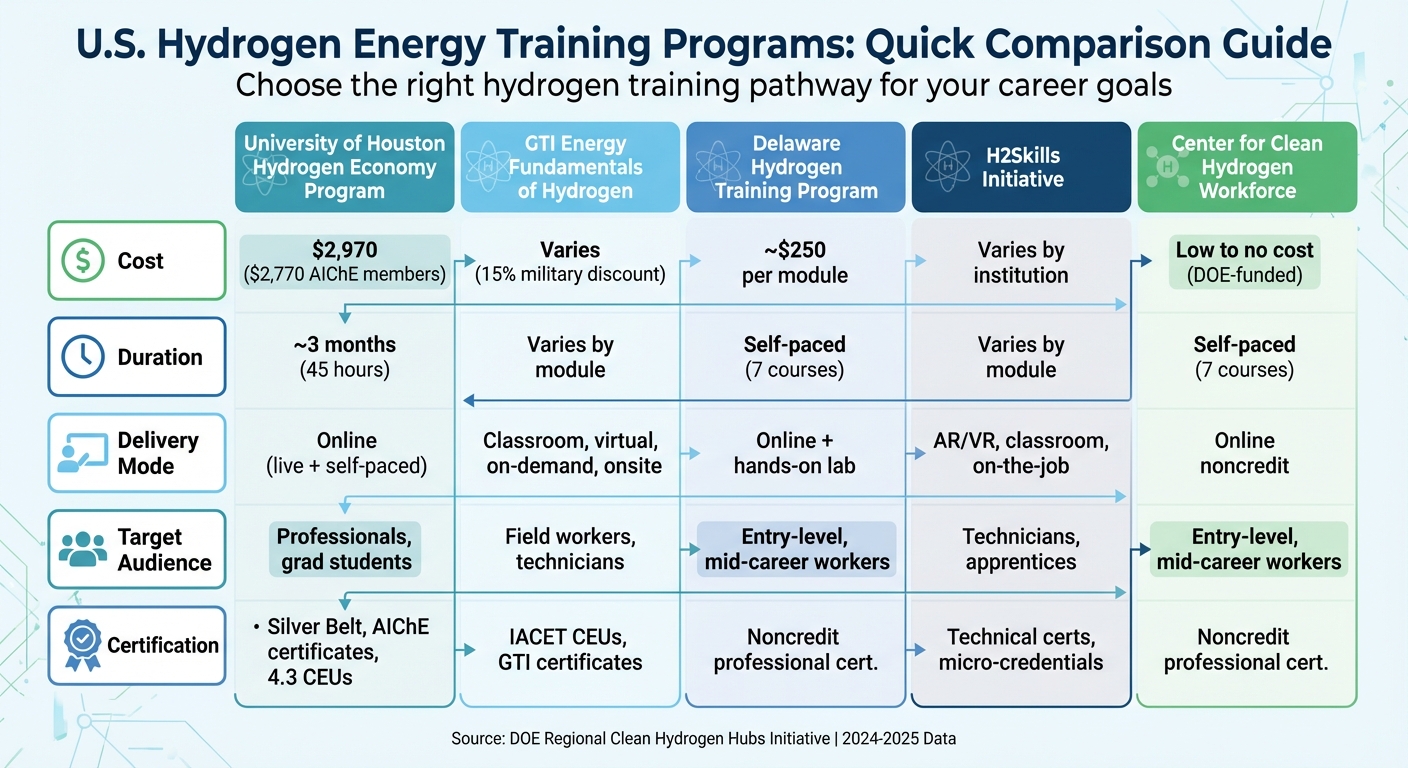
U.S. Hydrogen Energy Training Programs: Cost, Duration, and Certification Comparison
Course Overview: Foundations of the Hydrogen Economy
sbb-itb-aa28329
1. University of Houston Hydrogen Economy Program

The University of Houston (UH) has teamed up with the American Institute of Chemical Engineers (AIChE) to offer a specialized micro-credential series tailored for industry professionals and advanced students. This program is split into three distinct badges, each focusing on a critical aspect of hydrogen: production, transportation and safety, and commercial applications. Professionals from companies like Baker Hughes, Shell, and Linde have already participated in this training.
Cost
The full program costs $2,970 for all three badges, or $1,100 per badge if taken individually. AIChE members and UH alumni enjoy a discounted rate of $2,770. Keep in mind, traditional financial aid isn’t offered, and there are no refunds if you decide to withdraw from the course.
Duration
Each badge requires 15 hours of study over three weeks, making the entire program a 45-hour commitment spread across three months. Designed with busy professionals in mind, the program includes weekly one-hour Zoom sessions (typically held from 6:00 to 7:00 PM Central Time) and self-paced e-learning modules.
Delivery Mode
The program is delivered entirely online, blending on-demand lectures, notes, and quizzes with live weekly Q&A sessions. This format provides flexibility for participants to fit the coursework into their schedules, while still offering opportunities for real-time engagement with instructors.
Target Audience and Credentials
This program is aimed at energy professionals and those aspiring to work in fields like engineering, business, and technology. Upon completing all three badges – Hydrogen Production; Hydrogen Transportation, Safety & Use; and Commercial Opportunity for Hydrogen – participants earn a "Silver Belt" micro-credential from UH Energy. Additionally, they receive certificates from AIChE, along with 4.30 Continuing Education Units (CEUs) and 43.00 Professional Development Hours (PDHs).
Kay McCall, a board member and advisor, highlighted the program’s value:
Thank you to UH Energy for presenting the Hydrogen Economy program for those of us wanting more than a superficial view of the potential role of hydrogen in the energy transition.
This structured approach establishes a strong foundation for understanding hydrogen’s role in the evolving energy landscape.
2. GTI Energy Fundamentals of Hydrogen Course

GTI Energy’s Fundamentals of Hydrogen course is tailored to meet the growing demands of the hydrogen industry, focusing on the practical needs of field workers in construction and operations. With over 70 years of experience educating gas personnel globally, GTI Energy stands out as a trusted provider of industry training. As an IACET Accredited Provider, their courses adhere to internationally recognized standards for continuing education. This course is part of a larger curriculum, featuring 77 instructor-led modules designed specifically for professionals in construction, operations, and maintenance. This comprehensive approach supports the industry’s increasing need for adaptable and high-quality hydrogen training.
Cost
While specific pricing details are not provided, GTI Energy offers a 15% discount to U.S. Military personnel and veterans. To take advantage of this offer, you’ll need to email a copy of your Military or Retiree ID to education@gti.energy before registering. Additionally, GTI Energy provides a refund guarantee for participants who are not satisfied with the course.
Duration and Delivery Mode
GTI Energy offers a variety of learning formats to accommodate different schedules and preferences. Options include classroom sessions (primarily in Chicago), virtual instructor-led training (vILT), onsite training at your facility, and on-demand online courses. Program lengths range from single modules to intensive four-week blended sessions that combine classroom learning with hands-on practice. For those with packed schedules, the online and recorded webinar options provide 24/7 access, making it easier to fit training into your routine.
Target Audience and Credentials
This course is designed for energy industry professionals and newcomers alike, including field workers in construction, operations, and maintenance, as well as those looking to enter natural gas utility and pipeline operations. Participants who complete the course earn IACET Continuing Education Units (CEUs) and GTI Energy certificates. These credentials are aligned with industry standards and prepare participants for roles in hydrogen safety, production, and maintenance. Whether you choose standalone modules or a full certificate program, the training equips you to work safely and efficiently while opening doors to new opportunities in the evolving energy sector.
3. Delaware Hydrogen Training Program at University of Delaware

The Delaware Hydrogen Training Program is a noncredit certificate offered through a collaboration between the Center for Clean Hydrogen and the University of Delaware’s PCS. Backed by a $97,500 grant from the Delaware Workforce Development Board, the program supports the Mid-Atlantic Clean Hydrogen Hub (MACH2), an initiative expected to generate 20,000 jobs and potentially secure up to $750 million in Department of Energy funding. Below, you’ll find details on the program’s cost, structure, and intended audience.
Cost
While specific enrollment fees for the program aren’t publicly available, similar offerings, such as modules from the Solar Energy Academy, are priced around $250 each. For precise tuition details, it’s best to contact the university directly.
Duration and Delivery Mode
The program is designed with flexibility in mind, featuring a modular structure that allows participants to tailor their learning experience. It begins with a required foundational course, Electrochemical Fundamentals, Components, and Testing (Course 1), followed by a choice of six elective courses. These electives cover specialized topics like fuel cells, laboratory techniques, electrolyzers, and membranes and catalysts.
To accommodate working professionals, the program offers part-time and flexible scheduling options, including hands-on laboratory training. This structure makes it particularly suitable for those looking to transition into the hydrogen sector without stepping away from their current roles.
Target Audience and Credentials
The program is geared toward individuals new to the field as well as mid-career professionals who lack formal electrochemical training. Graduates earn a noncredit professional certificate, equipping them with foundational knowledge and practical skills in hydrogen electrolyzers and fuel cells. This emphasis on core hydrogen technologies addresses workforce skill gaps and aligns with the sector’s rapid growth. Yushan Yan, Director of UD’s Center for Clean Hydrogen, highlighted the program’s importance:
The University of Delaware and our collaborators at Cheyney, Rowan and Penn are well-poised to prepare students for rewarding careers in the new hydrogen economy.
4. H2Skills Hydrogen Workforce Training Initiative
H2Skills is a federally funded program designed to standardize hydrogen workforce training across the U.S. Led by Pacific Northwest National Laboratory (PNNL) and supported by 15 partners, the initiative aims to streamline training efforts. Instead of organizations and workers creating training materials from scratch, H2Skills integrates these resources into community college curricula and apprenticeship programs. It is funded by the U.S. Department of Energy’s Office of Energy Efficiency and Renewable Energy.
Cost
H2Skills isn’t a typical course with a set tuition. Instead, it collaborates with community colleges, labor unions, and employers to offer training, meaning costs depend on the specific institution or program. For more details about enrollment or associated costs, interested individuals can reach out to the H2Skills team at H2Skills@pnnl.gov.
Duration and Delivery Mode
The program operates through a phased rollout: Assess, Create, Deploy, and Scale. The assessment phase wrapped up in November 2024, pinpointing 18 key hydrogen-related roles across three U.S. regions. Out of these, six roles were identified as common across the regions:
- Instrumentation & Electrical Technicians
- Pipefitters & Steamfitters
- Mechanical Technicians
- Production Schedulers & Logisticians
- HSE (Health, Safety, and Environment) Officers
- Data Analysts
Training combines advanced AR/VR modules, classroom instruction, and hands-on job training to ensure participants gain practical experience.
Target Audience and Credentials
H2Skills is tailored for a diverse group, including community and technical college students, pre-apprentices, skilled workers looking to enhance their expertise, and adults re-entering the workforce. The focus is on individuals pursuing education beyond high school but short of a four-year degree. The initiative highlights the importance of creating "family-sustaining jobs" and offers various credentials, such as stackable micro-credentials, technical certificates, Associate degrees, and apprenticeship modules.
As the H2Skills team puts it:
A highly trained skilled and technical workforce is essential to build, operate, and maintain new hydrogen facilities and infrastructure in a manner that is both affordable and safe.
This approach not only supports workforce development but also lays the groundwork for advancements in hydrogen-related industries.
5. Center for Clean Hydrogen Workforce Development Program
The Center for Clean Hydrogen Workforce Development Program is a collaborative effort funded by the Department of Energy (DOE) and led by the University of Delaware. Key partners include the Electric Power Research Institute (EPRI), the Gas Technology Institute (GTI), Oregon State University, and Purdue University. In September 2020, the DOE awarded this consortium $2 million to support its mission. The program is designed to provide career-oriented training tailored to the growing hydrogen industry.
Cost
One of the standout features of this program is its affordability. Thanks to funding from the DOE’s Hydrogen and Fuel Cell Technologies Office (HFTO) and additional backing from the Low-Carbon Resources Initiative (jointly led by EPRI and GTI), participants pay little to no tuition. This financial support makes the program accessible to a wide range of learners.
Duration and Delivery Mode
The curriculum consists of seven modular courses, allowing participants to progress at their own pace. The program begins with an introductory course on electrochemical fundamentals, followed by six specialized courses that delve into topics like fuel cells, laboratory techniques, electrolyzers, and membranes/catalysts . This self-paced structure is ideal for professionals balancing work and study.
Target Audience and Credentials
The program is designed for both newcomers to the workforce and mid-career professionals aiming to transition into the hydrogen field. The University of Delaware emphasizes the importance of flexibility:
These programs must be flexible enough to train people entering the workforce for the first time while also being able to retrain individuals who wish to pursue a mid-career transition.
Participants earn a noncredit professional certificate through the University of Delaware’s Professional & Continuing Studies. This certification is tailored for individuals without prior formal training in electrochemistry, giving them a competitive edge in the U.S. energy job market.
Outcomes
This program addresses critical skill gaps in the hydrogen industry, ensuring graduates are equipped for roles in hydrogen production, delivery, storage, and use. Participants gain hands-on knowledge of electrochemical fundamentals, components, and testing techniques essential for working with hydrogen electrolyzers and fuel cells. The curriculum was developed in consultation with Delaware-based hydrogen organizations, ensuring that the training aligns with real-world employer demands in this rapidly growing sector.
Program Comparison: Strengths and Weaknesses
This section dives into the strengths and weaknesses of leading hydrogen training programs, building on the insights shared earlier. Each program caters to different career paths, offering a mix of academic, technical, and practical training options.
The University of Houston Hydrogen Economy Program stands out for its academic depth and strong industry ties. A highlight of this program is its "Shark Tank"-style capstone project, where participants craft business plans for clean hydrogen startups . However, with a price tag of $2,970 ($2,770 for AIChE members), it is the priciest option and leans more toward business and management, offering less in terms of technical, hands-on experience.
The H2Skills Hydrogen Workforce Training Initiative focuses on technical roles, such as technicians and pipefitters, and uses AR/VR technology to provide risk-free, practical training. It has identified 18 high-priority jobs across three U.S. regions, with six roles (e.g., H2 Pipefitters, Data Analysts) shared across all regions. On the downside, the program is still in its "Create" phase as of late 2024/2025, meaning full national scaling is yet to be achieved.
The GTI Energy Fundamentals of Hydrogen Course offers flexible, on-demand learning with multiple delivery formats, including classroom, virtual instructor-led, and onsite training. While it provides theoretical knowledge, it lacks the hands-on laboratory components that some regional programs offer.
The Center for Clean Hydrogen Workforce Development Program, supported by DOE funding, provides an affordable option for workers, even those without a background in electrochemistry. Its seven modular courses allow for self-paced learning, but the non-credit nature of the program may limit its appeal for individuals seeking academic credentials .
Here’s a quick comparison of the programs:
| Program | Cost | Duration | Delivery Format | Target Audience | Certification |
|---|---|---|---|---|---|
| University of Houston Hydrogen Economy Program | $2,970 ($2,770 for AIChE members) | 45 hours (~3 months) | Online (Synchronous & Asynchronous) | Professionals & grad students | Silver Belt, AIChE certificates, 4.3 CEUs |
| GTI Energy Fundamentals of Hydrogen Course | Contact for pricing (15% military discount) | Varies by module | Classroom, virtual, onsite, on-demand | Field workers, operators, technicians | IACET CEUs, GTI Energy certificates |
| H2Skills Hydrogen Workforce Training Initiative | Varies by institution | Varies by module | AR/VR, on-the-job, classroom | Technicians, apprentices, veterans | Technical certificates, micro-credentials |
| Delaware Hydrogen Training Program | ~$250 per module (estimated) | Self-paced (7 courses) | Online with hands-on lab | Entry-level & mid-career workers | Professional certificate (non-credit) |
| Center for Clean Hydrogen Workforce Development Program | Little to no cost (DOE-funded) | Self-paced (7 courses) | Online non-credit | Entry-level & mid-career workers | Professional certificate (non-credit) |
These comparisons highlight how each program aligns with the Department of Energy’s goals for workforce development, helping professionals choose the best path for their career aspirations in the evolving hydrogen sector.
Connecting Trained Hydrogen Workers with Projects Through ABLEMKR

Workers who complete hydrogen training programs earn digital credentials that align with ABLEMKR’s certification standards. For instance, the University of Houston offers a Silver Belt credential, providing a permanent record of a worker’s skills. Similarly, the Center for Hydrogen Safety issues the Fundamental Hydrogen Safety Credential, which confirms an employee’s understanding of hydrogen hazards and safe handling practices. These credentials help employers identify qualified candidates quickly. Using these verified achievements, ABLEMKR connects skilled professionals with key energy projects.
ABLEMKR’s platform uses these credentials to power its worker-project matching system. Designed with a mobile-first approach, the platform pairs workers with hydrogen energy projects based on factors like certifications, safety training, availability, and location. This efficient process eliminates the need for lengthy technical interviews. Workers holding certifications like the Silver Belt or Galileo Master Certificate make it easier for employers to assemble crews quickly. With hydrogen demand expected to grow significantly as it becomes a major energy source for decarbonizing heavy-duty transportation, having fast access to qualified workers is more important than ever. ABLEMKR addresses this need by offering real-time updates on worker availability, integrated payroll systems, and built-in compliance tracking.
For workers, ABLEMKR offers flexible access to high-paying opportunities across energy hubs in the U.S., along with reliable, on-time payments. By removing traditional barriers in labor deployment, the platform directly connects trained professionals to essential hydrogen projects. Credentials like the Silver Belt from the University of Houston or the Galileo Master Certificate not only validate a worker’s expertise but also open doors to better-paying roles. This streamlined approach to training and job placement is a critical factor in scaling the U.S. hydrogen industry to meet growing demand.
Conclusion
The comparisons above showcase various pathways to kickstart or advance a career in the hydrogen industry. Choosing the right program depends on your career goals and current skill set.
For entry-level technical roles like pipefitting or instrumentation, the H2Skills initiative stands out with its AR/VR modules, offering practical, risk-free training experiences. Additionally, the Center for Hydrogen Safety’s Fundamental Hydrogen Safety Credential delivers 9 hours of targeted training on hydrogen hazards and safe handling practices.
If you’re aiming for leadership positions, academic programs are the way to go. The University of Houston Hydrogen Economy Program includes a capstone project where participants create and defend a business plan for a clean hydrogen startup . Meanwhile, the Renewable Energy Institute‘s Hydrogen Energy Consultant Expert certificate focuses on project development and financing, requiring 80-90 CPD hours.
For career switchers, flexible learning options are key. The REI course offers a self-paced format with up to three months for completion. On the other hand, the Delaware Hydrogen Training Program caters to regional workers, emphasizing electrochemical fundamentals for electrolyzers and fuel cells.
The H2Skills program has pinpointed six high-priority roles needed across the U.S.: Instrumentation & Electrical Technicians, Pipefitters & Steamfitters, Mechanical Technicians, Production Schedulers, HSSE Officers, and Data Analysts. These training programs are vital for building a skilled workforce to support the nation’s growing hydrogen infrastructure and can help position you for long-term success in this evolving industry.
FAQs
Which hydrogen training program fits my background and career goal?
Choosing the right hydrogen training program depends on your experience and what you aim to achieve in your career. If you’re looking for a comprehensive introduction, the University of Houston’s Hydrogen Economy Program provides a mix of technology, economics, and policy insights. For those needing specialized knowledge in safety and operations, GTI Energy’s Fundamentals of Hydrogen is a great choice. Meanwhile, professionals aiming for advanced consultancy roles might consider the Renewable Energy Institute’s Hydrogen Energy Consultant Expert Certificate, which delivers detailed, globally recognized training. Select a program that best matches your background and career objectives.
Do these programs require an engineering or electrochemistry background?
Most hydrogen energy training programs are designed to be beginner-friendly, meaning you don’t need a background in engineering or electrochemistry to get started. Courses like Introduction to Hydrogen for Code Officials and programs offered by the Renewable Energy Institute focus on building foundational knowledge, making them accessible to a wide range of learners. While certain certifications, such as the Fundamental Hydrogen Safety Credential, might require some basic safety knowledge, these programs are generally tailored for professionals from various industries who want a practical understanding of hydrogen energy.
How can I use my hydrogen credentials to get placed on projects through ABLEMKR?
To secure project placements through ABLEMKR, it’s crucial to ensure your hydrogen training and certifications align with industry standards. Completing recognized programs, such as those offered by the Renewable Energy Institute, can strengthen your qualifications. Once you’ve completed the necessary training, set up a profile on ABLEMKR’s platform. Make sure to keep your certifications, safety training, and availability up to date. ABLEMKR connects pre-vetted professionals to projects, with a strong focus on verified hydrogen credentials for roles in the energy sector.


