
Hybrid energy systems integrate solar panels, batteries, and microgrids to ensure steady power, especially in cities. But managing these systems requires certified professionals trained in safety, compliance, and technical expertise. Certifications like REP™, NABCEP PVIP, and OSHA 10/30-hour training ensure workers meet industry standards and reduce risks. Advanced programs like HOMER Pro training and NABCEP Energy Storage Installation Professional (ESIP) focus on specialized skills like system design and battery integration. Platforms like ABLEMKR simplify hiring by matching certified workers with projects, ensuring compliance and efficiency. For workers, these certifications unlock career opportunities in the growing hybrid energy sector.
The Simplest NABCEP Solar Certification – Everything You Need to Know: PV System Inspector (PVSI)
sbb-itb-aa28329
Core Certifications for Hybrid Energy System Workers
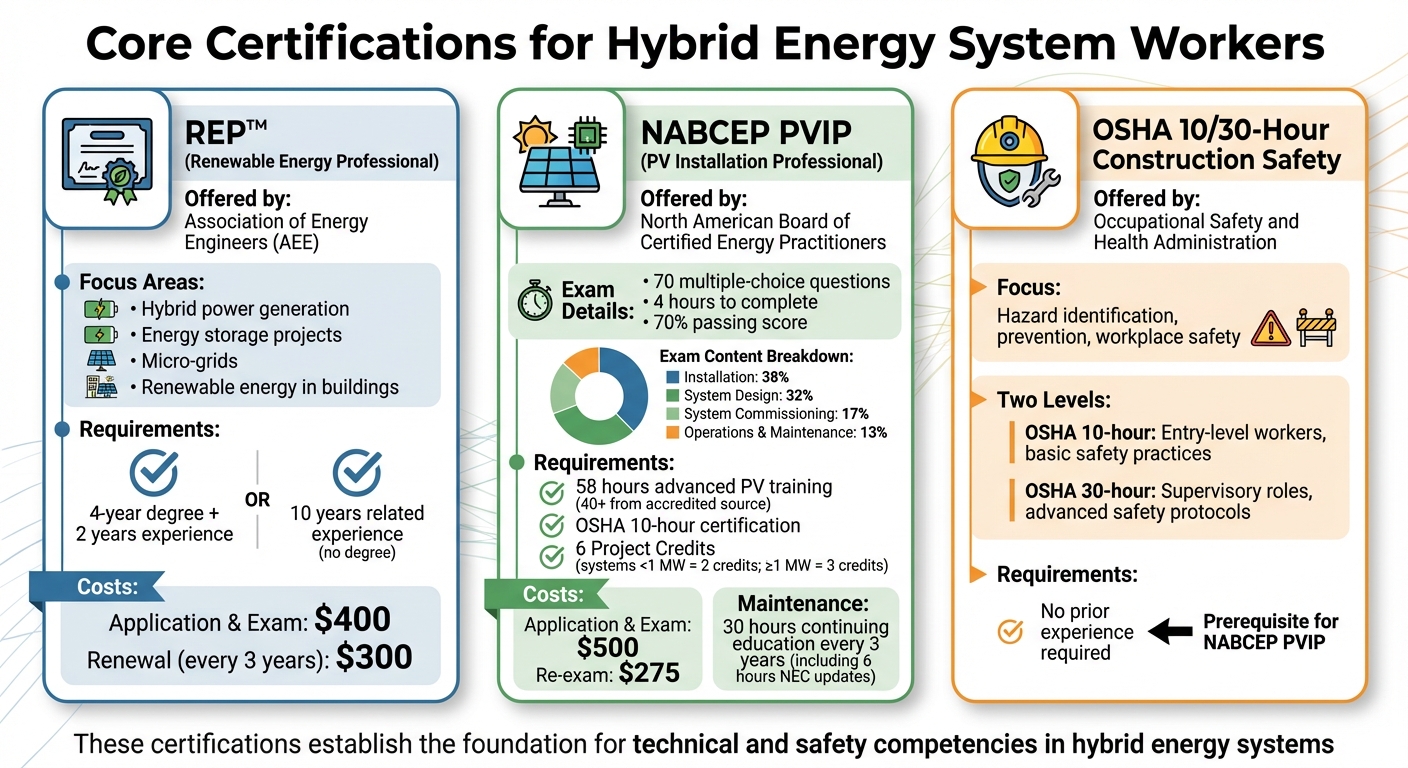
Core Certifications for Hybrid Energy System Workers: Requirements and Costs
For professionals working with urban hybrid energy systems, three key certifications lay the groundwork for expertise. These credentials ensure workers are equipped with the technical know-how and safety awareness needed to handle complex renewable energy infrastructure.
Certified Renewable Energy Professional (REP™)
The REP™ certification, offered by the Association of Energy Engineers (AEE), is tailored for professionals managing hybrid power generation and energy storage projects in urban environments. According to AEE:
"A Renewable Energy Professional (REP™) is an energy professional that has chosen to focus on renewable energy generation, production, and storage, plus the strategies and programs that support sustainable energy technologies".
This certification covers hybrid systems, micro-grids, and renewable energy applications in buildings. To qualify, candidates need either a 4-year degree in a related field and 2 years of relevant experience, or 10 years of related experience without a degree. The application and exam fee is $400, with renewal required every three years at a cost of $300.
NABCEP PV Installation Professional Certification
The NABCEP PV Installation Professional (PVIP) certification demonstrates advanced technical skills, from system design to maintenance, with a strong focus on compliance with the National Electrical Code (NEC) – a critical aspect of safely integrating solar components into hybrid systems.
The certification exam includes 70 multiple-choice questions, with specific weightings: Installation (38%), System Design (32%), System Commissioning (17%), and Operations & Maintenance (13%). Candidates have 4 hours to complete the test and must score at least 70 to pass.
Eligibility requirements include 58 hours of advanced PV training (with at least 40 hours from an accredited source), OSHA 10-hour certification, and 6 Project Credits for installation experience. Systems under 1 MW earn 2 credits, while larger systems count for 3 credits. The application and exam fee is $500, with re-exams costing $275. To maintain certification, workers must complete 30 hours of continuing education every three years, including 6 hours focused on NEC updates.
OSHA 10/30-Hour Construction Safety and Health Certification
OSHA safety training is a must for hybrid energy workers, especially on urban job sites. The OSHA 10-hour course introduces workers to hazard identification, prevention, and workplace safety practices. This training is also a prerequisite for the NABCEP PVIP certification.
For those in supervisory or more complex roles, the 30-hour course provides a deeper dive into construction safety protocols. No prior experience is required, making OSHA training an ideal starting point for newcomers to the renewable energy sector. Completing this training early can streamline the journey toward advanced certifications.
These certifications establish the foundation for technical and safety competencies, paving the way for more specialized credentials in hybrid energy system design and maintenance.
Advanced Training for Hybrid System Design and Maintenance
Once you’ve completed core certifications, diving into specialized training for system design and maintenance becomes essential – especially for urban hybrid energy projects. These advanced programs focus on equipping professionals with the technical skills needed to model, integrate, and maintain renewable energy systems. They expand on foundational knowledge by tackling challenges like system sizing, performance analysis, and energy storage integration.
Hybrid System Sizing and Design Specialist Certifications
One standout tool in hybrid system design is HOMER Pro, developed by NREL. This software models hybrid energy systems ranging from individual buildings to entire cities. It’s particularly useful for managing the trade-offs between components like solar panels, wind turbines, diesel generators, and battery storage. In urban settings, where space and reliability are critical, precision in system optimization is non-negotiable.
A full-day HOMER Pro training course is available for €560 (including VAT). It teaches participants how to use simulation, optimization, and sensitivity analysis to evaluate both the financial and technical aspects of hybrid configurations. HOMER Energy describes the software as:
"The HOMER software has become a global standard for engineering and financial analysis of hybrid distributed energy projects, whether off-grid or grid-tied".
For those seeking broader expertise, the RENAC Certified Renewable Energy Project Developer program offers in-depth training on PV-diesel hybrid systems. This six-month course requires 130 study hours and costs €1,100. It covers essential topics like energy demand assessment, generation mix optimization, control strategies, and maintenance protocols. The program is officially certified by Germany’s Staatliche Zentralstelle für Fernunterricht (ZFU), ensuring its credibility in distance learning.
Advanced PV Systems Performance Certifications
Urban hybrid energy systems demand more than basic installation skills – advanced certifications are key for ensuring system performance and reliability. The NABCEP PV Design Specialist (PVDS) certification is one such credential, recognizing expertise in configuring both mechanical and electrical components of PV systems. For those focused on maintaining system reliability, the NABCEP PV Commissioning & Maintenance Specialist (PVCMS) certification emphasizes system analysis, verification protocols, and preventive maintenance.
Another advanced option is the PVOL303 Advanced PV Multimode and Microgrid Design course. This 40-hour NABCEP-approved program includes 10 hours of National Electrical Code (NEC) credit and costs $795. It covers multimode systems for both grid-connected and off-grid applications, which are critical for urban microgrids. Participants learn about workspace clearances, labeling for energy storage systems, and compliance with building and fire codes. To enroll, applicants must have foundational training (like PV101 and PV203) or pass a placement quiz.
These certifications and training programs help bridge the gap between basic skills and the more complex requirements of hybrid energy systems.
NABCEP Energy Storage Installation Professional (ESIP) Certification
Battery integration is a cornerstone of hybrid systems, and the NABCEP Energy Storage Installation Professional (ESIP) certification validates expertise in energy storage design, installation, and maintenance. To maintain this certification, professionals must complete 30 hours of continuing education every three years. Courses like PVOL303 can contribute 20 hours of Job Task Analysis (JTA) credit and 10 hours of NEC credit. Topics covered include MPPT charge controller operations, DC versus AC coupling configurations, and large-scale energy storage applications.
As NABCEP emphasizes:
"Board Certifications ensure you have the knowledge and skills to meet the demands of renewable energy projects and employers across the world".
When pursuing advanced credentials, it’s essential to confirm that your training program is NABCEP-approved and meets recertification requirements. These typically include 6 hours of NEC, 12–18 hours of JTA, and 2 hours focused on building and fire codes.
Using ABLEMKR to Connect Certified Workers with Hybrid Energy Projects

In the world of hybrid energy projects, meeting rigorous certification standards requires efficient tools to manage and deploy a qualified workforce. That’s where ABLEMKR steps in, offering a streamlined way to connect certified professionals with the right opportunities.
Simplifying Workforce Deployment with ABLEMKR
Manually screening resumes to find certified workers for hybrid energy projects can be tedious and time-consuming. ABLEMKR simplifies this process by automating the matching system. It filters professionals based on specific qualifications like REP™, NABCEP certifications, OSHA training, and energy storage expertise. This ensures that project requirements align perfectly with worker credentials, covering both technical know-how and safety compliance.
One standout feature is the platform’s ability to automatically verify certifications. While organizations like NABCEP provide public verification tools and digital badges, ABLEMKR integrates these checks directly into its workflow. Employers gain instant access to up-to-date certification statuses, ensuring that every worker deployed to a site meets current regulations. This is especially useful for urban projects that often demand multiple certifications, such as PV installation and battery safety, all at once.
The platform also includes location and availability filters to help operators mobilize crews quickly. Whether it’s a solar-battery integration at a commercial site or a microgrid commissioning project, ABLEMKR matches pre-verified workers based on their proximity, skills, and availability. This approach not only speeds up the staffing process but also ensures that the right people are on-site when and where they’re needed.
Mobile-First Access for Workers and Employers
With ABLEMKR’s mobile app, job opportunities are always within reach for workers, while employers can manage staffing on the go. Workers can browse hybrid energy projects, review job details, and confirm their availability – all from their phones. The app also highlights required certifications, ensuring workers are prepared before they even step on-site.
For employers, the app offers real-time updates on worker status, project staffing, and payroll. This is especially valuable when managing multiple installations across various urban locations. Flexible scheduling allows workers to take assignments that fit their availability, while employers can quickly fill gaps. Integrated payroll features guarantee on-time payments, eliminating common pain points in workforce management within the energy sector.
Conclusion
Certifications play a key role in ensuring safe and compliant hybrid energy projects. They confirm that workers are equipped to handle high-voltage risks, understand regulatory guidelines, and follow operational best practices. This ensures technicians can manage complex installations with a focus on safety and precision, which is especially critical in a rapidly growing market that thrives on skilled, certified professionals.
The need for certified hybrid energy workers is skyrocketing. With clean energy goals becoming more ambitious, the development of accredited training programs and industry-recognized credentials is essential to support urban energy projects.
Platforms like ABLEMKR simplify the process of verifying and deploying certified workers. Using an automated matching system, the platform filters professionals based on qualifications such as REP™ and NABCEP certifications, OSHA training, and energy storage expertise. Its integrated certification verification ensures that only qualified professionals are sent to urban hybrid energy projects, reducing the challenges often associated with workforce deployment while keeping the focus on certification standards.
As the shift toward clean energy gains momentum, managing the workforce efficiently becomes critical to completing hybrid energy projects on schedule and within budget. Certified workers benefit from access to flexible, well-paying opportunities with timely payments, while employers gain real-time insights into worker qualifications and project staffing needs.
FAQs
Which certifications should I get first for hybrid energy work?
To kick off a career in hybrid energy, earning the NABCEP Associate Credential is a great first step. It lays the groundwork for understanding renewable energy fundamentals. You can also enhance your skill set by pursuing IREC micro-credentials, which focus on specific areas like solar technology and energy storage.
For those looking to stand out, certifications from NABCEP in photovoltaic (PV) installation and energy storage are highly regarded by industry professionals. These qualifications equip you with the knowledge and skills needed to excel in hybrid energy systems.
How long does it take to qualify for NABCEP PVIP or ESIP?
To qualify for the NABCEP PVIP certification, you’ll need around 30 hours of training. For the ESIP certification, you’ll need 58 hours of approved advanced energy storage training. These certifications are designed to ensure that professionals meet the required industry standards for working with hybrid energy systems.
How does ABLEMKR verify my certifications for job eligibility?
ABLEMKR leverages a mobile-first platform to instantly verify your certifications. It keeps your credentials current and compliant while offering real-time tracking of verified worker profiles. This simplifies the process, ensuring you’re always ready for the job.


