
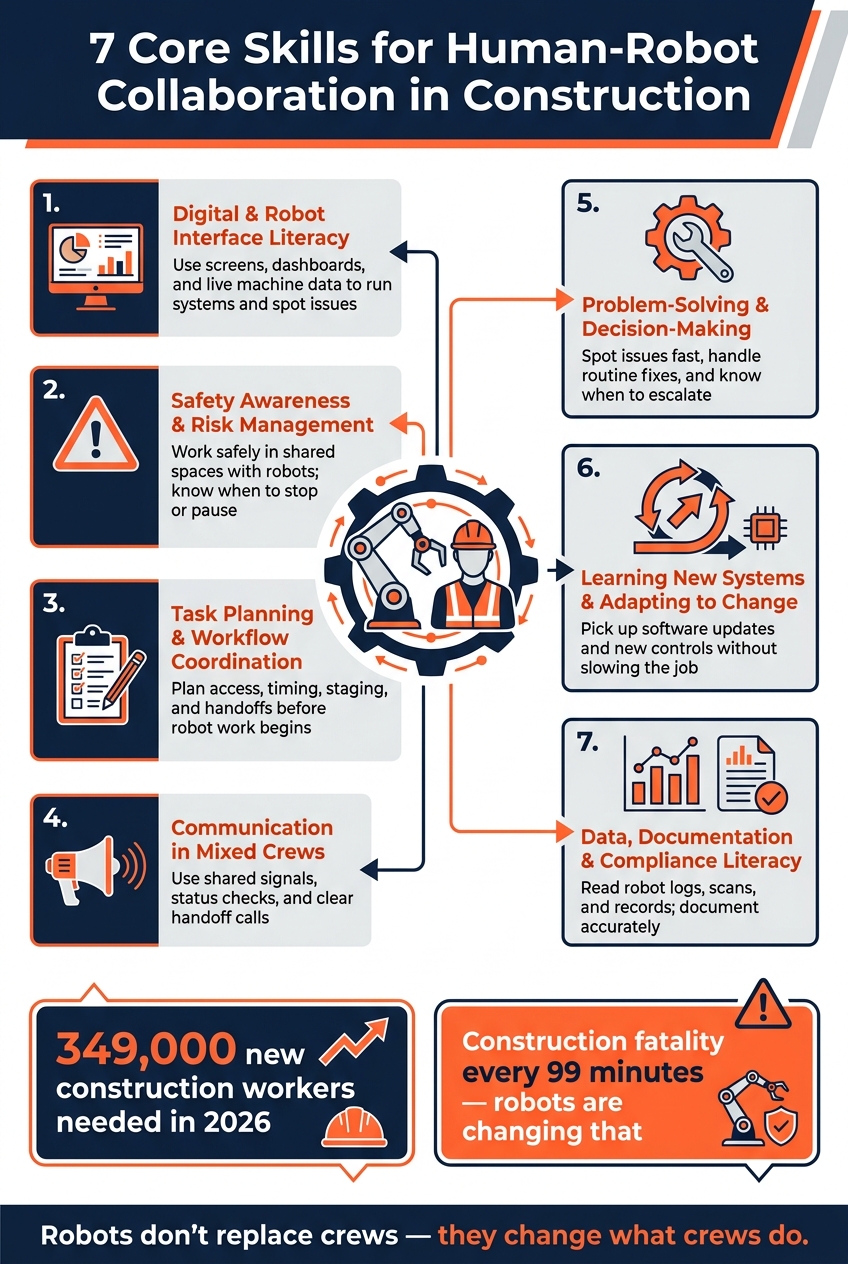
Construction crews don’t just need trade skills now – they also need to work side by side with robots. If I had to sum up the article in one line, it’s this: the job is shifting from pure manual labor to setup, monitoring, safety checks, problem-solving, and data handling.
Here’s the short version:
- The U.S. construction industry needs about 349,000 new workers in 2026
- Construction deaths still happen about every 99 minutes
- Robots are taking on repetitive, heavy, and high-risk work
- People still handle judgment, site changes, coordination, and quality checks
So if you want to work well in a mixed human-robot crew, I’d focus on 7 core skills:
- Digital and robot interface literacy
You need to use tablets, dashboards, and control panels, and understand what the machine data is telling you. - Safety awareness and risk management
You need to know where the robot is, where it may move, and how to stop or pause work when something looks off. - Task planning and workflow coordination
Robot work needs clear staging, access, timing, and handoff points. You can’t just “figure it out” in the moment. - Communication in mixed crews
Teams need shared signals, clear status checks, and simple handoff rules before robot movement starts. - Problem-solving and decision-making
When a robot stops, drifts, or hits a site issue, workers need to spot the cause and decide the next step fast. - Learning new systems and adjusting to change
Software, sensors, and controls change often. Workers need to learn updates without slowing the job. - Data, documentation, and compliance literacy
Robots create logs, maps, scans, cycle counts, and layout data. Workers need to read and record that information the right way.
The main point: robots do not replace crews. They change what crews do. People move toward supervision, coordination, troubleshooting, and quality control.
Quick comparison
| Skill | What it means on site | Why it matters |
|---|---|---|
| Interface literacy | Use screens, controls, and live machine data | Helps workers run systems and spot issues |
| Safety awareness | Work safely in shared spaces with robots | Cuts risk when people and machines work close together |
| Task planning | Plan access, timing, staging, and handoffs | Keeps robot work from stalling other trades |
| Communication | Use shared calls, signals, and status checks | Keeps crews aligned when conditions shift |
| Problem-solving | Fix routine issues and know when to escalate | Limits downtime and job delays |
| Learning new systems | Pick up updates and new controls fast | Helps crews keep pace with changing tools |
| Data and compliance | Read logs, scans, and records | Supports quality, tracking, and rule compliance |
If I were reading this article to get the answer fast, this would be it: the best human-robot workers combine field awareness with digital skill, safe work habits, clear communication, and sound judgment.
7 Core Skills for Human-Robot Collaboration in Construction
Universal Robots help Autodesk push construction industry’s boundaries for human-robot collaboration
sbb-itb-aa28329
Why Human-Robot Collaboration Is Growing on U.S. Construction Sites
Robots are showing up on U.S. jobsites for a simple reason: the pressure is building from every direction.
Three things are driving the shift. First, there aren’t enough people to fill open roles. The construction industry needs to attract roughly 349,000 net new workers in 2026 to meet demand. Second, the work can be dangerous. Construction is still one of the most hazardous industries in the world, with worker fatalities occurring about every 99 minutes. Third, productivity growth has been slow, and firms are looking for ways to get more done without cutting corners.
This isn’t limited to one corner of the market, either. Adoption is spreading across commercial and industrial construction, infrastructure, and specialty trades like welding, joint sealing, bricklaying, and ceiling-glass installation.
Just as important, the job itself is starting to change. Instead of spending all day on repetitive physical tasks, workers are moving into roles tied to setup, monitoring, troubleshooting, workflow coordination, and quality checks. In plain English, the work doesn’t disappear – it shifts. And that shift puts digital control, safety awareness, and coordination front and center in the skills covered next.
1. Digital and Robot Interface Literacy
The first skill is simple to describe, but it matters a lot on site: workers need to know how to use the tech itself.
That includes control panels, tablets, and dashboards used to manage robots and autonomous equipment. It also means reading machine data in real time and knowing what that data is saying in the moment, not five minutes later. In construction HRC, experts rank human-robot interfaces and robot control systems among the top five critical knowledge areas.
This kind of interface literacy does more than help someone operate a screen. It helps workers spot unsafe system behavior before it turns into a jobsite hazard.
You can already see this on sites using large mixed-fleet hauling systems. Those setups depend on workers who can monitor multiple machines from one interface.
And that skill comes from training, not just software. Manufacturers are pulling more machine data into a single dashboard. Komatsu’s "My Komatsu" platform and Caterpillar’s AI-integrated systems show how interface complexity grows as fleet size grows.
So digital interface training should be part of equipment onboarding from day one. Workers who can read machine data, flag anomalies, and use control systems help keep autonomous equipment productive and compliant.
Once workers can read the system, the next step is knowing how to respond safely when conditions change.
2. Human-Robot Safety Awareness and Risk Management
Once workers can read the system, they also need to read the risk around it.
Old-school equipment safety depends on separation: fixed exclusion zones, swing radii, and physical barriers that keep people away from machines. Human-robot collaboration changes that setup. Robots and workers now share the same space, often at the same time. Both industry professionals and academic experts rank "HRC safety and standards" among the top five most critical knowledge areas for the modern construction workforce.
The core skill here is spatial awareness. Workers need to know where a robot is, where it’s going, and how to place themselves around it. Autonomous equipment uses sensors and cameras to detect people and adjust in real time, but that doesn’t mean workers can treat it like magic. They still need to understand its limits. That matters around demolition machines, robotic material handlers, and autonomous haul trucks on tight job sites. In plain terms, robots call for new safety skills, not just old machine habits with a new label.
Workers also need to know how to step in when something goes wrong. That means spotting when a robot has run into an unexpected site condition and knowing how to request a new motion plan or safely pause operations.
Compliance adds one more layer. On top of standard OSHA requirements, HRC settings involve robot-specific documentation, including calibration records, sensor maintenance logs, and software version tracking. Those records help keep collaborative systems within safe operating limits.
Safe collaboration also depends on clear task handoffs and timing.
3. Task Planning and Workflow Coordination
Once crews know how to work safely around robots, the next step is planning the work around them. Human-robot handoffs can’t be improvised. They need to be planned. Robots bring their own pace, power, sensor reach, and movement limits.
Experts rank task planning near the top of the knowledge areas needed for effective human-robot collaboration because robots change the work sequence.
So crews can’t lean on old craft-based scheduling alone. They need to think in task blocks, with the robot treated as its own resource. It has its own timing, access needs, and work envelope. Before a robot starts, the crew should confirm access routes, staging areas, charging or power needs, and clear handoff points between human prep work and robotic execution. If a framing crew needs to finish before a drywall robot can move in, that’s not a nice-to-have. It’s a hard scheduling requirement.
Spatial planning matters just as much. Crews need to set clear operating zones for the robot and stage materials where its sensors and arms can actually reach them. A layout robot scanning a floor slab, for example, needs clear sightlines. Debris, parked equipment, or foot traffic in the wrong spot can stall the whole sequence.
Traditional scheduling tends to be linear. HRC planning is different. It’s zone-based, parallel, and tied to robot access, staging, and accountability. That leaves human crews focused on exceptions, adjustments, and oversight. And for that to work, teams need a fast way to communicate changes.
4. Communication and Teamwork in Mixed Crews
Mixed crews need a shared way to communicate. That’s because robots don’t pick up context the way people do. A 2025 Delphi study ranked communication and robot interface skills among the most critical skills for construction workers entering mixed-crew environments, which puts shared signals and clear crew communication on the same level as machine operation.
The hard part is that robots don’t signal status like people do. Workers have to read status lights, interpret safety signals, and issue stop commands at the right moment. If that signal chain breaks, crew coordination can fall apart fast.
There’s another issue too. Research shows robots can reduce face-to-face interaction, and that can weaken communication and crew cohesion. In plain terms, when people talk less, handoffs get shakier and small misunderstandings can snowball. Supervisors can help by standardizing verbal or digital handoff calls before robot movement starts. That gives crews a clear checkpoint before anything moves.
In mixed crews, communication has to stay shared, clear, and consistent so people can react fast when conditions shift. That common language matters most when crews have to solve problems in real time.
5. Problem-Solving and Decision-Making
When a robot stops in the middle of a task on an active jobsite, somebody needs to figure out what went wrong – and fast. That could mean checking an alert, noticing an obstruction, or seeing that uneven ground is throwing off the robot’s position. This is where human judgment matters. It can be the difference between a short pause and a much bigger delay. On mixed crews, workers need to clear the obstacle, decide what to do next, or shut the system down before the slowdown spreads.
That same judgment applies to site conditions in real time. Construction sites change constantly. Surfaces shift, materials stack up, and other trades move through the same area. Because of that, problem-solving isn’t a nice extra skill. It’s part of the job. A 2025 Delphi study identified problem-solving, critical thinking, and spatial awareness as three of the most critical abilities for workers in human-robot collaboration environments.
A bricklaying project shows the same thing in practice: robots still rely on human crews to coordinate material flow and keep the workspace clear.
Not every problem needs to go up the chain. Workers should know how to handle routine adjustments on their own, such as software resets and simple interface errors. Hardware failures and compliance issues should go to a technician or supervisor. Clear escalation rules help crews keep working without unnecessary stoppages.
It also helps to log every unexpected robot stop or deviation. Those notes make future troubleshooting faster and improve planning for the next job. They also give crews a simpler way to get up to speed with new systems on the next task.
6. Learning New Systems and Adjusting to Change
Once workers can operate and coordinate with robot systems, they still have to keep pace as those systems shift.
Construction robots move fast. Software updates, sensor upgrades, and new controls can change how a system works from one phase to the next. That means workers often need to relearn tools fast and make adjustments in the middle of the job. Interfaces change, habits have to change with them, and that puts learning right in the middle of daily work.
In human-robot crews, the most useful workers are the ones who can reset, relearn, and adjust without slowing everything down.
Workers who expect frequent updates tend to adjust faster and make fewer operating errors. And workers who understand both the tool and the workflow usually adopt new systems faster, make fewer errors, and keep productivity steady.
That is why upskilling needs to be continuous, short, and tied to daily tasks. Instead of long training sessions that pull people away from the site, it helps to build learning into the work itself. A short refresher before a shift or a quick walkthrough during setup can go a long way.
It also helps to pair newer workers with experienced operators so teams learn faster and adjust together. That exchange should go both ways. One person may know the machine better, while another may spot a better way to fit it into the crew’s workflow. That kind of back-and-forth keeps the whole team moving forward.
7. Data, Documentation, and Compliance Literacy
Once workers know how to run the system, the next job is reading the records it creates. That part matters more than it sounds. Construction robots produce a steady flow of data, and crews need to read it, check it, and record it the right way.
Drones, laser scanners, RFID systems, autonomous haulers that produce cycle counts and machine-performance data, and robotic total stations all generate information used for monitoring, progress checks, quality control, and coordination.
Modern jobsite systems turn machine activity into live production data that workers have to read and act on.
Workers also have to log robot activity and confirm that it stays within required safety and regulatory limits. That means checking compliance and keeping the records that the job, the company, and regulators may require.
These records show up across the main robot systems crews use now:
| Robot/Technology | Key Data Workers Manage | Documentation / Compliance Focus |
|---|---|---|
| Drones (UAVs) | Site maps, inspection images, flight logs | Flight regulations, site monitoring standards |
| Laser Scanners | 3D spatial data, progress measurements | Quality control verification, BIM integration |
| Autonomous Haulers | Cycle counts, machine performance | Safety protocol logs, telematics records |
| RFID Systems | Material location, inventory movement | Resource tracking documentation |
| Robotic Total Stations | Layout coordinates, model-based positioning | BIM data and field coordination records |
Put simply, workers need to understand the data the robot produces and document it with care.
Traditional Equipment Safety vs. HRC-Specific Safety Practices
Safety on construction sites has always been serious business. Once robots show up, though, the playbook changes. Moving from standard equipment safety to human-robot collaboration, or HRC, means moving to a different way of controlling risk. And that shift changes how crews work around machines.
With standard equipment like excavators or cranes, the main rule is simple: keep people away from the machine. Physical barriers, exclusion zones, and lockout/tagout (LOTO) procedures do most of the work. A person is either operating the machine or staying clear of its area. OSHA’s construction standards under 29 CFR 1926 cover most of those cases.
HRC works differently. Humans and robots share the same space. Instead of fixed separation, safety depends on virtual "fences", real-time sensors, and software that watches distance and limits force. The main standards here are ISO 10218 and ISO/TS 15066. In the U.S., contractors also need to account for OSHA’s General Duty Clause, which requires employers to deal with recognized hazards, including hazards tied to robotic systems.
This side-by-side view shows what changes when machines move from isolated operation to shared work zones.
| Feature | Traditional Equipment Safety | HRC-Specific Safety |
|---|---|---|
| Primary Goal | Keep humans physically separated from machines | Enable safe interaction in shared work zones |
| Safety Barrier | Physical guards, fences, exclusion zones | Virtual fences, sensors, collision-avoidance software |
| Regulatory Framework | OSHA 29 CFR 1926 | ISO 10218, ISO/TS 15066, OSHA General Duty Clause |
| Key Safety Tech | Emergency stops, lockout/tagout (LOTO) | Power and Force Limiting (PFL), Speed and Separation Monitoring (SSM) |
| Worker Role | Operator or bystander outside the zone | Collaborator, supervisor, or co-worker alongside the robot |
| Machine Behavior | Predictable, repetitive, or human-steered | Adaptive, autonomous, and responsive to people and site conditions |
| Incident Response | Manual stop and mechanical repair | Control-system checks and software troubleshooting |
The risk profile changes too. Standard equipment safety is mostly about mechanical failure and people getting into a machine’s operating envelope by mistake. HRC brings a different set of problems: sensor latency, software glitches, unexpected robot paths, and interaction errors that a fence alone can’t stop.
That is why HRC safety calls for new crew skills. Workers need human-robot interface, or HRI, literacy. They need to understand robotic control systems. They also need strong spatial awareness, because these work zones are more dynamic and less predictable than standard machine setups.
For contractors, training has to go beyond basic machine clearance. Crews should know how to read sensor feedback, track robot movement, and shut systems down safely. Those rules also affect how teams split tasks between people and robots.
Who Does What: Human-Led, Robot-Led, and Shared Tasks
Safety rules set the baseline for HRC. But on the jobsite, crews also need a clear answer to a practical question: who owns the task?
Once people know how to work around robots safely, the next step is deciding who leads what. That decision usually comes down to interface literacy, coordination, and problem-solving. Some tasks still belong with people. Some are a better fit for robots. And some work best when both handle different parts of the same job.
A simple way to sort the work is to split it into three buckets: human-led, robot-led, and shared. This helps teams assign work based on the task itself, not just the trade name on someone’s badge.
| Construction Activity | Human-Led | Robot-Led | Shared |
|---|---|---|---|
| Layout Marking | BIM data setup, coordinate verification, and final quality checks | High-precision marking on floors and ceilings | Real-time adjustments when site conditions differ from the model |
| Drilling | Positioning, bit changes, and workflow coordination | Repetitive overhead or floor drilling | Human monitors via interface; robot executes drilling |
| Rebar Tying | Rebar placement, complex intersections, and inspection | Repetitive wire tying at standard intersections | Human feeds rebar; robot performs high-volume tying |
| Material Handling | Complex rigging, navigation in unstructured areas, and logistics planning | Heavy lifting and autonomous transport across clear paths | Human loads and unloads; robot handles transport |
| Site Scanning | Data interpretation and compliance auditing | Autonomous data collection via UAVs or UGVs | Human sets flight or path parameters; robot executes 3D mapping |
| Demolition | Structural assessment and safety perimeter management | High-risk breaking and debris handling in unstable zones | Human operates the robot remotely; robot performs the impact work |
| Drywall/Glass Install | Fine adjustments and site-specific deviation handling | Precision placement guided by BIM | Robot positions materials; human intervenes for corrections |
The main thing to remember is this: robot-led does not mean human-free.
Even when the robot handles most of the physical work, crews still need to read the interface, track progress, spot issues, and adjust when conditions change. That split only works if people can communicate clearly and respond fast when the site doesn’t match the plan.
How Contractors and Workers Can Build These Skills
Once teams know which tasks are human-led, robot-led, or shared, training needs to match those roles exactly. Vendor-led onboarding should cover machine controls, safety steps, and the data workers will use on site. After that, crews need hands-on practice before they work near live machines. Short, layered modules work well here because they let people build skills step by step, from setup to live operation.
On-the-job mentoring matters just as much. Pair experienced operators with workers who move fast with digital tools, and you get a strong mix of field judgment and interface know-how. As NCCER‘s Lisa Strite notes, training performs best when it is built into the robotic equipment purchase or lease.
For contractors running more than one crew, ABLEMKR can track certifications, safety training, and worker availability in real time. That matters because the job is moving away from repetitive labor and toward operating and overseeing robotic systems. Verified worker profiles also make it easier to place the right people on mixed-crew jobsites without manual vetting.
Conclusion
These skills work together as a system: interface literacy, safety awareness, coordination, communication, judgment, adaptation, and documentation. When they come together, robots stop being just tools and start functioning like reliable crew partners.
HRC works when crews can run the system, stay safe around it, and adjust on the fly. That gap in skills helps explain why demand is climbing for robot-ready workers who can handle this kind of work well.
Demand for robot-ready workers is going up, and crews with verified HRC skills will get placed faster and work more safely. Workers stepping into these roles are moving into jobs that are safer and focused on operating and coordinating robotic systems.
For contractors, the upside is simple: train for HRC now, and crews can use robots with fewer delays, fewer risks, and better jobsite control. The crews learning these skills today will be the ones ready for the next wave of construction work.
That shift is already happening on U.S. jobsites.
FAQs
Do robots replace construction workers?
No. Robots are built to assist construction workers, not replace them.
They help with jobsite safety, labor shortages, and output on the worksite.
What training do crews need first?
Crews should start with human-robot interfaces, safety standards, and task planning.
They also need a mix of hard and soft skills, including:
- Technical know-how
- Safety management
- Communication
- Safety awareness
- Problem-solving
- Spatial awareness
Which construction tasks are best suited for robots?
Robots work best on construction jobs that are repetitive, risky, or physically demanding.
That’s why they’re often used for tasks like material handling, demolition, rebar tying, welding, and site surveying.


