
The U.S. offshore wind industry is growing fast, aiming for 30 GW of capacity by 2030. But there’s a major issue: a shortage of skilled workers. The industry needs 62,000 workers by 2030, with 38,000 roles unfilled, especially in offshore wind. Globally, the wind sector faces a 6–8% workforce gap by 2028, requiring over 532,000 technicians. Without enough qualified talent, projects risk delays and higher costs.
Key challenges include:
- High demand for specialized skills: Floating wind platforms need expertise in mooring systems and dynamic cables.
- Competition with other industries: Oil & gas offers higher pay and overlaps with 60% of offshore wind skills.
- Regional shortages: East Coast states lack local talent and training centers.
Solutions:
- Recruit from related industries: Oil & gas, construction, and marine sectors offer transferable skills. Fast-track retraining programs help workers transition to wind energy.
- Expand training programs: Focus on certifications like GWO, regional training centers, apprenticeships, and rapid upskilling bootcamps.
- Leverage technology: Platforms like ABLEMKR streamline workforce management, matching pre-vetted workers to jobs, tracking certifications, and simplifying payroll.
- Promote diversity: Target underrepresented groups through outreach, scholarships, and mentorship programs.
- Government and industry partnerships: Align funding and expertise to create job-specific training pipelines.
The industry must act now, combining short-term recruitment strategies with long-term workforce planning to meet future demands and ensure project success.
A New American Workforce – Building a Diverse, Skilled Offshore Wind Workforce
What Causes the Talent Gap
Several factors contribute to the shortage of skilled workers in the offshore wind industry, making it increasingly challenging to staff projects effectively.
Industry Growth and Worker Demand
The rapid expansion of offshore wind energy is one of the biggest reasons behind the talent gap. With the U.S. government aiming to achieve 30 GW of offshore wind capacity by 2030, the demand for skilled workers has skyrocketed – far outpacing the current workforce’s capacity.
Adding to the challenge is the shift toward advanced technologies like floating platforms. Unlike traditional fixed-bottom wind farms, these platforms require workers with specialized knowledge in areas such as mooring systems, dynamic cable installation, and platform maintenance. These skills are relatively rare, creating a significant hurdle for the industry. Globally, the wind sector is projected to face a 6–8% workforce shortage by 2028, and 40% of those roles will need to be filled by people entirely new to the wind industry.
The rapid pace of growth means the industry can’t rely solely on experienced offshore workers anymore. Instead, it must ramp up efforts to recruit and train new talent, which adds further strain to an already competitive labor market.
Competition with Other Industries
Offshore wind companies are also competing with other sectors for skilled workers, and this competition is fierce. The oil & gas industry, for example, offers higher salaries and well-established career paths, making it a tough rival for attracting talent.
This challenge is compounded by the overlap in skills between industries. Around 60% of the skills required for floating offshore wind positions are shared with oil & gas roles. However, transitioning workers from oil & gas to offshore wind isn’t always straightforward – they need to adapt to different safety standards and learn wind-specific technical skills, which can be a time-consuming process.
Other industries, like construction and marine sectors, also pull from the same talent pool. Project managers, engineers, and technical specialists often move between these industries, drawn by better pay or more stable career opportunities. This competition further reduces the number of workers available for offshore wind projects.
Regional Worker Shortages
Geography plays a big role in the talent gap too. Offshore wind development in the U.S. is heavily concentrated along the East Coast, particularly in states like New York, Massachusetts, and New Jersey. These areas face some of the most severe worker shortages because they lack the deep pools of talent seen in regions with established oil & gas industries.
To meet staffing needs, companies often have to recruit from other states or bring in workers from unrelated industries. However, these workers usually require extensive retraining to meet the demands of offshore wind roles. The shortage is further exacerbated by the limited availability of local training centers and the need for certifications like GWO (Global Wind Organisation) certifications, which are essential for many roles.
This mismatch between where the projects are located and where skilled workers live highlights the need for creative solutions, such as digital workforce management tools, to bridge the gap.
How to Bridge the Talent Gap
The offshore wind sector needs to act now to build its workforce by tapping into nontraditional talent pools.
Recruiting from Other Industries
Workers from the oil and gas sector bring a solid starting point, with about 60% of their skills overlapping with those needed for floating offshore wind operations. Other industries like construction, shipping, and utilities also offer professionals with expertise in marine operations, electrical systems, project management, and managing large-scale infrastructure. To make the transition smoother, skills transfer programs are critical. These programs focus on modular training courses that cover turbine technology, offshore safety standards, and the regulatory requirements specific to renewable energy.
Fast-track retraining initiatives allow oil and gas engineers to quickly adapt by building on their existing knowledge while addressing key differences between fossil fuel and renewable energy operations. Companies are also bridging gaps in salary expectations and workplace culture by offering comprehensive onboarding programs. These programs help new hires understand the innovation-focused nature of the renewable energy sector and provide clear career advancement opportunities.
Beyond recruitment, targeted training and rapid upskilling programs ensure that new workers are fully prepared to meet the demands of the offshore wind industry.
Training and Upskilling Programs
The Global Wind Organization (GWO) certification is the gold standard for offshore wind workers, equipping them with essential safety and technical skills regardless of their previous industry experience. To meet urgent staffing needs, rapid upskilling bootcamps help workers get job-ready while also laying the groundwork for long-term expertise.
Regional training centers offer hands-on, accessible training, reducing the need to bring in workers from outside the area. In coastal U.S. states, partnerships between community colleges and wind developers have created tailored programs that lead directly to job opportunities.
Apprenticeship programs combine classroom learning with real-world experience over 12 to 24 months, pairing trainees with experienced offshore wind professionals for mentorship. Companies are also focusing on continuous learning opportunities for their current workforce. Flexible training options, including online modules and modular in-person sessions, help workers keep up with evolving technologies.
These structured training efforts are crucial for building a skilled and adaptable offshore wind workforce.
Diversity and Inclusion in Worker Development
The offshore wind industry understands that diversity sparks innovation and helps address labor shortages by drawing from underutilized talent pools. Inclusive hiring practices, paired with technical training programs, further expand the available workforce.
Targeted outreach connects companies with underrepresented groups through partnerships with community organizations, veterans’ groups, and technical schools. Scholarship and mentorship programs help remove financial barriers for students and career changers while offering guidance from experienced industry professionals.
Companies are also revising job requirements to eliminate unnecessary hurdles, focusing on essential skills rather than traditional industry experience. The sector values career changers from fields like teaching, the military, and manufacturing, as they bring critical skills like problem-solving, attention to detail, and teamwork – qualities that align well with offshore wind operations.
sbb-itb-aa28329
Using Technology for Worker Solutions
Offshore wind companies are turning to digital tools to address workforce challenges, making operations smoother and reducing reliance on hard-to-find talent.
Digital Tools for Worker Management
Automation and remote monitoring are reshaping how offshore wind farms function, tackling labor shortages by cutting the need for hard-to-fill positions. For instance, remote monitoring allows onshore teams to oversee turbine performance, weather conditions, and equipment status, significantly reducing the number of technicians required on-site.
Predictive maintenance, drone inspections, and AI-driven diagnostics are game-changers. These tools help predict potential issues, eliminating the need for risky manual inspections. They also enable companies to plan maintenance during favorable weather conditions, ensuring crews are deployed efficiently instead of rushing to handle emergency repairs.
These advancements ensure that companies can operate safely and efficiently with fewer workers, all while maintaining high safety and performance standards. To further optimize operations, integrated platforms are taking workforce management to the next level.
ABLEMKR‘s Worker Deployment Solution
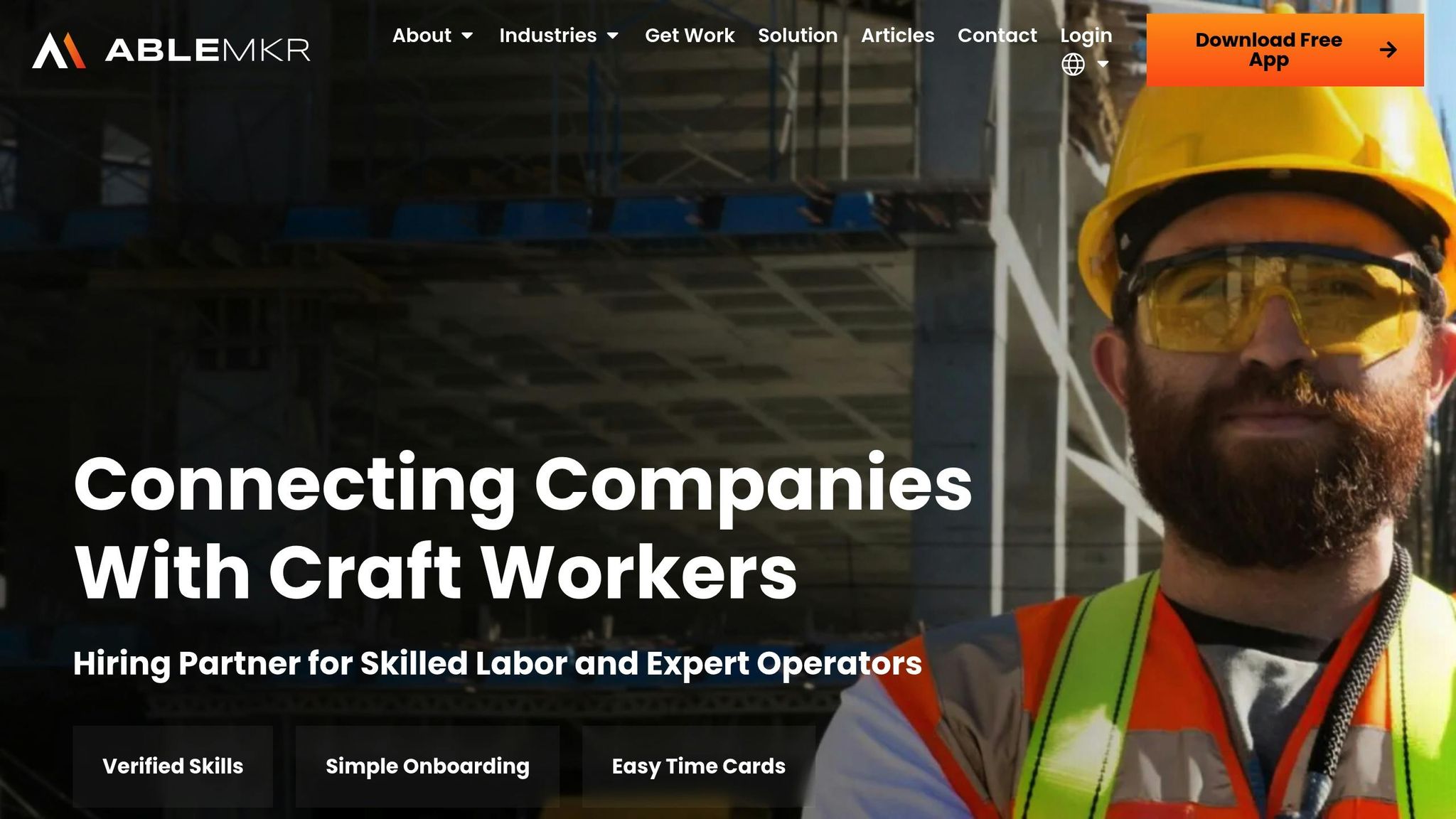
Digital innovation is driving the development of integrated workforce platforms, and ABLEMKR is leading the charge with its tailored solution for the offshore wind industry. Their platform is built to address talent shortages using advanced technology designed for high-demand sectors.
The mobile-first platform connects pre-vetted workers to offshore projects based on their certifications, safety training, availability, and location. This precise matching ensures that companies can quickly assemble teams with the exact expertise needed – whether it’s for turbine repairs, electrical work, or marine operations.
With real-time worker tracking, project managers gain full visibility into their teams. They can monitor worker availability, current locations, and task progress, which helps minimize delays caused by weather or logistical challenges.
Integrated payroll workflows simplify administrative tasks. Instead of juggling multiple systems for hiring, timekeeping, and payments, everything is handled in one seamless process. Workers benefit from timely payments, a key factor in attracting and retaining talent in a competitive market.
Compliance tracking is embedded into the platform, automatically verifying that workers meet safety and certification requirements, such as GWO credentials and safety training records. This ensures that only qualified personnel are deployed to critical tasks, reducing risks and maintaining project integrity.
The platform also offers flexible scheduling options tailored to the offshore wind sector’s unique demands. Companies can hire temporary workers for short-term projects, use flex-to-hire arrangements to evaluate candidates for permanent roles, or directly hire for long-term positions. This flexibility is crucial in an industry where staffing needs often shift due to unpredictable project timelines and weather conditions.
With its strong foothold in key U.S. energy regions, ABLEMKR is positioning itself as a vital partner in the energy transition. By leveraging smart technology and streamlined processes, they’re helping offshore wind companies tackle workforce challenges and stay ahead in a rapidly evolving industry.
Building a Long-Term Offshore Wind Workforce
Creating a dependable offshore wind workforce requires a mix of strategic partnerships and consistent training efforts to ensure a steady supply of skilled professionals for decades to come. At the heart of this approach are strong collaborations between public and private sectors.
Industry and Government Partnerships
Public–private partnerships are essential for developing a workforce that meets the demands of the offshore wind industry. These collaborations align federal funding with industry expertise to design training programs tailored to real-world needs. For instance, the U.S. Department of Energy‘s Wind Workforce Development Program partners with state governments and private companies to fund initiatives that develop job-specific curricula.
On a state level, initiatives like New York’s Offshore Wind Training Institute, along with similar programs in New Jersey and Massachusetts, demonstrate how aligning government funding with industry requirements can create effective training pipelines. These partnerships leverage public resources and private knowledge to reduce risks and ensure workers are prepared for the field.
Standard Training and Certifications
Uniform training programs and certifications play a key role in ensuring workers can transition seamlessly across regions. When technicians meet consistent safety and technical standards, companies can allocate personnel where they’re most needed. The Global Wind Organization (GWO) certification, for example, has become a widely recognized benchmark for safety and technical skills in the U.S., with many industry leaders advocating for its broader adoption to simplify hiring and improve workforce mobility.
However, challenges persist. Variations in state regulations, differing educational resources, and inconsistent recognition of certifications can complicate worker mobility. In some cases, additional safety modules or specific licensing requirements create barriers that prevent technicians from easily moving between states. Addressing these issues will require collaboration among state agencies, industry groups, and training providers to harmonize standards and promote mutual recognition of credentials. Streamlined certifications are critical to building a reliable and mobile workforce.
Long-Term Worker Planning
Long-term workforce planning is vital for stability and growth in the offshore wind sector. Multi-year staffing agreements, already adopted by major developers, provide job security, reduce turnover, and allow for continuous training – all of which cut recruitment costs and improve workforce satisfaction.
Planning must also factor in future industry growth. According to the Global Wind Workforce Outlook, 532,000 new technicians will be needed worldwide by 2028, with a projected global shortage of 6–8% in skilled wind technicians by that time. Meeting this demand will require proactive strategies to ensure workers are trained and prepared for evolving industry needs.
Digital platforms, like ABLEMKR’s system, are proving invaluable in long-term workforce planning. These tools maintain up-to-date worker databases, track certifications, and provide consistent job opportunities. This ensures companies can access qualified talent as projects scale up while offering workers steady employment in a rapidly expanding industry.
The most effective long-term strategies combine job security, professional growth opportunities, and competitive pay. By investing in their workforce, companies not only foster loyalty but also develop the expertise needed to manage increasingly complex offshore projects. These efforts ensure a robust talent pipeline, helping the offshore wind industry grow and thrive.
Conclusion: Solving the Offshore Wind Talent Shortage
The offshore wind industry faces a pressing challenge: a shortage of skilled workers. Addressing this requires a mix of training programs, cross-sector partnerships, and smart use of technology to meet the growing demand for talent. Together, these elements create a roadmap to build a workforce capable of sustaining the industry’s rapid expansion.
Globally, the wind sector will need over 532,000 technicians by 2028. In the U.S. alone, the shortfall is projected to peak at nearly 38,000 workers by 2030. One immediate solution lies in recruiting from adjacent industries, especially since there’s a 60% skills overlap between offshore oil & gas and floating offshore wind. This overlap offers a fast track to filling gaps while more comprehensive training initiatives take shape.
Specialized training programs remain critical for long-term workforce development. GWO-certified training and upskilling programs have already shown success in countries like the UK, where focused efforts helped increase offshore wind jobs from 26,000 to 69,000. In the U.S., community colleges, union-led apprenticeships, and industry collaborations are creating education pipelines that directly address the needs of real-world offshore projects.
Technology also plays a transformative role. Tools like ABLEMKR’s workforce deployment platform streamline how companies manage skilled labor. By matching pre-vetted workers to job sites based on certifications, safety training, and availability, these platforms reduce inefficiencies in labor deployment. Features like real-time worker tracking, integrated payroll systems, and compliance monitoring help operators quickly mobilize teams for critical offshore projects. While technology solves immediate challenges, it also lays the groundwork for a more agile and responsive workforce.
A winning strategy combines short-term fixes with long-term planning. Cross-sector recruitment and digital platforms tackle immediate gaps, while standardized certifications and multi-year workforce agreements build lasting stability. Partnerships between industry and government ensure that training programs are well-funded and aligned with the latest technological advancements.
Collaboration is key. Developers, government agencies, educational institutions, and technology providers must work together to close the talent gap. Companies that invest early in workforce strategies, adopt advanced deployment tools, and support standardized training will be best equipped to thrive in this booming sector. By aligning training, technology, and partnerships, stakeholders can effectively address the offshore wind talent shortage and secure the industry’s future growth.
FAQs
What skills are required to work on floating offshore wind platforms, and how can workers develop them?
Working on floating offshore wind platforms demands a mix of technical know-how, safety awareness, and operational skills. Key areas of expertise include offshore safety protocols, marine operations, electrical and mechanical systems, and a solid understanding of renewable energy technologies. Workers also need to excel at problem-solving and be prepared to adapt to challenging and unpredictable environments.
Building these skills often involves a combination of education and practical experience. Specialized training programs and certifications, such as GWO Basic Safety Training, provide essential knowledge in offshore safety. Hands-on experience gained through apprenticeships or internships is equally valuable. Additionally, connecting with industry-focused platforms like ABLEMKR can open doors to high-paying, critical roles in the energy sector while helping workers sharpen their expertise.
What can the offshore wind industry do to attract skilled workers and address talent shortages?
The offshore wind sector can tackle talent shortages by adopting focused strategies like investing in specialized training programs, collaborating with educational institutions, and utilizing modern workforce platforms. These initiatives ensure that workers gain the skills and certifications needed to meet the industry’s growing demands.
Platforms such as ABLEMKR are instrumental in simplifying workforce management. They connect skilled laborers to key projects by matching them based on certifications, availability, and location. This not only speeds up crew deployment but also ensures compliance with industry standards. For workers, it means access to flexible, well-paying opportunities, while companies benefit from reduced hiring challenges.
How can government and industry partnerships help solve the offshore wind talent shortage?
Government and industry partnerships are instrumental in tackling the offshore wind talent shortage. By working together, they can design training programs, open up job opportunities, and simplify workforce deployment. Strengthening these partnerships through technology-focused tools can make it easier to connect skilled workers with critical projects, ensuring a more efficient process.
For instance, platforms like ABLEMKR are making a difference by linking pre-qualified workers to job sites based on their certifications, safety training, and availability. Using such tools allows companies to assemble crews more quickly while maintaining compliance, helping to meet the rising demand for skilled professionals in the offshore wind industry.


