
Upstream executive hiring is high-stakes: one weak hire can hurt safety, output, cash flow, and board trust at the same time. If I were hiring for a U.S. oil and gas operator, I’d keep the process simple: define the business problem, target people with the right basin and role history, test them with hard interview questions, tie pay to results, and put a tight 90-day plan in place from Day 1.
Here’s the short version:
- Start with the business need, not the title. A COO, VP Drilling, VP HSE, or CEO should be tied to clear targets like output growth, lower LOE, lower NPT, or fewer safety events.
- Keep the candidate pool narrow. Upstream leadership is a small market. In 2023, the U.S. upstream sector supported 385,662 direct jobs, while production was up about 45% since 2015 even after about 80,000 jobs were cut.
- Look for direct upstream history. More than 90% of CEOs at top 200 E&P companies came from inside the industry. That tells me this market still leans hard on deep sector experience.
- Interview with proof, not talk. I’d score candidates on six areas: technical depth, judgment, safety leadership, finance, stakeholder handling, and use of data.
- Make pay match results. Bonus and long-term pay should connect to output, free cash flow, cost control, uptime, and safety.
- Treat onboarding as part of the hire. The first 90 days should include site visits, field reviews, early findings, and a 12–24 month plan.
A fast way to think about it: define, source, test, choose, onboard. That’s the whole playbook in plain English.
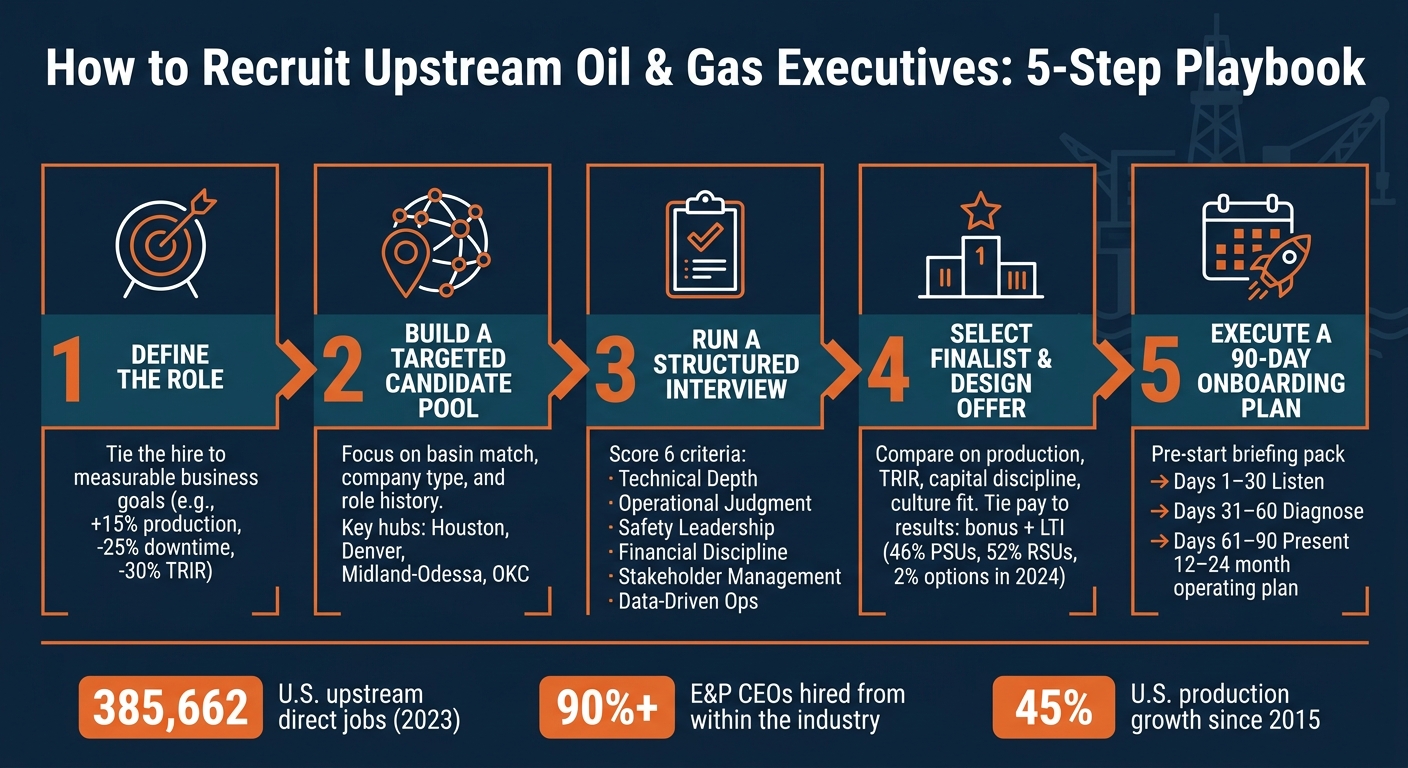
How to Recruit Upstream Oil & Gas Executives: 5-Step Playbook
1. Define the role and build the executive profile
Before you post a job or call a recruiter, get clear on what the business actually needs. Don’t hire a title. Hire the fix to a business problem. If field operations are scattered, you may need a COO or VP Operations. If investors are pushing hard, you may need a CEO with capital markets and IR experience.
Start with a simple diagnostic: what are your top 5–7 measurable priorities over the next three to five years? Keep them concrete. That might mean increasing production in the Delaware Basin by 15%, reducing LOE from $12.50 to $10.00 per BOE, cutting unplanned downtime by 25%, or lowering TRIR by 30%. Once you know the priority, match it to the executive seat that owns the result.
Map business priorities to leadership requirements
Each upstream executive role drives a different operating result, so the profile should match that role with precision.
| Business Priority | Best-Fit Role | Core Competencies Required |
|---|---|---|
| Production growth, LOE reduction, downtime | COO / VP Operations | Field execution, contractor management, artificial lift, multi-basin experience |
| Well cost reduction, completions optimization | VP Drilling & Completions | Well design, stage spacing, NPT reduction, vendor negotiations |
| Reserves replacement, new basin entry | VP Exploration | Subsurface interpretation, play evaluation, portfolio risk management |
| Safety performance, regulatory compliance | VP HSE / HSE Director | Behavior-based safety, incident investigation, TRIR/LTIR reduction |
| Capital discipline, investor relations, M&A | CEO / CFO | Portfolio strategy, capital allocation, board and lender management |
Spell out decision authority, P&L ownership, span of control, and reporting lines. Be plain about which calls sit with the role and which ones need CEO or board approval. That makes it easier to decide whether you need a VP or a C-suite leader, and it sets clear expectations before the first conversation.
The profile also needs to fit your ownership structure. A PE-backed shale operator often wants a COO focused on capital returns and operating discipline. A publicly traded E&P company needs leaders who can manage public-company reporting, investor communications, and stakeholder management. Same title, different job. Use this profile as your filter for sourcing, interviews, and offer design.
Set compensation, incentives, and relocation expectations
Upstream executive pay usually leans heavily on variable compensation, with bonuses and long-term incentives tied to production, LOE, EBITDA, free cash flow, and safety.
| Role | Typical Pay Mix | Key Performance Metrics |
|---|---|---|
| CEO | Heavy long-term incentive mix | Total shareholder return (TSR), ROCE, free cash flow, safety, emissions intensity |
| COO / VP Operations | Strong variable cash and meaningful LTI | Production volumes, LOE, uptime, NPT, TRIR |
| VP Drilling & Completions | Base plus bonus, with a smaller but meaningful LTI | $/well, NPT, safety incidents |
| VP Exploration | Base plus bonus, with a smaller but meaningful LTI | Reserves additions, successful wells |
| VP HSE | Competitive base and bonus, with LTI if safety is a board-level priority | TRIR, LTIR, audit scores, process safety events |
Long-term incentives – RSUs, performance shares, phantom equity, or options – should vest over three to five years and tie to durable outcomes, not short-term volume spikes.
For relocation, put expectations on the table early. Packages should cover home-sale help, temporary housing, moving costs, and pre-move visits. For remote basins like Midland–Odessa or the Bakken, add travel allowances or housing stipends, and state site-visit frequency in the role profile.
With the profile and package defined, the next step is building a targeted candidate list.
2. Build a targeted sourcing plan for upstream leadership
Keep the target profile tight: function, asset type, operating scale, and the growth problem the executive has already solved. Start with the role profile, then narrow the market from there.
Prioritize basins, companies, and leadership backgrounds
Begin with geography. Houston is a major energy hub and a natural starting point for most upstream searches. Denver and Oklahoma City offer deep pools of Rockies and Midcontinent leadership. Midland-Odessa is a core Permian talent center. Gulf Coast markets like Houston, Lafayette, and New Orleans are strong targets for offshore and services-side experience. The goal is simple: match each basin to the operating problem the role needs to fix.
Then map the target by company type. Different backgrounds tend to produce different kinds of executives, and that matters when the role calls for a specific style of leadership.
| Target Company Type | Preferred Operating Experience | Must-Have Leadership Traits |
|---|---|---|
| Independent E&P operators | Basin execution, reservoir management, capital efficiency | Fast decision-making, field credibility, cost discipline |
| Integrated producers | Portfolio management, governance, cross-functional scale | Process rigor, cross-functional coordination, capital allocation |
| Drilling contractors | Rig operations, uptime, safety, scheduling | Operational reliability, safety culture, fleet and crew management |
| Oilfield services firms | Field logistics, vendor management, mobilization | Commercial agility, margin control, deployment speed |
Use relationships and search partners
Relationships often get you to a credible shortlist faster than cold outreach. Boards, investors, industry associations, and trusted search partners can point you to leaders who have already run capital-constrained programs, safety turnarounds, or integrations.
Energy-focused retained search firms and basin-specific networks can also extend your reach in ways internal teams usually can’t. Use that source map to shape the interview shortlist in the next step.
3. Run a structured upstream interview process
Once you have a shortlist, the interview process should test fit, not just rubber-stamp it. For upstream executive roles, that means looking at six clear areas: technical depth, operational judgment, safety leadership, financial discipline, stakeholder management, and data-driven operations. Score each one against specific examples. Then use those same six areas to shape every interview.
Test technical, safety, and strategic leadership
Build your questions from big-picture strategy down to day-to-day execution.
Reserves strategy: Ask candidates to walk through a past role where they shaped reserves replacement. What portfolio moves did they make? What reserve replacement ratios did they deliver?
Drilling and completions performance: Ask for one campaign where they owned metrics like NPT, cost per foot, and safety. Then dig into what happened when results fell short of target.
Production optimization and process safety: If the conversation turns to artificial lift or facility throughput changes, ask how they kept well integrity and process safety margins in check.
Sustained safety performance: Ask which safety programs they personally led – behavior-based safety, stop-work authority, safety stand-downs – what their TRIR was when they came in versus when they left, and how they handled a near-miss.
Scenario prompts work better than loose, open-ended discussion. Put a $500 million budget in front of the candidate, split across a mature cash-generating basin, a higher-risk unconventional play, and a mid-cycle asset that needs maintenance capital. Then ask them to allocate that budget and explain why. Press on how they weigh breakeven prices, decline curves, and service cost inflation.
A second scenario should test price volatility response. For example, WTI drops from $80 to $55 per barrel while service costs stay flat. Ask how they would adjust drilling pace, operating costs, and stakeholder communication without cutting corners on safety.
Use scorecards, case exercises, and reference checks
Have every interviewer score the same criteria on a 5-point behavioral scale, tied to specific projects, metrics, and decisions. A 1 should signal a clear concern. A 5 should reflect clear, proven strength. Before interviews start, run a calibration session so the panel agrees on what “good” looks like for each criterion.
| Criteria | Weight (%) | Interviewer Score (1–5) | Comments |
|---|---|---|---|
| Safety & HSE leadership | 20 | 4 | Led TRIR reduction by 35% over 3 years |
| Technical upstream expertise | 15 | 3 | Strong in shale; limited deepwater experience |
| Financial & capital allocation | 20 | 5 | Rebalanced portfolio, +15% ROCE |
| Operational leadership | 15 | 4 | Managed multi-basin operations effectively |
| Stakeholder & regulatory management | 15 | 3 | Community pushback early; improved over time |
| Data-driven operations | 15 | 4 | Implemented real-time production analytics |
Add a case exercise too. A field-development case works well because it forces the candidate to deal with drilling, completion, infrastructure, and HSE constraints at the same time. Score that case with the same rubric so you can compare interview answers with how the person works through an actual operating problem.
Reference checks should follow the same structure. Use a standard form that mirrors the scorecard criteria, and speak with former direct reports, peers, and supervisors. For safety, ask specifically: How did safety performance metrics change under their leadership? and How did they handle a near-miss or incident? For operations, ask whether production, uptime, and cost targets were met on a steady basis – and what they did when performance slipped.
If references describe something that doesn’t line up with what the candidate said in interviews, flag it. Bring those gaps back to the panel before anyone moves to the offer stage.
Use the scorecard and reference feedback to rank finalists before moving to the offer. Then carry that same scorecard into finalist selection and offer design.
sbb-itb-aa28329
4. Select the finalist, design the offer, and complete pre-hire checks
Once you have the scorecard and reference feedback, turn it into a clear, written decision.
Compare finalists and document the decision
Bring the full group into one decision meeting. That should include the hiring manager, HR, the right business-unit leader, such as the EVP Upstream, and, for C-suite roles, the CEO plus at least one board or compensation committee representative. Review each finalist side by side on operating track record, capital discipline, safety, culture fit, leadership style, and compensation expectations.
| Criterion | Finalist A | Finalist B | Finalist C |
|---|---|---|---|
| Production & Uptime | +8% YoY; 97% uptime | +3% YoY; 94% uptime | Flat production; 96% uptime |
| Capital Discipline | FCF positive 4 of 5 years; ROIC 12% | FCF positive 3 of 5 years; ROIC 9% | FCF negative 2 of 5 years; ROIC 7% |
| Safety Performance | TRIR below peer median 5 consecutive years | TRIR improved but above median | TRIR variable; 2 recent incidents |
| Culture Fit | Strong field rapport; collaborative | Results-driven; more top-down | High change-agent; mixed feedback |
| Target Pay | ~$3.5M, flexible mix | ~$3.0M, high cash focus | ~$4.0M, heavy equity focus |
Don’t let the table do all the talking. Add short notes that explain the context behind the numbers, such as basin conditions or commodity price swings that shaped a candidate’s results. A flat production line can mean one thing in a weak asset and something very different in a mature field with tight capital limits.
After the meeting, write a short decision memo. It should spell out the process used, the data reviewed, the trade-offs discussed, which operating priorities the finalist is best suited to handle, and why the finalists were ranked the way they were. For public companies, this record helps support board fiduciary duties and gives you something solid if the hire is later reviewed by regulators, investors, or internal audit. For these roles, get the needed board or compensation committee sign-off before the offer moves ahead.
Use that ranking to lock in the pay mix, performance measures, and start-date terms.
Build an offer tied to upstream performance
The offer should lean toward variable pay tied to results the executive can influence. Use market data to set the mix, then connect payout to production, cash flow, safety, and returns.
Think of the offer in three layers. The annual bonus should tie to production versus plan, asset uptime, unit lifting and development costs, free cash flow, and safety measures such as TRIR and lost-time incident rate. The long-term incentive should lean on performance shares and restricted stock instead of options. In 2024, the oil & gas LTI mix was about 46% performance share units, 52% restricted stock units, and only 2% stock options.
For each KPI in the bonus and LTI plan, set clear threshold, target, and maximum levels. That way, the executive knows exactly what results lead to what payout. It also helps prevent windfall pay, where someone gets rewarded because oil prices jumped, not because they made better capital allocation calls.
Issue the offer on a conditional basis, then finish screening before final acceptance.
Before the offer is final, complete pre-hire due diligence. Run identity and credential checks, verify prior employment, review conflicts of interest, media, sanctions, and litigation, and complete drug and alcohol screening. Issue a conditional offer after approval, then finalize it once screening clears. Document each step so there’s a clean paper trail for internal policy and regulatory compliance.
Once the offer is accepted and the checks are cleared, move straight into the first 90 days.
5. Onboard the executive through the first 90 days
After the offer is accepted, onboarding becomes the last step that decides whether the hire works out. The first 90 days set the tone for the executive’s time in the role. Hiring doesn’t stop at acceptance. Onboarding is what shows whether the executive can deliver on the role profile. In upstream oil and gas, a weak start can hit capital, production, and safety fast.
Two to four weeks before Day 1, send a briefing pack with production, basin activity, well inventory, the drilling and completions schedule, HSE data, JV relationships, and board priorities. This gives the executive the operating context behind the priorities already defined in the role. Grant access before the start date to reserves data, type curves, drilling and completions KPIs, HSE records, vendor contracts, and financial models. Wrap up relocation, housing, travel, and per diem terms before Day 1.
Set early priorities, site visits, and reporting rhythms
Once the executive starts, the focus should move from prep work to relationships and field exposure. Use the first 30 days to listen and learn. Meet the CEO, CFO, COO, key asset leaders, and key board, investor, and JV contacts to understand the capital plan and risk scenarios.
Schedule two to three multi-day site visits in the first 60 days across a shale pad, mature conventional asset, liquids facility, and pipeline or gathering system. Field time shows what the priorities look like in day-to-day operations. Each visit should begin with a safety briefing on recent incidents and site-specific risks, followed by a walk with the site supervisor. Watch for PPE use, housekeeping, lockout/tagout discipline, stop-work authority, and crew engagement.
After the first month, shift from listening to diagnosis. Deliver a short memo that names three to five priorities and ties them to quantified impacts, such as cost overruns in a basin, contractor quality variance, or permitting bottlenecks. This memo helps test the assumptions behind the hire and check fit against the business problem. Run one cross-functional session with operations, drilling, geology, reservoir engineering, HSE, and finance to confirm immediate actions and refine dashboards, cadence, and decision rights.
By the final month, turn those findings into a working operating plan and cadence. Use this 90-day framework:
| Phase | Focus | Key Output |
|---|---|---|
| Pre-start | Data access, compliance, logistics | Briefing pack reviewed; systems access confirmed |
| Days 1–30 | Listening, relationship-building, field visits | First impressions memo; stakeholder map complete |
| Days 31–60 | Diagnosing, early decisions, pilot changes | Diagnostic memo with 3–5 priorities and quantified impact |
| Days 61–90 | Strategic plan, org decisions, reporting rhythm | 12–24 month plan presented to CEO and board |
By Day 90, the executive should present a 12–24 month operating plan with targets for production, TRIR, cost per well, and free cash flow. That 12–24 month plan should use the same production, safety, and cash-flow measures used during selection. The reporting rhythm should also be clear from the start:
- Weekly reviews on HSE incidents, production versus plan, drilling and completions progress, critical equipment status, and upcoming high-risk work
- Monthly reviews of well results versus type curves, cost per foot, LOE trends, project IRR, AFE deviations, and regulatory issues
- Quarterly updates on strategic and financial targets, risk register changes, and key talent or organizational updates
- Biweekly one-on-ones with asset leaders and the HSE head, plus monthly finance reviews
ABLEMKR can support real-time workforce visibility, certification tracking, and compliance monitoring across U.S. energy sites.
Conclusion: A repeatable process for stronger upstream executive hires
A disciplined 90-day onboarding plan helps turn a strong hire into a faster, lower-risk upstream leader.
FAQs
How long should an upstream executive search take?
For executive and highly specialized technical roles in upstream oil and gas, the search usually takes 85 to 120 days. Standard positions tend to land in the 65 to 85 day range.
That longer runway matters. With engineering and technical hiring ranked as a top challenge by 50% of managers, companies should expect a slower process when hiring for leadership posts or niche project roles.
What mistakes lead to bad upstream executive hires?
Bad upstream executive hires often come down to a few avoidable mistakes: vague job requirements, weak credential checks, and thin evaluation of technical ability, problem-solving, and people skills.
Another common issue is skipping fit checks and full background screening, including identity verification. Companies should also confirm certifications and project-specific experience to cut compliance, safety, and fraud risk.
How do you assess culture fit for upstream leaders?
Assess culture fit by looking past technical know-how and paying close attention to soft skills, communication, and a strong commitment to safety. Emotional intelligence matters here. It helps people build solid working relationships, stay steady in high-pressure settings, and make team members feel safe speaking up when something seems off.
At the same time, make sure the person has technical credibility and can shift how they communicate based on who’s in the room. A C-suite executive may care most about budgets and business trade-offs. A facility manager usually needs clear operational guidance and practical detail.


