
Hiring safety specialists for wind and solar projects is critical to ensuring worker safety, project efficiency, and regulatory compliance. These professionals manage risks such as fall hazards, electrical dangers, and high-altitude work while adhering to strict industry standards. Here’s a quick overview of what you need to know:
- Key Certifications: Look for GWO Basic Safety Training (BST), Advanced Rescue Training (ART), and NFPA 70E for electrical safety. Pair these with OSHA certifications for U.S. compliance.
- Experience: Prioritize candidates with hands-on experience in wind turbine or solar farm operations, including construction safety and maintenance protocols.
- Skills: Seek expertise in incident investigation, system analysis, and safety audits. Leadership and training abilities are also essential.
- Compliance: Specialists must navigate federal and local regulations, coordinate permits, and ensure adherence to OSHA standards.
- Hiring Tools: Platforms like ABLEMKR can simplify finding and vetting qualified professionals, offering features like certification tracking and flexible staffing options.
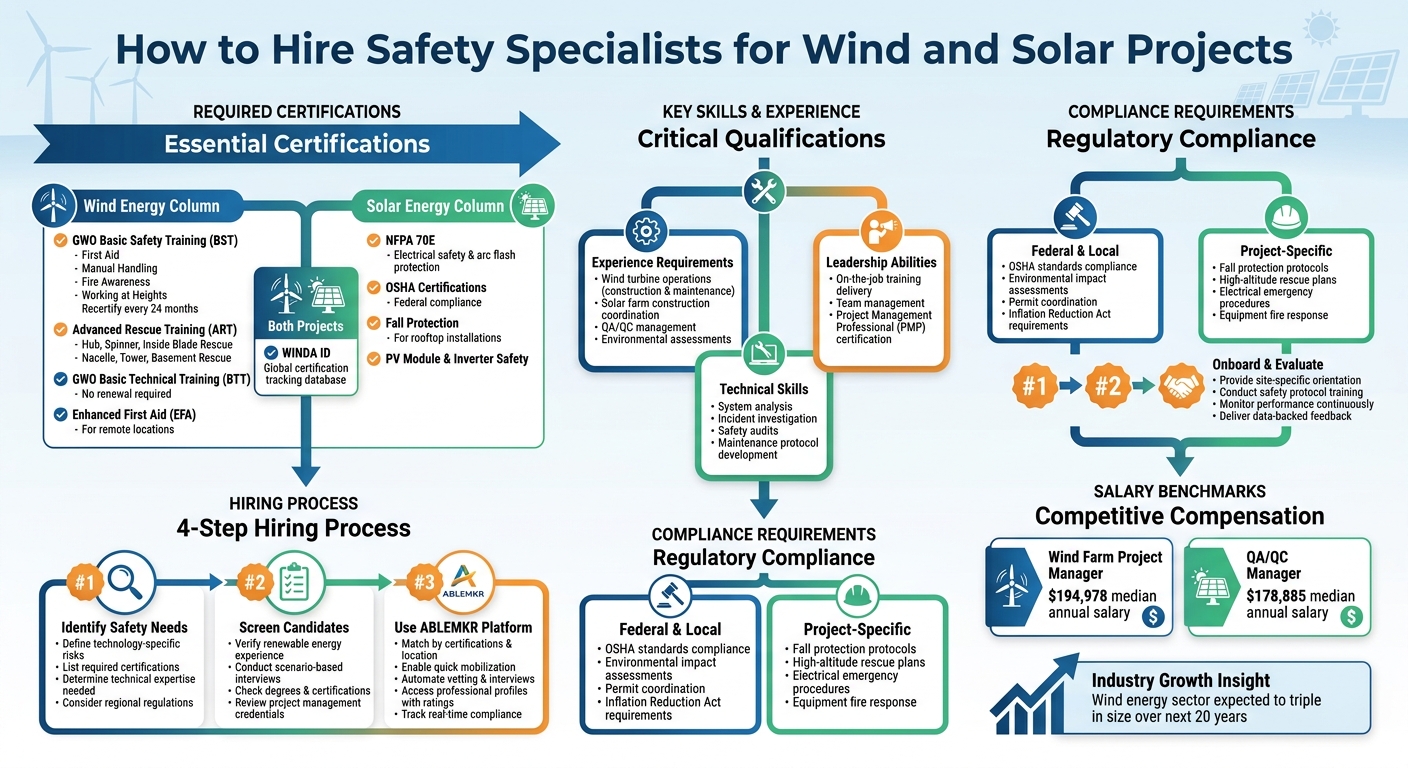
Step-by-Step Process for Hiring Safety Specialists in Renewable Energy Projects
Required Certifications for Wind and Solar Safety Specialists
Core Certifications and What They Cover
To work safely and effectively in renewable energy, specialists need certifications that address both specific hazards in the field and compliance with U.S. regulations. For wind energy, the Global Wind Organization (GWO) sets the international safety standard, focusing on prevention and emergency response protocols. The foundational certification is the GWO Basic Safety Training (BST), which covers key safety areas like First Aid, Manual Handling, Fire Awareness, and Working at Heights. This certification requires recertification every 24 months to stay valid.
To handle the unique challenges of wind turbines, specialists often need Advanced Rescue Training (ART). This credential includes Hub, Spinner, and Inside Blade Rescue, as well as Nacelle, Tower, and Basement Rescue, ensuring preparedness for emergencies in turbine environments. For those working in remote or isolated locations, Enhanced First Aid (EFA) provides the skills to manage emergencies when immediate medical assistance isn’t available. On the technical side, GWO Basic Technical Training (BTT) is essential for tasks involving mechanical, electrical, and hydraulic systems, and it does not require renewal.
In the U.S., GWO certifications are often paired with OSHA certifications to meet federal safety standards. Electrical safety, crucial for both wind and solar projects, requires NFPA 70E certification to ensure protection from arc flash hazards. While solar projects emphasize photovoltaic module and inverter safety, wind energy focuses more on working at heights and rescue techniques.
GWO certifications are tracked through WINDA, a global database that ensures standardization and easy verification of credentials. According to Tech Safety Lines:
The Global Wind Organization… aims to standardize safety protocols and training for the wind industry both on the ground and in the air.
With the wind energy sector expected to triple in size over the next two decades, the demand for certified safety specialists is growing rapidly. Ensuring the right certifications align with project needs is critical for maintaining safety and regulatory compliance during the hiring process.
Matching Certifications to Project Type
Beyond the core credentials, certifications should be tailored to the specific demands of wind or solar projects. For wind installations, specialists must have up-to-date Working at Heights and Advanced Rescue Training certifications, as technicians often work inside turbine nacelles and towers at high elevations. Additionally, rescue kit certifications like SRK-15 and SPARK are frequently required for wind projects.
Solar farms have different safety priorities. Ground-level hazards and electrical safety are key concerns, with rooftop solar installations still requiring fall protection expertise. Large-scale solar farms, however, focus on photovoltaic system safety, inverter protocols, and balance of system (BOS) compliance. Verifying a candidate’s WINDA ID ensures their GWO certifications are current and valid. For projects in remote areas, specialists with Enhanced First Aid training are particularly valuable.
Choosing certifications that align with the specific requirements of wind or solar projects ensures both compliance and safety readiness. This approach lays the groundwork for effective candidate evaluation and project success.
sbb-itb-aa28329
Experience and Skills to Look For
Renewable Energy Safety Experience
When it comes to renewable energy projects, having direct, hands-on experience is non-negotiable. For wind energy projects, prioritize professionals who have overseen wind turbine operations during both construction and operational phases. This includes managing maintenance schedules and ensuring safety compliance at active wind farms. These specialists often earn competitive salaries due to the complexity and responsibility of their roles.
For solar energy projects, seek candidates with experience coordinating large-scale solar panel installations and overseeing solar farm construction. A strong background in quality assurance and quality control (QA/QC) is essential, as these professionals ensure projects meet safety and design standards throughout construction. QA/QC Managers in this field can earn an impressive average salary of $178,885 annually.
Additionally, candidates should ideally hold technical degrees and have experience conducting environmental assessments. This expertise enables them to identify potential hazards and ensure compliance with regulations.
This foundation naturally leads to a discussion of the technical and leadership skills that define top-tier safety specialists.
Critical Skills for Safety Specialists
The best safety specialists bring more than just certifications and experience to the table – they excel in both technical and leadership capabilities. Proficiency in system analysis, incident investigation, and conducting safety audits is essential for identifying risks and implementing effective solutions. This skill set separates true experts from those who simply follow procedural checklists.
Candidates with experience in developing or implementing maintenance protocols for renewable energy technologies – such as wind turbines or solar panels – are particularly valuable. These protocols play a critical role in preventing equipment failures. Leadership and training abilities are equally important. Specialists should have a track record of providing on-the-job training for wind turbine technicians or solar installers, ensuring safety measures are consistently applied.
Certifications like Project Management Professional (PMP) are also a strong indicator of a candidate’s ability to handle the complexities of large-scale renewable energy installations while maintaining rigorous safety standards.
$100/Hour Solar Jobs: Heatstroke, High Voltage, and Isolation
Compliance and Regulatory Requirements
Safety specialists working on wind and solar projects must navigate a maze of federal, state, and local regulations to ensure projects remain compliant with the law. This expertise is critical – not just for protecting workers but also for managing costs and sticking to project timelines. For instance, Solar Project Managers oversee regulatory compliance to ensure solar construction aligns with environmental engineering standards, while Wind Farm Site Managers handle site safety and optimize power generation efficiency.
But compliance goes far beyond basic safety rules. These specialists are also responsible for coordinating permits and conducting environmental impact assessments to streamline project execution. Projects tied to the U.S. Inflation Reduction Act add another layer of compliance requirements. As Solar Landscape highlights:
Our projects exceed the highest design and safety standards, and we do what we say.
This level of regulatory understanding forms the backbone of well-structured safety programs.
OSHA Standards for Renewable Energy Projects
Every safety program for wind and solar projects starts with OSHA compliance. These standards are tailored to address the unique hazards tied to renewable energy, such as fall risks, high-altitude rescues, and electrical emergencies. Fall protection is especially critical – wind turbine technicians often work hundreds of feet above ground, while solar installers face risks on rooftops or elevated structures.
Wind Farm Project Managers oversee both construction and operational phases, ensuring OSHA standards are met at every step. These specialists must have a solid grasp of various renewable technologies – like solar panels, wind turbines, and energy storage systems – to effectively manage site-specific risks. Their technical know-how, often supported by degrees in electrical or mechanical engineering, helps them turn OSHA guidelines into actionable safety measures.
Emergency Response and Risk Management Plans
In addition to OSHA compliance, comprehensive emergency response plans are vital for addressing project-specific dangers. Solar farms, for example, need protocols for handling electrical emergencies and equipment fires. Wind projects, on the other hand, require plans for high-altitude rescues and turbine malfunctions.
Wind Farm Site Managers are typically in charge of rolling out these emergency protocols, ensuring both turbine performance and site safety are not compromised. Risk management also includes hands-on training for wind turbine service technicians to minimize hazards associated with renewable energy equipment. With the rapid growth of renewable energy projects fueled by the transition away from fossil fuels, the demand for specialists capable of managing these risks has surged. Comprehensive emergency planning also serves as a key indicator of a candidate’s practical expertise and technical capabilities.
Step-by-Step Hiring Process
Finding the right safety specialist for a wind or solar project takes careful planning. By focusing on safety and regulatory priorities, you can follow these steps to simplify the hiring process.
Identifying Your Project’s Safety Needs
Start by outlining your project’s specific safety requirements. This includes understanding technology-specific risks, necessary certifications, and the technical expertise required. For example, wind projects may involve high-voltage systems for turbine maintenance, while solar projects often deal with rooftop hazards. Regional regulations and government incentives can also influence candidate availability and costs.
Create a detailed list of specifications. This should include academic qualifications (like degrees in electrical or mechanical engineering), certifications such as Project Management Professional (PMP), and technical skills like energy storage systems knowledge or turbine optimization. By aligning safety expertise with your project’s unique risks, you can maintain regulatory compliance and ensure effective risk management.
Evaluating and Screening Candidates
When screening candidates, prioritize those with direct experience in renewable energy safety. Safety protocols and risks can vary significantly between turbine operations and solar installations, so this experience is crucial. Use scenario-based interviews to gauge their regulatory knowledge. For instance, ask how they would apply environmental engineering regulations or make energy efficiency recommendations tailored to your project.
Check for relevant degrees, certifications, and, for leadership positions, project management credentials. Look for candidates with a proven track record in similar roles. Once qualifications are verified, streamline the process further with tools that simplify hiring.
Using ABLEMKR to Speed Up Hiring

The ABLEMKR platform takes the hassle out of finding and vetting safety specialists. Here’s how it helps:
- Matches candidates based on certifications, safety training, availability, and location.
- Enables quick mobilization for scheduled solar farm construction or urgent wind turbine maintenance.
- Handles vetting and interviews according to your specifications, acting as an extension of your HR team.
- Provides access to professional profiles with ratings for added transparency.
- Offers real-time location tracking and integrated messaging tools.
- Automates payroll workflows and compliance tracking to ensure certifications and records are up to date.
For projects that don’t need full-time safety staff, ABLEMKR’s flexible worker model is a game-changer. It allows you to fill staffing gaps during high-risk phases without the cost and commitment of permanent hires. Specialists arrive on-site ready to work, fully compliant with your project’s specific requirements.
Onboarding and Performance Evaluation
Setting Up New Safety Specialists
When bringing new safety specialists on board, it’s essential to provide a focused, site-specific orientation. Wind Farm Site Managers play a hands-on role, offering practical training to ensure technicians can work safely and efficiently. This tailored approach helps new hires grasp the unique risks associated with each location – whether it’s managing high-voltage systems on wind farms or addressing specific safety challenges at solar installations.
Before specialists are deployed on-site, evaluate their qualifications against the specific needs of the project. Initial training should prioritize critical areas like site-specific safety protocols, emergency procedures, and equipment handling. For instance, a specialist working at a wind farm must quickly become familiar with turbine shutdown procedures and emergency safety protocols.
By using ABLEMKR’s platform, you can simplify compliance tracking with real-time certification updates. This ensures that all necessary credentials are up to date before work begins, minimizing the chance of unexpected compliance issues.
Once the onboarding process is complete, ongoing performance evaluation becomes crucial to maintaining safety and operational efficiency.
Monitoring Performance and Providing Feedback
After onboarding, continuous performance monitoring is vital to uphold safety standards throughout the project. QA/QC managers play a key role here by delivering clear, data-backed feedback to ensure specialists consistently meet quality and compliance expectations. Regular audits and inspections help identify areas of strength as well as opportunities for improvement.
ABLEMKR’s tools, such as rating systems and profile feedback features, make tracking performance more straightforward. You can access specialist profiles, monitor their real-time locations during inspections, and provide direct feedback using integrated messaging. Scheduling regular check-ins allows you to review performance metrics, address any concerns, and acknowledge top performers. This ongoing feedback process ensures your team maintains the highest safety and design standards at every stage of the project.
Conclusion
This guide lays out the essential steps for hiring safety specialists, from verifying certifications to utilizing tools like ABLEMKR for a more streamlined process. Bringing on board the right professionals ensures that your projects – whether turbine installations or expansive solar arrays – adhere to OSHA standards, safeguard workers, and operate efficiently.
The stakes are undeniably high. For example, Wind Farm Project Managers, tasked with overseeing construction and operational safety, earn a median annual salary of $194,978. Similarly, QA/QC Managers, who handle quality assurance and control, see a median annual salary of $178,885. These figures underscore the immense value of specialized safety roles in renewable energy projects. Beyond compliance, these experts play a critical role in driving project success. A notable example is the $117 million preferred tax equity investment closed in April 2026 by Solar Landscape and Nuveen Energy Infrastructure Credit, anchoring a $240 million portfolio of solar projects. This achievement highlights how adherence to rigorous safety and design standards supports large-scale distributed generation efforts.
By following these outlined steps, you’re not just ensuring compliance and worker safety – you’re setting your renewable energy projects up for success. Efficient hiring practices, especially when supported by platforms like ABLEMKR, are a key part of this process.
ABLEMKR simplifies the hiring process by connecting pre-vetted safety specialists with your projects based on certifications, training, and location. Its real-time compliance tracking and integrated workflows help accelerate mobilization for both planned work and emergency situations.
FAQs
Which certifications are must-haves for my wind vs. solar project?
Certifications play a crucial role in ensuring quality and safety in renewable energy projects. For wind energy, UL‘s wind turbine certification guarantees that turbines meet safety and performance standards. Additionally, specialized wind technician training ensures professionals are equipped to handle on-site tasks effectively.
In solar energy, the ETA Photovoltaic Installer – Level 1 (PVI1) certification emphasizes core skills like installation, safety protocols, and troubleshooting. Both certifications underscore the importance of safety, technical proficiency, and adherence to industry standards.
How do I verify a safety specialist’s GWO credentials and recert dates?
To check a safety specialist’s GWO credentials and recertification dates, you’ll need to use the GWO WINDA database (Wind Industry Training Records Database).
Here’s how to do it:
- Get their WINDA ID: Ask the specialist to provide their unique WINDA ID.
- Search the WINDA database: Enter their ID into the database to locate their records.
- Review the details: Confirm their certification status and check their training history, including recertification dates, to ensure everything is up to date.
This process ensures you’re working with someone whose qualifications are verified and current.
What should I ask in interviews to confirm real renewable safety experience?
To gauge a candidate’s experience with renewable energy safety, dive into their hands-on work with wind or solar safety protocols and certifications. Ask about specific areas such as lockout/tagout (LOTO) systems, completed safety training, and any relevant certifications they hold. It’s also helpful to explore their experience managing safety in high-risk environments or their use of remote monitoring systems. These questions can offer a clearer picture of their practical expertise in renewable energy projects.


