
Want to operate cranes and stand out in a growing industry? Getting NCCCO-certified is the first step. Here’s what you need to know:
- What is NCCCO? A nationally recognized certification ensuring crane operators meet OSHA safety standards.
- Why get certified? Certified operators earn about $85,000 annually – 19% more than average – and meet federal and state requirements.
- Steps to certification:
- Meet eligibility: Be 18+, pass medical checks, and follow NCCCO’s ethics and substance policies.
- Pass exams: Take a written test (Core + Specialty) and a practical skills test within 12 months.
- Renew every 5 years: Recertify with shorter exams or prove 1,000+ hours of crane work.
Pro tip: Tools like ABLEMKR can help you find jobs and track certification deadlines. With crane operator demand growing at 10%, now’s the time to get started.
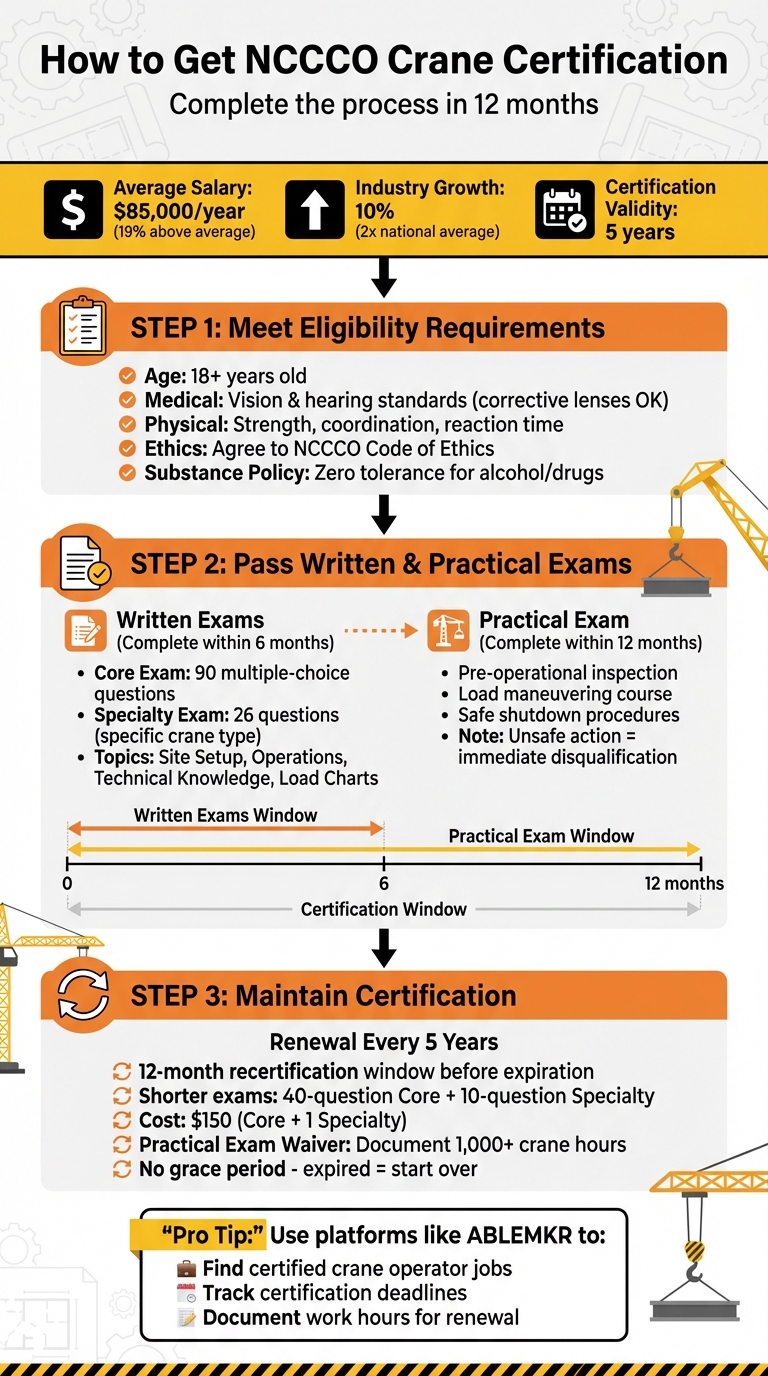
NCCCO Crane Certification Process: 3 Steps to Get Certified
How to Get Your Mobile Crane Operator Certification | Step-by-Step Guide
sbb-itb-aa28329
Eligibility Requirements for NCCCO Certification
Before diving into NCCCO exam preparation, make sure you meet the essential physical and legal requirements. These guidelines align with ASME B30 standards and OSHA regulations to ensure safety and professionalism.
Age and Legal Requirements
To qualify, you must be at least 18 years old and agree to the NCCCO Code of Ethics. This commitment underscores the importance of integrity and professionalism in crane operation.
Medical and Physical Standards
Crane operators need to meet specific physical and medical benchmarks. This includes having adequate vision (corrective lenses are allowed) to identify colors and depth, as well as sufficient hearing for effective on-site communication. Physical capabilities like strength, endurance, coordination, and quick reaction times are also crucial for safe crane operation. Medical conditions such as seizure disorders, which could lead to a sudden loss of control, are disqualifying factors. Employers often verify these standards before assigning tasks.
"The ASME B30 standards specify the physical and medical requirements every crane operator must meet." – Train For The Crane
Substance Abuse Policy
The NCCCO enforces a strict Substance Abuse Policy. This policy bans alcohol, illegal drugs, and impairing prescription medications. Refusing a substance test is treated the same as a positive result. Staying sober is non-negotiable, as crane operation demands full mental clarity and physical control.
"Operating a crane demands absolute sobriety and a clear mind. The NCCCO has a strict policy regarding substance abuse, and all candidates must adhere to it. This policy is a cornerstone of ensuring safety on job sites." – Train For The Crane
Once you’ve confirmed you meet these requirements, you’re ready to register and begin preparing for your NCCCO exams.
How to Get NCCCO Certification
Earning your NCCCO certification involves a straightforward three-step process: registering online, preparing with the right resources, and passing both written and practical exams. You must complete all parts of the certification within 12 months of your first exam, with written exams needing to be finished within the first six months. Before starting, make sure you meet all eligibility requirements.
Step 1: Register for the Written Exams
Head to the myCCO portal, your go-to platform for managing the certification process. Here, you can apply for and schedule your exams. The registration process includes choosing two exam types:
- Core Exam: This is a 90-question, multiple-choice test covering general crane operation knowledge.
- Specialty Exam: Focused on your specific crane type (e.g., Telescopic Boom Fixed Cab or Lattice Boom), this test includes about 26 multiple-choice questions.
Make sure you know the crane designation required for your certification. You can choose to take your exams online, at a test center, or via paper/pencil testing depending on your location.
Step 2: Prepare for the Exams
While NCCCO doesn’t provide direct training, they offer helpful resources like candidate handbooks, OSHA and ASME reference materials, and practice tests. Pay close attention to interpreting load charts, as this is a key part of the specialty exams and a common source of mistakes. The written exams cover four main areas: Site and Setup, Operations, Technical Knowledge, and Load Charts.
Step 3: Take the Written and Practical Exams
Once you pass the written exams, you’ll receive an Authorization Code in your myCCO account. Use this code to schedule your practical exam at an approved test site, where a CCO-certified proctor will oversee the test. The practical exam evaluates your skills in three areas:
- Performing a pre-operational inspection to identify hazards.
- Maneuvering loads through a course to test precision and control.
- Executing a safe shutdown.
Proctors assess both your safety practices and efficiency. Any unsafe action during the test will lead to immediate disqualification. After passing, you’ll be ready to learn about maintaining your certification in the renewal process.
How to Renew NCCCO Certification
Renewing your NCCCO certification is essential for demonstrating your continued safety and operational competence.
Renewal Timeline
Your NCCCO certification remains valid for five years from the date it was issued. A 12-month window before your certification expires is available for recertification. This gives you enough time to schedule exams and gather any necessary documentation. Keep in mind that there’s no grace period – if your certification expires, you’ll need to start over with the full initial certification process, including both written and practical exams.
It’s a good idea to plan ahead since test centers can fill up quickly. Any delays in scheduling might put your recertification at risk. If you complete the recertification process early, your new five-year period will still begin from the original expiration date.
Documentation and Fees
To apply for recertification, use the myCCO Portal at my.ccocert.org. The recertification written exams are shorter than the initial ones, consisting of a 40-question Core exam and 10 questions for each Specialty exam. The fees are as follows:
- Core + 1 Specialty (Written): $150
- Additional Specialties: $5 each
- Practical Exam (if required): $60 for the first category, $10 for each additional category
- Late Application Fee: Around $50
If you’ve logged over 1,000 hours of crane-related work during your certification period, you can skip the practical exam, saving $70–$100 per Specialty. Qualifying work includes operating, maintenance, inspection, or training tasks. You’ll need to provide proof, such as signed employer statements or time sheets. However, Signalperson certification always requires a practical exam for recertification.
| Recertification Cost | Amount |
|---|---|
| Core + 1 Specialty (Written) | $150 |
| Additional Specialties | $5 each |
| Practical Exam (if required) | $60 (first category) |
| Additional Practical Categories | $10 each |
| Late Application Fee | Approximately $50 |
Continuing Education Credits (CECs)
You can also earn Continuing Education Credits (CECs) through approved training programs. Be sure to keep detailed records of any CECs you complete, as you’ll need to include this documentation with your recertification application. These credits help show that you’re keeping up with current safety standards and best practices in the industry.
In addition to completing your exams and CECs, you’ll need to meet the required physical standards and comply with NCCCO’s Substance Abuse Policy and Code of Ethics. Don’t forget to update your contact information in the myCCO Portal to ensure you receive reminders about your certification’s expiration date.
This process helps certified operators stay aligned with industry standards, maintaining their professional edge and readiness for future opportunities.
How ABLEMKR Supports Certified Crane Operators

Once you’ve earned your NCCCO certification, staying compliant and finding consistent work can feel like a juggling act. That’s where ABLEMKR comes in – connecting certified crane operators with job opportunities while simplifying compliance along the way.
ABLEMKR’s platform makes it easy to match your credentials with employers who need your skills. Using filters like certification type, location, and availability, the mobile-first system helps you access high-paying projects in construction, energy, and extractive industries. Whether it’s a planned infrastructure job or an emergency shutdown requiring immediate staffing, ABLEMKR ensures you’re in the loop.
Employers post projects ranging from pipeline repairs to mine development, and the platform automatically matches them with operators whose certifications meet the job requirements. This credential-based approach eliminates guesswork, saving time for both operators and employers. Plus, because ABLEMKR operates in key U.S. cities and energy hubs, you can find work without the hassle of endless job searches.
Tracking Certifications and Compliance
Managing your NCCCO five-year certification and 12-month recertification deadlines can be tricky, especially when juggling multiple projects. ABLEMKR offers digital tools to help you stay on top of your certification status and compliance requirements, ensuring you never miss a renewal. The platform also tracks safety training and broader compliance needs, which is critical since OSHA regulations (29 CFR 1926 Subpart CC) require employers to verify that operators are trained, certified, and evaluated for specific equipment.
For those pursuing recertification, ABLEMKR’s tools make it easier to document the 1,000 hours of crane-related experience required to qualify for a practical exam waiver. By aligning this documentation with your renewal needs, the platform helps streamline the process and keeps your records organized for your recertification application. Employers also benefit by gaining real-time updates on certification statuses, cutting down on administrative tasks while ensuring safety standards are met across their worksites.
Conclusion
Getting your NCCCO certification can significantly boost your earning potential, with crane operators averaging $85,000 annually – about 19% higher than the national average. But earning the certification is just the first step. Keeping it active requires staying on top of renewals. NCCCO certifications are valid for five years, and if you miss the 12-month recertification window, you’ll need to retake both the written and practical exams.
However, there’s a way to make the renewal process easier. If you document 1,000 crane hours during your certification period, you might be able to skip the practical exam altogether.
Finding steady work and juggling deadlines can be tough, but tools like ABLEMKR can help. It connects certified operators with high-paying jobs in industries like construction, energy, and mining. Plus, it keeps your credentials organized and tracks deadlines in real time, so you don’t miss your renewal window.
With the crane industry growing at 10% – double the national average – staying certified is more important than ever. Whether you’re just starting your career or preparing for recertification, understanding the process and using tools like ABLEMKR can help you stay ahead in this expanding field.
FAQs
How long does NCCCO certification take?
Obtaining an NCCCO crane certification generally takes up to 12 months. The process involves choosing the specific certification type, meeting the eligibility criteria, passing both written and practical exams, and ensuring all steps are completed within this period. To keep your credentials current, recertification is required every five years.
Which NCCCO specialty should I choose?
Selecting the right NCCCO specialty is all about aligning it with the type of crane you plan to operate. Your options include:
- Mobile Crane
- Tower Crane
- Overhead Crane
- Articulating Boom Crane
If your career involves operating more than one type of crane, you’ll need to pass the exams for each specialty. Take some time to review the certification categories and requirements to ensure your choice supports your professional goals.
What counts toward the 1,000-hour renewal requirement?
According to NCCCO guidelines, the 1,000-hour renewal requirement covers crane-related tasks performed during your certification period. This includes activities like operating cranes, performing maintenance, conducting inspections, or providing training. If you can document at least 1,000 hours of such work within your certification’s active period, you might be eligible for recertification without needing to retake the practical exam.


