
Wind turbine technicians are in demand, with job growth expected to rise by 50% from 2024 to 2034. If you’re interested in this career, here’s what you need to know:
- Education: A high school diploma or GED is required. Focus on STEM courses like physics, algebra, and electronics.
- Training: Enroll in a technical school or apprenticeship program. These last 9-24 months and cover electrical systems, mechanical systems, hydraulics, blade repair, and safety practices.
- Certifications: Obtain Global Wind Organization (GWO) Basic Safety Training and OSHA certifications. Additional certifications, such as NFPA 70E, can boost your qualifications.
- Physical Requirements: Be prepared for physically demanding work, such as climbing towers over 200 feet tall while carrying tools.
- Salary: Median annual pay in 2024 was $62,580, with higher earnings in states like California and Texas.
This career offers hands-on work, travel opportunities, and a chance to contribute to renewable energy. Whether you start with an apprenticeship or a technical program, the key is gaining the right skills and certifications to succeed.
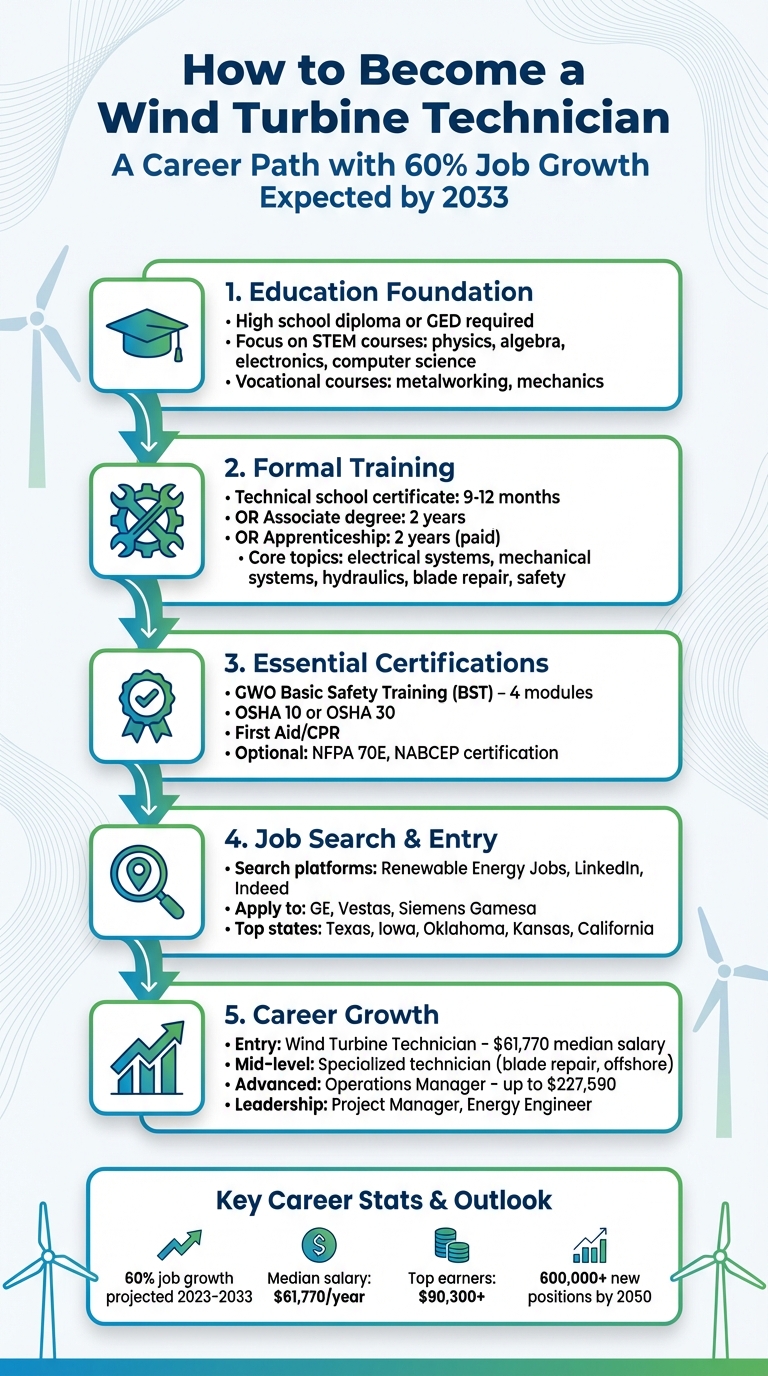
5 Steps to Become a Wind Turbine Technician
Education and Basic Requirements
High School Diploma and STEM Courses
The journey to becoming a wind turbine technician starts with earning a high school diploma or GED. While in high school, focus on building a solid technical foundation by taking STEM courses – science, technology, engineering, and math. Classes like algebra, computer science, electronics, and physics are particularly helpful for developing the analytical and problem-solving skills needed for diagnosing turbine issues. Vocational courses such as metalworking, woodshop, and mechanics are also valuable. These hands-on classes teach you how to safely use tools and build the manual dexterity required for precise, technical work. Together, these skills lay the groundwork for the physical and technical challenges you’ll face in the field.
Physical and Personal Requirements
Physical fitness is a must for wind turbine technicians. You’ll be climbing towers that can reach heights of 100 to over 400 feet, often while carrying heavy tools and safety gear. Once at the top, you’ll work in tight spaces inside the nacelle, which houses the turbine’s critical components. As Charlie Tran, a wind turbine technician, puts it:
"I wish I had known how physically demanding everything is. Everything from the climb, to the maintenance, to the torquing, and even troubleshooting. It’s all labor-intensive physically and sometimes mentally… You have to be mentally and physically fit." – Charlie Tran
Flexibility is another key requirement. Most technicians work full-time and need to be on-call for emergencies, which can mean working evenings or weekends. Strong communication skills are also essential for coordinating safety protocols with your team and documenting repairs accurately. While physical strength is important, technical know-how is equally critical.
Technical and Mechanical Skills
If you’re someone who enjoys figuring out how things work, you’re already on the right track. A natural curiosity about mechanics is essential, as troubleshooting is a big part of the job. You’ll need a strong mechanical aptitude to diagnose and repair complex hydraulic, electrical, and mechanical systems.
Before diving into formal training, it’s helpful to gain hands-on experience. Shadowing local electricians or mechanical contractors can give you valuable exposure to electrical systems and professional troubleshooting techniques. Even hobbies like automotive repair or metalworking can help you get comfortable with hand and power tools. These skills will come in handy for tasks like testing electrical systems, replacing worn components, and fine-tuning controls to keep turbines running smoothly.
sbb-itb-aa28329
Training and Apprenticeship Options
Wind Energy Apprenticeships
Apprenticeships approved by the U.S. Department of Labor typically last about two years, blending paid, hands-on work with classroom learning. During this time, you’ll work directly on wind turbines under the supervision of seasoned technicians, gaining practical skills in turbine maintenance. To locate these programs, you can use Standard Occupational Classification (SOC) codes 49-9081.00 or 49-9099.02 in official databases. Another option is to reach out to local wind farms to inquire about technician helper roles or internal apprenticeship opportunities. Keep in mind that requirements differ by state, so it’s a good idea to check with your local or state apprenticeship office to find programs that align with regional standards. If you prefer a more classroom-centered approach, formal technical programs may be a better fit.
Technical Schools and Certificate Programs
Technical schools and community colleges offer certificate programs that can be completed in 9 to 12 months or Associate of Applied Science (AAS) degrees, which usually take two years. These programs combine theoretical coursework with hands-on lab sessions in simulated environments. For example, Colby Community College provides online certificate programs complemented by weekend intensive training. When selecting a program, make sure it’s accredited and uses tools and technology that meet industry standards. Schools with onsite wind turbines or realistic lab setups are particularly valuable, as they allow you to practice in conditions similar to real-world scenarios. Both apprenticeships and technical programs cover a shared set of essential training topics, which are outlined below.
Core Training Topics
Whether you opt for an apprenticeship or a technical school program, your curriculum will likely focus on several key areas:
- Electrical Systems: Training often includes AC/DC theory, circuit basics, programmable logic control (PLC) systems, and troubleshooting using tools like multimeters and diagnostic equipment.
- Mechanical Systems: You’ll learn about turbine structures, drive and gearbox systems, braking mechanisms, and lubrication techniques.
- Hydraulics: Courses cover diagnosing and repairing fluid power systems used for braking and pitch control.
- Blade Repair: This involves working with fiberglass and composite materials to repair damaged turbine blades.
- Safety Training: Programs emphasize tower climbing, fall protection, high-angle rescues, first aid, and CPR, ensuring you’re prepared for the physical demands and risks of the job.
This well-rounded training prepares you to pursue industry-recognized certifications and advanced safety qualifications, setting the stage for a successful career in wind energy.
Required Certifications and Safety Training
Global Wind Organization (GWO) Certification
The GWO Basic Safety Training (BST) is widely regarded as the go-to certification for aspiring wind turbine technicians. Recognized across the globe, it includes four essential modules: Working at Heights, Manual Handling, Fire Awareness, and First Aid. If you’re eyeing offshore roles, you’ll also need to complete the additional Sea Survival module. All completed certifications are recorded in the WINDA database, making it easy for employers worldwide to verify your credentials.
As Wind Trade Academy explains, "GWO certification doesn’t just prove you’ve been trained – it proves you’re serious about your safety, team, and future in renewable energy". Employers often require these modules as a baseline qualification, so obtaining GWO BST is a critical first step. It lays the groundwork for safety before tackling U.S.-specific regulatory requirements, like OSHA standards.
OSHA Compliance and Safety Standards
In the U.S., wind turbine technicians are expected to complete OSHA 10 or OSHA 30 training to comply with federal workplace safety regulations. These courses cover essential safety topics, including hazard communication, personal protective equipment (PPE), lockout/tagout (LOTO) procedures, and confined space protocols.
For roles involving electrical work, many employers also require NFPA 70E certification, which focuses on electrical safety and prepares you to handle high-voltage equipment safely. Additionally, the NFPA WTT-I certification demonstrates a deeper understanding of turbine components and energy isolation procedures. Together, these certifications ensure technicians can work safely in challenging and potentially hazardous environments.
Additional Technical Certifications
Beyond the basics, earning additional certifications can boost both your skills and career prospects. For example, the North American Board of Certified Energy Practitioners (NABCEP) offers a Wind Energy Technician Certification, which highlights your expertise in specialized technical areas. Many technical programs also incorporate OSHA 30 and First Aid/CPR training into their curriculum, providing a comprehensive approach to safety and readiness.
It’s worth noting that most safety certifications require periodic recertification to stay aligned with evolving safety protocols and technologies. Some employers, such as Vestas, GE, and Siemens Gamesa, may also have their own specific training requirements, so it’s a good idea to research what’s needed for the companies you’re interested in.
Finding Jobs and Advancing Your Career
Entry-Level Job Search
Once you’ve got the right education, training, and certifications, it’s time to dive into the job hunt. Getting started in the wind energy industry takes a bit of strategy. Begin by exploring industry-specific job boards like Renewable Energy Jobs and GreenJobs. Broader platforms like LinkedIn and Indeed can also be helpful for finding openings. The American Clean Power Association is another great resource – they offer exclusive job boards for members and host conferences where you can connect directly with hiring managers.
Major manufacturers such as General Electric often post entry-level roles on their corporate career portals, so applying directly through these sites can be effective. Don’t forget to follow wind energy companies on LinkedIn and join renewable energy groups to stay updated on job postings and gain insights from industry professionals. If you’re in New York, NYSERDA’s directory is a good place to find internships and training opportunities.
For a more modern approach, platforms like ABLEMKR are making it easier for skilled workers to connect with renewable energy projects across the U.S. These platforms match technicians with job sites based on certifications, safety training, and location, streamlining the hiring process. Focus your search on states with booming wind energy investments, such as Texas, Iowa, Oklahoma, and Kansas. These areas are hotbeds for wind farm development, with average salaries ranging from $82,470 in Kentucky to $94,320 in California. These roles often offer a mix of diverse work environments and flexible schedules, as detailed below.
Work Schedules and Environments
Safety is a top priority for wind turbine technicians, who typically work in pairs, especially when performing tasks inside the nacelle or at the hub. Be prepared for irregular hours, emergency on-call repairs, and frequent travel between sites. Often, technicians stay at a location for the duration of a project, moving between wind farms as needed.
The work environment can vary significantly depending on whether you’re working onshore or offshore. Onshore technicians usually operate on leased farmland or ranches, primarily in the Midwest, and travel between sites by truck. Offshore technicians, on the other hand, work on sea-based platforms along the East Coast. These positions demand specialized maritime skills and are often more challenging, but they typically come with higher pay. Understanding these conditions can help you plan your career path in wind energy.
Career Advancement Opportunities
The wind energy industry offers plenty of room for growth beyond entry-level roles. As you gain experience, you could move into positions like Operations Manager, Project Manager, or Site Manager. These roles come with a significant salary boost – while technicians earn a median hourly wage of $37.00, Operations Managers can earn up to $65.65 per hour, with annual salaries ranging from $68,860 to $227,590.
Specializing in areas like blade repair or offshore maintenance can further enhance your career prospects. If you’re interested in advancing even further, consider pursuing a bachelor’s degree in electrical or mechanical engineering. This could open doors to roles like Wind Energy Consultant or Energy Engineer. Stephen Matson, VP of Product at Milwaukee Tool, highlights the flexibility of career paths in this field:
"A person starting out as a wind turbine technician may just as naturally find themselves pursuing the path of a project manager or that of an energy engineer".
Certifications can also play a key role in career advancement. Earning credentials like the NABCEP Wind Energy Technician Certification or completing training programs from manufacturers like General Electric can keep you competitive for senior roles. Many technicians also use their on-the-job experience as a stepping stone for further education. As Matson notes:
"Becoming a windtech can serve as a good way to get started in the renewable/sustainable energy industry, providing good fundamentals should you want to pursue additional education/training down the line".
Becoming a Wind Power Technician | The Career Center
Conclusion
Kickstart your wind energy career with a clear, step-by-step approach. Start by building a strong foundation in STEM subjects during high school. From there, pursue a certificate program (6–12 months) or an associate degree (up to 2 years). Hands-on experience is key, so seek out internships or apprenticeships, and wrap up your training with essential certifications like GWO and OSHA.
The timing couldn’t be better. Wind turbine service technicians are expected to be the fastest-growing job in the U.S., with employment projected to jump by 60% between 2023 and 2033. The median annual salary stands at $61,770, with top earners bringing in over $90,300. Plus, the U.S. Department of Energy forecasts the creation of at least 600,000 new positions by 2050, offering long-term career potential and competitive wages.
Once you’re certified and ready, finding the right job is your next move. ABLEMKR simplifies this process by connecting pre-vetted wind turbine technicians with renewable energy projects nationwide. By matching workers based on certifications, safety training, and location, ABLEMKR helps you quickly secure opportunities in high-demand states like Texas, Iowa, Oklahoma, and Kansas.
This career isn’t for the faint of heart – it requires both physical and mental endurance. You might find yourself climbing towers over 300 feet tall, working in extreme weather, or troubleshooting intricate systems with thousands of components. Whether you choose to stay hands-on or transition into management, your technical skills and determination will drive your success in this rapidly growing field.
FAQs
Do I need a degree to get hired?
No, you don’t need a college degree to become a wind turbine technician. Typically, a high school diploma or equivalent is sufficient to get started. From there, you’ll need to complete a certificate or technical training program focused on wind energy technology. Most technicians also go through about 12 months of on-the-job training. While not mandatory, earning a certification can boost your chances of landing a job in this field.
How long does it take to become a wind turbine technician?
Becoming a wind turbine technician generally takes 2 to 3 years. This timeline includes finishing a 2-year technical program and completing over a year of on-the-job training offered by employers. The training emphasizes both technical skills and safety protocols, ensuring you’re well-prepared for the demands of the job.
Which certifications do employers require most?
Employers often seek certifications from the Global Wind Organisation (GWO) because these credentials confirm that technicians can handle the physical, technical, and safety challenges of the job. Some of the key certifications include:
- GWO Basic Safety Training (BST)
- Basic Technical Training (BTT)
- Control of Hazardous Energies (CoHE)
- Crane and Hoist
- Slinger Signaller
Beyond these, additional certifications related to safety and inspection, such as those for wind turbine statutory equipment inspection, are frequently regarded as important in the industry.


