
You can get into geothermal work without a four-year degree. In most cases, I’d start with a high school diploma or GED, add trade training or an associate degree, earn EPA 608 and OSHA 10, then build field time through HVAC, plumbing, electrical, drilling, or maintenance work.
Here’s the short version:
- I can enter this field through two main paths:
- Residential/commercial HVAC for ground-source heat pumps
- Plant/utility maintenance for power-site equipment
- Most geothermal technicians earn about $25.48 to $43.27 per hour
- About 65% of roles ask for a high school diploma or less
- A trade certificate often takes 6 to 12 months
- An associate degree usually takes about 2 years
- For many starter jobs, I’d look for titles like:
- HVAC installer helper
- HVAC service technician trainee
- Geothermal installer
- Looping technician
- Field service technician
- Maintenance technician
What matters most is simple: get trained, get safety credentials, get hands-on work, and apply for entry-level jobs that lead to more field time.
A few things I’d focus on first:
- Basic education: high school diploma or GED
- Job training: HVAC/R, plumbing, electrical, or industrial maintenance
- Core certifications: EPA Section 608, OSHA 10, and any state license tied to the work
- Field skills: piping, wiring, controls, testing, reading schematics, and safe tool use
- Related experience: HVAC, pipefitting, electrical, drilling support, or construction
If I wanted the fastest route in, I’d likely start with a trade program, then move into a helper or apprentice job. If I wanted more troubleshooting or plant-side work, I’d look harder at an associate degree.
| Path | Best starting training | Common first jobs |
|---|---|---|
| HVAC / building systems | Trade certificate, HVAC/R lab work, apprenticeship | Installer helper, service trainee, geothermal installer |
| Plant / utility maintenance | Associate degree or industrial maintenance training | Maintenance tech, mechanical tech, field service tech |
Bottom line: geothermal is a hands-on trade path. You do not need a perfect job title to start. You need the right training, basic certs, and field experience that proves you can work safely and solve problems on site.
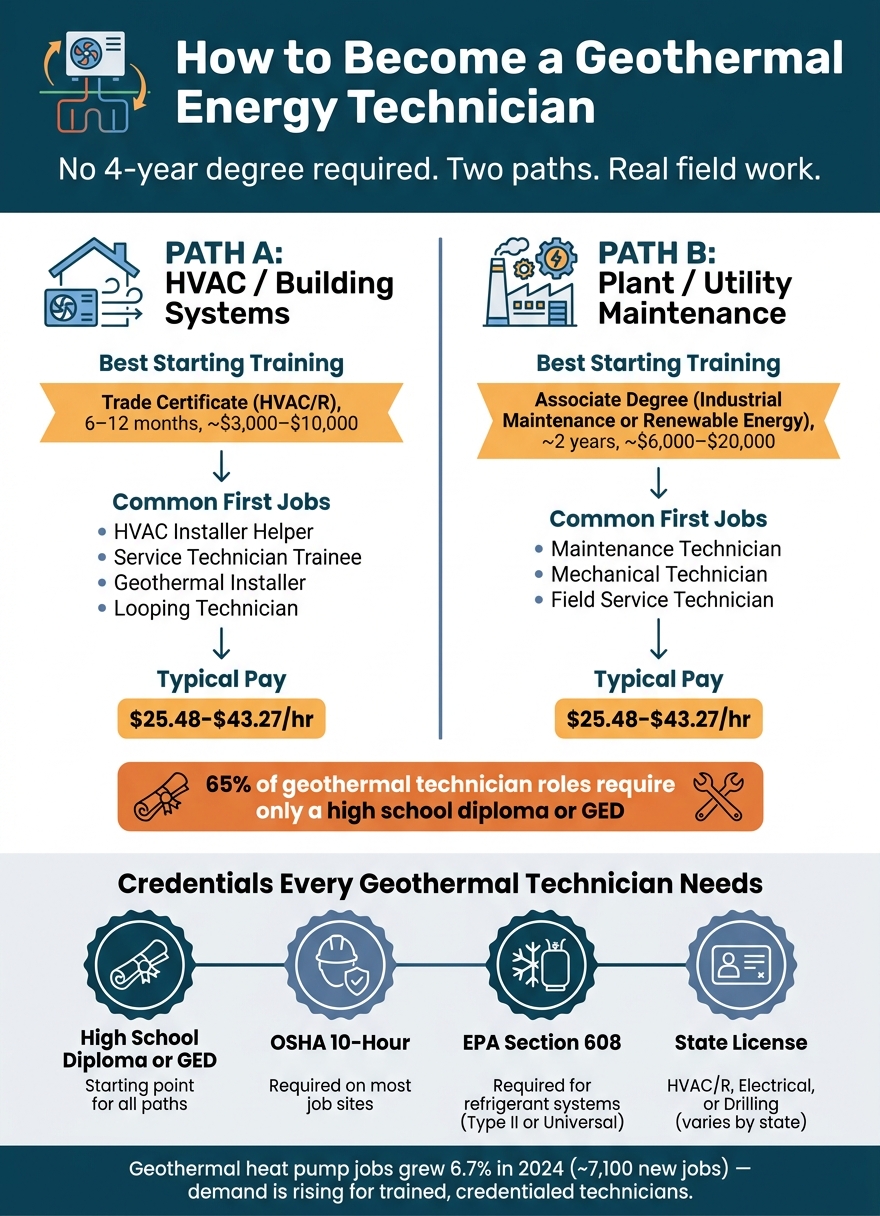
Geothermal Technician Career Paths: Education & Certification Roadmap
Step 1: Meet the Basic Education Requirements
Start With a High School Diploma or GED
For most people, a high school diploma or GED is the main way into this field. About 65% of geothermal technician roles ask for a high school diploma or less. So the first step is pretty simple: get that basic credential, then pick the fastest training route for the job you want.
Classes like algebra, geometry, and intro physics can help more than you might think. They come up when you’re laying out pipe runs, estimating fluid volume, or dealing with heat transfer. Vocational classes in electrical basics, plumbing, or building systems can also give you a solid head start.
Pick the Right Training Level for Your Goal
Your next move depends on the role you’re after and how fast you want to get to work.
| Education Level | Time to Complete | Typical U.S. Cost | Typical Entry Roles |
|---|---|---|---|
| High school diploma / GED | Already completed | No additional tuition | Field helper, installer/helper |
| Trade certificate (HVAC, plumbing, or electrical) | 6–12 months | ~$3,000–$10,000 | HVAC installer/helper, plumbing assistant, electrical apprentice |
| Associate degree (HVAC technology, renewable energy, or industrial maintenance) | ~2 years | ~$6,000–$20,000 (in-state) | Geothermal systems technician, controls technician, maintenance lead |
In plain terms, trade certificates are usually the best fit for HVAC and installation work. Associate degrees make more sense for diagnostic work and maintenance-track roles. If you want to work in residential or commercial HVAC, trade training is often the better place to start. If you’re aiming for plant or utility maintenance, an associate degree can give you more room to grow.
A trade certificate is the fastest route into the field. It teaches the core job skills used on geothermal projects, like piping, system installation, and code compliance.
An associate degree fits jobs that involve more troubleshooting or lead-level duties. It’s not often required for entry-level work, but it can strengthen your long-term job outlook.
It also helps to add OSHA 10-Hour Construction training early. Many job sites want it before you can begin on-site work, and ABLEMKR matches workers based on safety credentials, education, availability, and location.
Once you’ve chosen your education path, the next step is hands-on training and the certifications that help you get hired.
sbb-itb-aa28329
Step 2: Build Technical Skills and Earn Relevant Certifications
Learn Through Hands-On Training
Once you’ve got the basic education piece covered, the next move is hands-on training and the credentials employers tend to look for. In this field, employers want proof that you can do the work, not just talk about it.
HVAC/R programs at community colleges and trade schools are often the most direct path. Look for programs with lab time on heat pumps, hydronic systems, circulation pumps, and basic controls wiring. If you want to work on buildings, choose HVAC/R labs tied to building systems. If plant work sounds like a better fit, industrial maintenance training makes more sense. Clean-energy HVAC/R programs are a strong option too, since they teach the heat-pump, piping, and controls work geothermal employers often want.
A four-year HVAC apprenticeship gives you paid field work plus classroom instruction in installation, troubleshooting, and controls. That means you earn money while building the documented field hours that matter later for licensing. Regional HVACR apprenticeships work in much the same way.
By the end of training, you should be able to help with installs, check voltage, pressure, flow, and temperature, and use tools safely.
That said, classroom learning is just the starting line. Drilling and field work take years to get good at.
Add Certifications That Strengthen Your Job Prospects
A small group of credentials can make a big difference when you’re applying for your first geothermal job.
EPA Section 608 is required if you’ll work on refrigerant-based heat pumps and other regulated systems. At a minimum, aim for Type II or Universal certification so you can legally handle stationary refrigeration systems.
OSHA 10 is the standard entry-level field credential. OSHA 30 goes further and adds hazard recognition that helps for lead roles. Both are widely recognized in construction, utilities, and energy work.
It also pays to think about state licensing early. HVAC/R, electrical, and drilling work may call for documented hours, approved training, and a state exam.
| Credential | Who Needs It | Why It Matters |
|---|---|---|
| EPA Section 608 | Anyone servicing heat pumps or refrigerant systems | Federal requirement for regulated refrigerants |
| OSHA 10-Hour (Construction) | All field workers | Baseline safety training recognized by employers |
| OSHA 30-Hour | Lead roles or supervisory positions | Deeper safety training and hazard recognition |
| State HVAC/R or Electrical License | Technicians doing mechanical or electrical work | Requirements vary by state and scope of work |
| State Drilling License | Technicians involved in ground-loop drilling | Needed for some drilling-related loop work |
Once you have your core HVAC and safety credentials, you can add specialized geothermal installer or design courses. That helps you build system-specific knowledge and stand out from general HVAC applicants.
After that, the focus shifts to field hours and job-ready experience. The next step is turning what you’ve learned into time on the job and a resume that shows you’re ready to work.
Step 3: Gain Field Experience and Prepare for Hiring
Get Experience in Related Trades First if Needed
If you don’t have direct geothermal experience yet, a related trade can help you get your foot in the door.
A lot of the work overlaps more than people think:
- HVAC gives you heat pump basics, refrigerant circuits, ductwork, and customer-site experience.
- Plumbing and pipefitting help you get comfortable with pressurized systems, pipe layouts, and leak testing. Those skills show up directly in ground-loop installation.
- Electrical work builds wiring, controls, and schematic-reading skills used for circulator pumps and control panels.
- Drilling support gives you exposure to rig safety, well construction, and subsurface work that lines up with borehole drilling on geothermal jobs.
- Construction and maintenance help build job-site safety habits, tool skills, and the physical stamina this work takes in all kinds of weather.
A smart move is to start as a helper or apprentice, then lean into heat-pump, piping, controls, or drilling tasks whenever you can. That time in the field matters. It’s the kind of proof employers want to see on a resume.
Build a Resume Around Field-Ready Skills
Keep your resume to one page and build it around hands-on work. Put field tasks first, not coursework.
Start with a short summary that spells out your trade background, certifications, and the role you want. After that, shape your experience section around the work you’ve actually done, such as:
- Systems installed, tested, or serviced
- Piping, wiring, or controls work completed
- Safety habits and attendance record
- Tools and instrumentation used
Only include credentials that matter for the job, like OSHA 10/30, EPA 608, and any state license or operator card.
The goal is simple: turn installs, troubleshooting, and safe work habits into proof. Once your resume is in good shape, start getting it in front of employers and hiring platforms.
Use Workforce Platforms to Find Job Openings
Once your resume and credentials are ready, look for entry-level openings that fit your trade background.
Use ABLEMKR to find nearby energy and utility jobs that match your skills, credentials, and location. The platform matches pre-vetted workers to nearby jobs based on certifications, safety training, availability, and location. It also supports digital onboarding, which can help you move from application to job site faster.
Step 4: Apply for Entry-Level Geothermal Technician Jobs
Target the Right Employers and Job Titles
Once your resume and certifications are set, start applying to employers that hire for geothermal-adjacent work.
Most people starting out won’t land a job with the exact title “geothermal technician.” That’s normal. A better move is to go after employers that already work on geothermal or high-efficiency HVAC systems, like renewable-energy contractors, HVAC firms, utilities, and geothermal facilities.
When you search, don’t stick to one title. Use job titles like these instead of only typing “geothermal technician”:
- HVAC installer helper or HVAC service technician trainee
- Geothermal installer or looping technician
- Field service technician (renewable energy or HVAC)
- Maintenance technician or mechanical technician
Pay at the entry level depends on the employer, where the job is located, and what the work includes.
At this stage, most employers want to see recognized training, entry-level certifications, and some supervised field time in geothermal or related work. Small residential service companies often bring people in through helper and trainee roles first.
You can also use workforce platforms like ABLEMKR to match your certifications, safety training, availability, and location with open energy jobs.
Conclusion: Get Trained, Get Field Time, and Start Small
At this point, the goal isn’t the perfect title. It’s the first job that gets you field time.
Get trained, get field time, and start with entry-level roles that fit your background. Geothermal heat pump jobs in the U.S. grew 6.7% in 2024, which comes out to about 7,100 jobs. The demand is there for technicians who show up trained, credentialed, and ready to work. Start small, stay steady, and let your field experience show what you can do.
Geothermal Technician Career Video
FAQs
Do I need a degree?
Not necessarily. For entry-level geothermal energy technician jobs, a high school diploma or GED is often enough to get started.
A lot of people enter the field through a certificate program or a registered apprenticeship. That hands-on route is common, and it makes sense: this kind of work is learned on the job as much as in a classroom.
Later on, a bachelor’s degree may help if you want to move into advanced technical work or management. But at the start, practical training often matters more. Certifications like OSHA 10 or OSHA 30 can also help you get your foot in the door and move up over time.
Which certification should I get first?
If you’re starting a career as a geothermal energy technician, OSHA-10 (Construction) is the best first certification to get. It gives you basic jobsite safety training, and employers often like to see it for entry-level energy roles.
After OSHA-10, you can build out your resume with entry-level, industry-focused credentials like the NABCEP PV Associate.
Can HVAC experience lead to geothermal?
Yes. HVAC experience gives you a strong base for geothermal work because both fields use many of the same heating, cooling, mechanical, and electrical principles.
Skills like installation, maintenance, mechanical repair, and energy-efficiency work carry over well. If you want to move into geothermal roles, specialized training or industry certifications can help.


