
If you wait until a project is awarded to start staffing, you’re often already late. In construction and energy, seasonal hiring pressure hits fast, and that can push crew mobilization back by weeks, not days.
Here’s the short version:
- Peak demand bunches up in a few parts of the year, especially spring, summer, and outage seasons.
- Projects compete for the same trades at the same time, like welders, electricians, operators, and lineworkers.
- Late staffing requests turn a normal 2–3 week fill window into 4–6 weeks.
- Manual checks for OSHA cards, licenses, drug screens, and site access slow starts even more.
- The result is simple: crews arrive late, work gets resequenced, overtime climbs, and margin gets squeezed.
- A better approach is to forecast labor 60–90 days ahead, build pre-verified worker pools, and use digital onboarding so people arrive ready for day one.
A few numbers make the problem clear:
- 45% of construction firms link project delays to labor shortages.
- About 35% of annual boilermaker labor lands in Q2, and another 30% lands in Q4.
- Peak-season pay can climb by 10%–20% when too many jobs chase the same workers.
- Nearly 40% of worker injuries happen in the first six months on the job, which shows why rushed hiring can create safety problems too.
What this means for me is straightforward: seasonal labor gaps are not just a hiring issue. They are a project start risk tied to timing, clearance, and crew readiness.
The fix is also straightforward: see labor demand earlier, clear workers before the rush, and move onboarding out of email and spreadsheets.
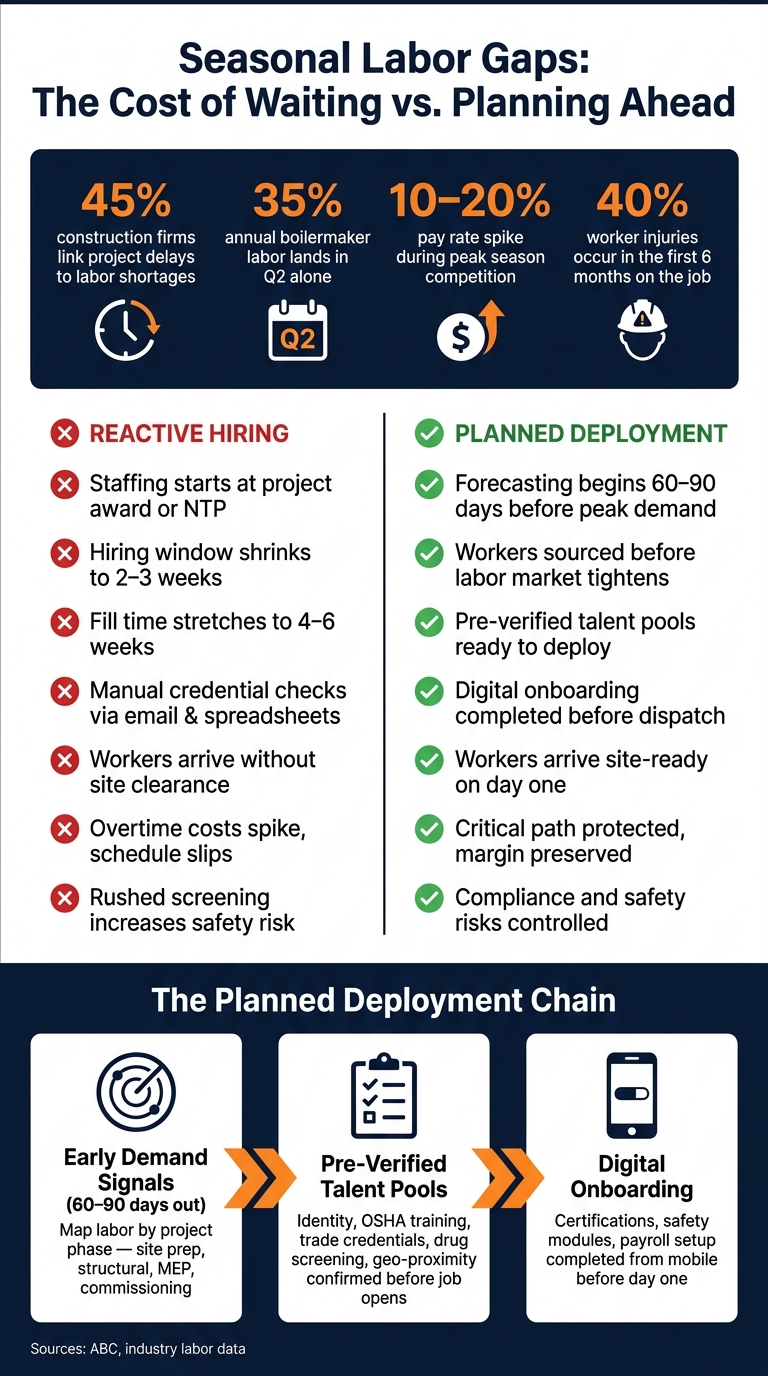
Reactive Hiring vs. Planned Seasonal Workforce Deployment in Construction & Energy
The main causes of seasonal labor gaps
Too many projects competing for the same trades at the same time
The core issue is timing, not a simple lack of workers. Too many jobs go after the same trades at the same moment.
Once spring hits, construction picks up across the U.S. Utilities tend to schedule major transmission and distribution work from May through September, while refineries pack turnarounds into tight seasonal windows to cut production downtime. That creates a pileup. Projects in the same area end up chasing the same licensed journeyman electricians, certified welders, equipment operators, lineworkers, and supervisors all at once.
More than half of contractors say they struggle to fill hourly craft roles during peak season. That pressure pushes pay rates up by 10%–20% and leads workers to jump from one job to another in the middle of a project.
At that point, the labor issue becomes a mobilization issue.
Late workforce planning and weak demand signals
A lot of firms still begin staffing from the award date or notice to proceed instead of planning from pipeline forecasts. By then, peak season has already arrived. Recruiters are maxed out, candidates are weighing several offers, and the hiring window has narrowed from 60–90 days to just 2–3 weeks.
Poor demand signals make it worse. Workforce teams often can’t clearly see bid pipelines, permit approvals that are about to come through, or past labor use by trade and location. A utility may have a detailed schedule for summer line upgrades, for example, but no shared forecast showing how many lineworkers it will need by week and by region. That disconnect means staffing requests show up at the last minute, and projects reach their planned start dates with only part of the crew in place.
ABC warns that labor shortages raise labor costs and reduce the amount of work that remains financially viable.
Without a forecast, hiring starts too late to get crews cleared before day one.
Manual verification and onboarding create avoidable bottlenecks
Even when workers have already been picked, manual onboarding can still slow mobilization. Coordinators often have to check OSHA 10/30 cards, licenses, drug tests, background checks, I-9s, tax forms, and site orientation records by email and spreadsheet. And in many cases, those checks happen one after another, not at the same time.
It doesn’t take much to throw the whole process off. An expired welding certification found right before mobilization can trigger a scramble for a replacement. Drug-screen labs that are backed up during peak hiring can delay clearance. Site orientations that happen only on fixed dates can push workers back even further. If one key role is missing – say, a crane operator or an electrical foreman – the whole mobilization can stall.
When even one credential is missing, the start date slips.
sbb-itb-aa28329
What delayed project starts cost in the field
Schedule slip, overtime, and margin pressure
When a project start moves to the right, the cost hits the job almost at once. Labor gets more expensive, equipment keeps billing, and contract risk starts stacking up.
Late starts often mean overtime, which can drive labor costs up fast. At the same time, cranes, manlifts, welding rigs, and site offices can sit idle while still adding charges. That’s a brutal mix: money going out while work isn’t moving forward.
And it doesn’t take long for the damage to spread. A delay of just a few weeks can set off liquidated damages and wipe out a big share of the project’s margin. It also throws downstream trades off balance. Crews then have to resequence work around unfinished areas, which adds cost and puts more pressure on the schedule.
Compliance and safety risks rise when hiring is rushed
Rushed hiring doesn’t just cost more. It also makes compliance and safety harder to control.
When onboarding gets squeezed, injury risk goes up, along with regulatory exposure and workers’ comp costs. Nearly 40% of construction worker injuries happen within the first six months on a job, which makes new hires one of the highest-risk groups on any site.
In high-hazard energy settings like refineries, gas plants, and transmission corridors, the stakes get even higher. An expired HAZWOPER certification or a missed drug screen can lead to regulatory citations and hurt the safety record a contractor needs to remain prequalified for future work.
That’s why mobilization timing matters just as much as headcount.
Reactive hiring vs. planned seasonal workforce deployment
Reactive hiring costs more and brings more risk. Planned deployment helps protect both schedule and margin.
Here’s the difference:
- Reactive hiring starts too late, drives premium pay, and leaves compliance checks rushed.
- Planned seasonal workforce deployment starts 60 to 90 days ahead, clears workers early, and keeps the critical path intact.
It’s a simple shift in approach. Late hiring responds to delay after it shows up. Planned deployment works to stop that delay from happening in the first place.
How to stop seasonal labor gaps from delaying project starts
Use early demand signals 60 to 90 days before peak labor demand
Start forecasting 60 to 90 days before peak demand. That window gives you enough time to source, screen, and confirm workers before labor pressure hits.
The forecast works best when it uses signals that reflect what’s happening on the ground: the live project pipeline, recent contract awards, permit approvals, long-lead equipment deliveries, planned outage or turnaround windows, and local seasonality. Those inputs tell you when crews need to be on site, not just when a project got awarded.
It also helps to map labor needs by project phase, instead of rolling everything into one headcount number. Site prep usually leans on equipment operators, survey support, and general labor. Structural work calls for ironworkers, welders, crane support, and rigging crews. MEP phases need electricians, pipefitters, and instrument techs. Commissioning and shutdown support often depend on specialty crews working on tight timelines.
That phase-by-phase view helps you avoid a common problem: hiring too many workers in one trade while coming up short in another. It also lets you time onboarding to the actual sequence of work, which makes mobilization a lot less chaotic.
Use that forecast to reserve screened workers before openings hit the market.
Build pre-verified talent pools for repeat and surge staffing needs
A pre-verified talent pool changes the order of operations. Instead of waiting for a job to open and then starting screening, you screen first. So when demand spikes, you’re pulling from workers who are already cleared.
A solid pre-verification process should confirm:
- identity and right-to-work status
- OSHA or site safety training
- trade credentials
- availability
- geographic proximity to the job site
Depending on the role, it may also include background checks, drug screening, medical clearances, and project-specific certifications such as confined-space, lift, or electrical qualifications. The point is simple: cut the delays that slow mobilization so workers can move straight into site access, orientation, and first shift.
ABLEMKR supports this approach. Its mobile-first platform matches pre-vetted workers to construction, energy, and extractives projects across the U.S. based on certifications, safety training, availability, and location. That helps operators mobilize crews fast, whether the job is a scheduled mine development, a remote pipeline repair, or a last-minute shutdown.
Once workers are screened, move them through digital onboarding before dispatch.
Use digital onboarding flows so workers arrive site-ready
Paper onboarding drags out mobilization. Digital workflows cut out those slow handoffs. Workers can complete document collection, certification uploads, safety modules, policy acknowledgments, and payroll setup from their phone before they ever arrive on site. Automated reminders flag missing items, and both the worker and employer can track progress in real time.
That turns peak-season staffing from a scramble into a repeatable mobilization process.
Construction Executive Answers Labor Shortage Questions
Conclusion: A better way to mobilize crews during peak season
Seasonal labor gaps usually start with two problems: planning begins too late, and onboarding is still done by hand. That strain hits hardest in project delays and rising field costs.
Across U.S. construction and energy work, the same thing keeps happening. Projects get awarded, peak season shows up, and companies scramble for the same electricians, welders, operators, and other certified trades at the same time. When hiring turns reactive, the fallout is hard to miss: schedule slip, overtime, rushed screening, and more safety risk. The better move is simple – plan labor before demand spikes.
Early demand signals 60 to 90 days out give teams enough time to source and confirm workers before the rush. Pre-verified talent pools let you pull from workers who are already cleared instead of starting the screening process after a job opens. And digital onboarding cuts the paper-heavy slowdown that keeps workers from showing up site-ready on day one.
Put together, those steps form one clear chain: early signals lead to pre-verified workers, which leads to site-ready onboarding and faster mobilization. That chain works best when it lives inside one deployment system.
ABLEMKR supports this approach by matching pre-vetted workers to construction, energy, and extractives projects based on certifications, safety training, availability, and location, with compliance tracking and payroll workflows.
Plan ahead, and peak season becomes manageable instead of disruptive.
FAQs
Why do labor shortages hit hardest in spring and summer?
Labor shortages tend to get worse in spring and summer because many construction and energy projects are planned for warmer months, when crews are less likely to lose time to winter weather.
The result is a seasonal spike in hiring across projects that are all competing for the same workers. That can stretch local labor pools thin, especially in remote areas where the talent base is already limited. On top of that, summer heat can make field work more demanding, which adds even more pressure to staffing as teams work to keep schedules moving and safety standards in place.
How early should I start staffing before a project begins?
For large-scale projects and shutdowns, start workforce planning at least six months before the start date. That window gives you enough time to lock in the scope, map out the skills you’ll need, and put standby rosters in place.
An early start also makes the admin side much easier. You can verify certifications, finish background checks, and sort out travel, lodging, and other logistics for non-local workers. That can help cut the premium costs that often come with last-minute hiring.
For long-term staffing needs, predictive analytics can help forecast demand three to five years ahead.
What slows crew mobilization after workers are hired?
Even after workers are hired, getting them onto the job can still take longer than it should. Manual onboarding and admin slowdowns often hold things up. Paper-based checks for certifications, safety training, and identity records can delay site access and leave crews waiting.
When compliance tracking isn’t kept in one place, expired credentials can slip by until a worker is standing at the gate. That’s a bad time to find out. In remote or high-risk settings, manual payroll setup and credential checks also make it harder to get the live view teams need to keep crews on schedule.


